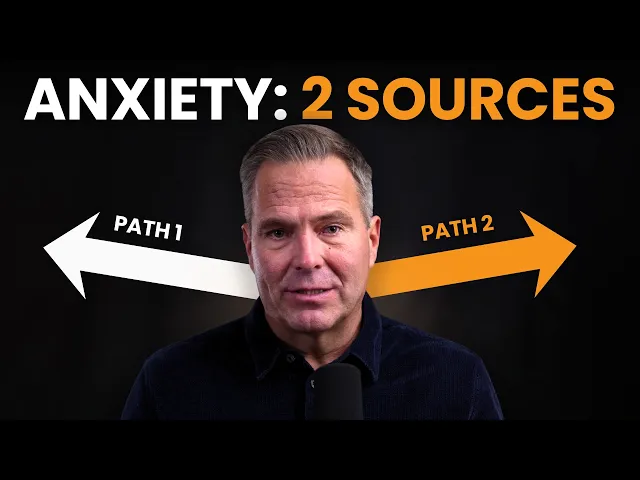
Anxiety Explained In A Way That Finally Makes Sense
Joe Hudson | Art of Accomplishment
0:00 Most of the anxiety in our life comes from not doing
0:03 the thing that we know that we want to be doing,
0:05 but it also comes from that moment when we are
0:08 doing the thing that we know we're meant to do,
0:11 stepping into that bigger room, and we're not feeling it all the way.
0:15 So, if we're deeply anxious, what happens is our brain becomes more limited,
0:19 our intellect becomes more limited.
0:21 We know that kids who live in super intense areas
0:25 of the world don't learn as much and don't learn as quickly.
0:29 We know that when people in work forces
0:31 are deeply anxious for prolonged periods of time, they're not as productive.
0:35 Anxiety prevents us from doing our best work.
0:39 Even though our brain might tell us, "No, no,
0:41 I need the anxiety to get the work done."
0:44 It's proven that that's not the case at all.
0:47 And so, sometimes the first thing you have to do
0:50 with anxiety is deal with the physical part of anxiety.
0:53 When we're not regulated, which just means when our anxiety is in control,
0:57 and our nervous system is not fully able to learn and receive,
1:02 the first thing we've got to do is just regulate the nervous system.
1:05 And the way to do that is enjoyment and getting into your body.
1:09 You can take a walk in the woods, you can do yoga,
1:12 you can do gentle stretching, you can get a massage.
1:17 Anything basically that puts you in your body and puts
1:20 you in the moment when you're not thinking about other stuff.
1:24 When you are basically paying attention
1:27 to your body and letting your body regulate itself.
1:30 You don't even have to try to regulate it because
1:32 that would be stressful cuz then you'd be sitting there going,
1:35 "I'm not regulated, but I have to regulate myself." So,
1:39 it's just as simple as "How do I allow my body to regulate
1:43 itself?" And you just put it in a great environment with great breath,
1:47 with great nature, with great massage, with great stretching,
1:51 and your body will just start to regulate.
1:54 And without that, it's really,
1:56 really hard to learn the lessons that you need to learn from anxiety.
2:00 So, that's often the first thing that you need to do.
2:03 The second thing you need to do is really understand what you're
2:07 telling yourself you should be doing and what makes you not do it.
2:10 Things like, "I'm not saying what I want to say.
2:13 I'm not being who I want to be with my partner.
2:16 I'm not allowing myself to feel the emotions
2:19 that I need to feel to be happy." And so,
2:22 it's basically knowing that there's something that needs
2:25 to be done and you're not doing it.
2:28 And it might not even be entirely conscious at first, but there's always a hint.
2:33 I'm going to give you a like a crazy example of this.
2:36 I have watched folks who are super high-capacity CEOs,
2:41 and some of them are entirely stressed out,
2:44 and some of them are not stressed out.
2:46 Both of them working 80, 90 hours a week,
2:49 both of them super passionate about what they do,
2:53 but one of them seems to have infinite energy and one of them doesn't.
2:56 And the difference is one of them is constantly telling
3:00 themselves everything that they should be doing that they're not doing,
3:03 and the other one is taking action every time one of those things happens.
3:08 Or they're saying, "That's important,
3:10 but it's not as important as this, so I'm going to do this." Right?
3:14 And so, I've seen this hundreds of times,
3:16 and it's why some of the most successful CEOs that I've
3:18 ever met are always focused on one or two things.
3:22 They know that here's the one piece of leverage that if I push it,
3:26 everything else will fall into place.
3:29 Everything else will be easier, or everything else will be irrelevant.
3:33 And so, they're solely focused on these one or two places where they
3:37 know that they can make a significant
3:39 difference for everything else that they're doing.
3:42 And when they know that, when they've done that thought process,
3:44 they're a lot less stressed as compared to somebody
3:47 who feels like they should be doing everything,
3:48 and there's no way they can do everything, and they've got to do everything.
3:52 That doesn't work.
3:54 And so, it's interesting to watch how one one
3:57 of these CEOs is just getting more and more tired and exhausted,
4:01 and the other one is not overwhelmed, is not tired, not exhausted,
4:05 and they're running a bigger company, and they have more decisions to make.
4:11 And so, it's just as as simple as how
4:14 you are speaking to yourself is what creates anxiety.
4:18 Now, the deeper psychology of this is some way in which
4:23 you're not being yourself just creates an everlasting anxiety in your system.
4:29 If you know you're not saying things that are true,
4:31 if you know that you're trying to manipulate
4:33 people instead of being direct with your wants,
4:37 you know that that you're not being authentic,
4:40 that's going to create a lot of stress.
4:43 Now, your mind is going to tell you there's
4:45 a whole bunch of reasons not to do it,
4:46 and we're going to talk about that at the end of the video
4:49 when we talk about some of the other emotions that anxiety is hiding.
4:53 But just for now, the one thing to really take a look at is to say,
4:58 "Oh, am I scared of the short-term consequences,
5:01 or am I scared of the long-term consequences?" So,
5:04 yeah, if I'm going to be myself,
5:06 I'm going to say something to my mom, and she's going to be upset.
5:09 That's a short-term consequence.
5:11 Here's the long-term consequence.
5:13 I want to say something to my mom, and I'm not going to say it, and therefore,
5:17 I am going to constantly have a mom who
5:20 thinks I should be different than how I am.
5:23 I'm want to say something to my mom, but I'm not going to say it, and so now,
5:27 every time I'm around my mom,
5:29 I'm resentful of her because she wants me to be different than who I am.
5:33 I want to say something to my mom, and I'm not going to say it, and therefore,
5:37 for the rest of our relationship,
5:39 I know I'm not being honest with her, and so she doesn't even know who I am.
5:43 She can't even love me because there's no me there to love.
5:46 There's just this thing that I'm pretending to be in front of her.
5:51 So, if you think about the short-term consequence of her being
5:53 upset and the long-term consequences of all those things,
5:57 it becomes really apparent what the right move to make is.
6:01 And you'll make the move,
6:02 and maybe it'll be upsetting, but I guarantee even afterwards,
6:06 the anxiety will be relieved a little bit because you have been authentic,
6:10 you've been who you want to be.
6:12 Now, the other part of this is the emotional part of this, which is
6:16 if you are not allowing yourself to have
6:19 the emotions that you know are necessary,
6:22 the grief or the anger or the excitement or the exuberance,
6:26 then on some level, that's going to create anxiety in your system.
6:30 You're constantly telling yourself, "No, you can't be who you are." So,
6:34 this isn't a you can't do what you want to do.
6:36 This is a can't be who you are.
6:38 Being is an emotional experience.
6:41 We feel being.
6:43 And if you're not allowing yourself to feel the aliveness, the joy, the pain,
6:49 the suffering, the sorrow, the wonder, the amazement,
6:53 the exuberance, there's just this natural anxiety.
6:56 The only reason not to be what I want
6:58 to be is because somehow I'm going to get in trouble.
7:01 And if I could get in trouble at any minute,
7:02 it means I'm constantly under threat.
7:04 And of course, I'm anxious then.
7:05 And so, that's one more way in which we're not
7:08 doing the thing that we know we need to do,
7:11 and that's what's causing us anxiety.
7:13 And here's the kind of weird loophole that the mind finds.
7:17 There's this intellectual thing that happens of our negative self-talk
7:21 just constantly hammering at us over and over and over again,
7:25 and that creates a lot of stress.
7:28 Now, as you start clearing your emotions up, the the voice starts slowing down.
7:33 As you start looking at the voice, it starts slowing down.
7:35 Now, we have a great podcast on voice in the head that you can look at.
7:40 We also deal with the voice in the head in the connection course,
7:43 so you can go there and find it.
7:45 There's lots of ways to deal with it,
7:46 but this video would be really long if we only did voice in the head stuff.
7:49 So, just know that the ways that we are creating stress for ourselves
7:54 are telling ourselves we should do something when we can't do it,
7:58 not doing the stuff that we know we should be doing,
8:01 not being who we want to be emotionally,
8:03 or constantly beating ourselves with the negative self-talk.
8:07 So, those are all the psychological things that happen.
8:10 And so, to work on any of them starts to relieve the anxiety.
8:14 But to get out of the anxiety is not a short-term play.
8:17 It's not a oh, I'm just going to take some deep breaths,
8:21 and then I'm not going to be anxious again.
8:24 The anxiety is pointing to something.
8:25 It's pointing to the way in which your life is out of alignment.
8:29 And if you're not willing to do the work to get your life back into alignment,
8:33 that anxiety is constantly going to be with you
8:36 to remind you that your life is not in alignment.
8:38 You're not taking care of yourself.
8:42 You're not, and therefore, you must not be safe.
8:45 Why on earth would you not take care of yourself unless
8:49 there's some something that's going to kill you if you don't.
8:52 And that's basically what anxiety is in your system, except for in some cases.
8:57 And this is that thing that we talked about at the beginning
8:59 of the video about how anxiety sometimes hides another emotion.
9:04 So, I had a friend who always had problems with stage fright,
9:07 and every time they got up and spoke, they had all this anxiety.
9:11 And I gave them this like very, very simple little exercise to do.
9:15 I said, "Hey, next time you get up on stage, I want you to fill the whole room.
9:20 I want you to feel like you are the entire room." That's it.
9:25 Just put your feeling into the entire room.
9:28 Luckily, they were somatically very aware.
9:30 They understood what I was saying.
9:31 They were like, "Oh, the anxiety's gone.
9:33 Actually, I was really excited to be up on stage." And that's the clue.
9:38 The clue is that often times, we're anxious when we're actually deeply excited.
9:44 And the times that that's the case is the times
9:46 when we are being asked to fill up the room,
9:50 to go into a new and bigger room, a new job, a new relationship,
9:57 a new way of being, a new set
10:00 of friends where we're actually being asked like, "Oh,
10:04 here is this new bigger way that you
10:07 can be in the world." And that creates anxiety.
10:10 At least we think it is, but it's actually not.
10:12 It's actually excitement.
10:14 And so we think to ourselves, "Oh my gosh,
10:17 I'm anxious." But if we feel the excitement, the anxiety goes away completely.
10:22 And there's an easy way to do this.
10:23 It's literally to like act excited and to say, "I'm excited.
10:27 I'm excited.
10:28 I'm excited.
10:28 I'm excited.
10:29 I'm excited.
10:29 I'm excited." like 10 times.
10:30 And you'll notice, literally 10 times of saying it,
10:33 you'll notice that all that anxiety turns into excitement.
10:37 So that's the weird piece.
10:39 There's most of the anxiety in our life comes from not
10:42 doing the thing that we know that we want to be doing,
10:45 but it also comes from that moment when we are
10:48 doing the thing that we know we're meant to do,
10:51 stepping into that bigger room, and we're not feeling it all the way.
10:55 Those are the two places that anxiety comes in.
10:59 And if you can work on both of those two arenas,
11:02 over time the anxiety will start to dissipate slowly.
11:06 And then pretty soon you'll notice that you're having
11:09 this life where you can be so productive and you can
11:11 do so much and you're not overwhelmed anymore because
11:14 the overwhelm never was by all the stuff you were doing.
11:17 The anxiety wasn't from all the stuff that you
11:19 had to do like your mind is telling [music] you.
11:21 It came from the fact that you weren't
11:23 doing the things that you really wanted to be
11:25 doing [music] and you weren't allowing that big feeling
11:28 of moving into the next stage of your journey.