Sleep Is Your Superpower | Matt Walker | TED
TED
0:00 Thank you very much.
0:02 Well, I would like to start with testicles.
0:06 (Laughter) Men who sleep five hours a night have significantly
0:12 smaller testicles than those who sleep seven hours or more.
0:17 (Laughter) In addition,
0:20 men who routinely sleep just four to five hours a night will have
0:26 a level of testosterone which is that of someone 10 years their senior.
0:33 So a lack of sleep will age a man
0:35 by a decade in terms of that critical aspect of wellness.
0:41 And we see equivalent impairments in female
0:45 reproductive health caused by a lack of sleep.
0:51 This is the best news that I have for you today.
0:53 (Laughter) From this point, it may only get worse.
0:58 Not only will I tell you about the wonderfully
1:01 good things that happen when you get sleep,
1:03 but the alarmingly bad things that happen when you don't get enough,
1:08 both for your brain and for your body.
1:11 Let me start with the brain and the functions of learning and memory,
1:16 because what we've discovered over the past 10
1:19 or so years is that you need sleep
1:22 after learning to essentially hit the save button
1:25 on those new memories so that you don't forget.
1:28 But recently, we discovered that you also need
1:32 sleep before learning to actually prepare your brain,
1:37 almost like a dry sponge ready to initially soak up new information.
1:43 And without sleep, the memory circuits
1:45 of the brain essentially become waterlogged,
1:47 as it were, and you can't absorb new memories.
1:52 So let me show you the data.
1:54 Here in this study, we decided to test
1:57 the hypothesis that pulling the all-nighter was a good idea.
2:02 So we took a group of individuals and we
2:05 assigned them to one of two experimental groups:
2:08 a sleep group and a sleep deprivation group.
2:11 Now the sleep group, they're going to get a full eight hours of slumber,
2:16 but the deprivation group,
2:17 we're going to keep them awake in the laboratory, under full supervision.
2:21 There's no naps or caffeine, by the way,
2:24 so it's miserable for everyone involved.
2:26 And then the next day, we're going to place those participants inside
2:31 an MRI scanner and we're going to have them try and learn a whole list of new
2:35 facts as we're taking snapshots of brain activity.
2:39 And then we're going to test them to see how effective that learning has been.
2:44 And that's what you're looking at here on the vertical axis.
2:48 And when you put those two groups head to head,
2:51 what you find is a quite significant,
2:55 40-percent deficit in the ability of the brain
2:58 to make new memories without sleep.
3:01 I think this should be concerning, considering what we know is happening
3:04 to sleep in our education populations right now.
3:08 In fact, to put that in context, it would be the difference in a child
3:12 acing an exam versus failing it miserably— 40 percent.
3:18 And we've gone on to discover what goes wrong
3:21 within your brain to produce these types of learning disabilities.
3:26 And there's a structure that sits on the left and the right side of your brain,
3:31 called the hippocampus.
3:32 And you can think of the hippocampus
3:34 almost like the informational inbox of your brain.
3:38 It's very good at receiving new memory files and then holding on to them.
3:44 And when you look at this structure
3:46 in those people who'd had a full night of sleep,
3:49 we saw lots of healthy learning-related activity.
3:54 Yet in those people who were sleep-deprived,
3:57 we actually couldn't find any significant signal whatsoever.
4:02 So it's almost as though sleep deprivation had shut down your memory inbox,
4:07 and any new incoming files— they were just being bounced.
4:11 You couldn't effectively commit new experiences to memory.
4:18 So that's the bad that can happen if I were to take sleep away from you,
4:22 but let me just come back to that control group for a second.
4:26 Do you remember those folks that got a full eight hours of sleep?
4:30 Well, we can ask a very different question:
4:32 What is it about the physiological quality of your sleep when you do get
4:37 it that restores and enhances your memory
4:40 and learning ability each and every day?
4:43 And by placing electrodes all over the head,
4:46 what we've discovered is that there are big,
4:50 powerful brainwaves that happen during the very
4:53 deepest stages of sleep that have riding on top of them these spectacular bursts
4:58 of electrical activity that we call sleep spindles.
5:03 And it's the combined quality of these deep-sleep
5:07 brainwaves that acts like a file-transfer mechanism at night,
5:11 shifting memories from a short-term vulnerable reservoir
5:16 to a more permanent long-term storage site within the brain,
5:20 and therefore protecting them, making them safe.
5:25 And it is important that we understand
5:27 what during sleep actually transacts these memory benefits,
5:32 because there are real medical and societal implications.
5:36 And let me just tell you about one
5:38 area that we've moved this work out into, clinically,
5:42 which is the context of aging and dementia.
5:46 Because it's of course no secret that, as we get older,
5:50 our learning and memory abilities begin to fade and decline.
5:55 But what we've also discovered is that a physiological
5:58 signature of aging is that your sleep gets worse,
6:03 especially that deep quality of sleep that I was just discussing.
6:08 And only last year, we finally published evidence that these two things,
6:13 they're not simply co-occurring, they are significantly interrelated.
6:18 And it suggests that the disruption of deep sleep is an underappreciated
6:23 factor that is contributing to cognitive decline or memory decline in aging,
6:29 and most recently we've discovered, in Alzheimer's disease as well.
6:36 Now, I know this is remarkably depressing news.
6:40 It's in the mail.
6:41 It's coming at you.
6:42 But there's a potential silver lining here.
6:45 Unlike many of the other factors that we know are associated with aging,
6:50 for example changes in the physical structure of the brain,
6:54 that's fiendishly difficult to treat.
6:57 But that sleep is a missing piece in the explanatory puzzle of aging
7:02 and Alzheimer's is exciting because we may be able to do something about it.
7:08 And one way that we are approaching this at my sleep
7:12 center is not by using sleeping pills, by the way.
7:15 Unfortunately, they are blunt instruments
7:17 that do not produce naturalistic sleep.
7:21 Instead, we're actually developing a method based on this.
7:24 It's called direct current brain stimulation.
7:28 You insert a small amount of voltage into the brain,
7:31 so small you typically don't feel it, but it has a measurable impact.
7:36 Now if you apply this stimulation during sleep in young, healthy adults,
7:43 as if you're sort of singing in time with those deep-sleep brainwaves,
7:47 not only can you amplify the size
7:50 of those deep-sleep brainwaves, but in doing so,
7:53 we can almost double the amount of memory benefit that you get from sleep.
7:59 The question now is whether we can translate this same affordable,
8:03 potentially portable piece of technology
8:06 into older adults and those with dementia.
8:10 Can we restore back some healthy quality of deep sleep,
8:15 and in doing so, can we salvage aspects of their learning and memory function?
8:21 That is my real hope now.
8:24 That's one of our moon-shot goals, as it were.
8:29 So that's an example of sleep for your brain,
8:32 but sleep is just as essential for your body.
8:37 We've already spoken about sleep loss and your reproductive system.
8:41 Or I could tell you about sleep loss and your cardiovascular system,
8:46 and that all it takes is one hour.
8:49 Because there is a global experiment performed on 1.6
8:54 billion people across 70 countries twice a year,
8:59 and it's called daylight saving time.
9:02 Now, in the spring, when we lose one hour of sleep,
9:06 we see a subsequent 24-percent increase in heart attacks that following day.
9:14 In the autumn, when we gain an hour of sleep,
9:18 we see a 21-percent reduction in heart attacks.
9:23 Isn't that incredible?
9:26 And you see exactly the same profile for car crashes,
9:31 road traffic accidents, even suicide rates.
9:36 But as a deeper dive,
9:38 I want to focus on this: sleep loss and your immune system.
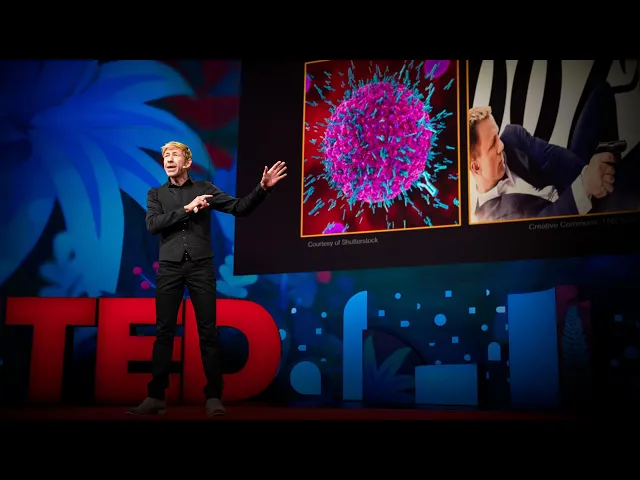
9:43 And here, I'll introduce these delightful blue elements in the image.
9:47 They are called natural killer cells,
9:51 and you can think of natural killer cells almost
9:54 like the secret service agents of your immune system.
9:57 They are very good at identifying dangerous,
10:01 unwanted elements and eliminating them.
10:05 In fact, what they're doing here is destroying a cancerous tumor mass.
10:10 So what you wish for is a virile set of these immune assassins at all times,
10:18 and tragically, that's what you don't have if you're not sleeping enough.
10:23 So here in this experiment,
10:25 you're not going to have your sleep deprived for an entire night,
10:29 you're simply going to have your sleep
10:31 restricted to four hours for one single night,
10:34 and then we're going to look to see what's
10:36 the percent reduction in immune cell activity that you suffer.
10:40 And it's not small— it's not 10 percent, it's not 20 percent.
10:45 There was a 70-percent drop in natural killer cell activity.
10:51 That's a concerning state of immune deficiency,
10:57 and you can perhaps understand why
10:59 we're now finding significant links between short
11:02 sleep duration and your risk for the development of numerous forms of cancer.
11:09 Currently, that list includes cancer of the bowel,
11:12 cancer of the prostate and cancer of the breast.
11:17 In fact, the link between a lack of sleep and cancer is now so strong
11:23 that the World Health Organization has classified any
11:27 form of nighttime shift work as a probable carcinogen,
11:33 because of a disruption of your sleep-wake rhythms.
11:37 So you may have heard of that old maxim that you can sleep when you're dead.
11:42 Well, I'm being quite serious now— it is mortally unwise advice.
11:48 We know this from epidemiological studies across millions of individuals.
11:53 There's a simple truth: the shorter your sleep, the shorter your life.
11:58 Short sleep predicts all-cause mortality.
12:04 And if increasing your risk for the development
12:08 of cancer or even Alzheimer's disease were not sufficiently disquieting,
12:15 we have since discovered that a lack of sleep
12:18 will even erode the very fabric of biological life itself,
12:24 your DNA genetic code.
12:28 So here in this study, they took a group of healthy adults and they limited
12:33 them to six hours of sleep a night for one week,
12:37 and then they measured the change
12:39 in their gene activity profile relative to when
12:42 those same individuals were getting a full eight hours of sleep a night.
12:47 And there were two critical findings.
12:50 First, a sizable and significant 711 genes were distorted in their activity,
12:57 caused by a lack of sleep.
12:59 The second result was that about half
13:02 of those genes were actually increased in their activity.
13:05 The other half were decreased.
13:08 Now those genes that were switched off by a lack
13:11 of sleep were genes associated with your immune system,
13:15 so once again, you can see that immune deficiency.
13:19 In contrast, those genes that were actually upregulated
13:22 or increased by way of a lack of sleep,
13:24 were genes associated with the promotion of tumors,
13:28 genes associated with long-term chronic inflammation within the body,
13:33 and genes associated with stress, and, as a consequence, cardiovascular disease.
13:41 There is simply no aspect of your wellness that can
13:45 retreat at the sign of sleep deprivation and get away unscathed.
13:50 It's rather like a broken water pipe in your home.
13:53 Sleep loss will leak down into every nook and cranny of your physiology,
14:00 even tampering with the very DNA nucleic
14:03 alphabet that spells out your daily health narrative.
14:09 And at this point, you may be thinking,
14:12 "Oh my goodness, how do I start to get better sleep?
14:15 What are you tips for good sleep?" Well,
14:18 beyond avoiding the damaging and harmful
14:21 impact of alcohol and caffeine on sleep,
14:25 and if you're struggling with sleep at night,
14:27 avoiding naps during the day, I have two pieces of advice for you.
14:33 The first is regularity.
14:35 Go to bed at the same time, wake up at the same time,
14:39 no matter whether it's the weekday or the weekend.
14:42 Regularity is king, and it will anchor your sleep
14:47 and improve the quantity and the quality of that sleep.
14:52 The second is keep it cool.
14:56 Your body needs to drop its core temperature by about two
14:59 to three degrees Fahrenheit to initiate sleep and then to stay asleep,
15:04 and it's the reason you will always find it easier
15:07 to fall asleep in a room that's too cold than too hot.
15:11 So aim for a bedroom temperature of around 65 degrees,
15:15 or about 18 degrees Celsius.
15:17 That's going to be optimal for the sleep of most people.
15:22 And then finally, in taking a step back,
15:25 then, what is the mission-critical statement here?
15:30 Well, I think it may be this: sleep,
15:33 unfortunately, is not an optional lifestyle luxury.
15:39 Sleep is a nonnegotiable biological necessity.
15:44 It is your life-support system,
15:48 and it is Mother Nature's best effort yet at immortality.
15:54 And the decimation of sleep throughout industrialized nations
15:59 is having a catastrophic impact on our health,
16:03 our wellness, even the safety and the education of our children.
16:08 It's a silent sleep loss epidemic,
16:11 and it's fast becoming one of the greatest public
16:14 health challenges that we face in the 21st century.
16:20 I believe it is now time for us to reclaim our right to a full night of sleep,
16:27 and without embarrassment or that unfortunate stigma of laziness.
16:34 And in doing so, we can be reunited with the most powerful elixir of life,
16:42 the Swiss Army knife of health, as it were.
16:46 And with that soapbox rant over, I will simply say,
16:50 good night, good luck, and above all...
16:54 I do hope you sleep well.
16:56 Thank you very much indeed.
16:58 (Applause) Thank you.
17:03 (Applause) Thank you so much.
17:08 David Biello: No, no, no.
17:09 Stay there for a second.
17:10 Good job not running away, though.
17:12 I appreciate that.
17:13 So that was terrifying.
17:14 Matt Walker: You're welcome.
17:16 DB: Yes, thank you, thank you.
17:18 Since we can't catch up on sleep, what are we supposed to do?
17:23 What do we do when we're, like,
17:25 tossing and turning in bed late at night or doing shift work or whatever else?
17:30 MW: So you're right, we can't catch up on sleep.
17:32 Sleep is not like the bank.
17:33 You can't accumulate a debt and then hope
17:36 to pay it off at a later point in time.
17:38 I should also note the reason that it's so
17:41 catastrophic and that our health deteriorates so quickly, first,
17:45 it's because human beings are the only species
17:47 that deliberately deprive themselves of sleep for no apparent reason.
17:52 DB: Because we're smart.
17:53 MW: And I make that point because it means that Mother Nature,
17:58 throughout the course of evolution,
18:00 has never had to face the challenge of this thing called sleep deprivation.
18:05 So she's never developed a safety net, and that's why when you undersleep,
18:10 things just sort of implode so quickly, both within the brain and the body.
18:15 So you just have to prioritize.
18:18 DB: OK, but tossing and turning in bed, what do I do?
18:22 MW: So if you are staying in bed awake for too long,
18:27 you should get out of bed and go to a different room and do something different.
18:32 The reason is because your brain will very
18:34 quickly associate your bedroom with the place of wakefulness,
18:38 and you need to break that association.
18:41 So only return to bed when you are sleepy,
18:44 and that way you will relearn the association that you once had,
18:47 which is your bed is the place of sleep.
18:50 So the analogy would be, you'd never sit at the dinner table,
18:54 waiting to get hungry, so why would you lie in bed, waiting to get sleepy?
18:59 DB: Well, thank you for that wake-up call.
19:01 Great job, Matt.
19:02 MW: You're very welcome.
19:03 Thank you very much.