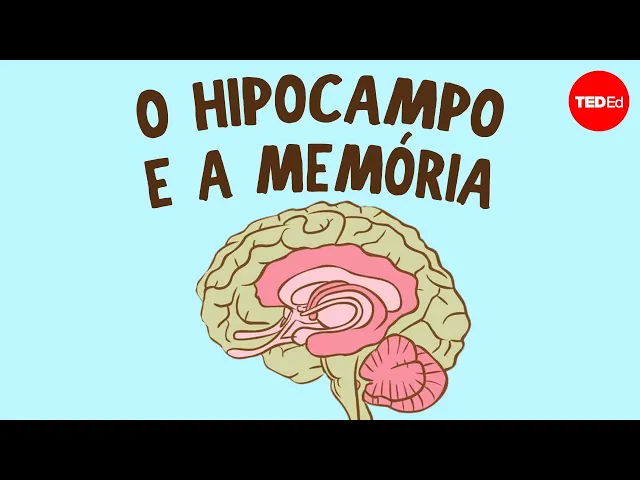
O que acontece quando você remove o hipocampo? - Sam Kean
Seja curioso — TED-Ed
0:06 On September 1st, 1953, William Scoville used a hand crank and a cheap
0:12 drill saw to bore into a young man's skull,
0:15 cutting away vital pieces of his brain
0:17 and sucking them out through a metal tube.
0:20 But this wasn't a scene from a horror film or a gruesome police report.
0:25 Dr.
0:25 Scoville was one of the most renowned neurosurgeons of his time,
0:29 and the young man was Henry Molaison, the famous patient known as "H.M.",
0:35 whose case provided amazing insights into how our brains work.
0:40 As a boy, Henry had cracked his skull
0:42 in an accident and soon began having seizures,
0:46 blacking out and losing control of bodily functions.
0:49 After enduring years of frequent episodes, and even dropping out of high school,
0:53 the desperate young man had turned to Dr.
0:56 Scoville, a daredevil known for risky surgeries.
1:00 Partial lobotomies had been used for decades to treat mental patients based
1:04 on the notion that mental functions
1:06 were strictly localized to corresponding brain areas.
1:10 Having successfully used them to reduce seizures in psychotics,
1:14 Scoville decided to remove H.M.'s hippocampus,
1:17 a part of the limbic system that was
1:20 associated with emotion but whose function was unknown.
1:23 At first glance, the operation had succeeded.
1:26 H.M.'s seizures virtually disappeared, with no change in personality,
1:30 and his IQ even improved.
1:32 But there was one problem: His memory was shot.
1:36 Besides losing most of his memories from the previous decade, H.M.
1:40 was unable to form new ones, forgetting what day it was,
1:43 repeating comments, and even eating multiple meals in a row.
1:48 When Scoville informed another expert, Wilder Penfield, of the results,
1:52 he sent a Ph.D student named Brenda Milner to study H.M.
1:56 at his parents' home, where he now spent his days doing odd chores,
2:00 and watching classic movies for the first time, over and over.
2:04 What she discovered through a series of tests and interviews
2:07 didn't just contribute greatly to the study of memory.
2:10 It redefined what memory even meant.
2:13 One of Milner's findings shed light on the obvious fact that although H.M.
2:18 couldn't form new memories,
2:19 he still retained information long enough from moment
2:22 to moment to finish a sentence or find the bathroom.
2:26 When Milner gave him a random number, he managed to remember it for fifteen
2:30 minutes by repeating it to himself constantly.
2:33 But only five minutes later, he forgot the test had even taken place.
2:38 Neuroscientists had though of memory as monolithic,
2:41 all of it essentially the same and stored throughout the brain.
2:45 Milner's results were not only the first clue
2:48 for the now familiar distinction between short-term and long-term memory,
2:52 but show that each uses different brain regions.
2:56 We now know that memory formation involves several steps.
2:59 After immediate sensory data is temporarily
3:02 transcribed by neurons in the cortex, it travels to the hippocampus,
3:06 where special proteins work to strengthen the cortical synaptic connections.
3:12 If the experience was strong enough,
3:13 or we recall it periodically in the first few days,
3:16 the hippocampus then transfers the memory
3:19 back to the cortex for permanent storage.
3:22 H.M.'s mind could form the initial impressions,
3:25 but without a hippocampus to perform this memory consolidation,
3:29 they eroded, like messages scrawled in sand.
3:33 But this was not the only memory distinction Milner found.
3:36 In a now famous experiment, she asked H.M.
3:39 to trace a third star in the narrow space between the outlines of two
3:44 concentric ones while he could only see his paper and pencil through a mirror.
3:49 Like anyone else performing such an awkward
3:51 task for the first time, he did horribly.
3:54 But surprisingly, he improved over repeated trials,
3:57 even though he had no memory of previous attempts.
4:01 His unconscious motor centers remembered what the conscious mind had forgotten.
4:06 What Milner had discovered was that the declarative memory of names,
4:10 dates and facts is different from the procedural
4:13 memory of riding a bicycle or signing your name.
4:17 And we now know that procedural memory
4:19 relies more on the basal ganglia and cerebellum,
4:22 structures that were intact in H.M.'s brain.
4:26 This distinction between "knowing that" and "knowing
4:29 how" has underpinned all memory research since.
4:32 H.M.
4:33 died at the age of 82 after a mostly peaceful life in a nursing home.
4:38 Over the years, he had been examined by more than 100 neuroscientists,
4:42 making his the most studied mind in history.
4:45 Upon his death, his brain was preserved
4:48 and scanned before being cut into over 2000
4:51 individual slices and photographed to form a digital
4:54 map down to the level of individual neurons,
4:57 all in a live broadcast watched by 400,000 people.
5:02 Though H.M.
5:02 spent most of his life forgetting things,
5:04 he and his contributions to our understanding
5:06 of memory will be remembered for generations to come.