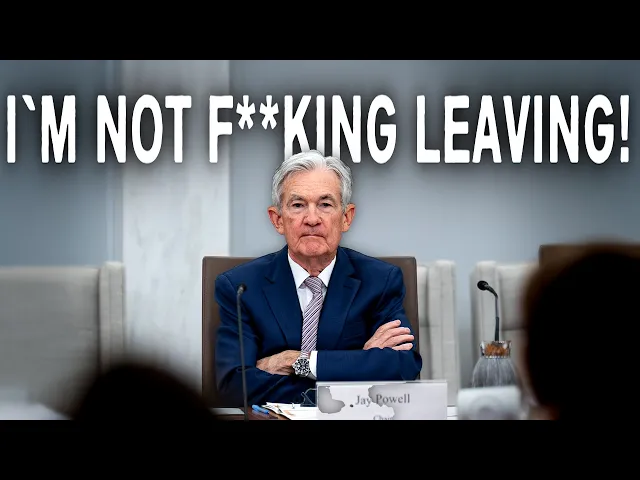
WTF is Going On at The FED?
How Money Works
0:00 In just over two weeks,
0:01 Jerome Powell will hang up the money printer for the last time
0:03 as his tenure as the chairman of the Federal Reserve comes to an end.
0:07 In his place, the financeier and former Fed governor Kevin Worsh
0:10 has been nominated by the president to take over this role.
0:13 But that job application has been going about
0:16 as well as most job applications in 2026, and that is to say, not well.
0:21 His confirmation for the role is currently being held up
0:24 in the Senate over questions around the source of his wealth,
0:27 potential conflicts of interest amongst his friends in finance,
0:30 and unanswered questions about his professional
0:32 relationship with the alleged financeier Jeffrey Epstein.
0:35 On top of that, there is a much bigger
0:37 problem that most coverage is either ignoring or simply misunderstanding,
0:40 and that is that the outgoing Jerome Pal could just
0:44 go full Wolf of Wall Street and refuse to leave.
0:47 His appointment as chairman ends in 14 days from now,
0:51 but he still has a seat on the board of governors until 2028.
0:54 So if he just sits his butt down and nobody else on the board makes room,
0:58 even a unanimous Senate confirmation for Wars won't mean diddly because
1:02 you can't be the chairman of a board you're not on.
1:05 Now, normally this is not a problem.
1:07 Historically, Fed chairman have fully stepped down from the bank
1:10 to free up a seat for their incoming replacement,
1:12 even if they do still technically have a few years left as a governor.
1:16 except that until about 2 days ago,
1:18 Jerome Powell, the current sitting chairman of the Fed,
1:21 was the target of an ongoing criminal investigation by the DOJ.
1:24 So, he doesn't really want to give up
1:26 this institutional protection until that gets fully resolved.
1:29 It should hopefully go without saying that this is
1:32 far from the standard operating procedure for this institution.
1:35 And that's before getting into the problems that they will
1:37 actually be facing once the musical chairs have been sorted out.
1:40 There is immense political pressure to cut rates,
1:43 unclear data about how bad inflation actually is,
1:46 unknown pricing shocks coming from the war in Iran,
1:49 tariffs, and an uncertain job market.
1:51 The disconnect between investor sentiment
1:53 and consumer sentiment has never been wider.
1:55 And this is to say nothing of the ticking clock.
1:58 The next interest rate decision is due in 45 days from now.
2:01 And while a vote can still be held without clear leadership in place,
2:05 the current uncertainty about the economy is only going to get worse.
2:09 The investigation was connected to the estimated $2.5 billion price
2:13 tag for renovations on the Federal Reserve's headquarters in Washington.
2:16 Well, we call him too late for a reason.
2:19 We should have cut him a year ago.
2:20 He's too late.
2:21 And I would remind the entire world
2:22 that this is a president who was a businessman first.
2:25 Spike in energy costs.
2:26 The consumer price index for March shows prices.
2:29 But he says the US just saw its biggest
2:31 single day spike in gas prices in three years.
2:34 Says in our statute, we're not removable except for cause.
2:38 who serve very long terms, seemingly endless terms.
2:42 The atrocious cost overrun of more than $1 billion.
2:48 Companies that have facilitated money laundering,
2:50 Chinese control companies or financing vehicles set up by Jeffrey Epstein.
2:55 It's a yes or no question.
2:57 Uh, Senator, I have worked tirelessly with the ethics officials at the office
3:00 of government ethics and you have not
3:02 come to an ethics agreement and have agreed,
3:06 Senator, to sell all of my financial assets, Mr.
3:12 Refusing to tell us.
3:15 Okay, so the Fed is currently stuck between the rock and a hard place
3:19 of an incredibly difficult economic environment to navigate
3:21 and no clear leadership to actually do the navigating.
3:25 Now, neither of these issues would be ideal by themselves,
3:28 but they also shouldn't be considered in isolation from one another.
3:32 So, beginning with the secession problem,
3:34 Worsh is the current nominee to replace Powell.
3:37 And as mentioned, his Senate approval has completely stalled
3:39 despite not actually being a total outsider to this role.
3:43 He was a Fed governor on the exact same
3:45 board he is now lining himself up to lead.
3:47 And he also sat on that board during the leadup
3:50 to and the recovery from the global financial crisis.
3:52 So, in the interest of fairness, he does have directly relevant experience,
3:56 but he also comes with some fairly uh notable baggage in three key areas.
4:02 The first issue is his wealth.
4:04 Worsh has an enormous personal fortune, and his wife's family has an even
4:09 larger fortune with some fairly dubious connections.
4:11 Now, this by itself wouldn't be disqualifying.
4:13 Fed governors and chairman typically come
4:16 from an economic or banking background,
4:18 and these are by their nature careers that can pay very well.
4:21 Powell himself was one of the richest Fed chairman ever.
4:24 But it's the nature of Worsh's wealth
4:26 that is a little bit more compromising because yeah,
4:29 the second issue is his prior relationships.
4:33 Worse was unable to fully deny a series of previous professional connections
4:37 to the late Jeffrey Epstein in front of the Senate during his approval hearing,
4:41 which as job interviews go is not ideal.
4:44 And the third issue is his actual investment portfolio,
4:47 which reportedly includes a complicated web
4:50 of indirect investments into private banks.
4:52 For hopefully obvious reasons,
4:54 these investments are specifically forbidden for a sitting Fed chair.
4:57 Any one of these alone might have
4:59 been survivable in a normal political environment.
5:02 But all three together in a Senate already looking for an excuse has
5:06 been enough to keep his nomination stuck in committee with the clock ticking.
5:09 But in a hilariously ironic political twist,
5:11 the Republican senator currently blocking Worsh from getting out
5:15 of the banking committee is not blocking him over any of that.
5:18 He is blocking him because he wants
5:20 the DOJ to drop their investigation into Powell,
5:23 which is where this whole situation gets really uh circular.
5:26 The DOJ reportedly opened that investigation
5:28 in the first place because the administration wanted
5:31 Powell gone early so it could install
5:33 a Fed share that would lower interest rates.
5:35 So the investigation that was meant to speed
5:38 up How Powell's removal may now be the exact
5:40 thing that delays his replacement and perhaps more
5:43 importantly keeps the controls on the old money printer.
5:46 Now unfortunately to actually understand how you need
5:48 to understand the bureaucracy of the Fed itself.
5:51 Powell is of course the chairman of the Federal Reserve.
5:54 But to get that role he is first also a sitting governor of its board.
5:58 The chairman is appointed to four years at a time
6:01 and this is the role where Powell's term is about to be up.
6:04 A Fed governor is appointed to 14 years and once they are in that seat,
6:08 they are extraordinarily difficult to remove by design.
6:11 Both to keep the Fed independent from political pressure and to stop governors
6:14 from bowing to whoever happens to be in the White House in that decade.
6:18 And it is actually the governorship, not the chairmanship,
6:21 that carries most of the real power.
6:23 Each governor gets a vote on the Federal Open Market Committee,
6:26 which is the committee that actually sets interest rates.
6:29 This committee is made up of seven governors from the Fed in Washington,
6:32 of which one is the chairman,
6:34 as well as representatives from five out of the 12 regional
6:37 Federal Reserve branches to make a total of 12 voting parties.
6:40 Out of this group, the chairman is more of a first amongst
6:43 equals kind of role responsible for communicating what the Fed is doing,
6:47 running the meetings,
6:48 and managing the institution's public face through press conferences.
6:51 But the actual decisions on rates themselves are made by a vote
6:54 between everybody on the committee with everybody getting an equal vote.
6:57 Now, this is a problem for an administration that wants
7:00 to use the chairmanship as a lever to crank
7:03 down rates because even a friendly chairman can be
7:05 outvoted by the other 11 people in the room,
7:08 which creates an even bigger problem for the administration.
7:11 Because while Powell's term as chairman is up in a week,
7:14 his term as governor doesn't end until 2028.
7:17 This bureaucratic detail is important because if Powell
7:19 refuses to give up his seat as governor, the Fed doesn't just make another one.
7:24 There are exactly seven seats on the board of governors.
7:27 They are set by statute.
7:28 So if Worsh wants to be chairman of the board of governors,
7:31 he needs to be a governor first.
7:33 If he doesn't have a seat,
7:34 he can't be the chairman regardless of what the Senate eventually decides.
7:38 Now, the only bit of good news for the administration
7:40 is that one of the current governors, Steven Myin,
7:43 is technically still in his seat beyond the end of his official term,
7:47 which ended back in January.
7:48 So, if Powell absolutely refuses to budge,
7:51 Wars could theoretically just take Myron's spot.
7:53 But that also means the White House loses
7:56 one of its own friendly appointees on the board,
7:58 who is more likely to vote on rate cuts,
8:00 which sort of defeats the whole point of this exercise.
8:03 What they really want is for Powell to bow out gracefully,
8:06 which would then let them reappoint Myron
8:08 to a brand new 14-year term and slot war into Powell's old seat to get a much
8:13 bigger friendly voting block establishment on the committee.
8:16 Now, typically, this has been what has happened.
8:19 Usually, if a new chairman is appointed and they
8:21 are not already one of the seven governors,
8:24 the outgoing chairman will just give up
8:25 their seat to make room for their replacement.
8:27 The problem at the moment is that Powell wouldn't
8:29 want to give up this position because the DOJ
8:31 is putting him under a criminal investigation for alleged
8:34 actions he took in his position at the Fed,
8:37 specifically around costly renovations to the bank's headquarters in DC.
8:40 Now, it's pretty clear that this investigation is politically
8:43 motivated to pressure the current chairman into lowering rates,
8:46 even though again, he does not have direct control over this.
8:49 And it's also pretty clear that this investigation
8:52 is unlikely to go anywhere legally.
8:54 But while it's ongoing, Powell is far better protected as a member of the Fed,
8:58 even if it is only so he has access
9:00 to the records that could be used against him.
9:03 And well, yep.
9:04 Lo and behold, literally as we were finalizing this video,
9:07 the DOJ announced that it would be dropping the investigation,
9:10 most likely to appease the Senate Banking Committee to get
9:13 worse confirmed and in place as quickly as possible.
9:15 Powell has, however, expressed his intention to remain on the board anyway,
9:19 at least until the matter is fully resolved.
9:22 Another potential motivating factor for his hold out is
9:24 also to run interference for his colleague Lisa Cook,
9:27 another Fed governor who is also under investigation,
9:30 also as thinly veiled political pressure to get the board
9:33 to drop interest rates or to make way for someone who will.
9:37 So again, ironically, a political move that was intended to speed
9:40 up Powell's departure and bring on those sweet,
9:42 sweet interest rate cuts may ironically end up making both take much longer.
9:46 Powell sticking around could also do more damage to this objective
9:49 than just losing an extra friendly vote on the board, too.
9:52 It is entirely possible that if Powell stays on as just
9:55 a regular governor until the end of his term in 2028,
9:58 he could end up holding more actual sway over
10:00 the board than whoever the official chairman ends up being.
10:03 And that is assuming they get through the Senate in the first place.
10:06 Powell is the person the other governors are used to working with.
10:09 He knows the building.
10:10 He knows the staff.
10:11 He knows the data teams.
10:12 And in a collegial committee, a respected ex-chair with a vote
10:16 in a decade of institutional memory is not nothing.
10:18 So that is the brief summation of the cluster
10:21 of a power struggle currently happening at the Fed.
10:24 And all of this would already be very
10:27 bad even if the wider economy was otherwise stable.
10:30 But this is kind of like a ship going through
10:32 a mutiny right as it is sailing into a storm.
10:34 So it's time to learn how money works to find out if the Fed
10:37 is still going to be a stabilizing force right when we need it the most.
10:41 This video is sponsored by Monarch Money.
10:43 Monarch Money is a private ad-free personal finance platform
10:46 that brings all your accounts into one clean dashboard.
10:49 It automatically tracks your spending and net worth
10:52 and helps you stay financially aligned without juggling spreadsheets.
10:54 Instead of just showing where your money went,
10:57 Monarch makes it easy to see the full financial picture,
11:00 make smart adjustments, and make progress towards your goals with confidence.
11:04 Plus, with bank level encryption and readonly access,
11:07 it is secure and thousands of users have given it a 4.9 star rating.
11:12 I started using Monarch for my monthly
11:14 budget check-ins and it has been a gamecher.
11:17 All my accounts, cards, loans,
11:19 and investments sync from over 13,000 institutions
11:21 into one beautiful view on web or mobile, saving me time hopping between apps.
11:26 I love the flexible budgeting that separates fixed
11:29 and flexible spending with customizable rules and categories.
11:32 and Monarch quietly comes through your numbers and surfaces patterns for you.
11:36 Things like spending changes or unusual transactions explained
11:39 in plain English so you stay aware without constant alerts.
11:43 There is also a built-in assistant you can
11:45 ask anything about your finances like how much
11:48 you spent on travel last summer or whether
11:50 you can afford a vacation without touching your savings.
11:52 It answers from your actual data, not generic advice.
11:56 Try Monarch yourself.
11:57 Scan the QR code on screen and use code HMW50 for 50% off your first year.
12:04 Okay, so assuming the secession issue actually
12:07 gets sorted out within the coming weeks,
12:09 it's also important to understand the economic environment
12:11 that any new chairman is going to walk into.
12:14 And it is, to put it generously, not ideal.
12:17 The first and most immediate problem is raw political pressure.
12:21 The White House very openly wants
12:23 interest rates down because lower rates normally
12:26 gives the economy a short-term boost at the long-term cost of higher inflation.
12:31 Cheaper borrowing will also usually drive up asset markets,
12:34 which means wealthy investors like Wors and a lot of the senior government
12:38 officials currently pushing for rate cuts stand
12:40 to directly profit from looser monetary policy.
12:43 The obvious problem,
12:44 putting aside the personal profits over good governance conversation,
12:47 is that asset markets are already pretty damn juiced at the moment.
12:50 While at the same time,
12:52 most regular people are measurably struggling with the cost
12:54 of living that would only be made worse by further inflation.
12:58 Asset markets are near an all-time high,
13:00 while consumer sentiment is near an all-time low,
13:03 which is not a great sign for statistics
13:05 that in a normal economy should be highly correlated.
13:08 In the past, the stock market did well
13:10 when the businesses listed on that market did well,
13:13 and the businesses listed on that market did
13:15 well when consumers were consuming lots of stuff.
13:18 And consumers only consume lots of stuff when they have confidence that they
13:23 won't lose their job or be hit with rising costs in every direction.
13:27 Logically, it makes sense, but according to the data,
13:29 it's just not the world we live in at the moment.
13:32 Which brings us to problem number two.
13:34 The data the Fed is actually looking at might not even be real.
13:38 The government's statistics around inflation and employment have
13:41 become increasingly questionable over the last few years.
13:44 The payroll report for the last month said America added 178,000 jobs
13:48 while the labor force in the exact same report shrank by 396,000.
13:53 Inflation measures have been quietly reweed more than once.
13:56 And that's not to mention the other issues
13:58 that I have spent three out of the last
14:01 seven videos on this channel ranting about because
14:03 they seem so detached from the economy the rest
14:05 of us appear to be living in, which is not a great place for a central
14:09 bank to be because the entire triple mandate
14:11 of the Fed is wrapped up in these numbers.
14:13 If the data is wrong, there is not much stopping the decisions from being wrong.
14:17 And if the data is wrong in a way that is politically convenient,
14:20 the incentive to fix it gets even weaker.
14:22 None of this would be a crisis on its own.
14:25 But the third problem is that there
14:27 are real identifiable supply side forces pushing prices
14:30 up and they are almost all things the Fed has zero ability to actually fix.
14:34 Tariffs have been layered into almost every
14:37 major supply chain, at least in theory,
14:39 even if their actual implementation remains genuinely up
14:41 in the air from one week to the next.
14:43 Some outside analysts have suggested that inflation
14:46 could have been more or less completely solved by now if it were not
14:50 for tariffs keeping import prices elevated on uncertainty.
14:52 This was also a sticking point for Worsh during his Senate
14:55 questioning because he was forced to walk the line between
14:58 appeasing the administration that was appointing him and the economic
15:01 reality he would actually have to face once in the job.
15:03 Because cutting rates into a tariff-driven inflation shock is kind
15:06 of the central banker's equivalent of pouring napom on a kitchen fire.
15:10 And this is before you get to the fourth problem which is the war in Iran.
15:15 Everything downstream of oil is getting more expensive.
15:18 And that is basically everything.
15:20 Shipping, energy, food, fertilizer, plastic parts,
15:23 even sausage raincoats are going to get more expensive.
15:26 And while the market has more or less priced in a short temporary spike,
15:30 a prolonged oil war would drive
15:32 supplyside inflation into an already inflated economy.
15:35 Now, to play devil's advocate,
15:37 there is one variable that the nominated incoming Fed share has highlighted
15:40 as a reason why it would be reasonable to start cutting rates.
15:43 And he kind of has a point,
15:45 although perhaps not necessarily for the reasons he expects.
15:48 Productivity gains from AI could in theory lower the cost of providing
15:52 a lot of services and pass those savings through into lower consumer prices.
15:56 And this has been a popular narrative amongst groups pushing for lower rates,
16:00 including Worsh himself.
16:01 In practice though, at least for now,
16:03 any real productivity gains from AI are currently being more than entirely
16:07 offset by capital spending and energy costs going to fuel its development.
16:11 And that is assuming that any downstream
16:14 productivity advantages get passed along to consumers.
16:17 However, that doesn't mean that this technology
16:19 won't justify a rate cut because inflation
16:21 is just one of the three mandates that the Fed has to compromise between.
16:26 AI is also fueling or at the very
16:29 least justifying widespread layoffs and layoffs reduce employment,
16:31 which is another variable that the Fed is tasked with controlling.
16:35 So, this may be a point in favor of cutting those rates.
16:38 And we know this is not speculation because
16:40 most of these companies have been more or less
16:43 openly bragging about it on their quarterly earnings call
16:45 as the main reason their margins are holding up.
16:47 So even the one deflationary variable we have is
16:50 mostly being pointed at wage suppression rather than price suppression.
16:53 Which brings us to the fifth and by far the biggest problem and it
16:57 is the one nobody at the Fed really wants to say out loud.
17:00 Right now there is still a lot of faith
17:03 in the US dollar as the global reserve asset.
17:05 But that faith is not infinite and there are already signs it is cracking.
17:09 If the Fed cuts rates in spite of visible inflation,
17:12 it risks accelerating an already existing global shift
17:15 away from the US dollar as a reserve holding.
17:18 And this has the potential to rapidly compound in itself.
17:21 A weaker dollar means imports get more expensive,
17:24 which means domestic inflation gets worse.
17:26 A weaker appetite for US debt means the Treasury
17:29 has to pay higher yields to find buyers,
17:32 which makes borrowing more expensive for literally everyone downstream.
17:35 Corporate debt is priced off treasuries.
17:38 Mortgages are priced off treasuries.
17:40 Car loans, student loans, small business loans, all priced off treasuries.
17:44 So, the scenario where the Fed cuts
17:46 the short end of the curve and long-term rates
17:48 go up anyway because the bond market is
17:50 scared is a real thing that can actually happen.
17:53 Despite no official rate changes from the Fed at all,
17:55 the US government's cost of borrowing through the 10-year Treasury is
17:59 already up around 40 basis points since the start of the war.
18:02 On a debt stack this large, 40 basis points works out to tens
18:06 of billions of dollars in additional interest payments,
18:08 which is real money, even by federal budget standards.
18:10 And that is the market repricing US debt before the Fed has even moved.
18:15 So, if investors lose faith in this institution,
18:17 rate cuts could ironically send long-term rates even higher,
18:20 as bond buyers demand a bigger risk premium for holding our money.
18:24 Now, none of these problems are unfixable,
18:26 but they are going to require diligent, sensible, long-term planning,
18:30 as well as potentially unpopular decisions from the Fed.
18:33 At the best of times,
18:34 these are a long list of problems impacting everything everywhere all at once.
18:38 But right now, we are not even entirely sure who is going to be running
18:42 the institution in two weeks time or what their real objectives are going to be.
18:46 Oh yeah, and that's also not to mention the debt problem.
18:49 Go and watch this video next to find out how we have
18:53 avoided this $40 trillion liability from turning into a crisis for now.
18:56 And don't forget to like and subscribe to keep on learning how money works.