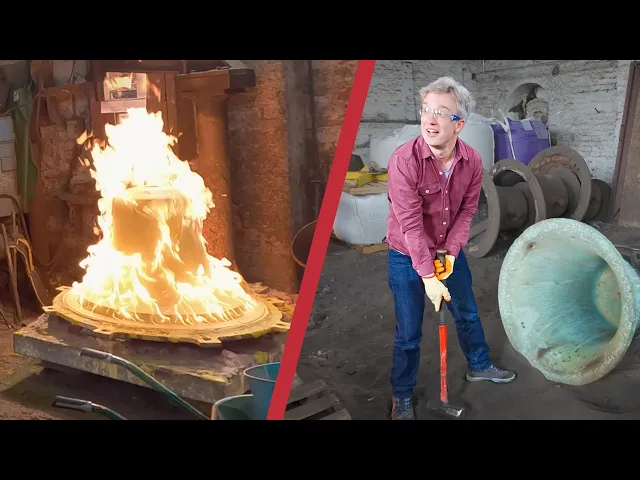
I helped break a 142-year-old bell, and that's okay.
Tom Scott
0:00 I went on a road trip through every English county,
0:03 and filmed something interesting in each of them.
0:05 And my journey started with fire, molten metal,
0:08 and taking a sledgehammer to a piece of history
0:10 in the centre of the country, in Leicestershire.
0:13 (church bells ringing) It was 7am when I
0:17 parked up at the John Taylor Bell Foundry,
0:19 the last working bell foundry in the UK.
0:21 Hello!
0:23 I’m sorry I’m late.
0:24 I managed to lose my car keys.
0:25 And after a few quick hellos, I was pointed straight into one of the buildings
0:28 where they turn molten metal into bells that weigh tonnes.
0:33 Wow!
0:33 Just bells casually lying on the floor.
0:37 Nope.
0:37 Completely wrong.
0:38 Those are not bells and I would find that out in a minute.
0:41 Now, there are around 30 people working at the foundry.
0:44 I met quite a few of them over the course of the day,
0:46 but the folks I spent most time with were Antony and Sam.
0:49 Samuel.
0:50 Bonjour.
0:51 Antony’s the foreman, he’s been working there for a while, and Sam...
0:54 -You’ve been working here how long?
0:55 -I’ve been here six years.
0:56 I started at 16.
0:58 And when I first started, I couldn’t lift, move or carry this.
1:03 And now...
1:04 -Alright.
1:05 Hang on...
1:07 Okay, right, well...
1:10 This is gonna be embarrassing.
1:12 Okay, I can at least lift it.
1:13 -You can...
1:13 I can do that.
1:16 No, not out at arm’s length.
1:18 Can’t do that.
1:18 -See, he passed it to me because we were using it for a job.
1:21 He just...
1:23 He just...
1:24 I literally just walked by him,
1:25 handed it to him, and it nearly just went flying.
1:28 I grabbed hold of it and was like,
1:29 “I’m going!” The plan for the day was to cast four bells,
1:32 and I’m going to be there generally demonstrating
1:34 why I tend to work with a keyboard
1:36 and not massive heavy lumps of stuff that need workshop cranes to move them.
1:40 If you want to get involved at any point, that will not be a problem.
1:43 (laughter) I’m not sure what the city boy can really add to...
1:47 Can you swing a hammer?
1:49 Have you ever swang a hammer?
1:50 I’ve done like a half day of blacksmithing once.
1:52 -Ooh.
1:53 Okay.
1:53 Yeah, that’ll be alright.
1:54 -Alright.
1:54 When we have to smash the bells up, ’cos that’s graft.
1:57 -Alright.
1:58 -So, more...
1:59 -Oh, have we got bells to smash up?
2:00 -Yeah, we’ve got four.
2:01 No, five.
2:01 -Awhh!
2:02 I don’t wanna do it!
2:03 For anyone wondering on the camera, Sam is the age of a foetus.
2:07 Straight out of school, straight into here.
2:09 And he was lovely and he was polite, and he did as he was told.
2:12 And now he’s the most teenage teenager I’ve ever met.
2:15 But I’m not a teenager anymore!
2:17 Yeah, well you want to act like it sometimes.
2:19 (laughter) “No.” He’s not going to get a ‘Kevin the Teenager’ reference, is he?
2:24 No, he’s not.
2:25 Sam cranked open the drying oven and we started
2:28 by sitting next to it with a cup of tea.
2:30 The oven’s not hot-hot, it’s not like a domestic oven.
2:33 It’s just warm enough to make sure that everything that’s put inside dries out.
2:37 So, anything bell-related has to be dried before we
2:40 can even think about going near it with molten metal.
2:44 These are the four bells that we’re gonna be casting today.
2:46 -Oh, right.
2:47 -Um, so we’ll...
2:48 Okay, so that...
2:49 So I’m confused, because those look already cast.
2:52 No, so these are the outer moulds.
2:55 Hang on, let me move my chair as well.
2:59 So that’s just the outside mould surface.
3:03 This is what the finished bell will look like.
3:05 -So it’s got all of its inscription, -Yeah.
3:08 got what the customer’s asked for, all the lettering.
3:10 -Yeah.
3:10 -And then this later on will get lowered over the top of these cores.
3:14 That’s the inside shape.
3:16 -Right.
3:16 So they’ll marry up, and then the cavity in between this surface...
3:22 -Yeah.
3:22 -...and that surface is the thickness of the bell.
3:25 Right.
3:25 That’s got to be so precise.
3:27 Er, well, yeah.
3:28 Well, we’ll find out when we close ’em later, but...
3:30 (laughter) The outer casing of those moulds is metal.
3:33 That’s what I saw on the floor earlier,
3:35 all the cases for different sizes and shapes and styles of bell,
3:38 and those cases date back to the 1840s because they’re big
3:42 lumps of metal to keep the more delicate moulds inside safe.
3:45 They don’t need replacing.
3:46 But packed into those cases are the actual moulds for the bells.
3:50 So, the moulding material that we use to make bells
3:53 is called loam and it’s effectively like a sticky mud.
3:57 That’s “loom”, l-o-A-m.
4:00 Some parts of the world pronounce it “lome”, but loam is basically sand, clay,
4:04 a bit of water with some extra stuff we’ll talk about in a moment.
4:08 -So this material here -Yeah.
4:10 is made of this.
4:12 -Oh, right.
4:13 We apply this to the steel case so you can see how that’s the steel case there.
4:18 -Oh you’re right, it is warm in here.
4:20 It’s lovely!
4:21 (laughter) And then we’ve got the loam here.
4:24 Obviously because this is wet, that’s what we have to dry.
4:27 They make the bell moulds out of loam,
4:29 press all the letters and designs into it, and then once it’s dried, it’s solid.
4:33 I was worried about putting a fingerprint in the loam and distorting the bell,
4:37 but no, Antony can knock on it once it’s dry.
4:39 Wait...that can’t be made of loam.
4:41 Yeah, it’s all...
4:43 That is the same material as that.
4:46 -Just dried out?
4:47 -Yeah.
4:47 Has it got anything added to it?
4:49 Um, it’s got, er, clay, goat’s hair and horse manure.
4:54 Sure, okay!
4:55 (laughter) Well, the horse manure,
4:57 ‘cos horses can chew straw a lot finer than we can cut it.
5:01 I had to do some research to work out
5:03 why they need that and while I can’t be certain,
5:06 most of the sources I found say it’s because when the bell’s cast,
5:09 organic materials burn when hit by the molten metal
5:12 and that creates tiny channels for gases to escape.
5:14 If you didn’t have them, steam would build up and the whole thing would explode.
5:19 Someone centuries ago figured out that’s
5:21 a good way to stop your bells exploding.
5:23 And the reason it all has to be dried first...
5:26 Any moisture in there is gonna instantly expand when the molten metal hits it.
5:29 Oh, and you’re gonna get steam and bubbles.
5:31 Yeah, in a closed cavity.
5:32 It’s not just gonna steam, it’ll go bang.
5:34 -Right, absolutely.
5:35 -So, everything has to be dried.
5:37 So today that is, as Sam has described it, perfect nap temperature.
5:41 -That...
5:42 -So...
5:43 That doesn’t sound safe!
5:45 (laughter) That’s the outer casing of the bell mould.
5:47 But a bell is not a solid lump of metal, so,
5:49 you also need the core, the inside part of the bell mould.
5:53 And at this point, Sam casually broke out the blowtorch!
5:56 Pre-warning, it’s about to get warm.
5:58 -Okay.
5:58 -Yeah, I’m gonna move out of the way.
6:00 So, yep.
6:01 Oh, okay, what?
6:07 -Um...
6:08 -So, because this is a different mould material.
6:11 -Right, what’s the material?
6:13 Well, we call it air set sand.
6:15 -Right.
6:15 -But it..
6:16 -So, we have to...
6:17 -Blimey!
6:18 I can explain all this in a minute.
6:20 That inner core is made of chemically bonded sand.
6:23 They’ve got a small silo of sand in the corner
6:25 of the foundry along with two big barrels of resin and catalyst,
6:29 and a mixing machine with various controls over it.
6:31 What comes out initially feels just like slightly sticky sand,
6:34 you can sculpt with it,
6:35 but over time the resin will harden it into a solid mass.
6:39 And the settings on the controls let you choose how rigid or crumbly it gets,
6:42 and whether it takes minutes or hours to get there.
6:45 But because the core is made of that sand, it can’t go in the oven.
6:50 So, these all have to have an alcohol based coating which we then
6:53 set fire to, which is what we just did, and that cures it.
6:56 -Which cures it, right.
6:57 -Yeah.
6:57 Okay.
6:58 This is the face of an idiot who
7:01 is trying to understand the sequence of events here.
7:04 Okay, so, outer mould of bell with the design pressed into it,
7:07 that’s made of loam inside a reusable Victorian-era
7:10 steel case which gets dried solid in the oven.
7:13 Inner mould of bell, big solid lump of chemically bonded sand,
7:17 covered in several coatings and cured with fire.
7:21 Different temperatures can damage moulds in different ways.
7:24 Basically, because we let the moulds cool slowly,
7:27 that puts added strain and pressure on the sand moulds,
7:32 so, they need an extra step of protection.
7:34 The final layer on those inner cores is a grey coat with graphite
7:37 in it and that’s to let the final bell come out of the mould easily.
7:40 Normally, if you’re casting metal, you want it to cool quite fast,
7:43 but for bells it’s got to be slow,
7:45 otherwise, the tone of the bell won’t sound right.
7:48 So, to cast a bell, you kind of have to go
7:50 against all of the good principles of making a good casting.
7:55 -Right.
7:55 -So, it’s a constant...
7:57 -Because otherwise it won’t sound right?
7:58 -Yeah, basically.
7:59 It will just sound a bit sharp.
8:01 -Sharp.
8:01 -Which is a big thing.
8:03 -Right.
8:03 I don’t bell ring or anything like that and I’m not very musically gifted.
8:07 I can play the triangle.
8:09 I think ‘sharp’ there is referring not to the pitch
8:11 of the bell but to the quality of the sound,
8:13 whether it’s resonant and sounds like you’re ringing a bell, not just...
8:16 (mug clinks) ...hitting a lump of metal with a hammer.
8:19 That...I was expecting that to go ‘clunk’.
8:21 That did not go...
8:22 That actually sounds really nice.
8:24 We won’t know if this mould’s been any good,
8:27 considering we made it, you know, this is two weeks’ worth of work.
8:29 Oh yeah, and you use it once.
8:31 -Yeah.
8:31 -For one bell.
8:33 It’ll all boil down to 20 minutes.
8:36 Once the metal’s in, sort of give it 20 minutes to solidify and then that’s it.
8:41 That’s two weeks’ worth of work and we’ve just
8:43 got to see and hope that it was done right.
8:46 What’s it like the first time doing that?
8:48 I imagine it’s more fresh in your memory.
8:50 -I get really nervous.
8:51 -Every time?
8:52 He gets nervous about things.
8:53 I’m the more chill one to be fair.
8:55 Yeah, he’s the most Gen-Z person I’ve ever met.
8:57 He just does not care.
8:58 I don’t stress about anything.
9:00 Nothing’s worth stressing about.
9:02 It is.
9:02 It frustrates me how little...
9:04 like, he’s not...that’s to say he’s not complacent or anything like that.
9:07 He’s just got a much better like mindset about it.
9:11 But I will still get a bit twitchy and a bit nervous like every time.
9:16 And it’s not a bad thing either.
9:18 You know, this is...it’s a dangerous job.
9:20 (hissing) “It’s a dangerous job”, he says, casually putting the fire out!
9:29 The techniques have changed a bit over time,
9:31 chemically bonded sand and compressed-air hoses are obviously modern inventions.
9:34 But if you put a 15th-century bellfounder in that workshop,
9:38 I think they’d recognise most of the processes.
9:41 And the metal would be much the same,
9:43 about a four-to-one ratio of copper to tin.
9:46 It’s not quite medieval still, but it’s about as medieval as a modern job gets.
9:52 First of all, let’s go and turn the fire alarm off.
9:54 Oh, because there’s gonna be a fire.
9:57 But why would...in a building designed to burn things,
9:59 why would you put a fire alarm in?
10:01 Bearing in mind, if we can’t put it out, and we’re running...
10:04 -Yeah.
10:04 -Just run too!
10:05 If we can’t put it out, run away.
10:07 Cases have been dried, cores have been coated.
10:10 Those will get put together in a bit,
10:11 but next, they need to get the furnace going.
10:14 Inside here is like a ceramic pot, you can just see the lip of it here.
10:18 When we get it going,
10:19 the fire will create like a cyclone around that pot and heat it up,
10:23 and that’s how we...
10:24 so, when this gets red hot, that’s how we’ll melt the metal.
10:27 If that leaks for whatever reason, the metal has to be able,
10:30 its full contents has to be able to go somewhere.
10:33 So, under these two plates,
10:36 you can just sort of see down here is a massive trough...
10:38 -Yeah.
10:39 ...that just we have to keep empty at all times so that if this starts to leak,
10:43 we can drain it straight into this trough.
10:45 Which is going to give people a very bad day cleaning
10:48 up afterwards but it safely gets the metal out of the way.
10:50 Yeah, but that bad day of cleaning is infinitely better than...
10:54 Than molten metal spilling on the floor of this.
10:56 Yeah, than the other consequences, absolutely.
10:59 But then as an added safety feature, this whole floor is a giant sand pit.
11:06 These are just steel plates put on the floor
11:08 for us to walk on, but underneath this is just sand.
11:13 It’s a diesel-powered furnace,
11:14 a colossal thing that takes hours to heat up to the temperature it needs.
11:18 Because it’s not warmed up yet, you can feel a little bit of heat there.
11:23 So, you can feel that vortex.
11:26 Oh, whoa!
11:27 -Yeah.
11:27 -Yeah, you can.
11:28 A little bit of heat coming from there.
11:29 -A little bit of heat!
11:30 -And then if you look under there...
11:31 Oh blimey, all right.
11:32 You can see the...
11:34 you can see the flame inside there.
11:36 Now you can see the flame starting to circle, look...
11:38 Oh, yeah.
11:40 Right.
11:40 Now we’re on the clock.
11:43 It’s all countdown now.
11:44 We’ve got to get these ready before that’s ready.
11:46 I’m going to stay out of your way.
11:47 Their next job is to stick together the outer moulds and the inner moulds.
11:50 The first three went without a hitch.
11:53 Perfect.
11:54 Like a glove.
11:56 -Oh, and it just goes straight down!
11:58 -I’m down.
11:58 -Yeah!
11:59 -Oh...
12:00 -I’m down.
12:01 I think.
12:01 -Oh yeah?
12:02 You’re down that side?
12:03 -Yeah.
12:04 -Yeah, boy!
12:05 They put some sealant on the bottom of each case as well just
12:08 to make sure everything was locked in and then they clamp them together.
12:11 They tried the fourth one, it didn’t quite match up.
12:13 It needed a bit of sanding first, and then they were good to go.
12:15 Sorry, so I had a bit of a brain fart then.
12:17 I had to try and remember what button to press.
12:19 They’re all labelled.
12:20 Labelled and marked.
12:21 I know.
12:22 Oh, alright, look at you!
12:24 Ooh!
12:25 Learn to drive a forklift, now he thinks he’s the big cheese.
12:29 If I was cheese, I’d definitely be the big cheese.
12:32 Really big cheese.
12:34 In fact, I’d be such a big cheese, I’d almost be the cow.
12:36 That’s a good point.
12:37 If you were cheese, what cheese would you be?
12:39 Just something really boring, like...
12:41 -Just be cheddar!
12:42 -I’d be Red Leicester!
12:44 I love Red Leicester cheese.
12:47 Cheddar is definitely the close second.
12:48 What would you be?
12:49 I feel like I’d be brie.
12:51 Maybe a nice Camembert.
12:52 Just a melt.
12:53 Yeah, because I’m a melt.
12:54 Thanks, mate!
12:55 (laughter) Oh, and it just goes straight down!
13:00 Done!
13:02 You know what I mean by like, three of them, not a problem.
13:05 Happy to be closed.
13:06 Let’s crack on.
13:07 -Twenty minutes!
13:08 This one?
13:08 Nah, don’t want to be a bell today.
13:10 Not feeling it.
13:11 Antony and Sam had a very difficult question for me.
13:14 If you were a cheese, what cheese would you be?
13:19 (laughter) See the question is not,
13:25 “What cheese do you like?” No, it’s if you were a cheese,
13:28 you woke up tomorrow, “Oh no, I’m a cheese.” What cheese do you want to be?
13:31 The best answer I’ve got is like that American plastic cheese.
13:35 Fair.
13:36 Like, it’s all a bit superficial, you know?
13:40 -Yeah.
13:40 -It’s not really doing any hard work here.
13:42 -Yeah, you’re spray cheese.
13:42 -Yeah.
13:43 Oh, no, I’m not going that far.
13:45 (laughter) Holding my second camera there is
13:48 Mae who handles all the foundry’s social media.
13:50 Because, yes, John Taylor’s is the last working British bell foundry,
13:54 but they also have some other lines of work:
13:56 installing the bells, advising on bells and bell towers.
13:59 And there’s also the Bellfoundry Trust which is
14:01 a small museum and heritage attraction doing tours,
14:03 and they have outreach to do.
14:05 There’s not the demand for bells that there once was.
14:08 The bells they’re casting today are for a church down in Cornwall,
14:12 and the raw material is that church’s old bells
14:15 which were cast in 1883 by that exact foundry.
14:19 There’s nothing wrong with the metal itself.
14:20 It’s just that after more than 140 years of summer
14:23 heat and winter cold while being repeatedly hit with hammers,
14:26 I mean, frankly, I wouldn’t sound good after that.
14:29 The bells, well, they don’t sound so good either.
14:31 But you can’t fit a whole bell inside a furnace,
14:34 so, they need smashing into pieces.
14:37 At this point, I need to give you, the YouTube viewer of this series a warning.
14:42 This new format that I’m working with will have mid-roll,
14:45 host-read adverts in it,
14:47 like basically every other long-form video on the platform,
14:50 because, well, this...
14:51 this ain’t cheap.
14:52 But if you’d like to see all these videos one week earlier,
14:55 without any of those adverts and, for one of them,
14:58 without the extensive blurring that’s going to be needed,
15:00 you can watch over on Nebula.
15:02 There’s a link in the description, and more about that at the end of the show.
15:05 Ta-dah!
15:05 (bell ringing) These were made in this building a hundred and...
15:10 well, however long 1883 was.
15:13 They’ve come home to where they were made.
15:14 They were made up there on those tables with the same kit.
15:17 -And they will become four new bells.
15:20 -Yep.
15:21 -Alright.
15:21 -How cool is that?
15:22 But that means that someone’s got to hit ’em with a sledgehammer now.
15:24 Yeah, that means there’s some graft to do now.
15:26 I set up a couple of cameras but before we started,
15:28 Antony did show me that the lettering on the new bells won’t just be similar,
15:32 it’s made with the exact same metal stamps.
15:35 -These...
15:36 -Yeah.
15:36 ...are the original stamps.
15:39 Oh!
15:40 There you go.
15:43 They’re the same.
15:44 -That’s the same.
15:44 That’s exactly the same.
15:45 -They’re the same stamps.
15:50 And so, they swung the sledgehammer and started
15:53 to smash up the bells with very little ceremony.
16:05 He’s only gone first so that now the next
16:07 person that hits it and it breaks apart, he did all the graft.
16:10 -Yeah.
16:11 Yeah, absolutely.
16:16 Someone else’s go!
16:18 Whew...
16:31 -That’s okay.
16:32 That’s what it’s there for!
16:33 -Sorry.
16:34 I’ll get the GoPro out of range.
16:36 We’re fine.
16:50 -Oh...maybe a year?
16:52 -Right.
16:53 That was my first question.
16:55 Have you ever swung a sledgehammer?
17:01 I mean, it’s pretty self-explanatory, but...
17:05 -All your weight is obviously at one end.
17:06 -Yeah.
17:06 For swinging, you bring it up, obviously the momentum will take it up, -Yeah.
17:11 And then as you come down, slide your hand down,
17:14 and follow through with like your whole core.
17:16 -Right.
17:16 -Because we’ve seen people try and go like,
17:18 “Uh...” -Oh, yeah, no this is not like..
17:20 And that’s how you break a back, pull out a shoulder, all kinds.
17:24 And you want to be aiming for just sort of anywhere there.
17:27 Anywhere there.
17:36 It’s difficult.
17:41 (chuckling) Not bad for a first attempt.
17:49 -Whey-hey!
17:49 -It’s going!
17:50 -That’s cracked it!
17:51 -It’s going!
17:52 -That’s cracked it!
17:53 -Whey-hey!
17:53 That was the change in tone!
18:00 Everyone always does.
18:10 Are you sure?
18:14 You cracked it!
18:14 You did.
18:15 Yeah.
18:27 That’s a tough bell.
18:29 That is a very tough bell.
18:31 I was waiting for you to just, like, ping, and it blows apart.
18:34 And when it didn’t, I was like, oh, okay.
18:35 Maybe we’ve actually given him like the hardest one to do.
18:37 It is a very tough bell.
18:38 (laughter) You okay?
18:43 Yeah, it’s just hard work!
18:45 While they smashed up the rest of the bells,
18:48 Mae gave me a tour round the workshops,
18:49 because they’ve got a huge space where they make the frames
18:52 for the bells and a load of other stuff besides, and where they do the tuning,
18:55 which is a process that involves steadily and carefully
18:59 shaving down the cast bells until they’re exactly on pitch.
19:02 And the offcuts, the swarf, from that bell tuning,
19:05 that goes back over to be raw material for new bells.
19:09 Calm down.
19:10 Calm down.
19:11 Before we put big chunks in the furnace,
19:14 we recycle old bell chippings, so, like, the off-shoots from tuning.
19:18 -Right.
19:18 -So, we weigh out a load of them, put them in the furnace first,
19:21 because then they make a soft base for us
19:23 to drop all the sharp, pointy metal onto.
19:28 That alone is probably 15 kilos.
19:31 Any bigger than that...
19:34 It’s heavy work.
19:36 You don’t need the gym.
19:37 I feel actively guilty just standing here with a camera,
19:40 but I am well aware that health and safety,
19:43 for very good reason, will not let me get my hands near that furnace.
19:47 How good’s your aim?
19:49 Hold that.
19:52 There you go.
19:54 (laughter) I asked Josh.
19:58 He said he’d be...
20:01 mozzarella.
20:03 What?!
20:04 The furnace started belching out green fire, burning off a load of impurities,
20:09 slowly heating up and then melting the metal.
20:11 This is only just over half.
20:13 When we’ve smashed up that bell and put all this in, that’s about half.
20:21 We’ve still got another, about five, six hundred kilos to go.
20:25 Remember earlier that they said the floor is just one
20:28 giant sandpit and that the bells have to cool slowly,
20:30 as slowly as possible, to get the structure and the sound right?
20:32 Well, the best way to insulate those bells and stop them
20:35 cooling too fast is to dig them into the sand pit.
20:42 So that’s the bottom bit that had the core on.
20:44 Yeah.
20:45 And this is the top bit that you saw us lowering down over the core.
20:48 And now they are met in the middle.
20:50 So inside here, there is a cavity that will run the entire length
20:54 up to the top of the bell where once this pit’s been dug,
20:58 we’ll lower it in and then we will put a box on top,
21:01 and that’s where we pour into, and then it’ll flow and fill the whole cavity.
21:05 You’re seeing a montage here.
21:07 This took an hour, even with the excavator.
21:16 It’s so nice that you do all these bits now.
21:19 Well, it was gonna happen eventually.
21:21 No, I know, but...
21:23 I’ve spent so many years having to do it myself.
21:26 Oh, it was such hard work!
21:28 And that’s where the molten metal will go.
21:30 Yep, that’s the pouring bush.
21:32 That pouring bush is made with the same chemically
21:35 bonded sand as the inner core of the bell.
21:36 It sets in just a few minutes,
21:38 and then it has to be protected with the same graphite layer on top,
21:41 which means they also need to get cured.
21:52 (delighted whooping) -Is that good?
21:55 -She is cooked!
21:56 -That’s hot!
21:57 -Right.
21:58 -So, you see how, like, smoky it is?
22:00 -Yeah.
22:00 Yeah, that means it’s more than hot enough.
22:05 So, when it melts, it creates like a crust
22:07 on top and you have to break through that crust.
22:17 We were joined by half a dozen folks over from the workshop
22:19 who were ready for their part in a well-practiced routine.
22:22 I was given a heat-resistant suit along with gloves, helmet and faceguard.
22:26 We were joined up on the balcony by visitors on a tour
22:28 including folks from the church whose bells they were recasting.
22:32 Antony, I’m just going to check with you one more time,
22:34 my job is “stay behind you”.
22:35 -Yeah, so just stay with me.
22:36 -Alright.
22:36 -And you’re all good.
22:39 Everybody where they need to be?
22:41 Gonna assume yes.
22:42 Cool, let’s crack on.
22:43 They don’t pour directly from the furnace into the bell
22:46 casings ’cos then they’d have to somehow move the whole furnace,
22:49 instead, the glowing molten metal at about
22:53 1,200 Celsius goes into a smaller pouring ladle.
23:01 -Are you nervous?
23:02 -Yes.
23:03 I’m always nervous.
23:04 This was metal pouring like water.
23:07 Your brain thinks it’s water and thinks
23:09 it’s got the properties and weight of water,
23:11 and I know it sounds obvious to say it out loud,
23:14 but that has the weight and inertia of metal because it is metal.
23:20 -Wait, where’s Tom?
23:21 Is he right behind me?
23:22 -Here.
23:22 If at any point you feel like you’re gonna get showered...
23:25 -Yeah.
23:25 -Tuck your shoulders in.
23:26 -Tuck your shoulders in, okay.
23:27 -‘Cos that protects your neck.
23:28 Got it.
23:31 You should be fine, but they’re little tricks that you pick up over time.
23:34 Yeah.
23:36 -That’s currently hotter than a volcano.
23:39 -Okay.
23:41 Every day for you.
23:44 Well, good news, my camera is working.
23:47 That’s good.
23:48 That’ll do, Bill.
23:49 ’Cos we don’t get a second take at that.
23:52 The metal is giving off its own light.
23:53 It’s illuminating the space around it and our faces.
23:56 The cameras can’t quite deal with it, but there’s detail in the surface,
23:59 little imperfections that aren’t glowing as much.
24:03 It looks like a crumble.
24:05 -So now we’re going to pick it up...
24:06 -Yep.
24:06 ...spin it round and then I’m going to take all the impurities off the top.
24:11 This is...
24:14 quite a lot.
24:15 Then we’ll put it down,
24:16 we’ll put the lid on and then we’ll go down and, well, we’ll have a look,
24:20 sort of gauge it by eye what the temperature’s looking like,
24:23 which I think is gonna be really hot.
24:24 They use the overhead crane to move the pot
24:26 of extremely dangerous molten metal across to the moulds.
24:29 You can put it down, we’ll leave it for a minute because that is way too hot.
24:34 -So, it’s too hot right now?
24:35 -Yeah.
24:35 -Okay.
24:36 -All it’d do is we’d pour it
24:37 in and it would just absolutely obliterate the mould surface.
24:41 -Right.
24:41 -So, it would cast the bell, but all the finish would just be horrendous.
24:44 -Right.
24:44 -So...but then too cold, you just go bang and you just get a slab.
24:49 Antony wasn’t using a thermometer or an infrared camera there.
24:51 He was looking at the pot and from experience and knowledge just going,
24:55 “That’s too hot.” That knowledge was passed down
24:57 to him by the people who trained him,
24:59 and he’s passing it to Sam and so the chain goes on for centuries.
25:04 But see how it’s like smoking out of every...
25:06 -Yeah.
25:07 -Yeah.
25:07 -It shouldn’t be normally doing that.
25:09 -Okay.
25:11 So, we’ve got to wait for it to cool a little.
25:13 Exactly.
25:13 Told you this bit’s chill.
25:15 (laughter) Yeah, Bill, if you woke up tomorrow and you were cheese,
25:20 what cheese would you be?
25:22 So when everybody sees us on the balcony
25:23 and they think we’re being really serious and professional,
25:25 this is what we’re asking when the visors are down and no one can hear us.
25:28 And there’s quite a few spectators up there as well.
25:31 Hello!
25:32 So you see how now look, it’s all sort of calming down?
25:35 I mean, I hope so.
25:36 I don’t know what’s showing up on camera
25:37 because it’s so bright compared to everything else around.
25:40 -I reckon we’re good for the first one.
25:43 -Alright.
25:43 Here’s the crucial moment.
25:45 Weeks of work and hard graft led up to this.
25:47 One person, Josh, he was controlling the position of the bucket on the crane.
25:51 Sam was controlling the pour.
25:52 He’s rotating the pot to keep the flow of molten metal steady.
25:56 Keep going, Sam, keep going, Sam, keep going, Sam, keep going, Sam.
25:58 -You’re in the lip.
25:59 -Ready?
25:59 Yeah, ready when you are, mate.
26:01 Nice and steady.
26:03 And Antony was controlling the flow,
26:04 watching when it’s nearly full and just providing a bit of movement
26:07 in the top to make sure everything’s flowing nicely and it’s a constant stream.
26:11 I don’t know if it’s showing up on camera,
26:12 but there’s a skin of slightly cooled metal on the top,
26:18 and then just liquid pouring out underneath it.
26:21 We did put a core in this one, didn’t we?
26:24 Well, yeah.
26:25 Oh, got it, there we go.
26:26 Fill the bush.
26:27 And then they moved on to the next bell.
26:29 They started with the smallest and they’re working up.
26:31 -Nice and steady, Josh.
26:32 -Yep.
26:33 -Good lad.
26:34 You ready?
26:34 -Yep.
26:35 Here we go.
26:36 These are a bit bigger.
26:37 This one’s a bit bigger, so...
26:38 -Only two inches.
26:39 -Oh?
26:40 Only two inches.
26:41 Makes all the difference, mate.
26:43 Don’t let anybody tell you it doesn’t.
26:45 Ooh, got it.
26:46 Yeah, got it, got it, got it.
26:48 Oh, look at that, didn’t even spill any.
26:50 Two bells down, two to go.
26:51 They dumped a few handfuls of sand on the top
26:53 of each one once it’s poured, as insulation.
26:55 I’ll explain what the folks behind were doing in a minute.
26:57 -Yeah, ready when you are, Sam.
26:58 -Yeah?
26:58 Nice and steady.
27:00 You’re jostling it through and making sure it doesn’t stick?
27:02 Yeah.
27:03 Basically, yeah.
27:03 I’m controlling the flow so that it’s a constant stream going in.
27:09 Got it.
27:10 Right.
27:10 With all those done, one final bell.
27:12 The big one.
27:13 -Are you a bit warm?
27:15 -Yep.
27:15 (laughter) Right.
27:18 Last one.
27:19 Here we go.
27:20 Nice and steady, Sam.
27:21 -Yeah.
27:21 -Ready when you are.
27:23 (sighs) Beautiful.
27:28 Whoa...
27:29 There was an air of quiet concentration over the whole group now.
27:33 Everything seemed to be going okay.
27:34 Sam was pouring the metal at exactly the right speed.
27:37 The level in the pouring bush was staying exactly
27:38 where it should be with the inflow matching the outflow,
27:41 but as we got near to the end of the last bell, Antony realised something.
27:46 Ooh, there is a lot left.
27:48 -There’s a lot left?
27:49 -There’s a lot left.
27:50 The team had worked out the mass of the bells they were
27:53 putting in and the mass of the bells that would be coming out,
27:55 but it could only be an estimate, and there was too much molten metal remaining.
27:59 The bell mould was about to be full and they can’t let
28:02 the remaining metal cool in the ladle because they’d never get it out again.
28:05 Right, Tom, I need you to go that side please, mate.
28:07 Mae, I need you to follow him.
28:08 As soon as the last bell was poured,
28:10 Sam cut off the flow and then very, very quickly got to digging.
28:13 Oh my goodness.
28:15 And as fast as he can dig with a thousand-plus
28:17 Celsius pot of molten metal next to him, that hole was getting filled up.
28:22 -So that’s just the excess there?
28:23 -Yeah, yeah.
28:24 So we’ll repurpose that.
28:25 Right.
28:26 -So that’ll get recycled again and again?
28:28 -Yeah.
28:28 Once that’s cooled, they can use the crane
28:30 and forklift to pull out the ingots of metal, break them up and use them again,
28:33 but it does mean there was some very heavy and unexpected work for Sam.
28:38 It’s warm back here!
28:41 Yeah.
28:42 Shut up!
28:44 (gasps) Go on, Sam.
28:46 You’re nearly there, kid.
28:47 I’m so proud of you.
28:50 Oh, oh, oh!
28:52 (laughter) -You okay, Sam?
28:54 -Yeah, I was just a bit warm.
28:55 Yeah, that’s fair enough.
28:56 Which means there’s one last thing to explain and which I got to have a go at...
29:00 What are they doing poking sticks into the molten metal?
29:03 -So if you take the bar above my hand.
29:04 -Yeah.
29:04 -Don’t put up any resistance.
29:06 -Yeah.
29:07 Right, hang on.
29:08 Don’t put up any resistance.
29:09 -Feel that?
29:10 -Yes.
29:10 -That’s the top of the core.
29:12 -Okay.
29:12 It is imperative we do not hit that, ’cos
29:15 remember there’s a hole straight through the middle.
29:16 -Okay, yes.
29:17 -If we hit through that, all that vanishes.
29:20 This is feeding the bell, agitating the top of it just a little
29:23 to make sure there’s no air bubbles no weird inconsistencies,
29:26 it’s all just solid metal.
29:28 I’m going to let go of the bar.
29:30 It’s yours.
29:30 See how it’s like kind of spongy?
29:32 -Oh, yeah.
29:32 Yeah, that’s metal structure starting to build.
29:35 Right.
29:35 And actually I can see what was completely
29:38 liquid is now just slightly sticking to it.
29:41 So now just big circles and you’re up
29:43 and down and you can gently touch that mushy bit.
29:45 I’m not gonna gently touch that mushy bit.
29:47 -I’m not gonna...
29:48 -Words you thought you’d never hear today!
29:50 Right?
29:51 (laughter) I’m gonna give that back to you.
29:53 Thank you so much for letting me try that.
29:55 I’m just...whoa!
29:57 As soon as these are all fed, that’s it.
29:59 Day’s done.
30:00 Um...folks, I hate to be the master of ceremonies here,
30:03 but I think they deserve a round of applause for that.
30:05 Oh, absolutely not.
30:06 (cheering, applause) Oh, look at that!
30:20 So, which ones are the new ones and which ones are the refitted ones?
30:26 So, the new ones are this one...
30:28 -Yep.
30:29 That one, that one, and the one over there.
30:33 Which are three, four, five and six.
30:35 Wow.
30:37 (bells ringing) Two to three!
30:47 Two to four!
30:54 Two to five!
30:57 And if you’re wondering about the numbers that are being called out,
31:00 that’s a future video on my road trip across England.
31:03 (bells ringing) If you want to see Episode 2 right now, you can on Nebula!
31:08 You’ll get all the episodes of this series a week before they’re on YouTube,
31:12 plus exclusive Nebula Originals, like the new Anatomy Of...
31:16 series from Real Engineering which starts with a deep-dive
31:19 into the iconic and seemingly-indestructible Nokia 3310, using a CT scanner.
31:24 Or there’s Season 2 of comedy presentation show Abolish Everything!
31:29 Right now, annual subscriptions are 50% off, just $30 a year,
31:32 which works out to only $2.50 a month.
31:35 Scan the code on screen or follow the link in the description
31:38 and you’ll also help support this channel and the England series.
31:42 As for what the next episode is, well...
31:44 Next time, or right now on Nebula,
31:47 I hunt for invisible chimneys in the sky, and make this noise: “Yaaaaargh!”