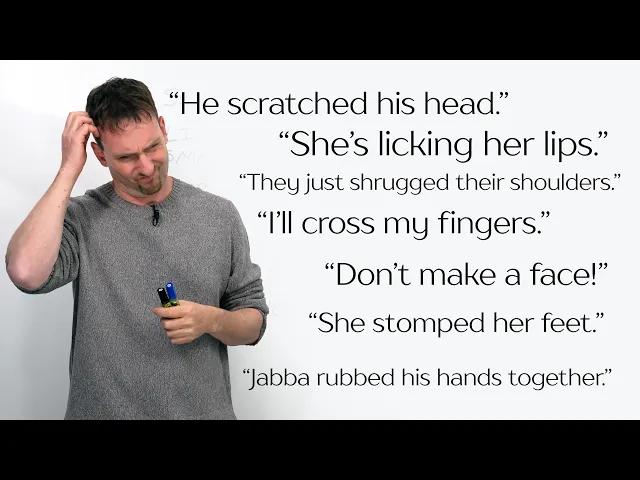
Everyday English: Say What People Did — Gestures & Reactions
Adam’s English Lessons · engVid
0:00 Hi, everybody.
0:01 Welcome to www.engvid.com.
0:02 I'm Adam.
0:03 In today's lesson, I have something that's a little bit interesting, I hope.
0:09 I'm going to talk to you about gestures,
0:12 hand signals, some things you do with your face, things you do with your body,
0:17 because communication is not all about words and sentences and vocabulary.
0:22 Communication, a lot of what you communicate
0:26 to people comes through the way you look,
0:29 how you do things with your eyes, how your body stands.
0:33 Like, if you're facing somebody or facing away from somebody,
0:36 the way your hands move, a lot of that is communication.
0:40 But I'm going to show you a bunch of actual physical gestures,
0:45 but people say these, especially when they're reporting about somebody else.
0:50 So, for example, if you ask someone about
0:54 somebody else's reaction to a piece of news,
0:57 for example, obviously you can't see the physical gesture.
1:02 But the person telling you what...
1:05 How the person reacted might simply tell you what gesture that person made,
1:11 and from the gesture you will understand their reaction.
1:14 Okay?
1:15 I'll give you an example.
1:16 We're going to start with "scratch one's head".
1:19 So, "scratch one's head", if I do...
1:22 If you're telling me something and I go...
1:25 What do you understand from that?
1:27 You understand that maybe I'm confused, maybe I don't really know what's going
1:32 on, but if you tell me that somebody else reacted
1:35 by doing that, I will understand that that person
1:39 was confused or didn't know what's going on.
1:42 Right?
1:42 So, I have a friend, he's a teacher,
1:45 and I knew he was going to teach his students a very complex grammatical point.
1:51 So, after the class, I asked my friend, "How did it go?
1:55 Do they understand the lesson?" And he said, "Oh, no,
1:57 they were pretty much scratching their heads
1:59 the whole time." So, when he says to me,
2:02 "They were scratching their heads the whole time",
2:05 I understand they didn't understand,
2:07 they were very confused, they didn't know what's going on.
2:10 He doesn't have to show me, he doesn't have to tell me they were confused,
2:15 he tells me the gesture that they made.
2:17 And in English, we have quite a few of these gestures
2:21 that people say that somebody else did to get the...
2:26 To get the reaction, basically, to see how somebody reacted.
2:30 Now, the reason we would say these, the reason I
2:33 would say he scratched his head instead of he was confused,
2:37 because this gives more of a visual description of the person's reaction.
2:41 Instead of saying he was confused...
2:43 Okay, he was confused.
2:45 If he was scratching his head,
2:47 it means it was maybe too complicated or he was trying to understand,
2:50 but couldn't really understand, and it gives more of a visual.
2:53 I can see him and I feel sorry for him
2:55 because scratching his head doesn't know what's going on.
2:58 So, let's go through a few more of these.
3:01 "To lick one's lips" or "to smack one's lips".
3:05 So, licking one's lips, smacking one's lips, like opening and closing.
3:13 So, mostly, we use this to describe someone's reaction to food.
3:18 So, you go to a restaurant and you can smell the food, it's really delicious,
3:23 everything around you, so you're licking your lips,
3:25 means you're excited about what is coming.
3:27 You are anticipating a very good meal
3:30 and you're getting your mouth ready for it.
3:33 But, these days, we also use this expression just to mean
3:38 generally excited or if you see a very good opportunity,
3:41 you get very excited and you're anticipating.
3:45 So, investors are licking their lips at the prospect of this company's success.
3:52 So, some investors put money into this company or they bought stocks,
3:57 and there's news that this company is going to have a very successful year,
4:00 so the investors are licking their lips
4:02 because they know money is coming to them.
4:04 So, they're very excited about that.
4:06 So, not only food, other things as well.
4:10 "To rub one's hands together".
4:13 Same idea, very similar to "lick one's lips",
4:17 you're anticipating something, you're excited about something that's coming.
4:20 So, I walked into a store, for example,
4:23 or I walked into a car dealership, that's a better example.
4:26 And over there in the corner, I see the salesperson with a young couple.
4:31 And the couple looks, you know, they're very excited, they're getting a new car.
4:35 But I could see the car dealer was just rubbing his hands,
4:38 waiting to sign the contract.
4:39 He was rubbing his hands, again, he knew money is coming to him,
4:43 he's getting a nice commission, he's excited,
4:45 he's a little bit greedy about what's coming.
4:47 So, I can describe that feeling.
4:50 I don't need to say the salesman looked very excited.
4:54 The salesman was rubbing his hands together, very clear what he was feeling.
5:00 "Shrug one's shoulders".
5:01 Right?
5:02 So, if somebody shrugs one's shoulders, that generally means one of two things.
5:09 One, they just don't care, or two, they just want to be in a bad mood.
5:14 It doesn't matter what you say to them, they just want to stay in a bad mood.
5:17 Especially when we're talking about a child, right?
5:20 A child doesn't want to go to school.
5:22 And you say to the child, or I...
5:25 Okay, I'll give you as a third person.
5:28 My friend's son didn't want to go to school.
5:30 So, I asked my friend, "What did you do?" So, she...
5:33 My friend says, "She offered him candy
5:35 and ice cream when he comes home from school.
5:38 If he goes to school, when he comes home,
5:41 he'll get candy and ice cream." And I said,
5:43 "Oh, that's a nice, nice little trade.
5:45 What did he say?" "Oh, he just shrugged his shoulders." Didn't really care,
5:50 or he just wanted to be in a bad mood.
5:52 He shrugged his shoulders.
5:54 To make a face.
5:55 You can make all kinds of different faces, but essentially,
6:00 when you're making a face, usually it means a negative reaction.
6:05 Right?
6:05 So, I offered her a position, a raise, but it included more duties,
6:11 and I say, "How did she react?" "Oh, she just made a face.
6:14 I don't think she was interested." "Make a face" usually means to show through
6:20 a facial gesture that you don't like
6:22 something or you're not interested in something.
6:26 To cross one's fingers.
6:27 Now, this actually has two meanings.
6:30 If you cross your fingers for someone, you go,
6:33 "I'll cross my fingers for you." Or you can say it on the phone.
6:38 "Good luck.
6:38 So, you have your interview tomorrow?
6:40 Okay, well, I hope you do very well.
6:42 I'll be crossing my fingers for you." It means I'll be wishing you good luck.
6:48 But a completely different meaning, if someone says something to you,
6:53 and then later it turns out that it's not true, and I say,
6:56 "But you told me you'll do this." I go, "Yeah,
6:59 I was crossing my fingers." It basically means crossing your fingers
7:03 behind your back means I'm not telling the truth, I'm lying.
7:07 But because I'm crossing my fingers, I'm not committing a sin.
7:10 I'm not going to be punished.
7:12 I'm not a bad person, because this lets me say whatever I want.
7:16 It's very childish, and if somebody...
7:18 If an adult says this, they're just basically taking a joke, right?
7:22 They weren't very serious the first time.
7:25 So, to wish someone luck or to not tell the truth.
7:28 Okay, so here are a few.
7:29 Let's look at some more.
7:31 Okay, so now we have a few more,
7:33 and some of these are a little bit less literal than others,
7:36 but I'll give you an example.
7:38 To give a thumbs up.
7:39 So, if you give somebody a thumbs up,
7:42 it means that you approve or accept something,
7:44 or that you just think something is very good, right?
7:48 So, this could be a very literal thing.
7:50 If somebody gives you a thumbs up from a distance,
7:53 or he gave me a thumbs up, I could see him from the crowd.
7:58 If I'm on the stage,
7:59 my friends in the crowd giving me a thumbs up means he thinks I did a good job.
8:03 But this can also be a more figurative expression.
8:08 The government gave the military the thumbs
8:12 up to proceed with the attack, right?
8:14 So, basically, to give the thumbs up is just to give permission in some cases.
8:19 It's not an actual physical thing, but it can be a physical gesture as well.
8:25 To raise one's hands in the air.
8:29 Like that, right?
8:31 So, when you do that, basically, what you're indicating is that you just...
8:34 You give up.
8:35 You're not going to try to argue with somebody,
8:37 or you're not going to try to convince somebody.
8:39 You give up.
8:40 You're frustrated, right?
8:41 So, again, we can say...
8:43 Report this about someone's reaction.
8:45 So, the mother and child were fighting.
8:48 The child wanted to be picked up.
8:51 So, finally, the mother just threw her hands in the air.
8:54 Oh, sorry, I should...
8:55 Sometimes it's a bit more...
8:59 Sometimes it's a little bit more emphasis.
9:01 If you throw your hands in the air, it means, like, you basically...
9:05 You're just giving up.
9:06 Raise your hands in the air could also mean surrender.
9:09 Like, if the police say freeze, the criminals will raise their hands in the air.
9:15 It means they're giving up.
9:16 So, but to throw is more about the frustration of giving up.
9:21 To plug one's ears.
9:23 So, if somebody plugs one's ears,
9:25 it means they don't want to listen to what you have to say.
9:29 So, I was...
9:31 The parent was trying to discipline the child, the teenager,
9:34 but the teenager just plugged his ears and wouldn't listen.
9:37 Very straightforward.
9:39 To stomp one's feet.
9:40 Again, that's a bit more childish.
9:42 Adults don't generally do that, but if we want
9:46 to show or say that somebody was acting childish...
9:50 So, for example, I told my boss that I can't come into work this morning,
9:55 tomorrow morning, and he just started stomping his feet.
9:58 He was angry.
9:58 Right?
9:59 So, when you're stomping your feet, you're angry.
10:02 A child wants attention or wants candy or wants to be picked up,
10:06 it will stomp its feet so the parents can react.
10:09 But when you talk about an adult,
10:11 they're probably just very angry or frustrated also.
10:14 It could be a reaction.
10:18 To sit on one's hands.
10:19 Basically, like, sitting on one's hands.
10:22 So, did you ask your sister for help?
10:24 I asked her, but she just sat on her hands and didn't do anything.
10:27 So, if somebody sits on their hands, it means they...
10:30 First of all, it means do nothing.
10:32 They don't want to do anything, or they just don't want to help.
10:37 Usually, it's also a sign of stubbornness.
10:40 The person just doesn't want to listen, doesn't want to help,
10:43 just sits on their hands and stays to the side.
10:47 Twiddle one's thumbs.
10:48 I'll try to show you this.
10:49 So, you're just sitting there, you're...
10:51 This is twiddling.
10:52 Just turning your thumbs one around the other.
10:55 I don't know where the word "twiddle"
10:57 came from, but that's what this gesture means.
10:59 So, if somebody's just twiddling their thumbs, it means they're bored.
11:03 They have nothing to do.
11:05 Or they're very restless.
11:07 They want to be busy, but they just have nothing to do.
11:10 So, they're bored, they're a little bit stressed out by that.
11:14 Okay?
11:14 So now, now you understand these physical gestures, what they mean,
11:18 but it's also very important to know
11:20 what they mean when somebody speaks the gestures.
11:23 Not when you...
11:24 When you can't see them, basically.
11:27 When somebody is reporting someone else's reaction,
11:30 it's important to understand these.
11:32 Okay.
11:32 So, if you have any questions about any of these, please go to www.engvid.com.
11:36 In the comment section there, you can ask me any question you have.
11:40 I'll be happy to answer them.
11:42 There's also a quiz.
11:43 You can try to understand your comprehension of this lesson.
11:48 And I hope you liked this lesson.
11:50 Please give me a like if you did.
11:52 Don't forget to subscribe to my channel
11:54 and ring the bell for notifications of new videos.
11:58 And come back soon.
11:59 We'll do this again then.
12:01 See you then.
12:02 Bye-bye.