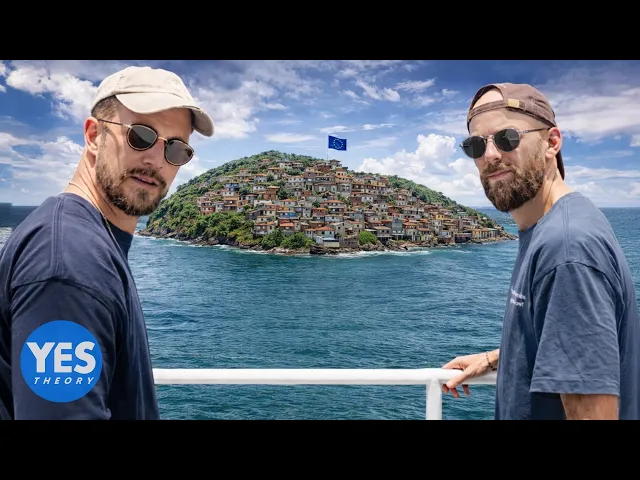
50 Hours on Europe's Most Dangerous Island
Yes Theory
0:01 We're on Europe's most dangerous island, but we probably shouldn't even be here.
0:08 If you're driving and you see like obstacle on the road, don't stop.
0:13 Just go.
0:13 Mayot, an island that in the most unlikely of ways still belongs to France.
0:19 Located off the coast of Madagascar, 8,000 km from its mainland,
0:24 yet fully considered part of the country and of the EU.
0:28 Their currency is the euro and its inhabitants are French citizens.
0:32 But somehow, despite it being one of EU's most southern borders,
0:36 it seems to have gotten completely forgotten.
0:39 So, after our story surprising our delivery driver, Vakar with a trip to Kenya,
0:43 we found this island just 2 and 1/2 hours
0:46 away that frankly none of us knew anything about.
0:48 While doing some research,
0:50 we could only find two totally contradicting aspects about this place.
0:53 First, it seems to be an absolutely stunning tropical paradise.
0:57 But it also, however,
0:59 seems to have very high crime rates and thus almost no visitors whatsoever,
1:05 which only left us with more questions.
1:07 How is this island actually a part of France
1:09 and doesn't even feel like the same country?
1:12 But most importantly, are things really as bad as the news make them out to be?
1:17 With a place this unknown,
1:18 we know that the only way to find out what is really going on is to go there.
1:23 So, we booked a two-day trip to this mysterious island,
1:27 not really knowing what we were getting ourselves into.
1:33 Made the journey to the beginning.
1:34 I don't think I've ever known so little about
1:35 a place that I'm going to in my entire life.
1:37 Yeah, we've been on the road for over 2 months and yeah,
1:40 back to back to France now.
1:42 Like in the middle of Madagascar and continental Africa, there's like France.
1:46 Makes no sense.
1:47 It makes no sense.
1:49 Seems not to be the safest place.
1:51 And I texted a couple of French friends about it and they said,
1:55 "I've only seen documentaries about how it's quite dangerous there."
1:58 You never know before you go to a place, right?
2:00 I mean, I've been to Afghanistan and Pakistan and people
2:02 thought I was going to not come back, right?
2:05 So, I think it's probably fairly okay,
2:07 but I think we just have to be a little cautious because we don't really know.
2:18 Hello.
2:27 Wow, everyone here seems so freaking friendly.
2:28 What did she say?
2:29 She asked if we're going to stay on the big island or the small island.
2:33 I don't know what that means.
2:34 I said big one, but I don't I have no idea.
2:38 Actually, we should have probably looked into this more.
2:42 There's no turning back now.
2:44 Let's see how this goes.
2:55 It's like paradise.
2:56 This is not what I thought it was going to look like.
3:00 Oh my god, it's so beautiful.
3:06 Welcome to France.
3:09 Thank you so much.
3:10 Thank you.
3:11 We go from Asantas Sana to me.
3:30 I have no idea where we are and there's barely anyone here at this airport.
3:36 Okay, it was around this moment that we began to realize how
3:39 very little we knew about this place due to our limited planning.
3:42 Literally none of the rental car websites worked.
3:45 I could not find a rental car place.
3:49 I uh think we're on on a small island, too.
3:52 I looked at the map.
3:54 Wait, what the So, we're on this small one that's like next to the big one,
3:58 and our hotel is on the other side.
4:00 So, we have to take like a ferry, maybe.
4:02 How do How do we get to the ferry?
4:04 You know when you enter a place and everyone knows you're a tourist?
4:07 This is us right now.
4:08 Apparently, the boat to the other island, the ferry, cost €1.
4:12 Mercy.
4:12 Hello.
4:13 Unlocked a new corner of the map, though.
4:17 I've never been in this general area at all.
4:20 It's wild to be this far, but still not be in a new country.
4:23 Well, you can go this far away from the mainland
4:25 of the country and still be in that country.
4:27 And why is it like that?
4:29 It must not be a really dark history related to that, right?
4:32 Yeah.
4:33 Cut to voice over explaining more.
4:35 May is an island between Madagascar and the coast of East
4:40 Africa and sits around 8,000 kilometers away from mainland France.
4:44 And somehow they are the same country.
4:47 For centuries, May was a part
4:49 of a network of trade routes influenced by African, Arab, and Malagasi cultures.
4:53 The island was governed by Muslim leaders, and the people lived freely,
4:58 moving to the rhythm of the Indian Ocean.
5:01 But everything changed in the 1800s.
5:03 At the time, European powers were racing
5:06 to expand their influence across the globe.
5:08 And in 1841, a local ruler made a decision that could reshape May forever.
5:13 Facing internal conflict and outside pressure,
5:15 the Sultan of Mayut sold the island to France.
5:19 And just like that, May became French.
5:22 Over the following decades, France tightened its grip,
5:25 eventually taking control of the entire Kumora's archipelago,
5:28 grouping May with its neighboring islands under colonial rule.
5:32 Fast forward to the 1970s.
5:34 A wave of independence movements swept across Africa.
5:37 The Kamoros voted for independence from France.
5:40 But Mayott did something unexpected.
5:42 It chose to stay.
5:44 Not once, but multiple times through referendums,
5:47 the people of Matut voted to remain French,
5:49 separating their path from the rest of the Kamoros,
5:52 which became an independent nation.
5:54 And today, May isn't just connected to France.
5:57 It is France, an overseas department governed under French law.
6:03 Thousands of kilometers away from mainland Europe,
6:07 we continue the track to our accommodation
6:09 by following these locals to the ferry.
6:11 I I literally am just following them.
6:14 I have no idea where we're going.
6:18 It truly feels like a little tropical paradise.
6:25 And once on the mainland,
6:26 we continued to search for a rental car, but ran into further difficulties.
6:30 tourism bureau is closed.
6:31 We hadn't realized that we had arrived on May during Ramadan.
6:35 And it turns out that around 95% of the population on the island were Muslim,
6:40 meaning that right now at 3:30 p.m., most businesses had closed for the day.
6:50 She was like, "No, man.
6:51 I'm done.
6:52 I'm going home." She giving you a number to call?
6:54 No, I'm calling another rental place.
6:57 Okay.
6:58 Trying next place.
7:01 on the car.
7:03 Yay!
7:04 Our vehicle.
7:05 And now, after struggling to find our way,
7:09 we were finally ready to see where this unusual adventure would take us.
7:23 They have like this white paint on their faces.
7:26 The goats.
7:27 Traffic here.
7:27 Traffic jam.
7:28 Who do they belong to?
7:29 As we headed to our accommodation for the night,
7:32 we had no idea how we would immerse ourselves these next
7:36 few days to understand more about this island's interesting mix of cultures.
7:46 We still don't have any plan.
7:48 The plan is to find the plan or for the plan to find us.
7:51 This looks like a nice market here.
7:53 Yeah, looks like they're selling all sorts of stuff.
8:00 I don't know.
8:01 People are looking at us like aliens.
8:03 Like, what the are these guys doing in here?
8:12 Nice.
8:17 Police.
8:21 Police.
8:46 Okay.
8:51 Right.
8:59 Okay.
8:59 He's saying there's like little groups of boys and that hang
9:03 out scanning and waiting and seeing what they can get up to.
9:08 Yeah.
9:09 They might throw rocks.
9:11 They might have other weapons.
9:14 She's saying she does not want to be filmed.
9:17 This is going to be difficult, I think.
9:24 Well, I guess we're going to have to see what we're going to do here.
9:27 I'll admit that this place is a little
9:30 bit more unpredictable than we originally expected.
9:33 And one thing that's been a bit out
9:36 of control and challenging everywhere we travel has
9:39 been taking out cash in various ATMs
9:42 and my bank hitting me with outrageous conversion fees.
9:46 And being out here in May in the middle
9:49 of the Indian Ocean has definitely made that very clear.
9:53 And so many of my friends and actually direct family were
9:56 telling me to stop complaining about this and to just use Revolute.
10:00 So I finally downloaded it.
10:02 Revolute, the sponsor of this video,
10:04 is a financial app used by over 70 million people worldwide.
10:08 It basically gives you way more
10:10 flexibility when you're dealing with money internationally.
10:12 You can hold money in 25 different currencies at the same time,
10:16 spend in local currencies and exchange between them
10:19 directly in the app at really good rates.
10:21 So whether I'm out here in my yat in Pakistan or in Kenya,
10:25 I'm not constantly losing money on conversions anymore.
10:28 Let me show you.
10:29 Inside of the app, you can instantly exchange currencies at the market
10:33 exchange rates instead of whatever markup your bank decides to add.
10:36 You can also send money internationally to over 140
10:39 countries just using someone's Revolute name or phone number.
10:43 A lot of our friends already use it,
10:45 which makes splitting costs while traveling way easier.
10:48 If they are also on Revolute, you can send it in seconds with no fees.
10:51 If you want to try it out,
10:52 you can get $40 when you sign up using the link in the description.
10:56 Their standard plan has no monthly fees
10:58 and it only takes minutes to create an account.
11:01 Honestly, if you travel a lot or if
11:03 you move between countries regularly like we do, it makes life so much easier.
11:08 Money freedom wherever you are.
11:10 And now back to seeing what we can explore safely on this island.
11:15 That was interesting.
11:16 Yeah, that was uh that was that was that was that was harder than we expected.
11:21 Yeah, that was very hard.
11:22 Maybe markets is not the way to do this.
11:25 It's hard, you know, because we have no like rule map to follow, right?
11:28 when you go to a country, well, the country is France,
11:30 but when you go to an island like this that is less traveled,
11:33 we're like ping the way right now hopefully to be able to show others,
11:36 but we we don't know how to how to do this.
11:38 Another thing the policeman said is like there's no age limit to uh to crime.
11:42 He basically said if you see these little
11:45 groups of boys hanging around like they're looking
11:47 for something to do and he was like they
11:51 might have knives or machetes or things like that.
11:54 Do you think people like the police?
11:56 Okay.
11:57 But the mission is maybe then to like yeah
12:00 actually find someone who can be our guardian angel.
12:02 Of course, we don't want to like fear humans and fear strangers.
12:06 It goes against everything what we believe in.
12:12 But it's also good to be mindful.
12:17 After driving around and checking out the surrounding towns,
12:19 we stopped by a small pharmacy to grab some sunscreen where we were
12:23 met with someone who would end up changing the course of our trip.
12:26 And how long have you been in Miami?
12:28 Uh, 7 months.
12:29 Okay.
12:30 So, pretty new.
12:30 Yeah, pretty new.
12:31 Have you seen a little bit of the island yourself?
12:35 Yeah.
12:36 Yeah.
12:36 Yes.
12:37 So far.
12:37 Uh, mixed.
12:38 Mixed.
12:39 Yes.
12:39 because you have a lot of uh insecurity
12:42 and now it's pretty calm because uh people
12:44 are fasting and sometime during the evening uh
12:48 you can have a we call them uh match.
12:52 Uh so this is why uh it's a little bit complicated to drive during the night.
12:59 You need to gather information.
13:01 Jesse then continued to explain to us how insecure living
13:04 on May was and the complicated reality we had flown ourselves into.
13:08 You can have like a two months calm and then you will have a one month
13:14 where is a lot of insecurity all over
13:17 the Why does the insecurities go up sometimes?
13:19 What is the main reason too?
13:21 Uh sometime politics other time is because
13:24 you have they call it alliance between villages.
13:28 So Jesse, it's like kind of serious but like
13:31 this sometime it's very complicated to understand what's going on.
13:35 Despite having the appearance of a beautiful tropical island,
13:38 Jesse was beginning to shine light on how Mayot
13:41 had struggled with its crime rate in recent years.
13:44 Much of the violence stems from neighborhood
13:46 and village-based gangs of young boys, some as young as 12,
13:50 who carry out territorial attacks on rival areas with innocent
13:54 bystanders often getting severely injured or killed in the chaos.
13:58 However, there are many factors that contribute to the high
14:02 crime rates that the locals have no control over.
14:04 Firstly, with an unemployment rate of 30%
14:07 and 80% of the people living in poverty,
14:09 May is by far the poorest department in France with local
14:13 politicians campaigning for France to provide more infrastructure to the island.
14:17 Secondly, Mayott also has a huge problem with undocumented immigrants,
14:21 many of whom sail over from neighboring islands in search of a better life.
14:25 And finally, children born of undocumented immigrant parents land
14:28 in a legal gray area in terms of their nationality,
14:32 which can make it harder to attend school,
14:35 access healthcare, and find legal work.
14:37 All these factors lead to an increase in people being drawn into crime.
14:41 According to Jesse, our chances of encountering any
14:43 trouble are lower right now because of Ramadan.
14:45 But she warned us that getting attacked while
14:48 driving on a remote was still a major risk.
14:51 And if you're driving and you see like
14:54 a group that has put obstacle on the road,
14:57 then you just need to drive very fast.
14:59 Don't stop.
15:00 Just go like through the obstacle.
15:02 Yes.
15:02 Through the obstacle.
15:03 How long are you planning to stay?
15:05 We're staying until Sunday afternoon.
15:07 Oh, for just a few days.
15:09 You're free.
15:10 It's okay.
15:10 Okay.
15:11 It's okay now.
15:12 So, yeah, you should come explore with us.
15:14 Oh, no worries.
15:15 Yeah, sure.
15:16 Get me your Instagram.
15:18 So, so tomorrow morning at 8 a.m.
15:20 there is a big market.
15:22 It's once a month.
15:23 So, you need to go there.
15:26 Oh, yeah.
15:26 Maybe we can go together.
15:28 Okay.
15:28 Sure.
15:28 I'm planning to go there.
15:29 So, I will text you.
15:30 Okay.
15:31 Amazing.
15:31 Okay.
15:31 So, nice to meet you.
15:33 So nice to meet you.
15:34 This is fun.
15:35 So nice to meet you.
15:36 Yeah.
15:37 You too, Jessie.
15:38 Thank you.
15:39 I think we met our guardian angel in a pharmacy.
15:42 Okay.
15:43 This is a good time to tell people don't do what we do.
15:46 I was just going to say that actually like you need to you need to look
15:49 into you need to read more honestly like she's
15:51 going to a market tomorrow morning at 8 a.m.
15:53 once a month.
15:54 Yeah.
15:54 So maybe we bring our small cameras and go join her.
15:57 Yeah.
15:58 I'm I I I often have words to say but right
16:01 now I'm a bit you know and obviously 99% of people all
16:04 around the world are always kind of lobbying but it's just if
16:07 you're in a little specific corner at the wrong place in time.
16:10 Yeah.
16:10 She did say that.
16:11 Yeah.
16:12 specifically.
16:12 There's three people that have told me we're
16:14 lucky we're here during Ramadan because people are fasting.
16:17 Yeah.
16:18 They're like a bit, you know, they're in the shade,
16:20 they're at home, like they don't have as much energy.
16:23 But she said after school, during the school periods,
16:25 kids are waiting on the side of the road and just throwing rocks at cars.
16:30 Contrasting.
16:30 Yeah.
16:31 Yeah.
16:31 Feel me in a lot of updates.
16:35 Yeah.
16:35 Yeah.
16:36 Her her bio on Instagram is I'm a dreamer.
16:39 A world citizen.
16:40 She's a dreamer.
16:41 She's not the only one.
16:43 You, me, and her, we are like dreamers, you know?
16:46 You know what I mean?
16:47 You, me, and her, we are like dreamers.
16:51 Like, we dream.
16:53 And Oh.
16:54 Oh, did you did you forget that I was here?
17:05 As we ended our day with a swim in this tropical rainy paradise,
17:09 we couldn't help but reflect on a day that hadn't quite gone to plan.
17:13 In our search to meet locals, we'd mainly encountered more concerns about
17:17 the dangers of exploring this island unaccompanied.
17:19 So, we were eager to meet up with Jesse
17:23 in the next morning to explore the island's famous market.
17:29 Ah, hi.
17:30 So the French greeting it's always it always gets there.
17:35 What is this market?
17:37 So this one is like a famous market.
17:40 You will have a once a month.
17:42 Okay.
17:42 So it will gather all the people from Mayot.
17:45 They will come from all over the place.
17:47 Thanks for taking us.
17:48 We've been a little bit lost in May.
17:51 Yeah.
17:51 You've been our savior so far.
17:53 This is nice.
17:53 The energy here is very chill.
17:55 Feels like people are just selling their local crafts and food.
18:03 Okay.
18:04 After 7 months like what's what's the essence of Mayot would
18:06 you say like after being here the people you need a little
18:10 bit time because they will not open at the first month two
18:14 months maybe it can take 4 months before they opens to you.
18:17 Yeah.
18:17 But after that you are like a family to them.
18:20 So that's great.
18:21 Wow.
18:22 So we have to be here for 4 months.
18:25 Yeah.
18:25 At least.
18:26 Okay.
18:26 At least four months.
18:28 One of the main obstacle in Mayard is
18:31 that it's a French territory but they have another language.
18:35 So most of the people they don't speak French.
18:38 Most people don't speak French.
18:40 Yeah.
18:40 What language do they speak?
18:42 Shim is the local language.
18:44 Local language.
18:44 Shim.
18:45 Shimo.
18:45 And I read that in 1974.
18:47 The rest of Kamaros voted to be independent.
18:51 Yes.
18:51 But not here.
18:52 But not here.
18:53 No.
18:53 Do you know if people are happy with that decision
18:56 or are they like wishing they were independent?
18:58 No.
18:58 People from Maya they are very happy that you will have a a lot
19:02 of migration migration people from Kong will come here uh to seek nationality.
19:07 They want to be French again.
19:09 Locals are not happy with that.
19:11 When you arrive there, they will say most of the time
19:14 that people from Mayot are very racist against people
19:17 from Koma because sometime they can use harsh
19:20 words and it's sad because they're like cousin.
19:23 It's the same family.
19:25 Yeah.
19:25 And they are treating each other like strangers.
19:31 I don't get that.
19:34 So it's painful to watch.
19:42 Jesse, can you explain to us what a futari is?
19:46 The futari is uh meals that you will
19:48 share with people after fasting during the Ramadan period.
19:51 So you you told us about one.
19:54 Yeah.
19:54 It's a colleagues of my friends.
19:56 Okay.
19:57 So they are going to organize it tonight.
19:59 Yes.
20:00 You need to go there.
20:01 I'm getting photos from your friend here.
20:04 We have been invited to the thing we've been looking for.
20:07 They cook food for the breaking of the fast, which happens tonight.
20:10 So, we're going to go check it out.
20:13 Somehow, as we strolled around this market,
20:15 Jesse had contacted a distant connection who was hosting
20:17 one of the most local experiences we could ask for.
20:20 A futari where a village will prepare for days,
20:23 sometimes for their whole neighborhood to break their fast together.
20:26 Jesse couldn't join us herself,
20:28 but sent us an address and a contact, and off we went.
20:36 We are approaching where the uh preparations are happening.
20:50 Is it your family here?
20:53 Yeah.
20:53 Oh, wow.
20:54 And wow.
20:56 Something we hadn't expected to discover on the trip
21:01 was that Mayott's culture was actually heavily matriarchal.
21:04 Property and homes are often passed down through women,
21:06 and it's common for men to move
21:08 into the household of their wife's family after marriage.
21:11 This tradition has roots in Camorian culture, where lineage,
21:14 inheritance, and social stability are closely tied to women.
21:17 Mothers and grandmothers often act as the anchors of the household,
21:21 making key decisions and maintaining the structure of daily life.
21:25 The social fabric here gives women a unique form of influence and security,
21:29 something rarely seen in many parts of the world.
21:54 Oh, feels like we're we've been struggling finding
22:08 our way in and they've totally invited us here.
22:21 for a tradition.
22:41 I don't know why I got touched now,
22:43 but like it's it's their preparation for Christmas, right?
22:45 Like it's Yeah.
22:47 How can we help out?
22:53 She said it'd be funny to watch you grill.
22:55 I don't I don't know how to grill.
22:57 I know you don't.
23:00 Why are you offering to do things you don't know how to do?
23:12 Hello.
23:13 Hello.
23:15 Gosh.
23:17 Wholesome there, Junior.
23:21 Oh, nice to meet you.
23:29 And by some miracle, we found ourselves in the very heart of a local community.
23:34 I survived.
23:35 He was like, "Are you doing Ramadan?" I was like,
23:40 "No." He was like, "Then you can eat.
23:44 Have some.
23:46 Okay.
23:53 Okay.
24:03 Ah, perfect.
24:11 Protect his little little Rudolph's nose.
24:17 Here we go.
24:18 Feeling like a local.
24:20 Yeah, I can't see any other men.
24:24 They said men have it as well, but I think they maybe tricked me.
24:32 time of breaking fast is approaching.
24:34 They have all of these different meals that have been
24:37 prepared in different homes and everyone is now coming together.
24:45 I am the best.
24:56 It is pretty incredible.
24:57 They've been telling me that back in the day they used to do
25:01 this a lot more without any particular occasion just sharing meals together.
25:05 But um it's becoming less and less common just as society is sort
25:10 of modernizing and individualistic ways of life
25:13 is becoming more and more the norm.
25:14 So it's quite beautiful to see them doing it here now.
25:16 And for a lot of the elders this is
25:19 very meaningful because this is how they remember growing up.
25:22 A lot of people come up and ask us what we're filming for.
25:25 They think we're journalists and typically
25:27 journalists have come here and not necessarily
25:30 represented people in the kindest of light when they found out that we're
25:34 here genuinely just to learn about their culture and everyone's super excited
25:37 that that we're here and we feel uh very welcomed by by everyone.
25:41 So this is always the scary part whenever we begin a yes trip.
25:45 We have no idea what's going to happen,
25:47 where we're going to end up or who we might meet.
25:49 And so at some point during the trip, we usually know we found the magic.
25:56 And being here right now, I think it's quite clear that we did.
26:13 Okay.
26:17 Ah, my father.
26:21 Ah, that's her father.
26:26 Yeah.
26:28 Really?
26:29 This is Jean's dad and uh he has like
26:32 a famous old school band here on the island.
26:35 He was the he was part of the first band that was playing
26:40 electric guitar in May and he has music here on YouTube and he
26:45 said he wants our help cuz he wants the young generation to remember
26:49 this music cuz now they don't play music like this here anymore.
26:57 See my red.
27:12 Oh yeah.
27:36 Yeah, this young kid here, he's been watching us shoot all day, film all day.
27:40 The protege that I haven't taught anything.
27:42 He just learned from watching, but he learned how to focus.
27:48 He learned how to hit record.
27:52 He even said, "Let's shoot it on the red." Wow.
27:59 Wow.
28:01 Everyone is breaking the fast.
28:08 Okay.
28:09 Wow.
28:09 This is um a very intimate moment.
28:11 It's quite beautiful.
28:12 Everyone is sort of seated at different corners here.
28:15 People from the whole neighborhood and family, friends, neighbors are gathered.
28:51 our guardian angel.
28:58 What do you wish for the future of May?
29:04 New problem security.
29:52 If you could whisper something into everyone's ear in my yacht,
29:56 what would you tell everyone on the island?
30:16 Super Mercy.
30:18 Mercy.
30:19 Now she's giving us food to go.
30:26 We should go.
30:27 Okay.
30:27 Yeah.
30:27 Yeah.
30:28 Yeah.
30:28 Unfortunately, as we were just getting comfortable,
30:30 we had also forgotten that the sun had now set.
30:33 Locals from the village came rushing to tell us we needed to move.
30:36 And he was like, "No, I think you guys need to like hit the road."
30:39 And then he looked worried and I was like,
30:41 "Oh, oh, I get it." It's hard to say what our real takeaway from this trip was.
30:46 The first natural one is that especially
30:48 in places surrounded by lots of pain and instability.
30:51 There are also always communities and families
30:54 like Jeans holding each other close.
30:57 May felt like an island we could
30:59 spend weeks exploring and still not fully understand.
31:02 One can only hope that France will prioritize
31:05 this island more in the future and that smart
31:08 and kind-hearted people like Jean will continue being
31:12 a part of planting positive seeds for a brighter future.