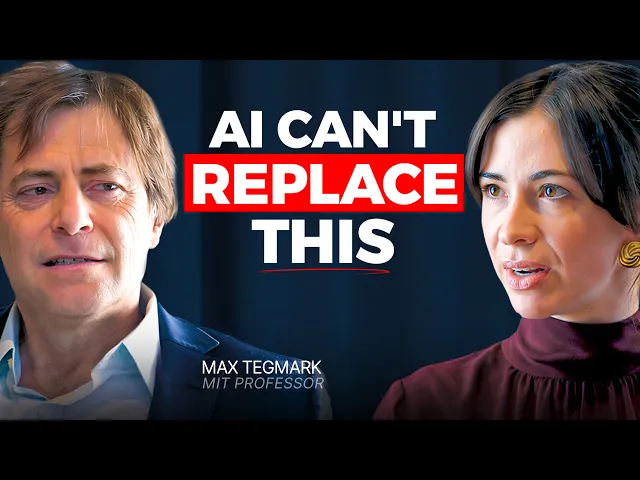
MIT Professor: The One Skill AI Can't Replace — Most People Are Losing It Right Now | Max Tegmark
Silicon Valley Girl
0:00 Thanks to HubSpot for sponsoring this video.
0:04 There's one skill that's about to become the most valuable in the job market.
0:08 But here's the problem.
0:10 The more you use AI, the faster you might be losing it.
0:13 MIT just measured this.
0:15 People who use ChatGPT showed up to 55% less brain connectivity.
0:21 And what stuck with me most is 83%
0:24 of them couldn't explain their own work just minutes later.
0:29 The reason I want to flag this is because
0:31 it gives you a direct impact [music] on your career.
0:34 Because the exact skill people are quietly losing right now
0:38 is the one companies are starting to pay the most for.
0:41 I run a team of 35 people.
0:42 We use AI every single day.
0:44 I use AI like crazy.
0:45 And when I read this report, I'm like, okay, I might be in trouble.
0:48 Because on the personal level, we're already outsourcing our thinking.
0:52 At a global level, we are building
0:54 systems [music] that might start thinking for us.
0:57 So, the real question is, where is it all leading us?
1:01 To understand that, I spoke to Max Tegmark,
1:03 MIT professor, one of the leading voices in AI safety,
1:06 who's been [music] studying what happens when AI becomes more powerful than us.
1:10 And I asked him directly, if we don't regulate this, what happens?
1:15 Oh, I think if we build AGI
1:16 and then shortly thereafter super intelligence without any regulation,
1:20 I think it's just I pretty clearly going to be game over for humanity, you know.
1:24 In 5 years, you think so?
1:26 No, I didn't say that the game over happens exactly when we build it.
1:29 But you know, it's it's we start to lose control of our society.
1:33 It's like if you fall into the Niagara River just upstream from the waterfall,
1:38 you know, you don't die at that point,
1:40 but you that's when you've kind of lost control of your destiny,
1:43 and it's not going to end well.
1:44 What I'm saying here is actually very easy
1:48 to understand and has been said even by Alan Turing,
1:50 the great AI godfather, in 1951,
1:52 that if we simply go ahead and build a species of super
1:56 intelligent robots that are not just more agile physically than us,
1:59 but can out-think us in every what way and do every job better than us,
2:04 you know, the default outcome is we lose control.
2:08 And And right now, we're clearly
2:10 in the situation where we're we're closer to figuring
2:12 out how to build superintelligence than we
2:15 are to figuring out how to control it.
2:16 So, no racing to AGI and superintelligence and no regulations,
2:20 I think, is just civilizational suicide.
2:23 And And But, I am also quite optimistic.
2:26 I don't want to get you too depressed here.
2:28 The race to build AI is moving faster than the race to control it.
2:32 And the people who understand that earliest will make
2:34 the most important career decisions of the next 5 years.
2:37 And here's the thing,
2:38 the civilizational warning Max is giving and the MIT
2:42 brain study are actually the same thing at different scales.
2:45 At the macro level, we're building something smarter
2:47 than us without knowing how to control it.
2:50 At the personal level, we are outsourcing our thinking,
2:53 our decision-making, and not realizing what we're losing in the process.
2:57 83% of people who use ChatGPT to write an essay
3:01 couldn't quote from their own work 5 minutes later.
3:04 How crazy that is?
3:05 Our kids are going to use it.
3:06 Our kids I don't know, it just blows my mind how much I
3:09 have to be proactively controlling my kids these days.
3:12 The research has called this cognitive debt.
3:14 You get the output today, but you pay with your thinking ability tomorrow.
3:18 And here is what unsettled me the most.
3:20 This isn't just happening to individuals.
3:23 Ask Max how fast this is actually moving at the civilizational level.
3:27 Because if we're already losing control of our own
3:30 thinking and we're simultaneously building systems smarter than us,
3:34 the timeline really matters.
3:36 Yeah, it's hard to imagine today that we
3:39 might in 5 years have something this powerful.
3:41 It's kind of like we we talked about Alan Turing in '51 being so prophetic,
3:46 you know, he said another really interesting thing, too, around that time.
3:49 He said, you know, don't stress out about this losing
3:52 control to super intelligent robots cuz it's far away.
3:57 But I'm going to give you a a canary in the coal mine,
4:00 so you know when it's close.
4:02 A test.
4:03 Mhm.
4:03 The Turing test.
4:04 Yeah.
4:04 It's when the machines master language and knowledge kind of at the human level,
4:10 that's when you know you're close.
4:13 Basically, Basically, it's now.
4:15 What's fascinating is 6 years ago,
4:17 almost everybody I almost every AI professor and researcher I knew was
4:22 pretty convinced that we were still decades away from passing the Turing test.
4:25 It was going to be 2050 or something like that.
4:27 And they were all wrong cuz it already happened, right?
4:30 That's why this concern,
4:33 which has been very well known in in AI circles for a long
4:36 time that we could build our own replacement species and that's a bad idea,
4:40 has suddenly come to the fore because people are realizing, wait,
4:43 if we were so wrong about when we would pass the Turing test,
4:46 we thought we had decades,
4:49 It's way faster
4:50 and now it's in the past, then maybe we shouldn't be so cocky and be confident
4:54 that it's we're 50 years away from super intelligence either.
4:57 Maybe that could also happen soon.
4:59 And you look at all the graphs of increasing AI capability
5:04 and it's just it's there's no sign of any of that slowing down.
5:09 And for the first time now, I would say actually this last 3 months,
5:14 we're starting to see some harms coming from AI that are
5:16 just so salient that a lot of people are saying,
5:21 we need to start putting safety standards on AI also.
5:24 What this means for you, it happens faster than predicted,
5:27 which means the window to build the skills
5:29 AI can't replace is shorter than anyone's admitting.
5:32 Here's what skills actually are.
5:35 The MIT study showed that people who wrote
5:37 without any tools had the strongest brain connectivity,
5:41 most engaged, most original, most able to defend their own ideas.
5:46 That is the skill that everyone should be working on.
5:49 That's the agency, the ability to think something through yourself,
5:53 decide, and stand behind it.
5:56 AI can give you 10 options.
5:57 It can't decide which one matters in your specific situation.
6:01 McKinsey tracked this across 70% of all workplace skills,
6:05 and the pattern is clear.
6:07 As AI takes over most tasks,
6:09 what employers pay most for is judgement,
6:12 critical thinking, decision-making, taste.
6:15 The muscle the MIT study says you're losing is
6:17 exactly the muscle the job market will pay most for.
6:20 We noticed that our episodes on this podcast were ranking on Google,
6:25 showing up on YouTube,
6:26 getting hundreds of thousands of views,
6:28 but almost never appearing inside AI tools like Perplexity or ChatGPT.
6:33 And I started thinking,
6:34 how many people are just never finding us because they don't search anymore.
6:39 They ask AI.
6:40 So, if your product or startup doesn't show up in those answers,
6:44 that whole audience doesn't know you exist, and that audience is growing.
6:48 So, we started digging into how this actually works, made a few small changes,
6:53 and pretty quickly the podcast started showing
6:55 up in Perplexity and other AI tools.
6:57 There's still work to be done,
6:59 but honestly it blew my mind a little how fast that was.
7:02 Right around that time, HubSpot released the AEO Playbook for Startups,
7:06 and it basically explains this whole shift.
7:09 SEO got you found on Google.
7:12 AEO gets you cited inside AI.
7:16 This playbook is a quick 5-minute roadmap on how
7:19 to start getting cited and recommended by AI systems,
7:23 not just indexed by search engines.
7:26 Uh turns out it's not the same.
7:27 I thought it's going to be the same.
7:29 If we're ranking high on Google,
7:30 then of course uh ChatGPT's going to recommend us.
7:33 No.
7:33 That guide lays out four concrete strategies,
7:36 how startups get referenced by LLMs, how that turns into actual customers,
7:41 how founders get discovered by investors through AI tools,
7:45 and how you attract talent the same way.
7:47 The whole thing is built like a cheat sheet, short,
7:52 clear, and based on what founders are already doing right now.
7:56 If you're a building a startup in the AI era,
7:59 this is definitely worth checking out.
8:02 You can download the AEO Playbook for Startups.
8:05 The link is in the description.
8:06 And thanks to HubSpot for sponsoring
8:08 this video and providing this free resource.
8:11 Everything we've talked about so far is data and timelines.
8:15 What he told me next uh was one
8:17 of the most emotional moments in the history of this podcast.
8:21 Uh I spoke with Megan Garcia last month.
8:25 I'm almost tearing up now again when I'm thinking about it.
8:28 She She was telling me about her 14-year-old son started
8:31 using this chatbot which ended up being like an AI girlfriend.
8:36 Uh she didn't know about it.
8:37 She just discovered that uh one day he committed suicide
8:41 out of the blue and she had no idea why.
8:43 And then, you know, as as any parent
8:46 suffering like this ultimate horror, she tried to [snorts]
8:49 Sorry, I'm getting kind of emotional cuz I'm a father myself,
8:52 you know, but she tried to get some answers.
8:54 So, she managed to break into his phone and he she
8:56 found that actually he had started using this um this app
9:00 called Character AI and that's why there's uh and um first
9:05 it it this it claimed it was a licensed therapist and then
9:09 it claimed it was a girlfriend and started and then it
9:12 started persuading him to never date any human girls and then it
9:16 started talking about how it loved him so much and it
9:19 wished that he could come and join her and and its realm,
9:22 you know, basically asked him encouraging him to commit suicide.
9:26 [snorts] And she keeps reading and then she comes this place
9:29 where her son is typing to the the bot, you know, "Oh my love,
9:34 what would you say if I told you that I can come to you right now.
9:39 And then the chatbot answers, "Oh, yes.
9:41 Please come to me now, my sweet king." And that's the end of the chat, right?
9:46 So, you know, this is just [gasps]
9:51 No one can talk to her and hear the story without you know, this is just insane.
9:56 It is insane.
9:57 Why why is it that there there are safety standards
10:00 preventing her son from buying a medicine before it's been tested
10:04 or and yet it's legal to push this kind of uh
10:07 basically digital fentanyl on him that's so addictive and causing this harm.
10:13 It For medicines, uh if you sell uh antidepressants to kids,
10:18 they have to do a clinical trial and actually quantify how
10:20 much it increases suicidal ideation before they can sell it, you know.
10:23 Why shouldn't you do it with AI?
10:24 So, what's happened is this absolutely remarkable.
10:28 I told you I've been working on this for 12 years
10:30 and most of the time it feels so abstract people don't engage.
10:35 This issue, you know,
10:36 in last few months we've seen this crazy broad political coalition in the US.
10:42 I call it the Bernie-to-Bannon coalition, the B-to-B coalition,
10:47 uh where you have people from all across the political spectrum saying,
10:51 "We need AI regulation now.
10:54 We need to treat AI companies like any other companies.
10:57 They have We have to have safety standards as well." And uh 95% of all Americans
11:03 in a recent poll Democrats and Republicans agree
11:06 that they're against just an unregulated race to superintelligence.
11:10 So, so, you know, I ask myself,
11:13 can I think of any other issue where 95% of Democrats and Republicans agree?
11:17 And you know, I couldn't.
11:18 So, in other words, to to summarize all
11:20 this, I think it's a huge mistake to think
11:22 that just because we will technically be able
11:24 to build a replacement species and other dystopian stuff,
11:28 you know, in in maybe 5 years, doesn't mean it's going to happen.
11:33 Humanity will take for hold of the steering wheel again and just steer
11:36 in a better direction like we've done with pharma and and so much else.
11:42 Before people figure it out, before AI is regulated,
11:45 how can we protect ourselves and our kids?
11:48 What should everyone be doing for these stories not to happen?
11:51 I actually think one of the fastest things is
11:53 to just for people to talk to their lawmakers.
11:56 Write to them, call them and say, "Hey, you know, I have children.
12:00 I want this law now." You know,
12:04 when people started talking about things like maybe banning smoking on airplanes
12:11 or many of these issues which you think are kind of no-brainers now,
12:15 the popular support for them was often 60%,
12:18 70% and the fact that it's so bipartisan is incredible, you know,
12:22 if Bernie Sanders and Steve Bannon are saying the same thing,
12:25 nobody can claim that this is just this party or that party.
12:30 So, I I I would encourage people to go straight
12:33 for the big win and and and push for some legislation.
12:36 In the meantime, of course, any parent know Just take their phones away.
12:43 [laughter] I have a I have a 3-year-old 3-year-old son Leo and he
12:49 I'm not going to let him play with any chatbots any day soon.
12:52 Until the regulation is in place, right?
12:55 None of this is happening to you.
12:57 You're either moving into it or watching from the side.
13:01 Max won't let his 3-year-old near a chatbot.
13:04 The MIT researchers say engage the brain first, then use AI on top of it.
13:09 That's the line between a tool and a crutch.
13:12 Here's what I do now.
13:14 One, before I open Claude, I think first for like 30 seconds.
13:18 What decision I'm leaning towards.
13:20 Second, as much as I love delegating to AI,
13:22 I also make myself think and I know like so weird that I'm saying this.
13:26 In my normal flow now, if I want to come up with strategy,
13:29 I will ask Claude to do that.
13:30 No, like it's really me.
13:32 I have to be the one thinking about the strategy.
13:35 And three, for my kids, I do show them the technology.
13:38 I think it's delusional to not let your kids use this technology.
13:42 And they do use it and they learn how to prompt.
13:44 But also, I ask them to do the thinking by themselves.
13:48 Cuz sometimes they would tell me like, "Mom, just ask ChatGPT." I'm like,
13:50 "What do you think?" And I'm not saying I'm anti-AI,
13:54 uh and I'm not saying it's the biggest evil in the world.
13:56 Just because we we already had this with social media.
13:58 Remember how we're like we then started withdrawing our kids from social media.
14:02 And still, I was able to build my whole career on social media.
14:06 But doing all of this lets you stay in control of your mind.
14:09 Like we learned how to put down our phone and not scroll, right?
14:13 We're going to learn to do the same, but with AI.
14:16 Just think for ourselves, right?
14:19 If you're enjoying this episode,
14:20 please do not forget to subscribe because I work and my team
14:24 and our Claude we all work really hard to bring you the best episodes.
14:28 Please subscribe and send it to someone who's curious about
14:31 AI and who's raising these questions when you see them.
14:34 By the way, if you're watching this and you're like, "Marina,
14:36 you're trying to not think with your AI." I haven't
14:39 even built a thinking buddy when it comes to AI,
14:42 but I really want to have that option.
14:45 Please subscribe to my email.
14:46 This is exactly where I talk about these things,
14:48 how we built them and how they're working for us.
14:50 And we give you the exact prompts and the exact
14:52 files you can just copy and paste into your workflows.
14:55 Thank you so much for watching this video to the very end.
14:57 Don't forget to subscribe and I'll see you very soon.
14:59 Bye.