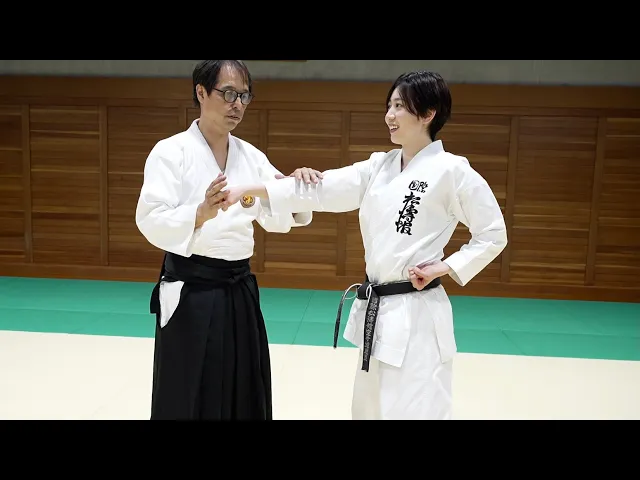
The karate girl's brain got tricked!【Daitoryu Aiki Jujutsu】
kuro-obi world
0:03 This is interesting!
0:04 Traditional karate champion Hiyori Kanazawa sensei is manipulated!
0:15 How does this happen?
0:18 The moment I was touched by him, I felt safe and didn't feel any danger.
0:25 Daito-ryu Aikijujutsu confuses the opponent's brain.
0:30 This is the final episode in the series.
0:32 Please take your time to watch it.
1:01 Please grab this short stick.
1:02 It's different from grabbing a hand, so I'll assume that this stick is a part of your body.
1:08 I'll operate it so that I don't move this part as much as possible.
1:13 If I move like this, you will resist by gripping tightly.
1:18 Then it will not work.
1:19 This way, I can lift it without you resisting.
1:23 I move my body in this direction.
1:33 This will cause you to resist.
1:36 So, make this stick vertical and drop it down.
1:41 This is also the result of weight shifting.
1:43 I am standing right now.
1:46 So leaning against this stick will have no effect.
1:49 When I shift my body weight, it works.
1:55 This is interesting.
1:56 I see.
1:58 This is the same with a long stick.
2:13 It's the same.
2:15 Yes, it's the same.
2:21 Ah, that's right.
2:30 I can't get up.
2:33 Even if the length of the stick changes, or even if you use your bare hands, do you always use your body in the same way?
2:42 Yes, that's right.
2:43 The longer it is, the more difficult it is to operate.
2:50 Because of this length, try to keep your wrist as still as possible.
3:00 It can be operated like this.
3:02 I'm using one hand now, but it's normally operated with two hands.
3:24 It's the same thing I did with my hand.
3:26 You must not place the stick too hard.
3:28 The first time the stick touches the surface is important.
3:32 It's gentle.
3:35 I put my weight on the point of contact between the stick and your body.
3:41 Whether you use your bare hands or a stick, you can train in the same way.
3:51 You can't understand this is true unless you experience it for yourself, right?
3:57 Yes, I hope my surprise is conveyed to the viewers.
4:00 Can you understand what Yamamoto sensei is saying when you actually experience it?
4:03 Yes, I can understand the meaning of what he says with my body.
4:13 When touching your opponent, try to be as gentle as possible.
4:18 Please take the karate "tsuki" posture.
4:23 This posture is strong.
4:26 If I tap you like this on the arm, your body will become more and more stiff.
4:30 So, I'll touch you like this first to make you lose your balance.
4:35 It's true.
4:38 A gentle touch. It's very soft, but...
4:41 If I grab you like this, you'll want to resist.-Yes.
4:45 You can spin around or attack with your other hand.
4:48 So I touch you like this.
4:53 When I block a strong punch like this, the next attack comes.
4:58 So I do it like this.
5:09 How interesting.
5:10 Don't make a mistake with the first touch.
5:12 If you block a punch like this, you will immediately be attacked again.
5:16 So...
5:25 Don't let your opponent know when you first touch them.
5:28 When I'm touched normally, I sense danger and try to fight back.
5:34 But the moment I was touched by Yamamoto sensei, I felt safe and didn't feel any danger.
5:41 I can understand the theory, but I think it would be very difficult to master it.
5:48 There is nothing to do but to keep practicing.
5:53 But if you keep practicing, anyone can do it.
5:55 I'm not a Budo professional, I'm just a regular office worker.
6:03 Taka, why don't you try it?
6:06 For example, this way of touching is not good.
6:11 But if I touch you like this, you will fall over like this.
6:19 When your punch actually comes, it's not good to block like this.
6:26 So I do it like this.
6:31 When you actually attack, you aim for this part, right?
6:37 So I'll just accept the trajectory of this punch as it is.
6:41 I won't push this outwards.
6:44 The image is of letting the attack pass through.
6:55 At this point, I catch it.
6:57 Basically, let the punch pass through.
6:59 It's on this center line, right?
7:02 Yes, letting the attack pass through.
7:07 You rotate your body so that the opponent's fist just barely brushes your body.
7:12 Your fist touches my body just a little.
7:15 We practice letting the attack pass through like this.
7:19 I know this theory, but it's very difficult to actually do.
7:23 Very difficult.
7:25 Especially when the opponent is attacking while moving.-Yes, that would be difficult.
7:30 It's impossible for me.
7:40 I wonder how Yamamoto sensei teaches such a difficult skill to beginners.
7:45 For beginners, we teach jujutsu first.
7:50 For example, we start with tekubi-gaeshi.
7:56 As you experienced just now, you can use jujutsu to take down your opponent's hand like this.
8:03 The opponent is not moving, but this is fine.
8:06 Because if the opponent loses their balance, you can strike from above.
8:10 So in practice, you don't have to go that far,
8:12 you can just make the opponent lose their balance.
8:15 This is the first step.
8:16 You can also turn your opponent's hand in the opposite direction.
8:22 As long as your opponent loses their balance, you can attack.
8:29 This is the first stage.
8:35 Next, it's time for the big move.
8:39 You can do this hula-hoop-like move, right?
8:44 You can do this too, right?
8:46 Combine this move with the hula-hoop move like this.
8:49 This is the first stage.
8:54 Next, you need to relax your whole body so that this movement is not visible from the outside.
9:02 Do you start with the big move?
9:04 Yes, from the big move to the small move.
9:07 It's the same in karate too.
9:13 We use our fingertips a lot.
9:16 Please hold my hand and push.
9:22 I can't move my fingers now so it's no good.
9:25 So I'll do this.
9:26 The opponent's movement will stop for this moment.
9:28 This is a necessary element.
9:30 Since her movement has stopped, I can do this.
9:33 This depends on how you use the fingers.
9:35 Please hold my hand tightly.
9:38 If I can move my fingers one by one, I can move her arm.
9:46 This is also possible through training.
9:54 If he grabs you from the side, you'll be knocked over if you don't do anything.
9:59 But if you move your fingers like this, he will stop moving.
10:03 At this point, you should draw a circle.
10:09 Next, to trigger a conditioned reflex...
10:12 If this hand approaches at 70km/h, I will go at 100km/h.
10:21 When his hand comes at this speed,
10:23 if I am slower, I will lose.
10:27 If I move a little faster...
10:30 The contact point?
10:31 Yes, the contact point shifts.
10:32 In addition to that, I use my fingers.
10:34 Using your fingers makes it more effective.
10:39 I see, I understand.
10:42 I understand, but I can't do it.
10:45 This is another element that creates a conditioned reflex.
10:49 I was momentarily unable to move.
10:52 There is also the opposite method.
10:53 When you try to grab my hand...
10:54 Did you understand what happened?
10:57 This is it.
10:58 You try to grab it, and I do this.
11:00 There is a moment when you stop.
11:03 It works then.
11:04 It's a feeling of my strength being absorbed.
11:10 We practice these skills.
11:15 How long have you been training aikijujutsu, Yamamoto sensei?
11:18 About 30 years.
11:21 You look young, but how old are you?
11:23 I'll be 49 this year.
11:25 It's amazing that you've mastered such skills at that age.
11:30 I wonder how high his level will be when he's around 80.
11:36 There are Budo masters who say that they look forward to growing old.
11:42 I once heard a 60-year-old Budo master say, “I'm looking forward to my skill level when I turn 70.”
11:53 I really respected that.
11:58 Yamamoto sensei, who is your mentor?
12:01 I studied under Seigo Okamoto sensei.
12:06 What age was Okamoto sensei when you first met him?
12:13 I think he was 72.
12:15 I see, he was already quite old.
12:18 Did he teach you directly, step by step?
12:20 His principle was that he would personally instruct every single person who came to the dojo.
12:29 That's why, when we teach, we take the hands of each person who comes to the dojo.
12:38 It's very tough, but we're learning a lot.
12:41 From beginners to long-term members.
12:45 When recruiting members for a Budo dojo, I think there are various sales pitches, such as “lose weight”, “self-defense”, or “compete in a tournament”.
13:05 What kind of sales pitch do you use when recruiting new members for aikijujutsu?
13:21 Our sales pitch is to release stress.
13:24 What? Stress relief?
13:28 In our dojo, instead of practicing in pairs facing each other, the students line up in a row in front of the teacher and are given direct instruction one by one.
13:39 As I showed you today, timing is important.
13:43 We want the students to have a simulated experience of the timing at which the techniques work.
13:50 This experience is really fun.
13:52 And many members look forward to going out for drinks after practice.
13:56 I love to go drinking too.
13:58 Our practice sessions seem to involve little physical activity, so it's also a selling point that anyone can easily get started.
14:05 In reality, it's quite a lot of exercise.
14:07 In reality, it's quite a lot of exercise.
14:12 There are Karate, Judo, and Aikido clubs at high schools and universities.
14:23 Are there Aikijujutsu clubs?
14:26 Hokkaido is the birthplace of Daito-ryu Aikijujutsu, so I've heard that there are university clubs.
14:39 However, I have never heard of any Daito-ryu Aikijujutsu club activities in the Tokyo area.
14:48 Aikijujutsu doesn't have competitions, right?
14:50 We don't have competitions.
14:54 How do you feel Aikijujutsu is positioned in the modern Budo industry?
15:07 Our Daito-ryu is not based on the assumption of actual fighting, but we practice physical manipulation in the dojo.
15:25 If you attack each other, it is difficult to apply techniques.
15:31 That's why we practice by dividing the roles between the attacker and the defender.
15:41 I think it is positioned as a Budo that studies physical manipulation.
15:48 You are talking to your own body.
15:51 You can move parts of your body that didn't move before.
15:56 You feel that kind of joy.
15:58 Normally, exercising makes you feel refreshed, right?
16:03 But when you come to our practice, you may still feel frustrated that you couldn't move.
16:08 Then you go out for a drink.
16:11 Do you drink a lot?
16:13 I have a lot of friends who go out for drinks.
16:17 Wow, I'm jealous.
16:19 After practice, we usually go out for drinks.
16:23 Do you apply techniques while drinking?
16:25 Yes, I do.
16:26 I knew it.
16:27 My teacher used to say,
16:29 “When drinking sake, aiki-age.
16:32 When pouring sake, aiki-sage.
16:34 If you repeat this, you'll get better.”
16:38 Those who listened to his teachings faithfully continued to drink sake.
16:45 Thank you very much for today, Yamamoto sensei.
16:48 Did you know about kuro-obi world before?
16:52 Yes, I used to watch it a lot.
16:54 So you knew about Taka san and Hiyori sensei?
17:00 Yes, thank you for today.
17:02 I knew it wouldn't be easy to perform a technique on you.
17:06 Not at all. I was easily manipulated.
17:10 I think there is something in Japanese Budo that has been passed down since ancient times.
17:17 If you are interested in the mind, technique and body, please come and train with us.
17:26 We want to know more about the depth of Aikijujutsu.
17:31 Let's definitely continue this series.
17:34 Please come back to KURO-OBI WORLD again.
17:38 Thank you for coming today.
17:41 Daito-ryu Aikijujutsu was amazing!
17:45 Thank you, Yamamoto sensei!
17:49 Please look forward to the next series!
17:56 Everyone is a Hero in "Kuro-obi World".
18:04 Of course you are also a Hero!
18:07 See you again in "Kuro-obi World"!