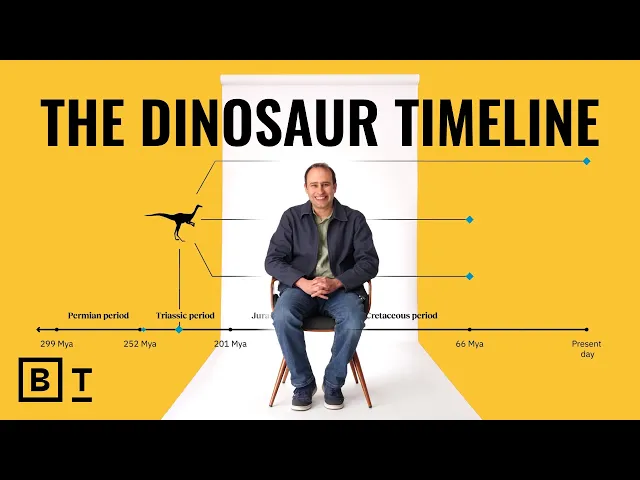
We know how the dinosaurs died. We don't know why they lived. | Steve Brusatte
Big Think
0:00 I'm Steve Brusatte, I'm a paleontologist.
0:02 I dig up dinosaurs, I teach at the University of Edinburgh.
0:05 I advise on films like the Jurassic World films,
0:08 and I write pop science books like The Rise and Fall,
0:14 The Dinosaurs, and The New One, called The Story of Birds.
0:22 The Rise and Fall of Dinosaurs
0:25 The story of dinosaurs actually begins in tragedy.
0:30 Dinosaurs emerged from the worst mass extinction in the history of life.
0:35 The closest life has ever come to completely dying out.
0:39 And this happened about 250 million years ago at the end
0:43 of what we call the Permian period of Earth history.
0:46 And this was the time where there was the supercontinent, Pangea.
0:50 All of the land was gathered together as this one enormous
0:54 land mass stretching from the North Pole to the South Pole.
0:57 And it was a land mass that was ruled by a lot
1:01 of early relatives and cousins and ancestors of us distant mammal ancestors.
1:07 But then, in what is now Siberia,
1:10 these enormous volcanoes started to erupt about 250 million years ago.
1:15 And these are not volcanoes like those that we know today.
1:18 It's hard to even envision what these were like.
1:21 These weren't the Hawaiian volcanoes or Mount Pinatubo blowing its top one day.
1:25 No, no, no, these were enormous fissures in the Earth.
1:29 It's like the Earth was slashed with a giant
1:33 machete and it bled lava for millions of years.
1:37 And as that lava came up through those cracks in the Earth,
1:42 it burnt its way through all the rocks.
1:45 And that released unholy amounts of carbon dioxide
1:49 and methane and other greenhouse gases that warmed the atmosphere,
1:53 led to runaway global warming and that caused an extinction,
1:57 and not just any extinction, but the granddaddy of all mass extinctions,
2:03 90 or 95% of all species died out.
2:07 But there were a few plucky survivors,
2:11 and among those survivors were some small little reptiles
2:15 that had long arms and legs that could move fast,
2:19 that were agile, that were smart,
2:21 and is in those reptiles that we find the roots of the dinosaur family tree.
2:28 Some of the fieldwork that I've done with friends and colleagues
2:32 of mine in Europe has identified some of the first
2:36 very tantalizing clues of those dinosaur ancestors living soon
2:40 after that terrible extinction at the end of the Permian.
2:44 And these are in many ways very meager clues because they are not nice,
2:48 beautiful, complete skeletons like you might see in a museum.
2:52 But they are tiny little footprints and handprints, just a few centimeters long.
2:57 And we find them in Poland and these little footprints,
3:02 they were made about 249, 250 million years ago.
3:05 They were made by these little reptiles that we call dinosauromorphs,
3:09 which were no bigger than a cat, than a pet cat that we might have.
3:15 I could hold one of these in my arms.
3:18 From those humble ancestors came the true dinosaurs.
3:20 And the first true dinosaurs,
3:23 we find their fossils about 230 million years ago in the Triassic period.
3:28 And really, they're just distinguished by a few changes in the pelvis
3:31 and the backbone that allowed them to walk more upright and move more quickly.
3:36 And these very first dinosaurs,
3:38 they split into the three major groups of dinosaurs.
3:41 And these were the theropods, those are the meat-eating dinosaurs,
3:44 the ones that would eventually become T-rexes and velociraptors and birds.
3:48 Then secondly, there's the sauropods and their close relatives,
3:51 those are the long-neck dinosaurs,
3:53 the brontosaurus and diplodocus and brachiosauruses.
3:56 And then the third group is the ornithischian dinosaurs.
3:59 And this is a whole variety of mostly plant-eating dinosaurs that had
4:04 beaks and that could chew their food really well like triceratops,
4:07 the ones with plates on their backs like stegosaurus, the duck-billed dinosaurs,
4:11 the armored dinosaurs, the ones with the dome heads that headbutt at each other.
4:15 Those are all ornithischian dinosaurs.
4:17 So as you can see, there's this great diversity of dinosaurs that was
4:21 starting to establish itself in the Triassic
4:24 period on the supercontinent of Pangaea.
4:26 But this was not an easy thing for these first dinosaurs to do because
4:31 they had a lot of competition from the animals that were living with them.
4:38 But they also were kept in check by the weather, by the climate.
4:43 When it comes to the physical environment,
4:45 Pangaea was not an easy place to live, not at all.
4:50 This enormous supercontinent was so big that much of the interior
4:55 was thousands of miles from the oceans, from the shoreline.
4:58 So there were vast deserts covering much of the supercontinent.
5:02 But the shorelines weren't really that much more
5:05 hospitable because the shorelines were battered by storms,
5:09 by what geologists call mega monsoons, which sounds very hyperbolic.
5:15 But it is what they were.
5:18 They were supersized monsoon systems.
5:20 So that's the sort of weather and climate and environment
5:23 that these early dinosaurs would have had to face.
5:26 But also, they were in this battle of survival,
5:30 in this battle of evolution with other groups that had
5:34 also survived that terrible extinction at the end of the Permian.
5:38 And some of those groups were amphibians.
5:40 The rivers and the lakes of Pangaea were ruled by salamanders,
5:44 the size of cars, with enormous heads with thousands of teeth.
5:50 There were crocodiles and their relatives living all across Pangaea,
5:53 and some of them were meat eaters, some of them were plant eaters,
5:57 some of them had beaks, like a turtle, some of them had sails on their backs,
6:01 some of them walk only on their hind lakes.
6:05 There was an enormous menagerie of fossil crocs.
6:08 And these were the competitors of the very first dinosaurs,
6:11 and there were more of these crocs.
6:13 And they lived in more places,
6:15 and they were more diverse in terms of their diets
6:17 and their habits and the way that they lived.
6:20 And so really the Triassic period,
6:22 for many tens of millions of years, yes, dinosaurs were there.
6:28 Yes, dinosaurs were diversifying, but they were really second-rate characters,
6:34 B-list actors in this Pangaea drama,
6:37 a drama that was headlined by the crocs and the giant salamanders.
6:43 And it would have seemed like those animals would have kept going,
6:47 kept evolving, kept thriving, kept dominating.
6:50 But something happened, something changed that story.
6:54 Back at the end of the Triassic period, once again, another mass extinction,
6:59 and this was caused by the breakup of the supercontinent.
7:03 And you can see the legacy of that South America and Africa
7:09 look like two puzzle pieces that fit together because they once were together,
7:14 and then Pangaea broke apart.
7:16 And the Earth bled lava, and it was a time of major volcanic
7:21 eruptions all across what is now the Atlantic seaboard.
7:24 And once again, as that lava came up, it burnt through the Earth,
7:28 it released a lot of carbon dioxide,
7:30 it led to global warming, it led to an extinction,
7:33 not quite as bad as that one at the end of the Permian,
7:37 about 50 million years earlier, but still one of the worst,
7:40 sudden moments of death in Earth history.
7:44 And that extinction decimated the crocodiles, almost all of them when extinct.
7:51 Only a few species survived.
7:53 The ancestors that led to the crocodiles of today,
7:56 same with those giant salamanders, most of those died out.
8:02 But the dinosaurs, the dinosaurs,
8:04 they just sailed right on through that extinction.
8:08 They were the great survivors of that extinction.
8:12 They were the success stories.
8:14 And because they passed through that extinction,
8:16 they had the opportunity to diversify in this largely
8:20 empty world in the next interval of time, the Jurassic period.
8:23 Now, I wish I could tell you exactly why dinosaurs survived.
8:30 But the truth is, I don't know the answer.
8:35 Nobody really knows the answer.
8:36 The answer must be out there.
8:38 There's lots of different ideas that have been proposed.
8:41 Maybe the dinosaurs could move faster, maybe they were more intelligent,
8:45 maybe they had feathers to insulate
8:48 their bodies against the whims of climate change.
8:52 Many other ideas, but it's really hard to know.
8:56 And so about 200 million years ago, the extinction happens,
9:00 the volcanoes erupt, global warming causes a lot of species to die.
9:05 Dinosaurs make it through.
9:06 Now, the Triassic period transitions into the Jurassic period.
9:10 And there's a reason why the book, the film, is Jurassic Park,
9:15 or the new ones that I work on are Jurassic World.
9:18 And that's because it's in the Jurassic
9:22 that dinosaurs truly become the stupendous,
9:27 spectacular, sublime creatures that we all know and love.
9:31 Giant meat eaters the size of buses,
9:33 long-neck dinosaurs that got as big as Boeing 737 airplanes,
9:37 the ones with horns and spikes and duck bills and dome heads
9:42 and armor and all of those fantastic things that make dinosaurs so engaging.
9:47 This is happening in the Jurassic period.
9:50 And dinosaurs are diversifying so much in the Jurassic period,
9:53 really for two reasons.
9:55 First of all, they survived that extinction
9:57 that killed off a lot of their competitors.
10:00 So the playing field was largely empty.
10:03 And dinosaurs had an opportunity.
10:06 They were pioneers.
10:07 They could go out and make their own destiny in this new evolutionary landscape.
10:13 But also, Pangea is now breaking apart.
10:16 What was once a single unified landmass
10:19 is now fracturing into many bits and pieces.
10:22 And the dinosaurs were along for the ride.
10:25 And as these different continents, butted off, broke off,
10:29 spun off of Pangea, the dinosaurs
10:32 adapted and changed as their environments changed.
10:35 And from that, by the end of the Jurassic period,
10:41 we had a whole stunning array of dinosaurs living all over the world.
10:47 Different species in different places,
10:49 including some of the most famous dinosaurs of all,
10:53 like Brontosaurus, Brachiosaurus, Stegosaurus, Allosaurus,
10:56 living in the American West.
10:58 And today, we find their fossils
11:00 in places like Colorado and Wyoming and Montana, Utah and the Dakotas.
11:05 These are some of the richest fossil
11:07 sites in the world and its Jurassic dinosaurs.
11:10 That we can find there.
11:12 About 103 million years ago, the Jurassic transitions into the Cretaceous.
11:18 And unlike many of the other transitions in Earth history,
11:23 between one period and another, this one is not marked by some great extinction
11:27 or some spasm of volcanism or the impact of an asteroid.
11:30 It really is just a line geologist used to divide a long time frame.
11:35 But you have dinosaurs continuing to adapt
11:38 and evolve as the continents move around.
11:41 Now, where we really start to see a change
11:44 is a little bit later in the Cretaceous, in the middle part of the Cretaceous.
11:49 But here things get a little bit frustrating again,
11:52 because the fossil record largely goes silent.
11:56 We know things are changing because we can see that in the early Cretaceous,
12:02 there are certain groups of dinosaurs that are dominant and diverse.
12:06 You have things like the Spinosaurus with the scales on their backs
12:08 and the long snouts that ate fish and swam around in the shallow water.
12:13 You had big Carcharodontosaurus predators.
12:14 Then later on in the Cretaceous, they're gone,
12:17 are mostly gone, and you have Tyrannosaurs and other major groups.
12:20 But best we can tell from the rocks that we have and the fossils that we have,
12:25 and especially the clues of the chemistry of the rocks,
12:28 which can tell us a lot about
12:31 temperature and precipitation and sea level in climate.
12:34 It seems like there was a period of climate change,
12:38 a period again of global warming, a period where sea levels were moving around.
12:43 And out of that came new types of dinosaurs.
12:46 And the dinosaurs that were able to survive,
12:50 that interval of climate change in the middle Cretaceous,
12:53 they were the ones that then had
12:55 the opportunity to take over in the late Cretaceous.
12:59 But still, again, this is largely a mystery.
13:02 By the latest Cretaceous, and I'm talking between about 80 million years ago
13:06 and about 66 million years ago, by that time,
13:09 the continents had moved around so much that Pangaea was a distant memory,
13:13 and a map of the world would have looked pretty similar to the world today.
13:18 There were small differences, sea level was much higher,
13:21 there were no ice caps at the poles.
13:23 India was an island in the middle
13:25 of the ocean racing northwards to collide with Asia,
13:28 but by and large, if you looked at that map, it would look similar to us.
13:32 And on those different land masses lived different dinosaurs.
13:35 The ones in North America were quite distinct
13:38 from the ones in South America and the ones in Africa.
13:41 And where we really see that is with the top predators,
13:46 the latest Cretaceous, this was the kingdom of T-Rex, but only in North America.
13:51 There were other close Tyrannosaur relatives
13:54 at the top of the food chain in Asia, but south of the equator in South America,
13:59 in Africa, it was totally different dinosaurs, called a allosaurus,
14:02 much more primitive dinosaurs that were the top predator.
14:06 In Europe, Europe wasn't really even a continent,
14:08 it was just a bunch of islands poking out of the sea.
14:11 There were not many big dinosaurs there at all.
14:14 There were a lot of smaller dinosaurs living on those islands,
14:17 and it was little raptor dinosaurs that were
14:19 the top dinosaur predators and other groups of animals,
14:22 like the Pterodactyls, which were not dinosaurs,
14:24 they were another group of reptiles that could fly, but they were not dinosaurs.
14:28 They were the biggest predators in many parts
14:31 of Europe and it's all because of the geography, because different continents,
14:36 different land masses had different climate, different weather patterns,
14:39 different environments, and that bred this richness of dinosaur diversity.
14:43 And it really does seem that in the latest Cretaceous,
14:46 this was the apex of dinosaur diversity,
14:49 the time when they were thriving most, when there were most species,
14:53 the largest number of species, different species living in different places,
14:57 a world in which dinosaurs were firmly in control,
15:01 even though it wouldn't last a whole lot longer.
15:06 If you woke up on the last day of the Cretaceous period 66 million years ago,
15:11 you would have woken up to a world thrown into turmoil.
15:15 This was an asteroid, and not just any asteroid,
15:20 the biggest asteroid that was sniffing around our part
15:23 of the solar system over the last 500 million years.
15:26 It was about six miles wide,
15:29 about 10 kilometers wide or so, so a pretty sizable rock,
15:33 and it smashed into what is now
15:36 the Yucatan Peninsula of Mexico in a split second.
15:39 And I mean that in a literal sense, in a split second,
15:43 it detonated with more energy than a billion nuclear bombs put together,
15:49 and it punched a hole in the face of the earth over a hundred miles wide,
15:54 a crater that we can still see in parts of Mexico today.
15:58 It's largely covered by the Gulf of Mexico,
16:00 the parts of it are visible on land around Cancun.
16:03 That asteroid it triggered earthquakes, it triggered tsunamis,
16:08 it triggered a volcano going into overdrive, hurricane force winds.
16:12 The atmosphere got so hot from all of that energy
16:16 that forests spontaneously combusted through wildfires all over the world.
16:22 And those were the things that just happened in the first
16:25 few minutes and hours and days after the asteroid hit.
16:28 The real killer, though,
16:30 was what happened over the next few weeks and months and years,
16:34 and that is that the soot from those fires, the dust and the dirt and the grime
16:40 from the collision of asteroid hitting earth,
16:42 all that stuff went up into the atmosphere.
16:45 And there's currents in the atmosphere just like in the ocean,
16:48 and that stuff spread all around the world,
16:51 and it cloaked the earth in darkness.
16:54 It was a nuclear winter, a global winter that lasted for maybe a few years,
17:02 maybe up to a decade or so.
17:05 The earth went dark and cold and silent.
17:09 Plants did not have sunlight to photosynthesize to make their own food,
17:13 so over a quite short period of time plants died, forests collapsed.
17:17 Plant eating animals had very little to eat.
17:20 They died.
17:21 Then the meat eaters, ecosystems collapsed like houses of cards.
17:25 And this led to a mass extinction.
17:28 This is the most recent mass extinction to today,
17:32 so it's the last one that happened.
17:34 And three out of every four species died.
17:38 So if you were living that morning before the asteroid hit,
17:44 your entire species had a 25% chance of baking it through.
17:49 Everything bigger than a husky dog that lived on land died out.
17:55 It was probably just too hard to get food, too hard to hide if you were big.
18:00 But even a lot of smaller animals died as well.
18:04 All of the dinosaurs, despite all of their previous successes,
18:09 all of their millions of years of dominance,
18:13 they died only one weird type of small,
18:17 feisty, plucky, quite sophisticated dinosaur made it through.
18:20 These were the dinosaurs with feathers and wings
18:23 that could flap those wings and fly.
18:25 These were the birds.
18:27 The only dinosaurs that have survived the present day.
18:30 And many other animals died as well.
18:32 The pterodactyls died.
18:33 All the reptiles living in the oceans died.
18:36 The ammonites, those beautiful, coiled shells.
18:38 They died in the ocean.
18:40 But, of course, some things survived.
18:43 And among the survivors, in addition to birds were some tiny, furry, smart,
18:47 feisty little creatures that could dig burrows and hide
18:52 away and survive by their intelligence and by their endurance.
18:56 And these were our mammal ancestors.
18:58 We had ancestors that stared down that asteroid.
19:02 And it's because they were able to endure
19:05 this worse moment of Earth history because of that.
19:11 That is why we are here today.
19:16 Chapter 2 T.
19:18 Rex, the king of dinosaurs.
19:21 With the fossil record, we can trace evolution over time.
19:26 That's one of the main reasons why paleontologists like me study fossils.
19:30 We want to understand evolution.
19:32 And what we see with dinosaurs is that we have a good enough fossil record.
19:35 We can trace a single lineage over 10s or even hundreds of millions of years.
19:40 And to give an example of that, I'll just turn to my favorite dinosaur,
19:44 the most famous dinosaur.
19:46 Some might say the most overrated dinosaur,
19:48 but I think it deserves all the accolades that it gets.
19:51 That, of course, is T.
19:53 Rex, the tyrant lizard king, the king of the dinosaurs.
19:56 And it was the top predator in North America at the very
20:00 last stage of the dinosaurs at the end of the Cretaceous.
20:03 But it wasn't always that way.
20:05 T.
20:05 Rex came from a long line of ancestors.
20:09 Ancestors that changed and adapted and endured and survived.
20:13 And believe it or not, the fossils show that the Tyrannosaur family goes
20:19 back more than 100 million years before T.
20:22 Rex.
20:22 T.
20:23 Rex was the crowning achievement of a long period of evolution.
20:27 And for most of that time, Tyrannosaurs were not very special.
20:31 They just simply weren't.
20:32 For most of that time, Tyrannosaurs were basically my size.
20:36 Now, the very first Tyrannosaurs we see are
20:39 from the middle part of the Jurassic period.
20:42 We have a few very scrappy, very tantalizing fossils,
20:46 a little bit of a foot, one tailbone,
20:48 a few teeth that my crew has found on the Isle of Sky in Scotland,
20:53 where we do a lot of our fieldwork.
20:55 But there are better fossils of that age from China.
20:58 And these very first Tyrannosaurus, like Guanlong from China,
21:03 these lived about 165 to 170 million years ago.
21:08 They were the size of humans, literally, literally the size of humans.
21:13 And in fact, some of them were even smaller.
21:16 Some of the other early Tyrannosaurs were just the size of lapdogs.
21:20 They were not top predators.
21:22 They were second or third-tier predators in the food chain,
21:27 living underfoot of giant allosaurs and spinosaurus
21:30 and other terrifying dinosaurs from other groups.
21:34 And they were very good, it seems, at that role, at being smaller predators.
21:38 Now, over the course of the Jurassic, Tyrannosaurs stayed pretty small.
21:42 They made it into the Cretaceous.
21:44 They got a little bit bigger.
21:45 Some of them got to be about the size of horses.
21:48 A few random species here and there kind
21:51 of supersize themselves in their own local environment.
21:53 But by and large, they remained small
21:56 predators until this middle Cretaceous turnover in dinosaurs.
22:00 This time of climate change that we don't know much about.
22:04 But we know that it wiped away many of the incumbent top predators,
22:09 the spinosaurus and the allosaurs and the carcardana.
22:12 So with those animals out of the picture,
22:15 now a job was open at the top of the food chain.
22:19 And in North America and in Asia, Tyrannosaurs filled that job.
22:23 And they did so by supersizing their bodies and becoming the size of buses.
22:30 T-Rex was the size of a city bus.
22:34 But what is incredible about T-Rex, to me, isn't just that it was so big,
22:40 it's that it was also a very smart animal.
22:43 And as is often the case with celebrities,
22:46 there are a lot of misconceptions about T-Rex.
22:50 And frankly, a lot of those do come from the first Jurassic Park film.
22:54 And not to rip on the film.
22:56 I love that film.
22:57 That film was one of the things that inspired me to become a paleontologist.
23:00 And of course, now I work with the franchise
23:03 consulting on the newer Jurassic World films.
23:05 And in fact, we've corrected some of these misconceptions
23:08 in the latest film in Jurassic World Rebirth.
23:10 But to run through some of these, in the first Jurassic Park,
23:15 we see the T-Rex chasing down the jeep that a lot of the characters are in.
23:20 And this jeep is probably probably in third gear.
23:22 You know, this thing is moving probably at least 30 miles an hour or so.
23:27 In reality, T-Rex probably could not move that fast.
23:29 We don't know for sure,
23:31 but paleontologists have built computer models and have done simulations.
23:33 And it just seems that an animal of that size,
23:37 of that bulk, of that stature simply could not move at that speed.
23:41 It could probably top out at about 10, maybe 15 miles an hour,
23:45 still quite fast, but not fast enough to run down a jeep at that speed.
23:51 But there are other things in the films that don't give T-Rex enough credit.
23:57 So yeah, the film makes T-Rex look faster than it was.
24:01 But the films also make T-Rex, frankly,
24:03 look a bit dumber than it would have been in real life,
24:07 especially when it comes to its intelligence and its senses.
24:11 We see in the film this storyline that if you stand still,
24:16 the T-Rex cannot sense you.
24:19 Now in reality, you would be bait because it had
24:22 a pretty big brain for a reptilian creature of its body size.
24:27 Its brain had big old factory balls
24:30 that controlled a very powerful sense of smell.
24:33 Big optic lobes that powered keen vision.
24:36 And ear with a really long cochlea.
24:40 And we know from modern animals the longer the cochlea,
24:43 the greater range of sounds you can hear.
24:45 So T-Rex was a smart animal.
24:47 And we can tell from the fossils that some of the ancestors of T-Rex,
24:52 while they were still small,
24:54 while they were still the size of humans and horses,
24:57 it was then that they were developing these larger brains and keener senses.
25:03 So it seems that being smart may
25:06 have helped Tyrannosaurs endure this middle-cretaceous extinction.
25:09 Now, how did hunt though?
25:12 That's a question that a lot of paleontologists have wrestled with.
25:16 And these are difficult questions to answer, frankly.
25:19 But there is some evidence that Tyrannosaurs were pack hunters.
25:23 And that is different than how they're
25:26 often depicted in films as these solitary murderers.
25:29 Now, the evidence that we have is that there's a few
25:33 species of Tyrannosaurs that have been found in bone beds.
25:36 And basically bone beds,
25:38 that's just the term that we use as paleontologists for a mass graveyard.
25:43 And these bone beds, they have only bones of the same species of Tyrannosaur,
25:48 of many different individuals from juveniles up to adults.
25:52 So if you preserve a whole bunch of individuals together in a mass grave,
25:57 that is a good sign they must have been living together.
26:00 And if they were living together, maybe they were hunting together.
26:04 The thing about T-Rex that always throws me, because it's an incredible animal,
26:11 the size of a boss, head the size of a bathtub,
26:15 50 banana-sized teeth in his mouth that could crush the bones of its prey,
26:19 the ultimate predator from Earth history.
26:20 But its arms were the size of my arms.
26:24 And my arms are not that big.
26:27 So how could such an incredible, sublime animal have such pathetic arms?
26:32 It is a riddle that goes back to the discovery of T-Rex in the early 1900s.
26:38 And we don't honestly know for sure why the arms were so small,
26:43 but we have a pretty good idea.
26:45 And that comes from a few things.
26:46 First of all, we can see that over the course of Tyrannosaur evolution,
26:50 Tyrannosaurs started small.
26:51 First Tyrannosaurs were the size of people, the size of dogs.
26:56 They had longer arms and smaller heads.
26:58 But over time, as their bodies got bigger,
27:01 the heads got bigger and bigger, the arms got shorter and shorter.
27:05 So it definitely seems like there was a trade-off.
27:08 And the head was taking on most of the jobs
27:11 that the arms once did in terms of grabbing and processing food.
27:16 So something like T-Rex really was like a giant land shark.
27:21 It would have led with its head, done most of the work with its head.
27:26 But the arms were still there.
27:28 And that's the interesting thing, because if a structure is totally useless,
27:33 evolution will usually just get rid of it or make
27:36 it so tiny that you can barely see it.
27:38 Like the hind legs of whales.
27:40 You know, whales evolved from mammals that lived on land.
27:42 They had hind legs.
27:43 They went into the water.
27:45 They lost those hind legs.
27:47 So the fact that T-Rex still has arms, that means something.
27:52 The other thing that means something is, yeah,
27:54 the arms are the size of my arms in terms of how long they were, which is weird.
27:59 You know, this is a bus-sized animal with arms, the size of my arms.
28:02 Very strange.
28:03 But those arms of T-Rex were very muscular.
28:07 Much, much, much more muscular than my arms.
28:10 And we can tell because muscles leave scars on the bones.
28:14 And those scars are huge on the T-Rex arm bones.
28:17 Now, the muscles that were really big on the T-Rex arms were
28:21 the ones that would have brought them closer to the body like this.
28:25 So that motion must have been something that they were doing,
28:29 quite regularly, that was important to them.
28:32 And we can speculate.
28:33 Maybe they were holding onto each other and they were mating.
28:37 Maybe when they were feeding with their mouths,
28:39 they were bracing themselves with their arms.
28:42 Or maybe if they were two T-Rexes that were fighting over a kill,
28:46 they could wrestle grapple with their arms a little bit.
28:49 There's a lot of different possibilities.
28:51 But the fact that the arms are there and the arms
28:54 are muscular means they must have been doing something.
28:58 They must have been part of the repertoire of T-Rex behavior.
29:02 When we look at the depiction of dinosaurs in a lot of films,
29:06 especially older films and older books, older television programs,
29:09 but even some that are put out today,
29:13 there was one glaring issue, one glaring piece of just total unreality.
29:20 And that is that many dinosaurs were not covered in scales.
29:26 They wouldn't have been green or brown like some big reptile.
29:30 In fact, many dinosaurs had feathers.
29:32 Many dinosaurs had feathers all over their bodies.
29:35 Even some dinosaurs had wings on their arms.
29:38 Velociraptors had wings on their arms.
29:41 We know this because we know it directly from fossils, from real fossils.
29:47 Now these fossils were first found in the mid-90s.
29:51 One is a little dog-sized Tyrannosaur called D-Long, a primitive one.
29:56 The other one is called Eutyranus.
30:00 It's about 30 feet or about 8 or 9 meters long.
30:04 It weighed over a ton.
30:05 And that means that T-Rex itself probably had some kind of feather.
30:09 We don't know for sure.
30:11 T-Rex is from North America.
30:12 It has never been found fossilized
30:14 in those conditions that allow feathers to be preserved.
30:17 So we don't know for sure.
30:19 But we know it's ancestors must have had feathers.
30:22 Now I know that that is a controversial thing.
30:25 Kind of a weird thing.
30:26 I think for some people, I get this.
30:29 I get messages.
30:30 People send me emails decrying this.
30:33 Oh, you've taken away this idea of T-Rex I had from childhood
30:37 as this giant primeval reptilian monster and it's no longer scary.
30:42 And you've made it this fluffy feathery thing.
30:44 None, none, none, none.
30:46 First of all, we got to deal with the fossils we have.
30:49 So if it had feathers, it had feathers.
30:51 Your feelings don't matter.
30:52 Sorry.
30:53 But I think a big old feathery T-Rex is even more terrifying,
30:58 even more frightening than a T-Rex without feathers.
31:01 But at the end of the day, we got to deal with the fossils that we have.
31:06 And it's undeniable that at least some
31:09 Tyrannosaurs had feathers all over their bodies.
31:13 More dinosaurs now are being found than ever before.
31:16 And believe it or not,
31:17 there's a new species being found about once a week on average.
31:21 So about 50 new species every year.
31:24 Now you add them all up and we know of maybe about 2,000 species of dinosaurs,
31:29 which sounds like a lot.
31:31 It is a lot, but dinosaurs live for well over 150 million years.
31:36 They actually still live on today in the guise of birds.
31:40 And there are over 10,000 species of birds just alive today.
31:44 So really, there were probably millions of species of dinosaurs that once lived.
31:49 We've only found a tiny fraction of those dinosaurs.
31:52 It means there are a whole lot more dinosaurs out there to be found.
32:02 Chapter 3- The Rise and Rain of Mammals I
32:09 mostly studied dinosaurs during my career as a paleontologist.
32:13 It certainly was dinosaurs like T-Rex that got
32:16 me enthused about science as a teenager.
32:18 But the more I've studied dinosaurs, the more I've also expanded out to study
32:23 other groups and I've become particularly enamored with mammals.
32:26 And really, there's probably two reasons for this.
32:28 First of all, you know, I am a mammal.
32:31 We are mammals.
32:32 So if we want to understand our own history,
32:36 our own origin story, we need to understand mammal evolution.
32:39 But also, really the dinosaur story and the mammal story, it's the same story.
32:44 That asteroid comes down out of nowhere, ends the age of dinosaurs,
32:48 but some mammals make it through and forge a new world.
32:51 And so the more I studied that extinction, the more I,
32:54 of course, became interested in, well, how did the Earth recover?
32:58 What happened after that extinction?
33:00 And the story there is that the age
33:02 of dinosaurs gives way to the age of mammals,
33:05 and that's what we've been in for the last 66 million years.
33:09 We are mammals, and we know we are mammals,
33:13 not just from our DNA, that proves it,
33:15 but more broadly because there are many features of our own bodies,
33:19 our own behaviors that are classic mammal hallmarks.
33:22 So we have hair.
33:23 Some of us have more hair than others, but we have hair.
33:27 That's a mammal thing.
33:28 We have molar teeth and premolar teeth and incisors and canines,
33:31 the different teeth in our mouths that are
33:33 used for grasping and shearing and crushing, classic mammal features.
33:37 We feed our babies milk, a classic thing that mammals do.
33:43 And then even more broadly,
33:44 things that maybe we don't necessarily appreciate because there may be more
33:48 nuanced things that only an anatomist or a paleontologist might think about,
33:52 but we, of course, have big brains.
33:54 We have keen senses of smell.
33:56 Those are classic mammal things.
33:57 We have very, very, very good sense of hearing.
34:00 That's a mammal thing.
34:01 We have a single lower jawbone.
34:03 That's a mammal thing that bears teeth,
34:05 but one set of baby teeth, one set of adult teeth.
34:09 That's a mammal thing.
34:10 We have big, strong jaw muscles.
34:12 We actually have a hole behind our eyes.
34:15 It kind of merges their eyes,
34:17 but you can feel the border when you feel your cheeks here.
34:20 And that hole anchors jaw muscles.
34:22 That's a mammal thing.
34:23 And there are so many other features that make
34:26 mammals mammals that we have that other mammals have.
34:29 In the world today, there are three major types of mammals.
34:33 We are placental mammals.
34:34 And about 95% of all mammals are placental mammals like us.
34:39 Placentals are the ones that can give live birth to well-developed
34:43 babies that can develop for a long time in their mother's boobs.
34:47 So dogs and cats and bats and wells and elephants,
34:50 all placental mammals like us.
34:52 But there are two other groups.
34:54 One of those groups is the monotremes.
34:56 These are mammals that still lay eggs.
34:59 They are very primitive mammals.
35:01 And these are the platypus and the echidna species of mostly Australia.
35:05 So in looking at them,
35:07 it's not that the ancestors of mammals would have looked exactly like them.
35:11 They're specialized in their own way, but in looking at them,
35:14 we get a glimpse of this time when mammals still lay eggs.
35:18 The third group are the marsupials.
35:20 And these are ones that are very common in South America and in Australia.
35:25 There is one that's common in North America,
35:27 the possum that's made its way back up quite recently.
35:30 But these are the mammals that give birth
35:33 to tiny little babies that are born very premature,
35:36 that then develop more further in their mother's pouch.
35:39 So these are the three major types of mammals.
35:42 Placental mammals are the dominant ones today.
35:44 But we see the roots of these three major groups back in the Cretaceous period.
35:49 Now what we see in the fossil record is
35:51 that those features didn't just evolve in one burst.
35:55 They evolved one by one over time in many ancestors.
35:59 Things like hair, for instance,
36:01 goes way back even before true mammals to some of our antecedents living
36:06 in the Permian period and in the early part of the Triassic period.
36:10 But what we see a lot of change is right around the origin of true mammals.
36:16 The very first true mammals were around late
36:20 in the Triassic period and then early in the Jurassic period.
36:24 And we see the first fossils of true dinosaurs about 230 million years ago,
36:29 the first fossils of true mammals are
36:31 their closest relatives around the same time.
36:34 But if we look from the Triassic onwards,
36:36 from that moment that the first mammals and dinosaurs entered the scene,
36:40 dinosaurs and mammals would be living together for a long time.
36:44 But they had different fates.
36:46 Dinosaurs were destined for greatness, for grandeur.
36:48 Some dinosaurs became massive the biggest animals ever to live on land.
36:53 Whereas mammals, they went the opposite direction.
36:56 They went small and they stayed small for a long time.
37:00 No mammal that we know of was bigger than a house cat.
37:04 And as they got smaller, their brains got bigger, their jaws simplified,
37:09 their teeth changed from the teeth of their ancestors where
37:13 you would have just new teeth growing all the time,
37:16 kind of like in a shark today.
37:17 And this changed.
37:18 They were drinking milk.
37:20 They had one set of baby teeth, one set of adult teeth.
37:23 Some of the bones that used to be in their lower
37:26 jaw shriveled up and actually moved into the ear to amplify hearing.
37:29 This is a classic mammal thing.
37:32 And all these things were happening as mammals were getting smaller and smaller.
37:37 It seems like miniaturizing their bodies drove a lot
37:42 of these adaptations in the very first mammals.
37:45 And there is this this stereotype, this misconception that the mammals living
37:49 with the dinosaurs were all just these small,
37:52 boring, general little afterthoughts of Earth history.
37:56 No, that's not the case at all.
37:59 And with fossils, we see this.
38:01 Now for a long time,
38:02 there were not a lot of good fossils of the mammals of the Triassic,
38:05 Jurassic, and Cretaceous living with dinosaurs.
38:08 These were small animals.
38:09 It's true.
38:10 And because they were small, it was hard to turn them into fossils.
38:14 So for a long time, it was only a few little jaw bones,
38:17 a bunch of isolated teeth.
38:18 And that's all that we really knew.
38:20 We had to reconstruct a whole story based on meager fossils,
38:24 but more recently, especially in northeastern China,
38:27 in the same ecosystems buried by volcanoes
38:30 where you get feather-covered dinosaurs preserved, you also get a lot of fossils
38:36 of the delicate skeletons of little mammals covered in hair.
38:39 And these fossils tell us quite bluntly that yes, mammals were small.
38:45 The mammals living with dinosaurs were small.
38:47 There's no way around it.
38:48 There were no woolly mammoths, their saber-toothed tigers,
38:51 or whales, or anything like that back then.
38:55 That's true.
38:55 But just because mammals were small, it doesn't mean they were boring.
38:59 It doesn't mean they were all generalized.
39:01 It doesn't mean they were unimportant, quite the opposite.
39:04 There was a great diversity of small mammals.
39:07 There were mammals that could burrow, mammals that could climb and clamber,
39:11 mammals that could run pretty fast, mammals that could swim,
39:16 mammals that had wings of skin that they used to glide between the tree tops,
39:22 all living with dinosaurs.
39:24 So really, mammals were the kings and queens of the underworld.
39:28 They were the small ones living in the understory, coming out at night,
39:32 living underground in a world that dinosaurs,
39:35 at least on the surface, seemed to dominate.
39:38 And what's really intriguing to me is
39:41 that mammals and dinosaurs reached an equilibrium.
39:44 They kept each other in check for 150 million years or so.
39:50 Yes, dinosaurs kept the mammals small.
39:53 Being small, the size of mice, the size of rats,
39:56 that is what mammals needed to be able to survive in a dinosaur dominated world.
40:00 But conversely, the mammals kept the dinosaurs big.
40:04 And what I mean by that is we never find
40:08 a fossil of a T-rex the size of a mouse, a triceratops the size of a shrewd.
40:15 Mammals were the ones that were being very good at being small.
40:19 Now, during the Cretaceous period,
40:21 there was this burst of evolution, not just of mammals,
40:24 but of lots of other species,
40:26 that we call the Cretaceous terrestrial revolution.
40:28 It's a bit of a bombastic term, maybe.
40:32 But in many ways, it was revolutionary because it touched so
40:36 many aspects of life and of food webs and of ecosystems.
40:41 And what really triggered it, it seems, was the rise of flowers.
40:47 So in the world today, flowers are all around us.
40:52 So much of the food we eat comes from plants that have flowers,
40:56 even things like wheat and corn.
40:58 Those are grasses.
40:59 Grasses are a type of flowering plant.
41:02 The plants in our gardens, the plants in our parks,
41:05 most of them have fruits and flowers, and they have beautiful fragrance smells.
41:09 A huge percentage of the plants today are flowering plants.
41:13 But flowering plants are a very new innovation in the history of life.
41:18 The oldest fossils of plants with flowers are from the Cretaceous.
41:22 So for the first, you know,
41:24 four billion plus years of Earth history, no plants with flowers.
41:28 Now, when flowering plants entered the scene, they diversified, they adapted.
41:32 Some of them became big, became trees.
41:35 We have palm and magnolia trees in the Cretaceous period.
41:40 As they did so, as they diversified,
41:43 that triggered the diversification of insects,
41:45 the insects that pollinated those flowers, insects that would eat those plants.
41:50 And that, in turn, promoted the diversification of other animals
41:53 to animals that would eat the insects and then also,
41:56 of course, animals that would eat the leaves and the flowers
41:59 and the fruits and the roots of these flowering plants.
42:02 So that humble, what seems like a very humble origin of a flower,
42:08 it triggered something groundbreaking and something revolutionary.
42:12 And mammals in particular really
42:15 blossom during the Cretaceous-Terrestrial revolution.
42:17 And a lot of the modern groups of mammals,
42:21 it's not that they quite got their start then, but their immediate ancestors got
42:25 their start during the Cretaceous-Terrestrial revolution.
42:28 And one of the key things is that there
42:31 were all these mammals that were eating bugs, eating fruits and eating flowers.
42:36 And that is involved in the evolution of a new type of tooth,
42:39 a new type of molar tooth,
42:41 the type of molar teeth that we have that can both shear food and crush food.
42:47 These are very distinctive teeth, very intricate teeth.
42:51 You look at a tooth of a shark or a crocodile or a T-Rex,
42:55 yeah, they might be plenty scary looking,
42:57 but they're pretty simple, steak knives.
42:59 But our teeth, no, all the ridges, the valleys, the depressions,
43:03 the way they interlock with each other, that's the classic mammal molar,
43:07 and that evolved during this time of the Cretaceous-Terrestrial
43:11 revolution as all these new food sources,
43:15 insects and flowers and fruits and so on were there to be enjoyed.
43:21 Mammals had to survive and endure and persist
43:24 for a long time in a dinosaur-dominated world.
43:27 I mean, a single footstep of a brontosaurus
43:31 could probably obliterate a whole colony of mammals.
43:34 So mammals had to learn how to live incognito,
43:38 but it also set them up to take advantage
43:42 of one of the luckiest breaks in Earth history,
43:45 at least from their standpoint, and that is when the asteroid hit,
43:49 not a lucky break for the dinosaurs,
43:51 but all of a sudden the world is thrown into turmoil.
43:55 And these dinosaurs that for so long were accustomed
43:58 to being at the top of the food chain, to being the dominant animals.
44:02 Now, they were on their back feet.
44:04 They were at risk.
44:05 They were vulnerable.
44:06 They were so big.
44:07 They needed to eat so much food.
44:08 They couldn't hide very well, and they succumbed when the asteroid hit.
44:14 But mammals had fine-tuned their survival abilities.
44:18 They had honed their adaptations over 150
44:21 million years of living underfoot of the dinosaurs,
44:24 and that adaptability, that resiliency,
44:28 that really allowed them to stare down that asteroid.
44:34 During the first 10 million years or so
44:37 of evolution after the asteroid, there were mammals.
44:40 There were lots of new mammals.
44:42 These mammals were getting bigger.
44:44 It was mostly placental mammals, the ones that could give birth to bigger babies
44:48 that were part of this evolutionary spasm that was happening.
44:51 And that's probably not a coincidence.
44:53 Being able to give birth to larger,
44:55 more developed babies could help them achieve larger sizes overall.
44:59 But there's a really interesting story that we've pieced together recently.
45:03 This is research that's come out of my lab at the University of Edinburgh.
45:06 It's been largely led by Ornela Bertrand,
45:09 who is a postdoc scholar with me and is now a young professor in Spain.
45:14 And this is a story that really strikes at the heart
45:17 of what we think of when we think of mammals.
45:20 It knocks us down a peg a little bit.
45:23 And so I'll explain, because I didn't expect this to be the story,
45:26 but it turns out to be true.
45:28 Very early mammals living with dinosaurs did evolve pretty
45:31 sizable brains for the small little animals that they were.
45:35 And that might have allowed them,
45:37 our mammal ancestors, to survive, at least in part.
45:40 It may have been part of the story for why they could survive the asteroid.
45:44 They were pretty smart.
45:45 But that is when evolution goes off on a weird path.
45:49 Because you might think that, okay,
45:51 modern mammals are really smart and mammals survive the asteroid and mammals
45:56 diversified so much right after the asteroid to replace the dinosaurs.
46:00 So maybe it was being smart and evolving bigger brains
46:04 that helped mammals take over the world when the dinosaurs died.
46:09 But that turns out not to be the case because
46:13 we have CAT scanned all of these skulls of fossil mammals.
46:17 We have built digital models of their brains.
46:19 We can measure the size and the shape of their brains.
46:22 We can plot it out on the family tree of mammals.
46:25 And the picture is quite clear that during
46:28 the first 10 million years or so after the asteroid,
46:32 the mammal brains actually got smaller relative to their bodies.
46:37 So to put it very glibly,
46:40 mammals were actually getting a bit dumber during the time after the asteroid.
46:45 Now I know intelligence is a lot more than just brain to body size.
46:49 But to be very glib about it,
46:51 mammals were decreasing the size of their brain relative to their body.
46:55 So what was going on?
46:56 Well, it seems like what's really underwriting all of that is
47:00 that the bodies of these mammals were getting so huge.
47:04 So the asteroid wipes away T-rex and triceratops.
47:08 The classic dinosaurs are gone.
47:10 Some mammals have survived.
47:12 These mammals have never gotten bigger than cat size for 150 million years.
47:18 Now their dinosaur overlords are gone.
47:20 Those jobs at the top of the food chain,
47:23 the top meat eaters, the top plant eaters, they're suddenly available.
47:26 So what do mammals do?
47:27 They get big and they get big fast.
47:30 And in New Mexico, where I've done a lot of field work where we
47:33 have some of the best fossils of early mammals living right after the asteroid,
47:37 we see that within 200,000 years of the asteroid,
47:40 there are now mammals the size of pigs.
47:43 Remember, they never got bigger than cats for 150 million years.
47:46 Now they're the size of pigs.
47:48 Within a million years, mammals the size of cows.
47:51 So mammals are ballooning their bodies
47:53 in size and their brains are lagging behind.
47:57 So the real evolutionary force is mammals are really going into overdrive,
48:02 evolutionary overdrive to get bigger, fill the dinosaur niches.
48:05 And it was not intelligence that was driving things then.
48:09 But intelligence did catch up and by about 10 million years after the asteroid,
48:13 that's when we start to see mammal
48:16 brains now getting bigger and bigger and bigger.
48:18 And it's from that burst of brain size
48:21 evolution that the super huge brains of modern mammals,
48:24 especially of us, is from that burst of evolution that these brains emerged.
48:28 But during this first 10 million years of the age of mammals,
48:33 it wasn't the modern types of mammals that we all
48:36 know that were the ones that were really in charge.
48:39 It was their ancestors.
48:41 It was this whole host of archaic placental mammals,
48:44 things like Pantodonts and Taeniodonts and Tillodonts and Condylarths.
48:49 These mammals names mean nothing unless
48:52 you're a paleontologist that were thriving.
48:54 They eventually would go extinct, but in doing so,
48:57 they would spin out the ancestors of the modern groups that we all know,
49:01 including our own group, the primates.
49:03 It was about 10 million years after the extinction.
49:07 So we're talking about 55, 56 million years ago as the Paleocene
49:12 interval turned into the Eocene interval of time.
49:15 That's when the modern mammals really start to make their presence known.
49:20 And this happens at a time when the Earth is undergoing this moment of harsh,
49:30 sudden climate change, global warming,
49:34 the most recent big global warming spike in Earth history before today.
49:39 And it was caused by volcanoes.
49:41 That's what often caused global warming during the long span of Earth history.
49:45 In fact, as the volcanoes that still erupt in Iceland today,
49:49 that started to erupt back then, there are much more powerful back then.
49:53 There was a lot more lava back then, and all that lava burning through the Earth
49:57 as the North Atlantic Ocean opens up,
49:59 lava that actually scoured a whole lot of Scotland, even the field sites.
50:04 I have sites on the Isle of Sky where they're Jurassic age dinosaurs,
50:07 and we have the lava flows right over those dinosaur bones.
50:12 That is causing global warming.
50:14 And paradoxically, it didn't cause a big mass extinction this time.
50:18 That actually gives me some hope for the modern world that just
50:23 because temperatures rise doesn't necessarily mean
50:25 you're going to have a huge extinction.
50:28 It doesn't mean it's good, because as we see from the Paleocene transition,
50:32 maybe there wasn't an extinction,
50:34 but there was a period of upheaval, a period of change.
50:37 And what happened was it seems like it triggered this mass migration of mammals.
50:43 Now, a whole lot of the world could be traversed.
50:46 The high latitudes, they were free of ice.
50:49 It was easy to move around.
50:51 So mammals were on the move, and that unsettled things.
50:54 And from there, this new reality emerged where modern primates,
50:59 rodents, hoofed mammals, they become dominant at that time.
51:05 And a lot of these more archaic mammals,
51:09 these ancestors, they sputter away to extinction.
51:12 And since that time, it has been those mammals,
51:17 primates, rodents, hoofed mammals like cattle or horses or rhinos.
51:22 And then later on, bats and whales and so
51:25 on, it's those mammals that are the preeminent ones today.
51:29 And it's largely because of that spasm of climate
51:33 change that helped them take over the world.
51:36 Mammals move.
51:37 Many animals move.
51:38 That's really the story of Earth history, but we really see it with mammals.
51:43 But there's a difficulty there, at least compared to dinosaurs.
51:47 When dinosaurs got their start,
51:49 and during the first many tens of millions of years of the history of dinosaurs,
51:53 all the land was gathered together.
51:55 It was Pangaea that could move quite easily.
51:57 But for more modern-style mammals, it's harder to move around.
52:00 We have all these separated continents.
52:03 And that's been true for many tens of millions of years.
52:07 But some mammals have found a way against
52:10 the octs to move vast distances across those continents.
52:15 And they've done so in some cases by flying.
52:18 Bats enter the fossil record,
52:20 about 55 or 56 million years ago, as temperatures increased.
52:24 And they evolved wings and they could fly.
52:27 And that really was a ticket to global success.
52:29 They could move all around.
52:31 But for mammals that couldn't fly or couldn't swim long distances,
52:35 there was another way that every once in a while,
52:39 by sheer chance, they could move around quite long distances.
52:43 And that is by what we call these Hail Mary dispersals.
52:48 So if you're an American football fan, you know,
52:51 sometimes your team is down, and you have one last chance,
52:54 and you just throw the ball down the field
52:57 and hope that your receiver catches the ball, scores a touchdown.
53:00 The odds of success are very low because the pass is so long,
53:04 but every once in a while, that pass connects.
53:07 And your team wins the game.
53:10 We see this with migrations.
53:12 There are mammals in South America today, both primates and rodents.
53:17 So the classic monkeys, the howler monkeys of South America,
53:21 and some of the classic rodents of South America guinea pigs, capybara.
53:25 They've been there for a long time.
53:26 How did they get there?
53:28 Nobody really knew South America was an island
53:30 continent for many tens of millions of years.
53:32 How did these mammals make their way?
53:34 They couldn't fly, they couldn't swim, they couldn't jump between land bridges.
53:38 How in the world could they get there?
53:40 Well, the answer started to become really
53:43 clear with the genetics of those mammals.
53:45 It is clear from doing the DNA paternity test
53:50 that they are closely related to African rodents and primates.
53:55 Okay, so how do African rodents and primates get to South America?
53:58 Well, it seems like the only way is through one
54:01 of these Hail Mary dispersals where there are some of these mammals,
54:05 maybe after a storm, maybe they're on a raft of vegetation,
54:09 sometimes big chunks of the coast,
54:11 trees and grass and all kinds of stuff can be ripped apart,
54:15 thrust out into the ocean, and can actually travel the currents for many
54:19 weeks and then land somewhere in a distant land.
54:23 And that seems to be how the rodents and the primates got to South America.
54:29 And it seems inconceivable how in the world
54:32 could they survive a voyage like that.
54:34 But we have to remember that evolution has lots of time to work with.
54:38 And if you're talking about many, many, many millions of years,
54:41 most of the time there was some storm,
54:43 some little bit of the coastline and you ripped out,
54:45 it would go out in the water, nothing would come of it.
54:48 But maybe every once in a while there would be
54:50 a Hail Mary play and that raft of vegetation carrying
54:54 these monkeys and these rodents would reach thousands of miles
54:58 away and they would have a new shoreline to colonize.
55:01 And that is what happened and I think it
55:04 is one of the most incredible stories of evolution.
55:07 We wouldn't know about it if we didn't have
55:11 the genetics and the fossils together to tell us that story.
55:15 After the asteroid hit, the Cretaceous turned into the Paleocene,
55:18 the age of dinosaurs, gateway to the age of mammals.
55:21 But really, this greenhouse world of the dinosaurs persisted.
55:25 The Earth was still very warm.
55:27 There were no ice caps at the poles, for instance.
55:31 Then the Earth got even warmer as the Paleocene
55:33 turned into the Eocene with this spurt of global warming.
55:37 It got so hot that there were crocodiles lounging
55:40 in the shade of palm trees above the Arctic Circle.
55:44 And the Earth stayed hot for a while,
55:48 but then it started to gradually get a little bit cooler.
55:52 The tide shifted there.
55:54 And about 35 million years ago or so, it really started to get cooler.
55:58 And what happened was there were different changes in the orbit
56:01 of the Earth and the amount of carbon dioxide in the atmosphere,
56:05 small things, that over time can add
56:07 up and create quite profound climate change.
56:09 But what really, really, really drove this, what turned a small cooling trend
56:15 into a big trend of decreasing temperatures was that Antarctica became isolated.
56:22 Antarctica was connected to South America ever
56:26 so tenuously by a little tendril of land.
56:28 And that was snipped just tectonically, just the way the Earth's plates move.
56:32 Well, now suddenly you could have cold water
56:36 currents encircling Antarctica at the bottom of the world.
56:39 And this acted as a global air conditioner, an ice nucleated onto Antarctica.
56:44 The glaciers grew into ice sheets.
56:46 And that helped drive the temperature of the entire world to be much cooler.
56:51 Now, this was a long-term trend then that continued
56:54 to happen for many tens of millions of years.
56:57 About two and a half million years ago, another interval of change happened.
57:03 There was a switch that was flipped again.
57:05 And this had to do with how changes in the orbit of the Earth,
57:10 the shape of the orbit of the Earth around the sun,
57:13 how circular it is, compared to how oval there's small changes,
57:15 the tilt of the Earth's axis, these things that may seem subtle,
57:19 these things actually just by chance converge together to make
57:24 the Earth receive less light and energy from the sun added
57:29 on to this global air conditioner of the ocean currents
57:33 changing that now plunge the Earth into a proper ice age.
57:38 And this is the ice age,
57:39 the one that we all think of when we hear the word when we see the movies,
57:45 this is the time of Will Smith and Saber-toothed tigers.
57:48 It only started about two and a half million years ago.
57:51 And in fact, we're still in that ice age.
57:53 It's just we are heating the Earth so quickly through global
57:56 warming that we're basically burning ourselves out of the ice age.
58:00 But over the last two and a half million years, the Earth has been cold.
58:03 Now, it's not that the entire Earth has been covered in glaciers.
58:07 No, what's happened is those polar ice sheets have grown to such
58:11 size that at certain times they have crept down onto the continents.
58:15 This is especially true of the North Pole ice sheet.
58:20 It's grown, it's contracted, expanded, contracted in many pulses,
58:24 it's like a roller coaster just as small
58:27 changes in the orbit of the Earth occur.
58:30 About 50,000 years or so was one
58:32 of the peaks of the expansion of that ice sheet.
58:34 And that ice sheet grew so big that it
58:36 crept down and it covered Chicago, where I'm from.
58:40 It covered Edinburgh and Scotland where I live now.
58:43 It covered New York City.
58:44 A lot of North America, a lot of Asia,
58:46 a lot of Europe was completely engulfed in ice.
58:48 There would have been a mile thickness of ice
58:52 covering New York City and Chicago 50,000 some years ago.
58:56 Now, living on the fringes of the ice sheets were the woolly mammoths,
59:01 the Saber-toothed tigers.
59:02 There were woolly rhinoceroses.
59:04 There were armadillos the size of Volkswagen's.
59:07 There were swaths that lived on the ground that stood 10 feet high.
59:12 They could dunk a basketball.
59:13 There were giant deer with antlers bigger than a dinner tape.
59:18 There were American lions and hyenas.
59:21 Incredible time of mammal diversity.
59:24 These mammals had to live and adapt to this cold
59:28 world and many of them did so by getting big, being big pays when it's cold,
59:33 and by evolving these really shaggy coats of hair.
59:37 Generally speaking, when it comes to the mammals that lived on land,
59:41 some have gotten pretty big.
59:42 There are big elephants that lived today.
59:44 There were even bigger elephants that lived in Earth history.
59:47 There were huge rhinos without horns that lived many tens of millions of years
59:51 ago that got up to be maybe around 15 to 20 tons, pretty big.
59:56 But nowhere near the size of the largest dinosaurs.
1:00:00 Some of the long-necked dinosaurs, like Argentinosaurus and Patagotitan,
1:00:04 these things were heavier than Boeing 737 airplanes.
1:00:09 They weighed 50, 60 tons or even more.
1:00:13 Absolutely gargantuan.
1:00:14 They pushed the boundaries of what's possible in biology.
1:00:18 It's incredible.
1:00:19 They would have hatched from eggs.
1:00:20 Eggs that you could hold in your hand,
1:00:23 and they would have had to grow and endure
1:00:25 all of the tribulations of life to reach that size.
1:00:28 No mammals have been able to do that, to that degree.
1:00:32 It is a little bit of a mystery,
1:00:35 but I think it's probably several things put together that may explain it.
1:00:40 But one of the key reasons that I think that dinosaurs were able to get
1:00:44 so much bigger than land mammals is
1:00:46 that they breathed in a totally different way.
1:00:49 Mammals like us, we know how we breathe.
1:00:51 Our lungs are basically bags.
1:00:53 They inflate, they deflate.
1:00:55 We breathe in, we breathe out.
1:00:57 But birds today have a very different type of lung.
1:01:01 The lung of a bird is not like a bag that inflates and deflates.
1:01:04 No, it's more like a set of pipes or a set of straws.
1:01:09 An air can only go through in one direction.
1:01:12 And the whole way that birds make it work is that they attach these air sacs,
1:01:17 these balloons that can store air, they attach them to those lungs.
1:01:21 That controls this unidirectional airflow.
1:01:24 What that also means is that birds can get
1:01:27 oxygen when they breathe in and when they breathe out.
1:01:30 Just because some of that oxygen-rich air is shunted off to those air sacs,
1:01:35 and then when they deflate,
1:01:37 that air moves across the lung, there's still oxygen there.
1:01:39 It doesn't, and it's fine if you don't understand, it's a feat of engineering.
1:01:43 I think you really have to be an engineer to understand how it works.
1:01:46 But what it means is that birds have much more efficient lungs than mammals.
1:01:51 There are birds that can fly over the Himalayas.
1:01:54 We, a mammal, if we're in an airplane, and the cabin depressurizes,
1:01:58 that sort of altitude, we got to get the oxygen masks.
1:02:01 That's because our lungs are less efficient.
1:02:04 The key thing here is that we know many dinosaurs had those same lungs as birds.
1:02:10 T-rex did.
1:02:10 The long-neck dinosaurs did.
1:02:12 How do we know it?
1:02:14 Not because the lungs fossilize, because lungs are flimsy.
1:02:18 They decay very quickly.
1:02:19 But those air sacs that stick out from the lungs
1:02:24 actually invade the bones in a very characteristic way.
1:02:27 They enter holes in the side of the bones,
1:02:30 and they open up inside of the bones into these big chambers.
1:02:34 And we see that.
1:02:35 The exact same structures in birds today in T-rex and the long-neck dinosaurs.
1:02:39 So to circle back here, we know that a lot of these dinosaurs,
1:02:43 including the very biggest dinosaurs that ever lived,
1:02:45 had these ultra-efficient lungs.
1:02:47 They could take in more oxygen than any mammal.
1:02:51 And that's probably a major reason why these long-neck
1:02:55 dinosaurs were able to get bigger than the biggest elephant,
1:02:58 the biggest rhino, the biggest land living mammal ever.
1:03:02 Some of the most remarkable mammals of all, to me, are the whales.
1:03:07 These are mammals.
1:03:08 They look like fish.
1:03:09 They really do.
1:03:10 I mean, and they swim at incredible depths.
1:03:13 They never come on to land.
1:03:15 They are fully aquatic animals, but they are mammals.
1:03:18 And they have the classic features of mammals.
1:03:20 We know they're mammals.
1:03:21 They even have hair.
1:03:22 A lot of them have whiskers and eyelashes and so on.
1:03:25 They feed their babies milk, all the classic mammals.
1:03:28 Their DNA proves that they are mammals.
1:03:31 When we do the DNA paternity test,
1:03:34 whales actually slot right into the mammal family tree,
1:03:37 and it's hippos that are their closest modern relatives.
1:03:41 So they are hoofed mammals, just very derived, very modified hoof mammals
1:03:47 that underwent this incredible evolutionary transformation.
1:03:51 They transformed their bodies from a land mammal to an ocean mammal.
1:03:56 How do we know that part of the story?
1:04:00 Well, we actually have fossils that show those different transitional stages.
1:04:04 Now, we don't have fossils of every stage, but we have enough fossils.
1:04:08 We can string them together into a sequence and kind of like a flip book,
1:04:12 you have these different stages.
1:04:14 And if you look at them in a running film,
1:04:16 you get that story of how a land mammal turned into a whale.
1:04:20 And the starting point of that story is somewhere around 55 million years ago.
1:04:25 The Eocene interval of time is dawning with this burst of global warming.
1:04:30 There are small hoofed mammals that are living in different parts of the world.
1:04:35 And what's now India and Pakistan, there were these tiny little creatures.
1:04:39 They looked like little deer, fast runners, with hooves that lived on the land,
1:04:44 but they had a few interesting features of their skeletons,
1:04:47 including denser bones,
1:04:48 that would have allowed them to spend some time around the water,
1:04:52 similar to hippos today.
1:04:54 And then we see, stage by stage,
1:04:57 how the hooves of these animals start to change.
1:05:01 They start to morph into flippers.
1:05:03 At first, flippers that can be used on land and in the water.
1:05:07 But then the four flippers get really big,
1:05:10 the hind ones shrink in size, the bodies change.
1:05:13 They get longer, more tubular shaped like a torpedo.
1:05:18 And by this point, these whales, they couldn't have come back on land anymore.
1:05:25 They were fully ocean living species.
1:05:27 It is an incredible story of evolution.
1:05:30 It is a textbook example of a major evolutionary transition,
1:05:34 how one type of animal with the body that is suited for living
1:05:38 in one type of environment changes itself
1:05:41 thoroughly to live in a totally new lifestyle.
1:05:44 Because I consult on the Jurassic world films,
1:05:48 people are always asking me if it's possible
1:05:50 that we could bring dinosaurs back to life,
1:05:52 if we could find dinosaur DNA and clone a T-Rex
1:05:55 and have a T-Rex in the world of us today.
1:05:58 And I always have to tell people for better, for worse, it's very unlikely.
1:06:03 You never say never, right?
1:06:04 As a scientist, you never want to say something's impossible.
1:06:08 But nobody's found any DNA that's older than
1:06:11 about a million and a half years or so.
1:06:14 At least as far as complete good DNA in the fossil record.
1:06:18 Because DNA breaks down really quickly when an animal dies.
1:06:22 So it is unlikely a T-Rex we could ever bring it back to life,
1:06:25 which for me is fine.
1:06:26 I don't want to deal with the T-Rex.
1:06:28 I'm happy studying its bones.
1:06:30 But for things like woolly mammoths and saber tooth tigers,
1:06:34 they lived much more recently.
1:06:36 They went extinct really just a few thousand years ago.
1:06:41 We have their DNA.
1:06:42 We know the complete genome of the woolly mammoth.
1:06:46 We know more about the DNA of woolly mammoths
1:06:49 than we do about a lot of animals living today.
1:06:53 We have fossil specimens of woolly mammoths
1:06:55 that have been frozen in the ice and they have hair and they have the organs
1:07:00 and the muscles they have last meals in the stomachs.
1:07:03 These animals are so much closer in time to us that maybe,
1:07:06 maybe they could be brought back.
1:07:08 Now I'm not a geneticist and I won't pretend to understand what
1:07:13 it will actually take to clone a mammoth or a saber tooth tiger.
1:07:17 I'm sure it is not easy and I don't
1:07:20 want to trivialize what is certainly a very hardcore science.
1:07:24 But what I think I have a little bit more
1:07:27 perspective on is just the deep time history of the earth.
1:07:30 And what I would say is that there is a real risk of bringing back
1:07:34 extinct species because the world today is
1:07:36 a lot different than the world that they knew.
1:07:39 That's definitely true of a T-Rex.
1:07:40 But even a woolly mammoth, these were animals that were adapted to the ice age.
1:07:44 The world was a lot colder than their habitats have mostly disappeared.
1:07:48 They would be living in many ways on an alien planet.
1:07:53 So the ethics of that get very tricky.
1:07:56 On the flip side, the whole reason the woolly
1:07:59 mammoth doesn't live anymore is really because of us.
1:08:03 Because of humans changing the environment so quickly,
1:08:07 so thoroughly over hunting, but not just over hunting woolly mammoths,
1:08:13 but changing the land, clearing land, clearing vegetation.
1:08:17 This is why woolly mammoths and a lot of the other megafauna went extinct.
1:08:21 It wasn't because of an asteroid.
1:08:23 It wasn't because of volcanoes.
1:08:25 It was because of us.
1:08:26 So can we rectify things?
1:08:28 Can we have penance for our sins as a species by bringing a woolly mammoth back?
1:08:35 That's part of the ethical equation as well.
1:08:38 It's a tough, deep question.
1:08:39 And I'm not going to give an answer because I don't actually have an answer.
1:08:44 I think different things about this conundrum all the time.
1:08:48 But I do think, from what I understand of genetics,
1:08:51 what I know about what's happening with science, that it might be possible.
1:08:56 It might be possible.
1:08:58 So this is not some pie in the sky thing that we can debate philosophically.
1:09:03 You know, at a coffee shop, should we do it?
1:09:05 Could we even know this might be a real world thing that we have to deal with.
1:09:09 So I think we need to be prepared for having this debate
1:09:12 about whether it is ethical to bring back recently extinct species.
1:09:19 Chapter four, how birds became the last dinosaurs.
1:09:27 Birds, the birds around us today, they are dinosaurs.
1:09:30 They are real true dinosaurs.
1:09:32 And that's not just a turn of phrase.
1:09:35 That's not just some technicality.
1:09:37 Birds are dinosaurs because they are part of the dinosaur family tree.
1:09:42 They evolved from other dinosaurs.
1:09:43 They are just a strange type of dinosaur that got small,
1:09:47 evolved wings, and developed the ability to fly.
1:09:50 And in that way, really, they're a dinosaur version of a bat.
1:09:54 A bat is just a strange mammal that got small,
1:09:57 evolved wings, and developed the ability to fly.
1:09:59 But of course, it is still a mammal.
1:10:01 And in that sense, birds are still dinosaurs.
1:10:04 They're just the only dinosaurs that have lived on to the modern day.
1:10:07 And this idea is so enthralling to me
1:10:10 that it's inspired me to write my newest book,
1:10:13 which is called The Story of Birds.
1:10:15 And that book tells the story of how birds evolved from dinosaurs,
1:10:19 how dinosaurs evolved feathers and wings and took to the skies,
1:10:22 and then all the amazing things that birds have done
1:10:26 in the 150 million years since they entered the scene.
1:10:31 In writing The Story of Birds,
1:10:33 I learned a lot and I gained an incredible appreciation for birds.
1:10:38 But the birds today, even the really scariest ones today,
1:10:41 and I'm not talking about potoos, talking about the properly scary ones,
1:10:44 say hawks and eagles and vultures and so on, they pale
1:10:48 in comparison to some of the extreme eccentric extinct birds that once lived.
1:10:53 And I'm talking about things like terrorbirds.
1:10:55 Okay, I think the name says it all, but the nickname is well deserved.
1:11:00 These were the top predators on South America
1:11:03 for tens of millions of years after the asteroid.
1:11:07 They became bigger than humans.
1:11:08 They had heads bigger than a horse's head with a big
1:11:12 nasty hooked beak at the end that they use for devouring prey.
1:11:16 They were ferocious, they could run fast,
1:11:19 they had big powerful legs for a kickboxing their prey.
1:11:23 There were things called demon ducks that lived
1:11:26 on Australia for tens of millions of years.
1:11:28 Now this nickname is a little bit unfair,
1:11:30 it's a little bit of a misnomer because they wouldn't have been very demonic.
1:11:34 They were big, they were like a hundred times the size of a modern duck,
1:11:39 but they were plant eaters.
1:11:40 And they were in fact some of the most important
1:11:43 big plant eaters at the base of the food chain
1:11:46 in Australia along with some marsupials like kangaroos and wallabies
1:11:49 and so on for many tens of millions of years.
1:11:52 Our human ancestors, and actually not even our ancestors,
1:11:55 our species homo sapiens when they first reached Australia met the demon ducks.
1:12:00 Eight demon duck eggs for breakfast.
1:12:02 There are archaeological sites where there are charred demon duck eggs sadly,
1:12:08 probably why they went extinct,
1:12:10 but they were some of the heaviest birds of all time joined with another group.
1:12:15 There's like a joint heavyweight title
1:12:17 with these things called elephant birds from Madagascar
1:12:19 that stood like ten feet tall that weighed like 700 or more pounds.
1:12:24 Actually some of them may have even pushed close to a ton,
1:12:28 weighed more than cows, they laid eggs the size of watermelons.
1:12:32 There were things that were called colossus penguins.
1:12:34 These were penguins that were taller than
1:12:37 a human and weighed as much as a gorilla.
1:12:40 They were the top predators in the southern oceans after the ocean
1:12:45 reptiles went extinct with the dinosaurs at the end of the Cretaceous.
1:12:49 Later on they were superseded by killer whales and big sharks,
1:12:53 but for many many millions of years it was gigantic penguins
1:12:59 that were the big fish eaters and flesh eaters of the oceans.
1:13:02 And there were some giant birds, a lot of these by the way I should say,
1:13:07 the big penguins, the terra birds, the elephant birds,
1:13:08 the demon ducks, they could not fly in the air.
1:13:12 They gave up flight in order to get so big.
1:13:15 But there was one group that got big but maintained
1:13:18 the ability to fly and these were what we call the Pelagornithids.
1:13:21 They don't have a catchy nickname yet.
1:13:23 Somebody needs to come up with one.
1:13:25 Let me know if any of you have any good ideas.
1:13:28 But these had 20 foot wing spans.
1:13:30 They were like kites, giant kites that soared the thermals around the world
1:13:34 for many tens of millions of years, giant hanggliders.
1:13:37 And I could go on and on and on.
1:13:40 But the point really is that the birds we
1:13:43 see today as diverse as remarkable as they are.
1:13:48 Really it's just a pal in comparison to a lot
1:13:52 of the birds that once lived that are now extinct.
1:13:56 Now this idea that birds are dinosaurs, the birds evolve from dinosaurs.
1:14:01 You might think that it is a brazen audacious
1:14:04 new idea proposed by the new generation of paleontologists.
1:14:07 But no, no, and it's not.
1:14:09 In fact, it's a very old idea.
1:14:12 And it goes back to the time of Charles Darwin.
1:14:15 It was in the 1860s, right as Darwin was releasing the origin of species
1:14:20 articulating his ideas for evolution by natural selection.
1:14:23 It was then that some of Darwin's closest
1:14:25 scientist friends made the connection between dinosaurs and birds.
1:14:29 And it was Darwin's dear friend, Thomas Henry Huxley.
1:14:33 Darwin's bulldog.
1:14:33 That's what they called him because he was so
1:14:37 voracious in the way that he advocated for Darwin's ideas.
1:14:40 Huxley was a great communicator of science.
1:14:43 This was a day, you know,
1:14:44 in a time before there were a lot of pop science books,
1:14:47 but people communicated science quite broadly through lectures.
1:14:51 And this is what Huxley did.
1:14:53 And very famously in the 1860s, in a series of lectures, beginning in London,
1:15:00 Huxley proposed this idea that birds evolved from dinosaurs.
1:15:04 And this was in service of more broadly communicating
1:15:08 to the public that Darwin's ideas about evolution were true.
1:15:13 What Huxley understood is that yes,
1:15:16 today's birds are very distinctive with their feathers,
1:15:20 their wings, their wishbones, their beaks,
1:15:23 their lightweight skeletons, their stubby tails, their fast growth,
1:15:27 their high powered metabolism, of course, their ability to fly.
1:15:31 These are very unique things.
1:15:32 And there's really nothing else today that looks like a bird.
1:15:36 But if you look into the fossil record,
1:15:39 you can actually see that there are more primitive
1:15:42 creatures that lived long ago that have many bird-like features.
1:15:46 And these are dinosaurs.
1:15:48 This was around the time in the 1860s that some of the very
1:15:52 first good skeletons of dinosaurs were
1:15:54 being found and Huxley noted the similarities.
1:15:57 And they were things as basic as look at the foot of a chicken.
1:16:02 And it really looks like the foot of a small meat-eating
1:16:06 dinosaur with the three toes and the claws and so on.
1:16:09 This was before anybody even knew what DNA was.
1:16:11 So it was all based on similarities in the fossils.
1:16:15 And what really clinched the deal for Huxley was when
1:16:19 this new fossil was discovered in the early 1860s in southern Germany.
1:16:26 From rocks that dated back to the Jurassic period about 150 million years ago,
1:16:33 this was the fossil of a bird.
1:16:36 It had wings, it had feathers.
1:16:38 Of course it was a bird.
1:16:40 What else could it be?
1:16:41 But it was no normal bird.
1:16:43 It was a weird bird.
1:16:45 It still had teeth in its jaws,
1:16:46 little steak knife teeth that looked like the teeth of a little dinosaur.
1:16:50 It had big claws on its hands like the claws of a little dinosaur.
1:16:54 It had a long bony tail.
1:16:56 It really looked like it was half bird, half dinosaur.
1:17:00 Now this is Archaeopteryx.
1:17:02 It remains a famous fossil.
1:17:04 It remains the oldest known true bird.
1:17:08 An animal of feathers and wings that could fly.
1:17:12 And in it, Huxley saw this perfect intermediate stage,
1:17:16 this Frankenstein creature.
1:17:17 And this was the argument that he made
1:17:20 to the masses and by the end of the 1860s,
1:17:24 actually, people, at least in Britain,
1:17:26 were convinced largely that birds came from dinosaurs.
1:17:30 Darwin put it into his latest editions of the origin of species.
1:17:34 It became a widely known idea.
1:17:36 But then, as often happens in science,
1:17:38 when an idea starts to reach consensus, it started to attract its contrarians.
1:17:44 And people started to find new dinosaurs,
1:17:47 giant dinosaurs, as the American West opened up.
1:17:50 Allosaurus and brontosaurus and stegosaurus.
1:17:52 These things look nothing like birds.
1:17:54 So how in the world could a bird come from dinosaurs like these?
1:17:57 That's what people started to argue.
1:17:59 And it took many decades for the debate to circle
1:18:03 back around through the discovery of some really bird-like raptor dinosaurs,
1:18:07 like Velociraptor and Dinonychus,
1:18:10 that brought it back and that showed that Huxley was actually right.
1:18:14 And then in the 90s, finally,
1:18:16 people discovered feathers on dinosaur fossils and that was it.
1:18:19 The final piece of evidence to prove once and for all that, yes,
1:18:25 today's birds really did evolve from dinosaurs.
1:18:28 In the world today, you look around.
1:18:30 There are so many birds that we are familiar with.
1:18:34 There are more than 10,000 species of birds and we see them around us.
1:18:38 Many of us go bird-watching.
1:18:40 Some of us have pet birds.
1:18:41 Some of us enjoy chicken for dinner.
1:18:44 There are so many birds.
1:18:46 All of that diversity stems from dinosaurs.
1:18:49 And it's not like there were 10,000 different dinosaurs
1:18:52 that gave rise to the different species of birds today.
1:18:54 No, what happened was that there was basically one great,
1:18:57 great, great, great, great, great, great,
1:18:59 grandmother dinosaur that evolved the ability to fly and from that ancestor
1:19:05 sprang all of the diversity of modern birds today.
1:19:09 But that ancestor and the descendants of that ancestor
1:19:13 had to traverse and endure so many tribulations.
1:19:16 They had to do the same thing our mammal ancestors did and that is
1:19:22 survive the asteroid that ended the Cretaceous and killed 75% of all species,
1:19:28 including every other type of dinosaur.
1:19:31 And it really is a remarkable story because imagine, if you will,
1:19:36 an alternative world where every type of mammal,
1:19:40 including us, goes extinct and only bats survive.
1:19:43 That's basically what happened to the dinosaurs.
1:19:45 So how do they do it?
1:19:48 We can say, "Well, birds, okay,
1:19:49 they could fly." So that could help them get away from danger very quickly.
1:19:54 Birds are generally small.
1:19:55 They could hide away more easily than a T-Rex or a triceratops.
1:19:59 Those things probably help them and that is certainly true.
1:20:03 But the real crux of the issue,
1:20:06 the real mystery is why did only one type of birds survive?
1:20:11 Because when the asteroid hit, there was a whole panoply of birds.
1:20:15 There were very derived, advanced modern birds with beaks that grew
1:20:19 really fast and could fly really well,
1:20:21 but there were still birds with teeth and long tails and claws on their hands.
1:20:25 So why did only modern birds survive?
1:20:28 Why did they not follow T-Rex and triceratops to the grave?
1:20:32 It seems like it is probably because simply,
1:20:36 the earth devolved into this fickle casino.
1:20:39 There was no time for species to adapt
1:20:43 through the longer-term processes of natural selection.
1:20:46 You had to face the asteroid and the tsunamis
1:20:48 and the fires and the earthquakes in the nuclear winter.
1:20:52 You had to face that with whatever hand of cards you were already dealt.
1:20:57 Modern-style birds not only could fly, not only were they small,
1:21:01 but they grew super fast and reproduced really quickly.
1:21:04 That would help.
1:21:06 The generations could turn over quickly and they had beaks.
1:21:10 These were some of the birds that had beaks
1:21:13 and those beaks were very good at eating seeds.
1:21:16 And that might sound trivial.
1:21:17 But today, when there's a forest fire,
1:21:20 when a volcano obliterates an island, plants will grow back.
1:21:23 And why is that?
1:21:24 Because seeds can last a long time.
1:21:26 If you were an animal at the end
1:21:29 of the Cretaceous and you ate parts of a growing plant,
1:21:32 leaves, flowers, fruits, roots, your food would run out really quickly.
1:21:36 But if you could eat seeds, that would be your ticket for surviving longer.
1:21:41 That would be like the last food source available.
1:21:43 So having beaks eating seeds in addition to being small and flying well
1:21:47 and growing fast was probably the winning hand of cards at this crazy,
1:21:51 maniacal poker table at the end of the Cretaceous.
1:21:55 And I think it is a really, in many ways, quite haunting image,
1:22:01 but also an image of resiliency to think about
1:22:05 in those weeks and months and maybe years after the asteroids,
1:22:10 so many animals died.
1:22:11 But there were these modern style birds like Asteriornis,
1:22:15 which is known from Europe, the gave us from Antarctica,
1:22:19 these birds that would have been using their beaks to pick through the wreckage,
1:22:26 spearing seeds amidst all the fungal spores and the glass
1:22:30 bullets from the asteroid and the charcoal from the wildfires,
1:22:33 and something that seems so trivial, so basic,
1:22:37 just so happy to beat their get out of jail free card.
1:22:42 And that, in large part, is what allowed birds to survive to the modern day.
1:22:50 When we look at birds today, they are utterly unique and distinctive.
1:22:55 There are no other animals that really look anything like birds,
1:22:59 especially when it comes to feathers
1:23:01 and those sort of aspects that are distinctly avian.
1:23:04 But more broadly, there are so many parts of the bird
1:23:08 body that work together to enable that most birdie of things,
1:23:12 and that is to fly in an active way by flapping the wings, powered flight.
1:23:18 And you think of wings and feathers, but you also think of a light skeleton,
1:23:23 bones filled with air, a wishbone that acts as a spring as the wings beat,
1:23:29 a short towel with a big fan of feathers that's
1:23:32 used as a rudder and for steering and for landing.
1:23:35 There are so many things that if you take
1:23:37 any one of those features away from a bird,
1:23:39 it couldn't fly or it couldn't fly very well.
1:23:42 So you might think that these things all
1:23:45 evolved for flying so that birds could fly.
1:23:48 But no, what we see in the fossil record is
1:23:52 that these classic features of birds are actually dinosaur features,
1:23:56 almost all of them first evolved in the dinosaur ancestors of birds.
1:24:01 They evolved long before birds or these dinosaur ancestors could fly.
1:24:06 They must have evolved for reasons other than flying.
1:24:09 And the story of a bird evolving
1:24:13 is really a story of gradual piecemeal evolution,
1:24:17 tens of millions of years of different features evolving
1:24:20 one by one in different dinosaur ancestors for different reasons,
1:24:25 but then coming together eventually really through chance
1:24:29 to form what could function as a flying machine.
1:24:32 And I think the best analogy for that is
1:24:35 that the Wright brothers invented the airplane.
1:24:37 We all know that story,
1:24:39 but they didn't invent all the components of the airplane.
1:24:43 They didn't invent the wheel.
1:24:45 They didn't invent the propeller.
1:24:47 They didn't invent the wing.
1:24:49 Other people had invented those things,
1:24:51 many thousands of years before in some cases for different reasons,
1:24:55 but the Wright brothers put them together in a way that could fly.
1:24:59 We can talk about a few of the different classic features
1:25:03 of birds and actually see how they first evolved in dinosaurs.
1:25:07 One of them is walking bipedally.
1:25:09 That's just the fancy way of saying just walking on the hind legs.
1:25:13 This is what we do.
1:25:14 So we kind of take it for granted, but really it's quite unusual in nature.
1:25:20 And there's this famous line from the ancient Greeks that humans,
1:25:26 how do you define humans?
1:25:28 Well, they are featherless bipeds.
1:25:29 So really what that means is just that the other
1:25:33 animals alive today that walk on their hind legs are birds.
1:25:36 Now you might think, okay, birds need to walk on their hind legs.
1:25:39 They have their wings.
1:25:40 They use their wings to fly.
1:25:41 They use their legs to land and to take off and to move on the ground.
1:25:44 But no, actually being bipedal, long predates flying.
1:25:48 Early dinosaurs became bipedal.
1:25:50 Some of the first dinosaurs living on Pangea back
1:25:54 in the Triassic period started walking only on their hind legs.
1:25:59 Probably in order to move faster, to run faster, to move more efficiently,
1:26:03 to free their hands for doing different things for grabbing food and so on.
1:26:08 So it had nothing to do with flying.
1:26:11 Feathers.
1:26:12 Feathers.
1:26:12 Nothing is more birdy than feathers.
1:26:15 You find a feather.
1:26:16 You see one fluttering around in the breeze.
1:26:20 You know a bird was there.
1:26:23 No lizard, no snake, no turtle, no mammal.
1:26:26 No fish has feathers.
1:26:28 They are uniquely bird features.
1:26:30 But when we look at the fossil record,
1:26:33 we see that a lot of dinosaurs had feathers.
1:26:37 We actually see that feathers were normal for dinosaurs.
1:26:40 We have dozens of different types of dinosaurs
1:26:43 that have been found with feathers all over their bodies.
1:26:46 Small dinosaurs, the size of dogs, big dinosaurs.
1:26:49 There's a Tyrannosaur that's more than 30 feet long and weighed
1:26:53 more than a ton and feathers all over its body.
1:26:56 We see plant eating dinosaurs with feathers
1:26:58 and meat eating dinosaurs with feathers.
1:26:59 If you map this onto the family tree of dinosaurs,
1:27:02 really the only conclusion is that feathers must go deep into dinosaur history.
1:27:07 Probably the common ancestor of all dinosaurs.
1:27:09 Maybe even a more distant ancestor first evolved feathers.
1:27:13 But what we see from the fossils is
1:27:16 that most of these feathers were quite simple.
1:27:19 They were the starting stages, the beginnings of bird feathers.
1:27:23 Most of these feathers were just little strands that looked like hair.
1:27:27 They were hollow inside.
1:27:29 They were made of these beta proteins that feathers today are made of.
1:27:33 So we know they are feathers, but they are a simpler form of feathers.
1:27:38 That's what most dinosaurs had.
1:27:39 Those kind of feathers were normal for dinosaurs
1:27:42 in the same way that hair is normal for mammals.
1:27:46 I think it goes without saying, but I'll say it anyway.
1:27:50 We cannot fly with our hair.
1:27:52 Some of us have more hair than others,
1:27:56 but if you have the most luxurious mane of hair, you can't fly with it.
1:28:00 So these dinosaurs that had these hairy feathers, they could not fly with them.
1:28:04 That means feathers must have evolved for something else initially.
1:28:08 And we think it was for the same reason hair
1:28:11 evolved in mammals to help control body temperature to stay warm.
1:28:15 Part of the metabolism,
1:28:16 part of becoming more active and energetic and warm blooded.
1:28:20 Most dinosaurs had those simple feathers,
1:28:23 but some dinosaurs elaborated those feathers.
1:28:26 And these were the raptor dinosaurs.
1:28:28 And as their bodies were getting smaller over time,
1:28:32 they packed those feathers ever more densely all over themselves.
1:28:37 And they started to line up some of those feathers on their arms,
1:28:41 sometimes on their legs and on their tails.
1:28:42 And those feathers changed from simple little hairs into brushes.
1:28:46 So they branched out.
1:28:48 And some of them became rigid but pliable and became
1:28:52 the classic quill pen feather that we know today, the classic feather of birds.
1:28:58 And some of these dinosaurs even had wings on their arms
1:29:02 and sometimes their legs and their tails made of these feathers.
1:29:05 And they looked just like the wings of birds today, but but again,
1:29:10 the fossils throw a curve ball because wings show up on dinosaurs
1:29:16 that are about the size of sheep up to the size of horses.
1:29:20 That's where wings first evolve.
1:29:21 And those wings are no bigger than a laptop screen.
1:29:26 So just by the laws of physics, there's no way that if that dinosaur
1:29:31 flapped those wings that it could get aloft,
1:29:34 that it could get the lift and the thrust those aerodynamic
1:29:37 forces needed to stay in the air and move around the air.
1:29:41 So that means that even wings must have evolved for another reason.
1:29:45 And we don't know exactly.
1:29:47 We weren't there to witness evolution, but we can tell from the fossil melanin,
1:29:53 the fossil color pigments in some of these dinosaur
1:29:56 feathers that they had quite elaborate colors and patterns.
1:29:59 So we think that some of these dinosaurs were using those wings for display,
1:30:04 basically advertising billboards sticking off the arms
1:30:08 to attract mates to intimidate rivals.
1:30:11 But a peacock does today.
1:30:13 It's not flying with that tail.
1:30:15 And that's probably why wings first evolved.
1:30:18 And then wings later on were repurposed as air foils for flying.
1:30:23 And it probably happened quite by accident.
1:30:26 But the key thing is that feathers and wings did not first evolve for flying.
1:30:32 The fossils make that clear.
1:30:34 They were repurposed.
1:30:35 But how were they repurposed?
1:30:37 And did this happen once or did this happen multiple times?
1:30:41 The reality is we don't have a firm answer.
1:30:44 And it's not because we don't have the fossils.
1:30:46 It's because in a way we have too many fossils.
1:30:48 We have so much evidence.
1:30:50 It's hard to make a clear through line with this evidence.
1:30:53 But by and large, what the evidence that we know now,
1:30:57 what that tells me, is that flying probably evolved multiple times in dinosaurs.
1:31:02 And that modern birds are just one of those experiments in flying,
1:31:06 the one that's happened to reach the modern day.
1:31:09 Now, what's the evidence for that?
1:31:11 Well, the evidence for that is there's
1:31:12 a whole bunch of dinosaurs with feathers, with wings.
1:31:16 But they're very different types of wings.
1:31:18 Some have wings only on their arms.
1:31:20 Some have wings on their arms and their legs.
1:31:22 Some have wings on their tail.
1:31:24 So usually the wings are made of feathers.
1:31:26 But there's this one type of dinosaur.
1:31:28 It's called Yi qi.
1:31:29 It's from China.
1:31:30 It had a wing made of skin.
1:31:33 Kind of like a bat.
1:31:35 Now, it also had feathers on the rest of his body.
1:31:38 These are such different configurations.
1:31:39 I mean, it's like the difference between a jet airplane and a passenger jet,
1:31:46 a fighter jet, a blimp, a hang glider, a space shuttle, a rocket ship.
1:31:51 The vast differences seem to indicate
1:31:54 that there were different experiments in flying.
1:31:56 And probably what happened was you reached this point in dinosaur history,
1:32:00 where there was this zone on the family tree of dinosaurs.
1:32:03 There were a bunch of small dinosaurs that had feathers, that had wings.
1:32:08 They evolved these from ancestors for different reasons.
1:32:11 But now they could experiment with different ways.
1:32:14 And they were all kind of around that threshold,
1:32:17 where their wings were big enough compared to their bodies that just through
1:32:21 the laws of physics they could flutter about in the air a little bit.
1:32:24 Modern birds would have come out of that or the lineage leading to modern birds,
1:32:28 which then really changes the question in a way to how did modern birds,
1:32:32 how did that one particular type of flying dinosaur start to fly?
1:32:37 And here I won't profess to have an answer.
1:32:40 I don't think we know the answer.
1:32:42 There are different theories.
1:32:44 And some of those theories sound pretty good.
1:32:46 But the issue is that we weren't around to see it.
1:32:49 And I think the fossils that we have are compatible with different scenarios.
1:32:52 Now some of the different theories are,
1:32:54 there's one that's called the ground up theory.
1:32:57 And this is the idea that you had these small
1:33:00 dinosaurs that had evolved wings for different reasons for display.
1:33:04 And they started to move those wings.
1:33:06 And those wings gave them some lift and some thrust as they were running.
1:33:10 And they allowed them to defy gravity.
1:33:12 Okay, that could have definitely happened.
1:33:15 Now there's an alternative theory that it
1:33:17 happened the other way from the trees down,
1:33:19 that there were small dinosaurs with wings living up in the canopy,
1:33:23 using those wings were displaying to mates and rivals,
1:33:26 and then also sometimes for gliding, for parachuting.
1:33:29 And then by moving those wings, by flapping them, they would get more control.
1:33:34 And those wings in a way could be used to manipulate gravity.
1:33:38 Those are two end members, but there's other theories in between that maybe
1:33:43 it's little baby dinosaurs as they're learning
1:33:45 to move that flap their wings and that got them a bit of lift and thrust.
1:33:49 There's all sorts of ideas.
1:33:51 And evolution by natural selection, it doesn't work with a plan in mind.
1:33:55 There's no grand designer that 230 million years ago,
1:33:59 when the first dinosaur entered the scene
1:34:01 on Pangea that pushed some button and said, one day these dinosaurs will fly.
1:34:06 And no, no, no, evolution through natural
1:34:08 selection doesn't work with that kind of agency.
1:34:10 It really just works to fit individuals
1:34:13 and their populations to their own time and place.
1:34:16 And if there's some small change that can help an individual live a bit longer,
1:34:21 survive a bit better, reproduce a bit more,
1:34:24 have more offspring, that sort of feature, that is an adaptation that can then
1:34:29 cascade through the population and change over time.
1:34:32 And that's how species change over time.
1:34:35 So everything about birds evolving from dinosaurs evolve through that process,
1:34:39 steady accumulation of features over time.
1:34:42 Then after some of these dinosaurs started to fly,
1:34:46 it's not just that evolution stopped.
1:34:48 No, no, evolution turned their bodies into more efficient flying machines.
1:34:53 And two of the ways that happens with the tail and with the beak.
1:34:58 So the tails of the dinosaur ancestors of birds are really long,
1:35:03 straight, bony tails.
1:35:05 They had feathers on them, but they were quite cumbersome.
1:35:08 Birds today basically don't have a tail at all.
1:35:11 They just have a little nubbin of bone.
1:35:13 It's called the pica style.
1:35:15 If you roast a chicken on your Thanksgiving turkey,
1:35:17 you might see this, this little thing that's often
1:35:20 called the person's nose in really old cookbooks because
1:35:24 it's this really fatty glandular mess of tissue surrounding
1:35:28 this tiny little fused up remnant of a tail.
1:35:31 So birds have that kind of tail because
1:35:34 nowadays birds anchor a whole bunch of feathers, a big feathers to that tail,
1:35:39 that shortened tail,
1:35:41 and they use those feathers to steer and to break and as a rudder.
1:35:44 They're very important in take off and landing.
1:35:47 So they change that long dinosaur tail into a tail
1:35:51 that's more controllable and can be used for aerodynamics.
1:35:54 When it comes to the front of the body, to the snout,
1:35:58 to the face, to the business end, birds today have beaks.
1:36:02 It's one of those classic bird things.
1:36:04 The first birds did not have beaks.
1:36:07 The first birds had a bunch of small little razor-sharp steak-knife teeth
1:36:12 on their jaws that looked just like the teeth of a velociraptor.
1:36:16 Archaeopteryx, the very oldest true bird fossil from the Jurassic,
1:36:21 has those raptor dinosaur teeth.
1:36:23 We see over time the teeth reduce and the teeth are replaced by a beak.
1:36:29 This seems to have happened not just once but many times independently.
1:36:33 It might have had something to do with flying, at least in part losing teeth,
1:36:38 having a beak may have saved a little bit of weight for flying.
1:36:42 Being a very lightweight is important, but really it probably had more to do
1:36:46 with diet with what these animals were eating.
1:36:49 Maybe with foods that they were now able to eat better because they were flying.
1:36:54 Things like different types of insects, different types of seeds,
1:36:57 things that they could access more easily in the forest now that they could fly.
1:37:02 But by the end of this all,
1:37:04 by the end of the Cretaceous period, the time of T-Rex, the time of Triceratops,
1:37:08 there were a whole bunch of birds flying overhead of those dinosaurs.
1:37:12 Some were still quite primitive.
1:37:15 Some still had teeth and claws and long tails.
1:37:18 Others looked a whole lot like birds today with a beak,
1:37:21 with a short stubby tail, with the fan of tailfeathers.
1:37:24 That's where the world stood on that day that the asteroid came down.
1:37:30 When we go out from the city, away from cars,
1:37:34 away from sirens, away from the many sounds of modern life,
1:37:38 and we just listen, so much of what we hear, the soundscape of nature, is birds.
1:37:44 It's birds singing and tweeting and squawking.
1:37:47 You think about birds today like songbirds,
1:37:50 that sing songs that they learn from tutors,
1:37:54 that it's like a teacher and a student,
1:37:57 and they have this babbling phase where they learn like a toddler.
1:38:01 I was writing this book as my little boy was growing up,
1:38:04 and I just, the parallels there, just blew my mind.
1:38:07 Now, when did that evolve?
1:38:09 That's a really interesting question because it
1:38:11 gets at, would the Cretaceous world of T-Rex,
1:38:14 let's say, what would that soundscape have been like?
1:38:16 Would it have been like the modern world, or would it have been very different?
1:38:20 Might it have just been the trees rustling,
1:38:23 and the T-Rex's screaming, and the bugs buzzing around?
1:38:26 The movies certainly aren't right.
1:38:28 They wouldn't be roaring like lions.
1:38:30 That's a very big cat thing,
1:38:32 enabled by the unique vocal cords and bones of the throat of big cats.
1:38:36 So to me, these are the questions,
1:38:39 especially when I'm working on films and consulting
1:38:42 on programs that we often think about.
1:38:45 What would that world have been like?
1:38:47 Sound doesn't fossilize.
1:38:48 There's no Cretaceous cassette tape that we can find in the fossil
1:38:52 record and plug in, and hear what these things were sounding like.
1:38:56 But sometimes we do get clues from the fossils themselves.
1:39:00 And in some rare cases, the vocal organs do preserve,
1:39:04 and there is a bird fossil from about 68, 69 million years ago from Antarctica.
1:39:09 This bird is called the Vegavis iaai.
1:39:11 It's a very modern style bird.
1:39:13 It had a beak.
1:39:14 It grew really fast.
1:39:15 It had big wings.
1:39:16 It was actually in the duck and chicken part of the bird family tree.
1:39:20 So a very modern bird living roughly at the same time as T-Rex.
1:39:24 The bones are well preserved.
1:39:26 And inside the chest cavity, right above where the long would have been,
1:39:31 where basically where the chest connects to the throat,
1:39:35 is this cartilage structure that looks just like
1:39:38 the voice box of modern birds, the syrinx.
1:39:41 So it must be a syrinx.
1:39:42 Now a syrinx is a uniquely bird thing.
1:39:44 We don't have it.
1:39:46 We vocalize in the larynx in our throat.
1:39:48 We have the vocal cords.
1:39:49 That's the way mammals do it.
1:39:51 And actually lots of other animals vocalize in the throat too.
1:39:54 But birds have this organ basically right on top of their lungs.
1:39:58 And it is an incredible organ.
1:39:59 It has some of the fastest twitching muscle in the animal kingdom.
1:40:04 Both sides of it in some species can work separately.
1:40:07 So it'd be like you can speak English and French at the same time.
1:40:12 I mean, it just blows my mind that birds can do this.
1:40:15 We know that organ was present in at least
1:40:18 some birds living in the Cretaceous period.
1:40:20 So by the end of the Cretaceous,
1:40:22 you would have had some birds that could sound like the birds of today.
1:40:25 But it is really just one clue.
1:40:27 We need to learn so much more.
1:40:29 There are birds that say that can migrate incredible distances.
1:40:32 There are the finches on the Galapagos that are still evolving.
1:40:36 They are spinning out new species in front of our eyes.
1:40:41 And then there are birds like crows
1:40:44 and ravens and parrots which have huge brains,
1:40:47 some of the biggest brains relative to body size of any animals.
1:40:51 More so even than many mammals.
1:40:53 They are basically feathered apes.
1:40:56 And they're can we know it when a parrot repeats
1:41:01 words that we say more clearly sometimes than we can.
1:41:05 Amazing.
1:41:05 When a crow recognizes a self in a mirror, when a crow fashions his own tools.
1:41:11 I mean, a lot of animals use tools.
1:41:13 They might pick up a stick and use it to prod
1:41:15 open a nest of bugs or something or to scratch.
1:41:18 And a lot of animals use tools.
1:41:19 Crows do something that really humans and maybe,
1:41:22 maybe some other primates can do.
1:41:24 And that is fashion their own tools.
1:41:26 They take sticks and other things and actually make
1:41:29 hooks out of them and use them to get food.
1:41:33 These are incredible feats of intelligence.
1:41:36 And these are seen in animals that are
1:41:39 with us that share the world with us today.
1:41:42 And I don't think we appreciated enough.
1:41:44 I don't think I appreciated it enough before writing the book.
1:41:48 But I've come really come to love a lot of these birds.
1:41:52 And it's also inspired a lot of my research as a scientist,
1:41:55 my lab at the University of Edinburgh,
1:41:57 a lot of my students and I were working now
1:41:59 with a big team of zoologists and neurobiologists to study how
1:42:03 cognition and intelligence have evolved over time and to try
1:42:08 to make links between the intelligence and behaviors of modern species,
1:42:12 especially birds with things like T-Rexes and Brontosaurus.
1:42:15 You know, how did a dinosaur sense its world?
1:42:18 We're trying to get at questions like that.
1:42:21 And it's all inspired by learning more about birds.
1:42:25 When it comes down to it, for me,
1:42:28 it is astounding to look at even the most common bird,
1:42:32 even a bird that might annoy us, even a bird that we don't give much credit to.
1:42:37 We might swear under our breath at the pigeon
1:42:40 that's walking in front of us on the street.
1:42:44 Those birds, though, they are dinosaurs.
1:42:47 They are real, bonafide, unequivocal, absolute 100% living dinosaurs.
1:42:55 They evolved from dinosaurs.
1:42:56 They are part of the dinosaur family tree.
1:42:58 They have all the classic features of dinosaurs.
1:43:01 They are the only dinosaur that has survived all the whims and catastrophes
1:43:07 of Earth history and extinctions and volcanoes
1:43:10 and asteroids to reach the world today.
1:43:13 And more than anything, that's what I appreciate about birds.
1:43:18 They are the only ones of my beloved dinosaurs,
1:43:22 the animals that inspired me to become a scientist as a teenager.
1:43:26 They're the only ones of the dinosaur family
1:43:28 that have made it to the world today, and they give us an opportunity to watch,
1:43:36 to experience, to appreciate actual, real dinosaurs.
1:44:04 Want to support the channel?
1:44:06 Join the Big Think Members community where you get access to videos early?
1:44:10 Add free.