There's never been a better time to go into math
3Blue1Brown
0:00 Well, let's talk about it.
0:01 It feels like the whole math world is on fire talking about AI in math.
0:05 I have been thinking about this for a very long time.
0:07 So I put up this post last week
0:09 soliciting questions that people had on the matter,
0:11 and a lot of what I saw were comments from students,
0:14 maybe PhD students or undergrads who had been planning on going
0:17 into math or adjacent theoretical fields who were basically just saying,
0:21 what am I supposed to do?
0:22 What am I supposed to do next when the future seems so uncertain?
0:25 You know there's a lot of fear that math is
0:28 dead or math is solved or even if you don't
0:30 believe those that whatever the thing that math will become
0:33 is is unpleasant or not what you wanted to do.
0:36 I've also talked to a lot
0:37 of different professors who are essentially throwing up
0:40 their hands saying what am I supposed to tell my students like how am I
0:44 supposed to advise them in this moment and I thought for this video I would
0:47 focus on one specific comment that I saw that felt emblematic of so many others.
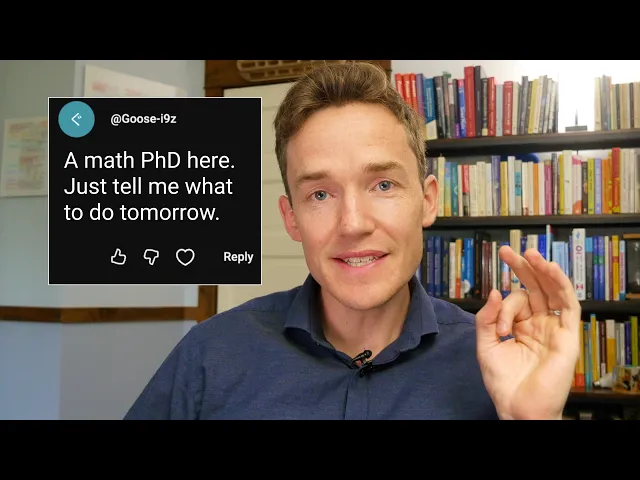
0:52 A math PhD here, just tell me what to do tomorrow.
0:55 So I would make the case, and I want to see if you agree with me
0:57 on this, that there has never been a better time to go into math,
1:00 that there's never been a better time to fund math,
1:03 and that maybe the most radical change that we'll see
1:06 in this moment is a reframing of how we assign academic credit,
1:09 but that the actual institution of math
1:11 and what it is remains surprisingly unaffected,
1:14 even in a hypothetical future where machines can Machines
1:17 can do anything that mathematicians can currently do, but better.
1:20 For the first section of this video,
1:21 I just want to lay out a framework for how I've been thinking about it,
1:24 where we just list out all the things that it is that mathematicians do,
1:28 and then we list out all of the ways in which math is valuable to the world,
1:32 and then we think about where the money comes
1:34 from and how the latter two relate to each other.
1:36 I think this is a useful exercise to do with any career,
1:39 regardless of the presence of AI, but once AI enters the discussion,
1:43 what you can do is you can do it with any career,
1:43 regardless of the presence of AI, but once AI enters the discussion,
1:43 what you can do is you can do it with any career.
1:44 What you can do is ask, suppose that machines are better than people at each one
1:47 of these tasks or maybe even all of the tasks.
1:49 What happens?
1:50 I'm certainly not going to be able
1:52 to claim to predict exactly what would happen.
1:54 I want to put very wide error bars around things that I say in this video.
1:58 But broadly speaking, I want to give you kind of a best faith effort
2:01 at trying to think that through and bring you along with me.
2:04 And by the way, it might be worth prefacing saying,
2:06 I don't really have any skin in the game
2:08 for necessarily wanting more people to go into academic.
2:10 academic math.
2:11 In fact, if anything, for a while I've thought that perhaps too many
2:15 students go and pursue PhDs for the wrong reasons.
2:18 You know, it's very comfortable to continue with some form
2:21 of school if you've always liked school and been good at it,
2:23 and PhD programs kind of feel like an extension of that.
2:26 Whereas what you should be asking is how
2:28 do you want to add value to other people in the world and how can you use
2:32 and develop your own skill sets to better do that.
2:35 do that.
2:35 Maybe academic research is the way to do that, but it might not be.
2:38 And it's important to ask that question.
2:40 For example, a lot of people leaving academia
2:42 in response to the present moment are doing
2:44 so motivated by a sense that the best
2:46 thing they could be working on is AI safety.
2:48 And if that's you, great, go do that.
2:51 Run, run, run.
2:51 But the main people I want to talk to right
2:53 now are the ones considering leaving out of fear,
2:56 out of a fear that the career won't exist
2:58 or that it won't be something that they would enjoy.
3:00 Anyway, because I really do believe that not
3:02 only is it going to continue to exist, it stands to be highly useful,
3:06 maybe more useful than it's ever been, and also just joyful.
3:14 All right, so first, what goes into math research?
3:16 The obvious one is proving theorems.
3:18 This is where a lot of people spend their time.
3:20 You have the tropes that a mathematician
3:22 is a machine that turns coffee into theorems.
3:24 But everybody has known for a while,
3:26 and it's a huge part of the discussion now, that that is not everything.
3:29 That is very far from everything.
3:30 One nice quote on this matter is that good mathematicians prove theorems,
3:34 great mathematicians make conjectures,
3:36 and the greatest mathematicians write definitions.
3:39 And so we can even add that to our list.
3:40 You know, aside from proving theorems,
3:42 you have the exercise of deciding what's even worth asking.
3:45 There's a lot of taste making in that.
3:47 Having a certain sense for when an idea
3:48 might be interesting enough that it produces good math.
3:51 And then instead of saying write definitions,
3:52 I'm gonna go ahead and throw in a third category of theory building.
3:56 You know you have a bunch of theorems that are proved
3:58 or maybe you have some sense of what questions are worth asking.
4:01 But we actually wanna get out of it is like
4:03 a broad understanding of of what's really going on here.
4:06 You know, when Descartes introduced Cartesian coordinates,
4:08 it wasn't so much any one question that was being answered,
4:11 it's just an entire framework of thinking.
4:13 Or when Galois was introducing the very seeds of group theory,
4:16 the significance of that had very little to do with, you know,
4:19 the unsolvability of the quintic.
4:20 It's that it was a new way of conceptualizing what was going on that would
4:24 produce an incredibly flowering portion of math
4:26 that was highly useful for the centuries thereafter.
4:29 After I think Grothendieck is a good example of this too.
4:31 He had all sorts of metaphorical ways of speaking but one of them
4:34 was if you're trying to get from the top of one mountain
4:37 to another you know one way is to solve all the problems to like
4:39 go down the mountain and then go up the other and the other
4:42 would be to have a rising sea that lifts up between the mountains
4:45 and just sail from the top of one to the other and the analogy
4:48 that rising sea is kind of all of the theory that you
4:50 build not necessarily proving one particular
4:52 theorem but giving a deeper overall understanding.
4:54 understanding to what's really going on.
4:56 You also have the component of applications.
4:58 figuring out in what way all of these abstractions
5:00 can be plugged into the sciences and engineering.
5:04 And with all these categories, another implicit part of what's going on is
5:07 clearly communicating what was done to others.
5:09 It's not just vomiting out a proof,
5:11 it's giving a reasonably motivated exposition of what that is.
5:14 Or in building the theory, it's not just like listing a bunch of definitions,
5:18 the great mathematicians will effectively communicate why
5:21 these are the structures worth engaging with.
5:23 And try to convey some of their taste in that.
5:25 Shifting over to where the value is,
5:27 the most obvious one here is the applications,
5:29 you know, the relevance to science and engineering.
5:31 And the thing everybody writes about in their grants for pure math at least,
5:35 is how sometimes these applications can be very downstream,
5:38 decades or even centuries later.
5:39 You know, to highlight a few classic examples,
5:42 you have a bunch of Italians trying to solve cubic equations in the 1500s,
5:46 one weird trick for that involves taking
5:48 the square root of a negative seriously.
5:50 seriously propagate the theory building of that down
5:52 a few centuries and you have imaginary numbers which
5:55 are a critical part of quantum mechanics and electrical
5:57 engineering and studying waves and like pretty much everything.
6:01 You have questions about Euclid's fifth postulate resulting in people
6:05 developing non-Euclidean geometry dot dot dot you get to general relativity
6:08 or pursuit of Fermat's last theorem builds up all
6:11 of this beautiful theory around algebraic
6:13 geometry and things like elliptic curves.
6:15 Those in turn end up unexpectedly being useful in cryptography.
6:19 Lots and lots of examples, people love to list them.
6:22 Another component of the value of math though
6:25 is not so much at the societal application level,
6:27 but at an individual one where the practice
6:30 of doing math and going through part of the training
6:33 to be a mathematician leaves you with a bunch
6:36 of problem-solving skills that it would appear are very transferably useful.
6:41 So we have tons of other portions in the economy
6:44 of people who go into computer science or machine learning research
6:47 or right now AI safety or finance or cryptography or all
6:50 of these things where people had a lot of training in math.
6:54 Maybe it was just a few classes in a math department.
6:56 Maybe it was even that they got a Ph.D.
6:58 in math, but they didn't end up becoming mathematicians.
7:01 They used all of those skills elsewhere.
7:03 It would appear there is something generalizable here.
7:06 There is something about the way of engaging with finding the right
7:09 abstractions or this kind of problem-solving
7:11 that makes people more valuable elsewhere.
7:13 And the third category for value here,
7:15 which is often underappreciated but I think
7:17 will become ever more and more worth appreciating, is just something aesthetic.
7:21 There is a joy simply to doing math.
7:24 Personally, I feel like there's this very specific emotion.
7:27 It's like a clicking in my head that I'll
7:29 get if I'm engaging with a good problem.
7:31 And I see this way that it's going to be solved.
7:33 Or if I'm holding a certain new theory that I haven't engaged with in my mind
7:37 and I see how it fits together and it
7:39 just gives me this completely different way of thinking.
7:42 And I think there's a lot of different parts
7:44 of math where it has that feeling of reshaping your thought.
7:47 Anybody who's taken a linear algebra class starts speaking
7:49 a little bit differently for the rest of their life.
7:52 They use words like orthogonal in talking about ideas
7:55 or people who engage with category theory sometimes Sometimes
7:58 feel like their brain has been turned upside down
8:00 for a very new way of thinking that's just satisfying.
8:03 It's just nice.
8:04 And if you talk to mathematicians about
8:06 what motivated them to go into the field,
8:07 not everyone, but I think for a lot of them, this is actually the reason.
8:11 There is a certain joy, a certain artistic pleasure to doing it.
8:15 And I also think this helps explain some
8:18 of the reactions you're seeing now to AI and math being such a strong echo
8:21 of the reactions from artists about AI and art.
8:24 hard, because in some sense it feels like
8:26 it is infringing on a certain art form.
8:28 But if we're thinking of this as a career, not a hobby,
8:31 none of this matters if there's not a source of funding.
8:33 So where does the money for math come from?
8:36 One big component is teaching.
8:37 A lot of mathematicians are math professors,
8:39 they're at a university, they teach in a math department.
8:42 Math departments themselves often teach many
8:44 more people than just the math majors,
8:46 so they have an outsized influence on credit hours and tuition.
8:49 Yeah, public funding, of course, like in the U.S.
8:52 we have NSF grants.
8:53 We have certain private funding as well from various institutions,
8:56 things like the Simons Foundation,
8:58 and then sometimes there will be industry funding as well.
9:00 And of those categories, by the way,
9:02 teaching is the biggest one as far as the source of funding is concerned,
9:05 which is a little peculiar to math
9:07 compared to other sciences because the research is
9:09 comparatively cheap and the scope of students
9:12 coming through the math department is relatively broad.
9:14 abroad.
9:15 All right, so we're about to go through the exercise of imagining what happens
9:18 if AI gets better than human mathematicians
9:20 at various parts of this research stack.
9:22 But first, it might be worth being clear about how
9:25 the value stack and the funding stack relate to each other.
9:28 For example, these second two sources of value,
9:30 the problem-solving chops and the aesthetic joy, are individual goods.
9:34 They are experienced only by the person doing the mathematics.
9:38 The public funding is not there just to support some prestigious
9:41 and aesthetically pleasing hobby for those in the inner circles practicing it.
9:45 I think a better way to think about what's going on here is
9:48 that those second two sources of value flow
9:50 through the money chain basically through the teaching.
9:53 The students walking through the halls
9:55 of math departments at universities around the world
9:57 are largely there to develop technical problem-solving
10:00 skills that they hope will be useful elsewhere.
10:02 Some of them are also there for the aesthetic joy of it.
10:05 I know that I was.
10:06 I mean, to be clear it was comforting
10:08 and validating to have the other benefits of math,
10:10 the fact that it exercises a muscle for a generally useful skill set.
10:14 But an honest depiction of a lot of the value I
10:16 was getting out of that math department is on that aesthetic side.
10:19 The benefit to society at large
10:20 of course comes from the downstream applications.
10:23 Although I think there is more shared benefit worth acknowledging.
10:26 For instance, math popularization, like what happens on this channel
10:30 or Numberphile or when mathematicians give talks,
10:32 really is a way of trying to share
10:34 that aesthetic joy more broadly among society.
10:36 And also, in terms of what justifies public and private funding,
10:40 even though everyone writes their grants around the downstream applications,
10:44 I think an even more significant positive
10:46 externality is that you have this institution
10:48 training up a bunch of people with a certain kind of problem solving ability.
10:52 You know, attracting them from around the world
10:54 to come to prestigious universities where they can do that.
10:57 And then most of them don't go in to become mathematicians.
10:59 They spill out into other very useful
11:01 parts of the economy using those transferable skills.
11:05 Just that component alone, I think,
11:07 is a very meaningful ROI on dollars pointed towards that institution,
11:11 at least insofar as it genuinely trains up good problem
11:14 solving skills and those problem solving skills are genuinely transferable.
11:18 All right.
11:19 So let's get into the meat of this.
11:20 What happens if AI gets good at various parts of this research stack?
11:27 As we step into this first block here of presuming
11:29 that machines are better than mathematicians at proving theorems,
11:32 it might actually be worth stepping back and summarizing what just happened.
11:36 So like I said, I've been thinking about this for a while.
11:39 Actually, a quiet project that's been happening in the background
11:42 of Three Blue and Brown is that since like mid-2025,
11:44 I've been recording interviews with mathematicians just to hear their take
11:48 on what they're feeling with respect to the presence of AI in math.
11:51 And one of my broad conclusions is that at any given snapshot,
11:54 snapshot in time, the position is overrated but the velocity is not.
11:57 It's So for example, back in 2023, I want to say,
12:01 I remember getting a text from a friend saying,
12:03 you know, did DeepMind just crush Olympiad-level geometry?
12:06 And he was referring to a certain model that DeepMind
12:08 had put out that could answer IMO-level geometry questions.
12:12 And at the time, the answer was like, yes, I guess,
12:15 but it's also clearly not in the spirit
12:17 of what we would mean by solving IMO-level problems.
12:20 It felt very bespoke and brute force,
12:21 but a lot of these problems are supposed to be solved.
12:23 They're supposed to require an element of kind of creativity and imagination.
12:26 But if you fast forward a couple years,
12:28 the natural language models, not even bespoke ones,
12:31 could solve IMO-level problems by any reasonable
12:34 definition of what you would mean by solve.
12:36 Or earlier this year,
12:37 you were starting to see proofs come out for these things called Erdős problems,
12:42 where a great mathematician named Paul Erdős
12:43 had posed a lot of different questions.
12:45 He had a good taste for what constitutes a good conjecture.
12:48 And there's an enumeration of them which naturally meant
12:51 the model companies enjoyed using it as a kind of benchmark
12:54 and whether or not that's a good benchmark you started
12:56 to see more and more machine generated proofs of these.
12:59 Now in the early days a lot of people were saying yeah yeah yeah
13:02 but if you look closely at these a lot
13:04 of them are just low-hanging fruit they're
13:06 problems people hadn't tried before or the problems
13:08 had been solved and it just hadn't
13:10 been well documented and the model was basically
13:12 just repackaging that but without without credit attribution,
13:15 which is of course a whole thing.
13:16 But if you fast forward to this point in time,
13:19 nobody is saying that the problems whose
13:20 solutions we're seeing were just low-hanging fruit.
13:22 These are a lot of very serious problems that mathematicians had tried
13:25 really hard to find proofs for where the LLMs are outputting proofs.
13:29 And here I also want to be very clear,
13:31 this is true and has been worth discussing even
13:33 if you set aside any of the headline-making results,
13:35 you know, the recent stuff from OpenAI,
13:37 like the Navier-Stokes things or the hundreds of problems.
13:39 problems they dropped.
13:40 If you were talking to mathematicians on the ground,
13:42 seeing the way that they're interacting with these models,
13:45 for some of them at least, what you'll hear is that they pose a serious
13:48 research question to one of these reasoning models,
13:50 and what they get back is something that they find insightful.
13:54 Of course this varies a lot from field to field and from person to person.
13:57 The frontier is spiky at a fractal level and it is not at all uniform.
14:00 There is also an immense amount of controversy around
14:03 the way some of these proofs are proofs are presented,
14:05 and not to downplay the significance of any of that, I
14:08 think the broad ten thousand high-foot view here is four years ago,
14:11 these things couldn't even add numbers.
14:14 They came to be able to do
14:15 contest level math much faster than anyone anticipated.
14:18 They jumped from that to doing anything relevant
14:20 to research much faster than a lot of people anticipated.
14:23 So even if it's an exaggeration to say that theorem proving is solved now,
14:27 even if it's the case that most of the proofs
14:30 that we're seeing are short hops away from contributions,
14:33 often very recent contributions, from human mathematicians,
14:36 even if it's not even well defined what
14:38 we would mean by theorem proven being solved,
14:40 given the pace of progress over the last four years, for the sake of argument,
14:44 for the sake of that first year PhD student trying
14:47 to look ahead and speculate about what is stable in their future,
14:51 let's just presume that machines are categorically
14:53 better at the proof generating side of math.
14:55 What happens?
14:56 In short, I think it has almost no influence on the value stack,
15:00 and therefore also the funding stack,
15:01 but it has a very massive influence for the culture
15:05 and credit assignment system of the institution of math.
15:08 So just looking at that value stack side, the applications,
15:11 like I said before, almost always stem from the theory building side of it.
15:15 It's not the proof of the unsolvability of the quintic that matters,
15:18 it's the creation of group theory, which in turn has effects like like
15:22 having people postulate that quarks might exist.
15:24 It's not the yes or no answer to Fermat's last theorem,
15:26 it's all of the math that sprung forward from it and its applications.
15:30 Sometimes you could say that the statement
15:32 of a theorem just on its own has some utility.
15:34 An example here might be that if you're pursuing nuclear fusion
15:37 and you want some system where the magnetic field is non-zero everywhere,
15:41 the hairy ball theorem tells you you couldn't
15:43 do this with something that has spherical topology.
15:46 That always kind of feels like a stretch to me,
15:49 though by and large the applications come from the theory building side.
15:53 So downstream to the funding that means
15:54 the public funding is still very much rational.
15:57 If anything the mathematicians are now
15:58 more leveraged to do their theory building, likewise for the private funding.
16:02 For the next item on the value stack, building up those problem solving muscles,
16:06 this is essentially unaffected by whether or not machines are better.
16:09 Like there are probably lots of humans
16:10 who are better than you at generating proofs.
16:12 proofs but it is nevertheless helpful to go through the exercise
16:15 of creating proofs yourself for the sake
16:17 of building those problem-solving muscles.
16:19 The analogy here is basically that of going to the gym
16:22 where yeah sure machines can lift heavier weights than you
16:24 do but that does not negate the value that you
16:27 get out of lifting those heavy weights and this is going
16:29 to be true by the way for pretty much every
16:31 item as we let AI get better and better at it
16:34 this portion of the value stack building up those problem-solving muscles
16:37 Principles always requires that you the human are engaged with it.
16:41 Now you could ask in the sci-fi futures that we're going to get to here,
16:44 implied by AI taking off more and more of these abilities,
16:47 do we need problem-solving abilities in humans?
16:50 We can postpone that question for now,
16:51 but as long as there is value to that, this then
16:54 flows through the funding channel through the teaching side of it.
16:56 It's still very valuable to have human experts capable
16:59 of generating proofs so that they can train students.
17:02 to be capable of generating proofs so that you get those spillover benefits.
17:06 The aesthetic joy side gets a little bit more nuanced here,
17:09 because I've seen both sides of it.
17:11 One sentiment I've seen a lot, especially online,
17:14 is that theorem-proof coming from machines completely sucks away the joy of it.
17:20 You know, often if it's a mathematician who
17:22 is maybe pushing forward towards a particular result,
17:24 and then that result was one of the hundreds that OpenAI kind of dumps down,
17:29 they'll say that just takes all of the wind out of their sails.
17:32 And I get that, and it's important to talk about that part.
17:35 For what it's worth I've also seen especially in person
17:38 the other side of this where some mathematicians are completely exhilarated.
17:41 They have these questions that they've always really wanted to know the answer
17:45 to and now they have this interaction with models where they're coming
17:48 to see the answers of it and especially when they care not just
17:51 about the proof but about the theory
17:53 building it feels like they've been unlocked.
17:56 Just to give you one little taste of this I want to share with you
17:58 a sample of a conversation I had
18:00 with Konstantin Kogler at the Institute of Advanced Studies.
18:02 and study, where he was talking about a very important problem from his field,
18:05 one of the most important,
18:07 and throughout the last year he would just try to pose it
18:09 to the state of the art models that were available to him.
18:12 And this was his commentary on it.
18:14 So I had two, I would say very very serious successes.
18:16 So on Sunday uh I had made maybe the major open problem in the field solved.
18:20 Uh and I had one other success with what which was were
18:24 these irreducible polynomials uh that were that we were telling you about.
18:27 So it was absolutely marvelous.
18:29 And it was simple, that was there already saw on Thursday, so it was simple.
18:33 It had a simple powerful idea.
18:36 First I felt incredible excitement because about the math, about the power,
18:40 about the truth I would learn, about the power of ideas I saw.
18:44 Mm-hmm.
18:44 So and and then I thought about the math and that made me sleep less and then
18:47 I thought about the excitement because I had
18:49 the insights that I really was craving for.
18:51 Yeah.
18:52 Hmm.
18:52 And this dichotomy by the way where there's
18:54 a tendency to see more negativity on online while
18:56 there's the tendency to see more joy in person
18:59 is of course not unique to AI and math.
19:01 That's just the nature of discourse in today's world.
19:03 And I don't want to downplay the reality
19:05 or the legitimacy of those negative feelings.
19:08 In fact, I want to dig into it in a moment.
19:09 But I do think this has an implication for that central
19:12 question of the PhD student asking what to do tomorrow.
19:15 Again, I promise to give you a concrete answer at the end of this video.
19:18 But the first portion of that answer is to be social.
19:21 Close the laptop.
19:22 Go on a long walk with your fellow PhD students.
19:25 As to the topics for discussion in that long walk, trust me, we'll get there.
19:28 I know we're spending a lot of time on this one item,
19:30 but it is where most of the present discourse is,
19:33 and I do have just a couple more things to say here.
19:35 For example, what does the practice of doing math actually
19:37 look like if the machines are better at the proof generation?
19:41 Well, if we take that optimist's perspective, the one who's exhilarated by it,
19:44 it basically looks like leaning into the theory building.
19:47 You are no longer rate limited by how
19:49 quickly you can solve certain problems along the way.
19:51 You can ask all of the questions that you want.
19:54 You can much more quickly see what the solutions to them are.
19:57 You can try to parse that and just
19:59 understand how does this fit into a bigger narrative,
20:01 what are the elements of simplicity among all of the proofs that I'm looking
20:05 at, and how can I weave this together into a fabric of a new kind of theory,
20:09 where Galois was introducing group theory
20:11 or Grothendieck was developing algebraic geometry.
20:13 What is it that you as an individual get to entirely grow out?
20:17 Maybe your PhD thesis is not a handful of a few proofs,
20:20 it is that entire theory building.
20:21 An analogue here would be that It's like going
20:24 through a textbook where you can come to understand
20:27 that material so much faster in part because you
20:29 have this answer key at the back of the book.
20:32 That's not to say you should always look at it,
20:33 you should still do the problems and engage with them.
20:36 But if you are stuck, having that more coherent presentation of the answers
20:39 does help you to get unstuck.
20:41 It makes you move faster than you would if it was totally terra nova.
20:44 Now you do have to be thoughtful in how you do this.
20:47 For example, a lot of machine generated proofs will
20:49 Use ideas that have their origins in a human-written publication,
20:53 and at present the attribution of that is not always automatic,
20:57 so that's obviously a problem, meaning you have to put in that extra step
21:01 to make sure the credit is given where credit is due.
21:04 But acknowledging that very real loss of joy that I was referencing,
21:08 I think a lot of mathematicians would look at what I just described and say,
21:11 God, that seems awful.
21:13 I don't want to be sitting there trying
21:15 to like parse through a bunch of machine-generated slop,
21:17 just understanding questions that somebody else has already answered.
21:20 I want to find the solutions myself.
21:22 My whole joy in pursuing math was to do it
21:25 myself and to come to my own understandings of things.
21:27 And I do think addressing that feeling is maybe one of the more
21:31 important questions for the community as a whole to grapple with right now.
21:34 But I suspect at least some of that feeling is referable to 2 different things.
21:38 things.
21:38 One of them is that at present the explanatory
21:40 quality of what's coming out of the models often
21:43 leaves a lot to be desired and no one
21:45 wants to just parse through a bunch of slop.
21:48 I suspect that'll get better.
21:50 I think this might be a temporary
21:51 blip in history when you have proof generation,
21:53 which is also just almost incomprehensible.
21:56 The model companies have a huge incentive
21:58 for their models to be able to explain things well.
22:00 If you look at the trajectory of code,
22:02 I think early on a lot of the code generated if
22:05 functional was still quite sloppy
22:07 and the trajectory has been towards cleanliness.
22:10 People might argue with me on that front.
22:11 They certainly over comment.
22:13 But by and large, I do think that's the trajectory.
22:16 The deeper issue, though, I suspect is one of cultural inertia around what
22:20 the mathematics community values and where credit has been assigned.
22:24 Because one of the things that sucks is if it feels like
22:27 you were pursuing a problem and then a model finds the answer,
22:30 especially if it's coming from the model
22:32 company and not like your interactions with it,
22:34 and then it feels like that problem is
22:36 solved and you're just kind of sweeping up after.
22:38 after it.
22:38 And for so much of the history of math,
22:40 we have used proof as the proxy for understanding.
22:44 It is the north star to shoot for where
22:46 to prove something means that you understand it.
22:48 We have these grand open problems and we consider the moment
22:51 that a proof is created to be the moment they are solved.
22:54 Now of course that's not everything
22:55 and everyone's always known that's not everything.
22:58 If you submit a paper to a journal
22:59 and it's poorly written they'll just send it right back.
23:02 If you were proving a very important theorem
23:03 in that and it was poor It was poorly written,
23:05 they would be frustrated because they would know that they should care,
23:08 but they would still send it back and the onus is on you to explain it well.
23:11 I think at this point we should consider proof
23:14 to be kind of the same as numerical calculation,
23:16 which is to say it's a form of raw data that is helpful for theory building,
23:22 but it is certainly not the end in and of itself.
23:24 This is not my own thought by the way,
23:25 other people have framed the idea of these machine-generated
23:28 proofs as being treated a little bit more like data.
23:30 But I think very broadly,
23:32 there is something liberating in thinking of theory building as being the goal,
23:36 not proof, and proof as being a kind of raw data that you can plug into that.
23:41 For example, I do not care about
23:42 the forced blow-up to the Navier-Stokes problems.
23:45 What I would care about is if somebody
23:47 understands the ideas that went into that proof
23:49 and the kind of mathematics that can flower
23:51 out of those ideas into a beautiful coherent theory.
23:53 And if someone puts in the work
23:55 to doing that, Give them the Millennium Prize problem.
23:58 That's the reason that we care it in the first place.
24:00 The proof is just data, it's like giving me more digits ofπ.
24:03 This also influences how you do research.
24:06 Maybe sometimes what you need is one more proof and interacting
24:08 with the model is the best way to do that.
24:10 But often it's probably not and what's better is to close the laptop,
24:14 scribble through your own understanding of it,
24:16 and ask, what's blocking me right now
24:18 from developing a deeper theory for what's going on?
24:20 Is it one more proof?
24:21 Or is it something about my understanding of the existing proofs?
24:24 Pulling up again our portions of math research,
24:27 if the machines generate proofs but they don't communicate them well,
24:30 that does mean you still need human mathematicians to make them understandable.
24:33 Frankly, that's probably not the most fun part.
24:36 It probably depends on your perspective, though.
24:37 In either case, I assume that's relatively transitory,
24:40 and let's just say the machines also get better at communicating their ideas.
24:43 Incidentally, that's just written communication.
24:46 A equally valuable form of communication is and is the more social side,
24:49 which often happens through oral presentation.
24:51 And I think throughout this whole future trajectory,
24:54 the relevance of oral presentation capabilities It just gets higher and higher.
24:59 The machine can't understand it for you,
25:01 and a big part of math is getting other people to understand and care,
25:04 and we're social creatures.
25:06 So even if the machine's better at explaining it,
25:08 a big part of what makes us care is seeing someone else who actually cares.
25:15 One item on here is asking questions,
25:17 deciding which theorems are the ones worth proving.
25:20 At present, that remains an incredibly vibrant and highly
25:23 levered area for mathematicians to spend their time.
25:26 But let's just imagine, again for the sake of argument,
25:28 machines get better at that too.
25:30 Your interaction with a model doesn't just
25:32 like asking it to prove a particular theorem, but it comes back saying,
25:35 here are the other questions worth asking which might yield fruitful math,
25:39 and by whatever way we're defining it,
25:41 they are better at asking those questions than the mathematicians are.
25:44 There's obviously a very blurry line between this one and theory building,
25:48 but at least to engage with it for a second,
25:50 let's suppose the humans are still better at that theory building side,
25:53 actually making sense out of this broad
25:54 set of theorems and how they were proven.
25:56 That is what's most relevant to downstream
25:58 applications and therefore from the perspective
26:01 of funding math not only does it still make sense to do so
26:04 you are much more leveraged in doing so because each individual mathematician is
26:07 able to push forward theory much faster than they were able to previously.
26:11 On the side of building up problem solving muscles,
26:13 as always it's like weights in the gym.
26:15 It does not matter if machines are better at it.
26:17 You still want a practice of humans being trained in how
26:20 to do that, assuming that human problem solving is at all relevant.
26:23 than anywhere else in the world.
26:25 On the aesthetic joy, I think we continue to see a little bit of a split there.
26:28 Some people will not find it very fun to have
26:31 a model both ask its own questions and then answer them.
26:34 I know I myself am probably going to spend my whole
26:36 life trying to think of interesting questions in my own
26:38 head and find my own ways to answer them kind
26:40 of irrespective of what the models are able to do.
26:43 But you'll also have those people who are exhilarated,
26:45 who feel less and less rate limited in building up theories,
26:48 coming to understand those theories.
26:49 And maybe even starting to see how they're applied at a cadence
26:52 that doesn't look like waiting decades
26:54 or centuries for some downstream application,
26:55 but to maybe seek them out a little bit earlier than that.
27:02 But what if, the grad student today might ask,
27:04 the theory building side of it falls as well,
27:07 and the most effective way to push forward
27:09 theoretical math in some abstract sense is not
27:11 just to have the machines generate the proofs
27:13 or to ask what theorems they should prove,
27:15 but they're also digesting all of those proofs,
27:18 finding the elements of simplicity in it,
27:20 understanding what truly novel fabrics you need to weave
27:23 in order to come up with a coherent theory around it.
27:26 It would be the analog of giving it all of math up to the...
27:29 up to the 1500s and then having it not only solve cubic equations but come up
27:33 with the right notation for how to even represent
27:35 it come up with the theory of complex numbers you
27:38 know all of the downstream things like that Maybe
27:41 you don't think that's likely and that level
27:43 of genuinely novel thinking is implausible from present LLMs
27:46 given their reliance on human knowledge and their training data.
27:50 But again, for the sake of hypothetical exploration, if nothing else,
27:53 what does the field of math look like in that world?
27:56 Well, insofar as we want to generate applications into the real world,
28:00 by the assumptions of this hypothetical,
28:02 the model is better at doing all of the theory generation.
28:05 But you would still need somebody to understand all of that theory
28:08 well enough to see how it gets applied in surrounding fields.
28:11 Is any of this stuff relevant to curing cancer,
28:14 or to making nuclear fusion a reality, or to high-temperature superconductors?
28:17 That's where all the rubber is really meeting the road.
28:20 On the individual problem-solving side,
28:21 same deal as it has been throughout this story, you're at the gym.
28:24 Does not matter if the machines are better,
28:26 if problem-solving muscles in humans are relevant at all,
28:29 you still want the practice of them going through all of that.
28:32 On the side of aesthetics and joy,
28:34 I realize I've actually been conflating two separate things here.
28:37 So one version of the joy I'm talking about is
28:40 that which is experienced by anybody doing math at whatever level.
28:43 It's the part where seeing a clever solution and feeling how
28:46 it clicks in your brain brings about a very unique kind
28:49 of satisfaction or where coming to understand a new topic can
28:52 change the way that you think in a way that's really desirable.
28:55 It's everything that you and I are doing on this channel, for example.
28:58 And then separately,
28:59 there's the joy experienced by the researcher at the frontier
29:02 for the feelings of pushing forward that frontier.
29:05 Now in the first category,
29:06 that one feels to me more or less unaffected by whether
29:09 or not AI is better at certain tasks on this list.
29:12 It's entirely analogous to the problem solving slot.
29:15 And for the same reason, in order to experience this part of the value,
29:18 you have to be the one who is actually doing
29:20 the math and engaging with it in your own head.
29:23 Now the existence of models capable of doing math
29:25 probably has some influence on that for some people,
29:27 but I also think this side of the joy
29:29 is much more intrinsically communal or social,
29:32 or at the very least it benefits from being communal and social.
29:35 I think it's a lot easier to feel passionate about
29:37 something when you are with others who are passionate about it,
29:40 or if you're seeing someone else who's passionate about it.
29:43 It can happen in isolation, it does,
29:45 but that social component is always going to be an amplifier.
29:48 For my part, I'm always going to want to engage with more pieces of math,
29:51 come to terms with them in my own head,
29:53 and share them with you, and spend my life sharing them with you,
29:56 regardless of the capabilities of any machine.
29:59 As to the joy experienced by the researchers...
30:01 Here again, I think that split I've been describing
30:03 just gets put into a sharper and sharper focus.
30:06 You'll probably always have those who are exhilarated by a machine that offers
30:10 them a very new kind of window into the world of math,
30:13 and I think you'll always have those who find that incredibly disheartening.
30:17 Because let's be real, something is lost here.
30:19 For so long you've had this tight coupling between
30:22 advancing human understanding and all of these downstream applications,
30:26 and in these hypotheticals we're talking about,
30:28 about those are getting more and more decoupled and that probably means
30:31 for some that that feeling of advancing
30:34 human understanding just for its own sake
30:36 loses a little bit of its oomph Maybe you don't want to be
30:39 reading a textbook that has an answer key at the back of it,
30:42 even if you don't have to look at it, that defeats the whole pioneering spirit.
30:46 A lot of the mathematicians I talk to, I think are not so interested in being,
30:49 you know, at the frontier or being the first ones to discover something.
30:53 They really do seem to find most of their joy in the community nature of it.
30:56 And so undoubtedly you're going to see more
30:58 and more subcurrents emerge within the math community,
31:01 espousing the benefits of pushing forward a human understanding of math.
31:05 math for its own sake as a worthy end in and of itself.
31:08 So just to sum up its relevance in our diagram,
31:11 insofar as there's always joy to be had in learning math,
31:14 and that can flow through the teaching channel
31:16 assuming people are willing to pay to learn it, that remains unaffected.
31:19 Admittedly though, insofar as some of that joy was
31:22 maybe coming from the hopes of being a pioneer,
31:25 of being the first one to set foot in new kinds of theory.
31:29 I mean, let's admit it, that would be a loss.
31:35 And just to play it all out, looking at the last one I have on this list,
31:38 suppose the machines are not just better at generating proofs and not
31:41 just better at posing conjectures whose proofs will yield fruitful mathematics,
31:45 and not just better at understanding what that fruitful mathematics is
31:48 and how it should be encapsulated into good definitions and good theory,
31:52 but they're also just better than humans at seeing what
31:55 applications those plug into and plugging it into science and engineering.
31:59 Let's call this the anything you can do I can do better future.
32:02 future.
32:02 Here's where things start to get more interesting because
32:05 for the first time on this value chain in theory
32:08 all of the benefits that flow to application are
32:10 better to happen just in the machine and so
32:13 in theory insofar as the public and private funding
32:16 was motivated by the downstream applications the most efficacious
32:20 use of those funds would be to pour it
32:22 towards some big blob of compute that just does math.
32:25 It creates the theories, it plugs them into applications,
32:28 it pushes things pushes things forward in that sense.
32:30 If I had to guess, even though at this point
32:32 that would be the rational use of funds,
32:35 insofar as they are motivated by downstream application,
32:38 I find it pretty hard to imagine that policymakers just flip the switch where
32:41 the public funding no longer flows to humans
32:43 but flows towards a big blob of compute.
32:45 What I can imagine are certain individuals
32:47 who have become highly wealthy from the AI
32:49 itself starting private foundations that just
32:51 pour towards a big blob of compute.
32:53 that, you know, does math, seems like there's a good chance that will happen.
32:56 What seems much more likely on the public funding side is that people will have
33:00 been talking more and more about the other
33:02 positive externalities that come out of math.
33:04 For example, having this institution that trains problem solvers
33:07 that spill out into the rest of the world, that is still incredibly valuable.
33:11 That on its own gives positive ROI to any kind of public funding.
33:15 Or if formal institutions do pop up
33:16 that are around human math done for human flourishing.
33:19 That's essentially embracing math as an art, which it always has been,
33:23 and maybe at that point that's the nature of how the funding is even perceived.
33:26 It is funded for the same reason that the arts are funded,
33:29 both publicly and also by certain channels of private philanthropy.
33:32 But again, keep in perspective,
33:34 those are not even where most of the money for math is coming from.
33:37 Most of it is coming from teaching, and the value of teaching ultimately stems
33:41 from these lower two elements in the value chain:
33:43 training people to build problem-solving muscles.
33:45 and instilling within them a very specific kind of joy by doing so.
33:50 The future implied by this anything you can do I can do
33:53 better future is so wild it's hard to even engage with seriously.
33:56 And as a side note, all of this conversation is contingent
34:00 on a branch where things go well and there's not something catastrophic.
34:03 So again, maybe some people think AI safety is just
34:06 a more important place for them to work right now.
34:08 But while we're engaged with this and we're
34:10 assuming that it's a good branch of the future.
34:12 future, it seems likely to me that you'll
34:14 still have something like existing university structures.
34:17 Even if in theory the AIs are better at explaining stuff,
34:20 people will still want to learn from humans because
34:22 education is not rate limited by the clarity of explanation,
34:26 it's rate limited by motivation.
34:28 Do people actually want to learn the material, and what motivates people?
34:31 Sometimes it's just the pure joy of learning in and of itself,
34:34 but we're social creatures, and a huge part of what motivates people
34:37 to learn is seeing somebody else deeply passionate about it,
34:41 especially if that's somebody that they respect or care about.
34:44 Teaching in general just feels to me like one of the most
34:47 safe positions from a standpoint of AI
34:49 job displacing because it's so relational,
34:51 because it depends so much on a human-to-human interaction.
34:54 No amount of clarity generated through a screen is going to substitute for that.
35:01 So where does this leave us?
35:03 I think for the foreseeable future, research needs to place more and more
35:06 of an emphasis on the theory building side of math,
35:09 which it always has, that always has been the point.
35:11 But the main difference is that proof was a very valuable
35:14 proxy for that, and it's losing its value as a proxy.
35:16 At this point it's a form of raw data,
35:18 it stands to be a useful form of raw data,
35:20 and yes, undoubtedly we have to change
35:22 how we measure human academic contribution.
35:25 But that's probably a good thing.
35:26 Proof in and of itself has probably been overvalued for decades.
35:30 Similarly, insofar as the institution
35:32 is valuable for sharpening problem-solving skills,
35:35 it also does throw into question how exactly to do
35:37 that, because previous methods for doing that training no longer apply.
35:41 For example, assigning and grading problem sets
35:44 on its own doesn't really make sense right now.
35:46 And then even if you're worried about some sci-fi
35:48 future where truly all of math can be mechanized,
35:50 or even if you're worried that The training
35:53 for problem-solving skills somehow won't be useful?
35:55 Seems like a stretch, but, you know, let's engage with that.
35:58 Math will always be valuable to humans insofar as there is joy in doing it.
36:02 And one of the reasons I'm most bullish on that last point standing to be
36:06 kind of a supporting pillar even in these wild
36:08 sci-fi futures is because of this channel.
36:10 I mean, think about what's going on here.
36:12 There are millions of you out there willing to engage here,
36:15 but what we're doing effectively is just...
36:17 Just wallowing in the beauty of math and finding elegant problems whose
36:20 solutions are very satisfying or trying to instill new ways of thinking.
36:24 Now admittedly it's not like millions of you out there are
36:27 willing to pay for that, I mean that would be great,
36:29 but thousands of you are and that makes all the difference.
36:32 And looking beyond this channel, one of my favorite examples to point
36:35 to for why there's clearly a big public appetite
36:37 for math is to consider all of the channels
36:40 run by Brady Haran where among all of them,
36:42 the most popular by far is the one that he...
36:44 One that he does about math.
36:45 Or stepping back in time a bit,
36:46 if you look at Martin Gardner, godfather of modern math popularization,
36:51 it was initially the case that his column
36:52 showed up at the end of Scientific American,
36:54 but then they had to shift it up to the beginning
36:56 because so many people were getting
36:58 their subscriptions specifically for his column.
37:00 Clearly, once people get a taste for what math really is,
37:03 there is an immense appetite for it from society at large.
37:06 So I think the mathematics community would be wise to turn itself outward.
37:10 word and lean into satiating that hunger.
37:13 Now for most of this video I've just been laying out why
37:15 I think the institution of math is valuable and will continue to exist,
37:19 but I opened with a stronger claim.
37:21 I said I think this is one of the best
37:23 times to go into math and I'm guessing many viewers clicking
37:26 on this video might have anticipated that what I mean
37:29 by that is that AI will unlock new opportunities in math,
37:32 but actually I'm not referring to any of that.
37:34 The reason I think it's one of the best times to go
37:36 in is because the community as a whole knows that it needs to change,
37:40 and so many people are leaning back looking
37:42 for guidance and examples on what that change should be.
37:45 So you, as a new entrant into that field,
37:48 stand to actually influence what it becomes at one
37:50 of the most pivotal times in its history.
37:53 I think that's incredibly exciting.
37:54 So to that comment from the PhD student, tell me what to do tomorrow,
37:58 I can tell you what I would do if I was a PhD student in 2026.
38:01 6, I would do 3Blue1Brown.
38:03 I would do exactly this.
38:05 If 10 years ago I had entered some math department and said, hey,
38:09 I have this concept for explaining math in a highly visuals first way,
38:12 and oh by the way, can you
38:14 please make that a academically recognized PhD thesis,
38:17 not just a hobby, I would have been laughed out of almost every department.
38:20 I'm not positive my younger self could pull that off today,
38:23 but if ever there was a time people would be open-minded to it, now would be it.
38:26 Now I'm not saying that's what you should do.
38:28 You should lean into whatever it is that makes you love math.
38:31 I love explaining it.
38:32 I love visualizing it.
38:33 That's my passion.
38:34 That's what I want to run with.
38:35 But what's yours?
38:36 What do you want to run with?
38:37 If you love the theory building side,
38:38 you want to be the next Galois or the next Grothendieck, great, run with that.
38:42 You have a proof generating machine at your availability that's
38:44 going to get better and better over the next four years.
38:47 Maybe you can use that to create a PhD
38:49 thesis the likes of which the world has never seen.
38:51 machine forging a new territory that you never
38:53 would have been able to in a previous world.
38:55 If you don't like the models, you don't want to use them,
38:58 they leave a bad taste in your mouth, great, lean into that.
39:01 There are undoubtedly going to be subcurrents
39:03 within the math community that want to establish
39:05 what math by humans for humans would be and what that would look like.
39:09 You can plant a flag in the sand.
39:10 You can decide what a PhD thesis emblematic of that goal would even look like.
39:15 The other thing I would do is recognize that if machines
39:17 are better at Are better at any subset of that research stack.
39:20 The most effective way to measure a human's understanding
39:22 of the material and their potential to help push forward the field,
39:26 whatever that means,
39:27 is going to shift more and more towards the oral presentation side.
39:30 So give talks, give lots of talks, get really,
39:34 really good at giving talks and make that a very
39:36 regular part of how you practice your math.
39:38 Now, my most concrete suggestion for what to literally
39:41 do tomorrow is to go on a long walk.
39:43 Find a friend, maybe someone else.
39:45 someone else from in your program,
39:46 and reflect with them on what is it that you like about math?
39:50 Why is it that you went into it?
39:52 And ask them, what is it that they love?
39:53 Why did they go into it?
39:54 And together brainstorm how exactly you want the next few years
39:58 of your life to contribute to various different parts of this value stack.
40:02 For my part, I still love math.
40:04 I'm always going to love math.
40:05 I'm always going to love finding ways to visualize
40:07 it and share them with you on this channel.
40:09 My biggest hope for you is that you can find
40:11 a way Find a way to lean into your own passion.
40:13 The community has never been more open-minded,
40:15 and they'll be listening to what you have to say.