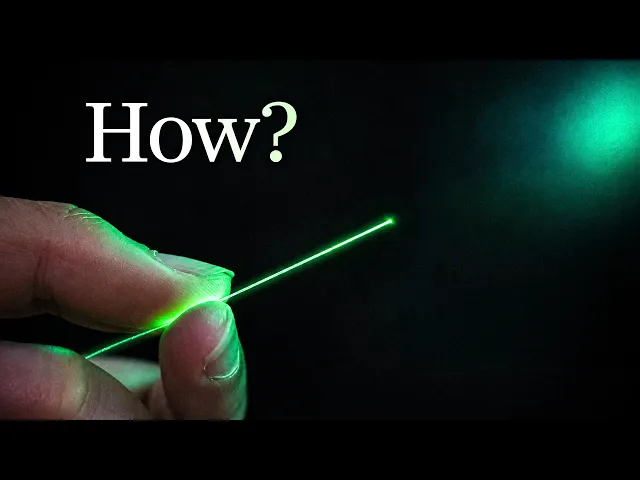
Fiber Optics are so much cooler than I thought
Veritasium
0:00 In 1887, a young physics teacher attached a thin glass rod
0:03 to the end of an arrow and loaded it into his homemade crossbow.
0:07 He torched the rod's end until a molten glass bead.
0:10 Roughly the size of a pin's head, it was barely hanging on.
0:13 And then he fired the arrow.
0:15 (air whooshing) (suspenseful music) Bright sunlight streaming
0:24 into the room glinted off a tiny glass fiber.
0:28 At its thinnest, it was less than a tenth of the diameter of a human hair.
0:32 Now legally we cannot shoot a crossbow indoors.
0:36 Luckily I am pretty quick.
0:37 (Henry chuckles) (suspenseful music) That is cool.
0:47 Look at that.
0:48 Look how thin we got it.
0:49 The physics teacher was using these fibers to measure very small forces,
0:53 but in the decades that followed,
0:54 other researchers found a different use for them: sending light signals.
0:59 (quiet dramatic music) Glass fibers can carry light even through bends.
1:02 Look at it.
1:03 It's like that's 90 degrees.
1:04 And during the 1960s,
1:06 the telecoms industry was desperate for a better way to carry more information.
1:10 As one American engineer said,
1:11 "It should be possible to transmit "all of the conversations going on "anywhere
1:16 in the world simultaneously "over a single thread
1:20 of light." But these glass fibers were terrible.
1:24 The light faded so much that you
1:25 couldn't decode a signal after just one kilometer.
1:28 No one thought they'd be practical.
1:30 Except for one man.
1:32 (dramatic theatrical music) His own boss called his dream
1:35 "a wild goose chase," but if he was right,
1:37 if he could prove that fiber optics were in fact viable,
1:40 and if someone could then figure out how to make them at scale,
1:43 well, eventually they could connect continents.
1:45 How much is in this warehouse?
1:47 Oh, there's millions of kilometers here
1:48 that we're pushing through here every month.
1:50 It's approximately three times as hot as the surface of the sun.
1:54 That's crazy.
1:55 And one day, it could build the internet.
1:59 (dramatic music fading) All that was unimaginable in the 1960s,
2:04 but even then telecom companies wanted a better communication system,
2:08 just for phone calls.
2:10 Between 1960 and 1973, the number of daily calls doubled in the U.S.
2:14 from 285 million to 576 million.
2:18 In that same time period,
2:19 NASA sent people to the moon for a total cost of $26 billion.
2:24 While AT&T had to spend nearly triple
2:26 that amount just to install new telephone infrastructure.
2:29 They just couldn't keep up with the demand.
2:32 At the time, phone calls were mostly transmitted over copper wires.
2:36 Now imagine I'm trying to phone my buddy Gregor.
2:38 Now, when I pick up, a constant current immediately flows through
2:41 the wire to supply power to the phone.
2:43 When I speak, my voice vibrates a tiny
2:45 diaphragm in the mouthpiece that modulates the current.
2:48 The louder I am, the bigger the current swing,
2:50 and my voice's pitch changes how fast the current oscillates.
2:54 At Gregor's end, that current reaches a speaker that turns it back into sound.
2:58 Now, this works for one call on one line,
3:00 but phone companies aren't going to install wires between every single house.
3:04 One cable needs to carry multiple calls.
3:06 So phone companies figure out a neat little trick.
3:09 Even though humans can hear frequencies up to 20 kilohertz,
3:12 you really only need to hear the ones between
3:15 300 and 3400 hertz to understand what someone's saying.
3:18 So phone companies drop frequencies above four
3:21 kilohertz or anything outside the voice band.
3:23 But if everyone used that zero to four kilohertz band on the same line, well,
3:28 then all the conversations would be on top of each other
3:30 and you wouldn't be able to hear the person that you're talking to.
3:32 Luckily, we can shift those electrical signals,
3:35 so my conversation can use zero to four kilohertz while another person's can use
3:39 four to eight and so on all the way down the same copper wire.
3:43 At the other end, a filter separates out the different frequency bands,
3:46 similar to how a radio can tune into one station.
3:49 Then the signal is shifted back down to the zero
3:51 to four kilohertz range before it hits the speaker,
3:54 so it sounds like a normal voice.
3:56 But as phone companies started using higher and higher frequencies,
3:59 they started running into problems.
4:01 That oscillating current carrying the signal generates additional fields,
4:04 a magnetic field shown here in red,
4:06 and little loops of current called eddy currents, which are shown here in blue.
4:10 Now, because of their shape,
4:11 those loops resist changes to the current at the center of the wire,
4:15 and they reinforce changes along the surface,
4:17 but eddy currents get stronger the faster the signal changes.
4:21 And if you want more calls,
4:22 you need more bands, which use higher and higher frequencies.
4:25 So soon the eddy currents are strong enough to cancel
4:27 out the oscillation in the center of the wire.
4:30 But if the signal can only travel along the wire's surface,
4:33 it's limited to a smaller cross section.
4:35 So resistance goes up and higher frequency
4:37 signals can't travel very far before they're absorbed.
4:40 For a while, telephone companies were able to work
4:43 around the high loss by boosting signals every few kilometers.
4:46 But past 65 megahertz, well,
4:48 the high frequencies died off in less than two kilometers,
4:51 so they were too impractical to use.
4:53 And this trade-off between signal power and data
4:56 rate was actually discovered back in 1948.
4:59 The Shannon-Hartley theorem described the maximum capacity
5:02 of a communication channel based on the signal power, noise, and bandwidth,
5:06 or the difference between the highest and lowest frequencies.
5:09 The best way to increase capacity is to increase the bandwidth.
5:13 But they'd already reached the limit for copper.
5:15 The telecoms industry didn't have another alternative,
5:18 (dramatic music) but then they saw the light.
5:20 Visible light has frequencies in the hundreds of terahertz.
5:23 As one researcher for Bell Labs put it,
5:25 "the possibility of extremely high frequencies "and accordingly vastly
5:30 wider bands of frequencies "appeared as a fabulous El Dorado,
5:34 "always beckoning us onward." But if you're going to use light,
5:38 there are two problems.
5:39 First, there wasn't a strong enough light source to send a signal.
5:43 A light bulb couldn't produce enough power.
5:45 There just weren't any options.
5:47 And along in 1960, Ted Maiman invented the laser.
5:51 [Reporter] A science fiction weapon that melts steel,
5:53 a death ray that could be more deadly than a nuclear bomb.
5:57 It's a beam of light.
5:59 This is called a laser.
6:02 [Henry] There's a running joke that the laser was
6:04 "a solution looking for a problem," but that's not really true.
6:08 [Donald] It rejuvenated the interest in possible optical communications.
6:13 As one Bell Labs engineer said,
6:15 "Think of all this bandwidth!" But they couldn't figure out the second problem.
6:20 Glass is not as clear as it looks.
6:23 Only a small amount of light actually makes it through.
6:26 In fact, only a year after the laser's invention,
6:28 a Bell Labs scientist started looking into fiber optics.
6:32 His boss told him to check its loss,
6:34 or how much a light signal weakens as it travels through the glass.
6:38 Now, signal loss is measured with decibels,
6:40 similar to how you measure audio volume.
6:42 Both are on a logarithmic scale,
6:44 but while volume uses sound pressure, loss uses signal power.
6:48 His boss said it would only be worthwhile if
6:50 the loss was less than 20 decibels a kilometer, so it was comparable to copper.
6:54 But when he checked the loss for the best fibers,
6:57 a thousand decibels a kilometer.
7:01 To understand just how bad that was,
7:02 imagine a leaky truck carrying sand over one kilometer.
7:06 If the truck starts with 100 kilograms, and it ends up with one,
7:10 well, that represents a loss of 20 decibels per kilometer.
7:13 That's only 1% of the signal left.
7:15 It's what was happening with copper, bad but still manageable.
7:20 A loss of a thousand decibels a kilometer is like starting with the mass
7:24 of the observable universe and ending up
7:26 with less than the mass of a single atom.
7:29 To be practical, these fibers would need to improve by a factor of 10 the 98th.
7:33 It sounded impossible.
7:34 It would have to be one of the most absurd engineering improvements in history.
7:39 So Bell Labs gave up.
7:40 And fiber optics might have died right there if it wasn't for one man.
7:45 Charles Kao.
7:47 In 1960, he started working for an English telecoms lab
7:50 that was looking for a way to communicate with higher frequencies,
7:53 but not with fiber optics.
7:55 Kao's boss said that it was "a wild goose chase" and the rest of the lab agreed.
8:00 But Kao kept coming back to it, asking,
8:02 "Why is glass so lossy "and can we remove those factors
8:06 "or are they intrinsic to the material?" If it was the latter,
8:09 then fiber would be dead in the water.
8:11 But if not, then maybe it had a chance.
8:15 So the question was: Why was the loss so high?
8:18 Well, you might think it's because light
8:20 is exiting through the sides of this fiber,
8:22 but glass is really good at trapping light, even through bends.
8:26 Here's how.
8:27 I've got a bucket of propylene glycol here and a green laser.
8:30 When I remove the tape,
8:32 (gentle dramatic music) the laser bounces one, two, three times.
8:39 And there are two things working together here that actually trap the light.
8:43 See, light travels slower in some materials than others,
8:46 and it travels as a wave shown here as a line
8:49 of crests with the beam always pointing perpendicular to that line.
8:52 When the wave meets a boundary at an angle,
8:54 one end of the crest crosses into the new material first,
8:58 and it changes speed before the rest.
9:00 If light travels slower in that new material,
9:02 then that end drags behind and the beam
9:05 bends or refracts away from the boundary.
9:08 How much it bends depends on the angle it hits
9:10 the boundary and on how much each material slows light down,
9:13 which is described by their index of refraction.
9:16 This relationship is defined by Snell's Law.
9:19 Now if light is moving from a material with a higher
9:22 index of refraction into one with a lower index, like propylene glycol to air,
9:27 well then one part of the wave crest
9:29 speeds up and the beam bends toward the boundary.
9:31 But as you increase the angle of the light,
9:33 the refracted beam gets closer and closer
9:36 to the boundary until it's running right along it.
9:39 That's the critical angle.
9:41 A little bit more and all the light reflects back into the glycol.
9:45 That's total internal reflection,
9:47 and you get the exact critical angle by setting the angle
9:49 of refraction to 90 degrees and then rearranging Snell's Law.
9:53 The key of it is the bigger the difference in index of refraction,
9:58 the more powerful this effect is.
10:00 If I have a really subtle difference between these two,
10:03 then the amount of bending that takes place will be smaller.
10:08 You can do the same demo with water, but propylene glycol works a bit better
10:12 because it has a higher refractive index, 1.43 compared with 1.33.
10:16 (liquid splashing) See,
10:17 once the liquid is low enough for the angle of the stream to be much sharper,
10:20 the light breaks through the water stream,
10:22 but it stays trapped in the propylene glycol.
10:25 And if you use something with an even higher refractive index,
10:28 like the glass types Kao was investigating,
10:30 well, then the critical angle decreases even more,
10:32 which traps the light signals through even sharper turns.
10:36 Okay, but the light has to move from a high refractive index to a low one.
10:40 In air that works right up until something touches the glass.
10:44 If you disturb that boundary, well, light can leak out the side.
10:48 So about a decade before Kao,
10:50 researchers realized that a fiber needed to have two types of glass.
10:53 The middle, the core, has the higher refractive index,
10:56 and around it goes a second glass, the cladding, with a lower refractive index.
11:01 Together, they keep the light trapped.
11:03 Now the fiber could be touched, coated in plastic,
11:06 buried in a cable, bent around things,
11:08 and the light would still travel down the core and come out the other end.
11:12 (quiet dramatic music) So Kao knew that if
11:14 the high loss wasn't from light leaking out the sides,
11:16 well, it had to be from something else.
11:18 He spoke with material scientists and glass experts,
11:20 but no one seemed to know what was really causing it.
11:23 He kept looking and eventually he landed on two potential sources:
11:27 scattering and absorption.
11:29 If you shine light through a perfect crystal that's transparent,
11:32 there's going to be a little bit of reflection,
11:34 but almost all of the electromagnetic energy will keep
11:36 going down in the same direction that it started.
11:39 But glass isn't a crystalline solid.
11:41 The basic building block is silica or silicon dioxide,
11:45 one silicon atom connected to four oxygen
11:47 atoms in a tetrahedra or pyramid shape.
11:50 In the glass, the pyramids are connected at the corners,
11:53 so every oxygen is shared with another silicon.
11:56 That's why it's called silicon dioxide.
11:58 For every two oxygens, there's one silicon atom.
12:01 This is an amorphous solid.
12:03 Unlike a crystal, its atoms have no long-range order.
12:05 Instead, its disordered liquid-like structure locks in as it cools,
12:10 with the exact arrangement depending on the glass type and cooling speed.
12:14 For example, if you quench the glass really fast,
12:17 the structure locks at a higher temperature.
12:19 The final solid has lots of dense regions,
12:21 which re-radiate more light than the sparse ones.
12:24 The light scatters, which weakens the signal.
12:26 This is called Rayleigh scattering, and you can't get rid of it completely,
12:30 but if you cool the glass slowly,
12:32 those pyramids have more time to settle and pack together evenly.
12:35 The structure locks in at a lower temperature and light scatters less.
12:40 But Kao needed to know the minimum scattering.
12:43 Was it 10 decibels a kilometer, a hundred, a thousand?
12:46 He needed something concrete.
12:49 Finally, he stumbled on a paper by Robert Maurer,
12:51 a scientist from Corning Glass who measured the Rayleigh
12:54 scattering across several glass types and cooling rates.
12:58 Kao used his calculations to estimate that if
13:00 the glass's structure was locked at a thousand degrees Celsius,
13:04 well, its scattering loss would be around one decibel a kilometer.
13:08 He was surprised.
13:09 He expected scattering loss to increase with higher temperatures.
13:12 That's what causes more density fluctuations,
13:15 but a thousand degrees Celsius was pretty hot compared to other glass types,
13:20 so then scattering couldn't be behind those crazy high losses.
13:23 Absorption had to be the problem,
13:25 but Kao didn't know what exactly was absorbing so much light.
13:29 Was it the glass itself or something else?
13:32 Well, absorption works like this.
13:34 In a single atom, electrons sit at discrete energy levels,
13:37 and there are usually some empty spaces in the upper ones,
13:40 but pack atoms together into a solid and those levels
13:43 smear up into wide bands separated by gaps.
13:46 Now when light hits the surface, it can excite an electron to a higher band,
13:50 but only if the photon has at least as much energy as this band gap.
13:54 If it does, the photon is absorbed
13:56 and eventually it releases that energy as heat.
13:58 In something like silicon, that band gap is very small.
14:01 It's only around 1.12 electron volts.
14:04 Visible light is between 1.63 to 3.26.
14:07 It's got plenty of energy, so it gets absorbed.
14:10 That's why pure silicon looks opaque to us,
14:13 but the silicon in glass is connected to oxygen
14:15 atoms that pull more on the shared electrons.
14:18 Now it takes a lot more energy to excite an electron.
14:21 The band gap is much larger, around nine electron volts.
14:24 Visible light doesn't have enough energy, so it passes right through,
14:28 and that's why glass looked clear to us.
14:30 But most glass types aren't pure silica.
14:33 The raw materials for glass, from sand, soda, lime, and other ingredients, well,
14:38 they contain impurities like trace metals,
14:40 and these metals absorbed far more light than silica did.
14:44 One of the worst impurities in glass is iron.
14:47 Inside the glass structure,
14:48 iron atoms form positive ions that strongly absorb violet,
14:52 bluish, and infrared wavelengths.
14:54 Of the visible light spectrum, impure glass doesn't absorb green light as much,
14:59 and you can even see this in a regular glass pane.
15:02 Looking at it from the edge, light travels down the entire width of the glass,
15:06 so by the time it reaches your eye, only green light is left.
15:09 So if you can see this attenuation after just a few centimeters,
15:13 imagine a glass fiber trying to carry light for kilometers and kilometers.
15:17 No wonder it had a crazy loss.
15:20 Kao spoke with more experts who estimated that without those metal ions,
15:23 the loss would drop to around 20 decibels a kilometer,
15:26 comparable to copper, just by removing impurities.
15:29 (quiet dramatic music) It was all theoretical at this point,
15:31 but it was enough for Kao.
15:33 In 1966, his team published a paper on their theories,
15:36 concluding with "the crucial material problem appears
15:39 "to be one which is difficult but not
15:42 impossible." But nobody really paid attention
15:44 to his paper because it really seemed impossible.
15:48 A 10 to the 98th times improvement was unprecedented,
15:52 and Kao didn't actually measure the loss in glass.
15:55 He didn't have anything concrete, so he needed proof.
16:00 Kao was trying to invent a new way to communicate,
16:02 but even today actually staying connected can be hard.
16:05 In fact, we just traveled to Spain for the eclipse a few weeks ago,
16:08 but with so many other projects going on, we still needed
16:11 to check in and send updates to the rest of the team, not to mention my mom.
16:15 (laughs) We drove seven hours to Burgos,
16:17 but the Wi-Fi when we got there was a little touch and go.
16:20 We needed to have everything set before we arrived on site,
16:23 so of course we used Saily, today's sponsor.
16:26 After I downloaded their app and activated my eSIM,
16:28 all I had to do was choose my data plan and country,
16:31 and then I was set before I'd even reached the airport.
16:33 It's available in over 200 destinations, and they even offer regional plans,
16:37 which is great if I have an extended shoot in multiple countries.
16:40 I'm automatically connected right when I land, ready to update my team,
16:44 access maps, or get transportation to wherever I'm filming.
16:47 I installed an eSIM once, and I use it almost anywhere in the world.
16:50 There's no hidden charges, so it's extremely affordable and convenient.
16:54 Actually, let me show you.
16:55 (buzzer ringing) Wait, I can't get SMS messages right now.
16:59 But with Saily you can now get a U.S.
17:01 phone number right through the app for voice
17:03 calls or SMS messages as an optional add-on.
17:06 There's no contract or physical SIM card needed.
17:08 So if you've got a trip coming up,
17:10 and you still don't know where you're going to get your data well,
17:12 you can scan this QR code for the Saily app and check out
17:15 with code "Veritasium" so you'll be able to get 15% off your first purchase.
17:18 Again, just scan this QR code,
17:20 use the code "Veritasium" and get 15% off, and you can stay connected.
17:25 Now, let's go back to Kao.
17:26 (striking dramatic music) Kao needed to prove
17:28 that his theoretical low-loss glass was really possible,
17:31 so he decided to measure the purest glass anyone had ever made, fused silica.
17:36 Now, the reason glass manufacturers had added all those extra ingredients
17:39 was to bring sand's melting point down to around 1400 degrees Celsius,
17:43 but fused silica was pure silicon dioxide melted at over 2,000 degrees Celsius,
17:49 so it was a lot harder to make,
17:51 and that meant that Kao couldn't get his hands on much of it.
17:54 Measuring loss normally takes hundreds of meters of cable, if not kilometers,
17:59 but he only had pieces less than 30 centimeters long.
18:02 To measure the loss in something that small,
18:04 he and his colleagues invented a new, very precise instrument.
18:08 Kao spent the next three years working on it,
18:10 but when he finally measured a sample, he found that fused silica had zero loss.
18:16 (dramatic music continues) That couldn't be right.
18:18 In a panic, Kao ran his experiment again.
18:21 It turned out that the loss was so low that it was within their margin of error,
18:25 a mere plus or minus four decibels a kilometer.
18:29 He spent months fine-tuning his equipment, and in 1969,
18:32 he finally reported that fused silica had
18:34 a loss of less than five decibels a kilometer.
18:38 Now, that got everyone's attention.
18:40 One scientist at Bell Labs said,
18:41 (audience applauding) "Kao gave everyone a jolt.
18:43 "That was the first practical measurement "which said, 'Hey,
18:46 you're not just whistling Dixie.'" Now everyone was interested.
18:49 Telecom labs around the planet rushed to fund fiber optics groups,
18:53 but Kao had only worked with small samples.
18:55 Nobody knew whether kilometers of low-loss fiber were even possible.
18:59 The problem caught the attention of one Robert Maurer,
19:02 Corning researcher and author of the scattering paper that Kao had referenced.
19:06 To make a practical fiber, he saw three major problems to tackle.
19:10 First, he needed to decide which glass to use.
19:12 He could try purifying raw materials for normal glass,
19:15 or he could try using fused silica,
19:17 which Kao had already proven to be very pure.
19:19 Most labs were avoiding fused silica because of how hard it was to work with.
19:24 But luckily, Corning had a secret technique.
19:27 Back in the 1930s, another Corning scientist had
19:30 ran silicon tetrachloride gas through an oxygen flame.
19:33 In the heat, water vapor from the flame would
19:35 break silicon tetrachloride into hydrogen chloride gas and silicon dioxide.
19:40 The latter would then start clicking together in a fine glassy silica powder.
19:44 Then the powder would be pressed into shape and melted to make fused silica.
19:49 Corning was one of the few companies in the world
19:52 using this technique called flame hydrolysis to make ultra-pure glass.
19:56 So they had the supply, but there was a bigger problem with fused silica.
20:01 It has a refractive index of 1.46, which is the lowest of any glass,
20:05 but for total internal reflection to work,
20:07 the core needs to have a higher refractive index than the cladding.
20:11 So if Maurer wanted to use a fused silica core,
20:14 well then finding another glass with a lower refractive index for the cladding,
20:18 well, that'd be a nightmare.
20:19 It simply didn't exist.
20:21 So everyone abandoned fused silica except for Maurer.
20:25 He said, "I had no reason to think fused silica "was any better,
20:28 but nobody else was working on it.
20:30 "If you do something that's different "from what everybody else is doing,
20:33 "you've got two advantages.
20:34 "One is you may succeed where they fail, of course, "but even if you fail,
20:38 you will gather information "that they don't gather." All
20:41 the other labs were thinking of using a fused silica core.
20:44 After all, that's where the light travels,
20:46 but Maurer decided to use fused silica for the cladding.
20:50 Then he could easily raise the refractive index
20:52 of the core by adding some impurities or dopants.
20:56 The only glass that we had with a slightly
20:59 higher index than fused silica was this titanium-doped glass.
21:03 [Henry] But that would mean adding titanium right where light needed to travel.
21:08 Kao worked hard to prove that glass could be pure enough.
21:11 All the other labs were trying to get rid of impurities,
21:13 and Maurer wanted to add some back in.
21:17 But he wasn't completely crazy.
21:19 Like silicon, the titanium in glass can
21:21 easily share electrons with four oxygen atoms, forming the same pyramid shape,
21:25 so it wouldn't disrupt the overall glass structure too much.
21:28 (gentle music) Now that he had the composition,
21:31 Maurer needed to tackle that second problem.
21:33 How do you make a tiny fiber with that perfect core and cladding cross section?
21:38 To help, he hired two more scientists, Peter Schultz,
21:40 a ceramics engineer, and Donald Keck, a physicist.
21:44 Each time you find a problem,
21:45 you put a development team on it and strike it down and make it happen.
21:51 To understand their technique,
21:52 I went to the Bay Area Glass Institute for some hands-on demos.
21:55 Here, our instructor, Erin is taking a colored rod of glass and then
21:59 dipping it in a bowl of clear molten glass.
22:01 In fiber optics, this large cylinder is called a preform.
22:05 (gentle music) We have two colors of glass here.
22:07 We have a color core and a clear outside.
22:11 If you want your inner rod to, say,
22:12 be a quarter of the diameter of your outer one,
22:15 you just set that in the preform, and then all the length along your pole,
22:17 the cross-section's going to be identical.
22:19 And this is pretty similar to how hard candies with patterns are made.
22:23 This sugar is an amorphous solid, just like glass.
22:26 So the process is the same, just at a lower temperature.
22:30 But there is one problem with this method.
22:33 Resting glass on a surface like this introduces a ton of stress and impurities,
22:37 but when I try and suspend it in the air, well, it sags.
22:41 [Erin] But yeah, from all that movement, it did create stress,
22:43 so now it's a curved piece of, of glass.
22:48 Thankfully, there's another option.
22:49 Now, gravity is pulling our glass for us,
22:52 and the surface section is keeping it together.
22:54 (light dramatic music) So now we get a much more straight and consistent fiber.
23:00 That's awesome.
23:01 (dramatic music continues)- With their drawing technique sorted,
23:04 the corning team could tackle the final problem.
23:06 How do you actually make the preform?
23:08 Well, instead of starting with a core and adding the cladding,
23:11 Schultz and Keck decided to start from the cladding and work in.
23:15 They used the flame hydrolysis technique to make titanium dope silica powder,
23:20 or soot as they called it.
23:21 Next, they took a pure fused silica
23:23 tube and tried spreading soot down the inside.
23:26 If they could get an even layer, well,
23:28 then they could melt and collapse the tube into a solid rod, a perfect preform.
23:32 But the soot collected at one end no matter how they sprayed it.
23:37 So one of the technicians grabbed a vacuum cleaner from the corner of the room,
23:41 and he held it up to the backside of this tube.
23:44 And it sucked a stream of titania dope
23:47 silica glass down through the center of the tube,
23:50 coated it just like we'd hoped it would.
23:53 [Henry] The vacuum did not survive that experiment,
23:55 but they tinkered with a new setup until they got the gas flow just right.
23:59 (striking dramatic music) All through the summer of 1969,
24:02 their furnace burned "hotter than Hades." They
24:04 drew kilometers of fiber from preform after preform,
24:07 testing various compositions, but none of it was good enough.
24:11 Titanium was breaking down in the high heat and absorbing too much light.
24:15 They ran the finished fibers through a second heat treatment
24:18 in an oxygen environment before they finally started seeing results.
24:23 (light dramatic music) A year later, on July 22, 1970,
24:27 a preform slipped against the furnace wall after
24:29 Keck only got a few meters of fiber.
24:31 The preform was ruined,
24:33 but he decided to test the short fiber anyway after its heat treatment.
24:37 When I slid it across and the laser light hit the core of the fiber,
24:41 all of a sudden I had another beam coming back in my face.
24:45 The core was brightly lit,
24:47 and it took a while to realize that the light was going all the way to the other
24:52 end of the fiber and reflecting off the far end and coming back into my eye.
24:57 [Henry] The loss was 17 decibels a kilometer.
25:00 The only word I could come up
25:02 with for this auspicious moment in history was "Whoopie".
25:06 So that's what's in my lab notebook, "Whoopie".
25:11 [Henry] But the fiber was much shorter than usual,
25:13 only 29 meters to their typical 200.
25:15 He added a careful "must remeasure" in his notebook.
25:19 Team quickly remade the preform,
25:20 but it took almost a month to get 210 meters of finished fiber.
25:25 It was finally done by late afternoon of Friday, August 21st.
25:28 It was a gorgeous summer day and almost everyone left early,
25:31 but Keck didn't want to wait.
25:33 The fiber was so fragile,
25:34 small temperature changes might break it over the weekend.
25:37 It would break if you looked at it crossways.
25:40 So alone in the lab,
25:41 he anxiously measured the loss, 16.9 decibels per kilometer.
25:46 (dramatic music continues)- I said "QED,
25:50 quod erat demonstrandum" There was no, (chuckles) no eureka.
25:55 [Henry] Maurer published their results that fall.
25:57 As Schultz described it, no one believed it.
26:00 And telephone companies all demanded to see the fibers firsthand,
26:04 so Maurer hand carried a spool of fiber to all the big telephone laboratories.
26:09 He would literally guard to make sure
26:10 that they didn't snip pieces off and keep them.
26:13 (dramatic music continues) For two years, they refined their methods.
26:17 And to make the fiber stronger, they switched to a germanium doping.
26:21 Like titanium it easily swaps with silicon
26:23 while still raising the refractive index.
26:26 But unlike titanium, germanium fibers didn't break down in the heat,
26:29 so they could skip the second heat treatment.
26:31 When they drew their first germanium fiber,
26:33 the end lit up with the light from the furnace.
26:36 Even when it reached the bottom and wound up around a large drum,
26:38 the fiber stayed bright.
26:41 And we kept winding and winding and winding
26:43 and thinking the light was going to go out, and it never went out.
26:48 The loss was only four decibels per kilometer with excellent strength.
26:52 Keck considers that the very first truly practical low-loss fiber.
26:57 By 1977, AT&T trialed a fiber system underneath Chicago.
27:02 Two years later, a fiber team from Japan was able
27:04 to get a loss of just 0.2 decibels a kilometer, the standard up to today.
27:10 Fiber networks continued to grow with the first
27:13 transatlantic fiber optic cable installed by 1988.
27:16 And it transmitted those phone calls differently than in copper.
27:19 The audio wave was split up or sampled into discrete values,
27:23 and then converted into binary to get a long string of ones and zeros.
27:26 Then a laser flashed on for one and off for zero, 280 million times a second.
27:32 These pulses of light traveled down the fiber, but that wasn't all.
27:36 Multiple conversations could now be weaved together,
27:39 one bit from one conversation,
27:40 then one from another and so on, slotting it together like a zipper.
27:45 As long as the receiver knew the timing
27:47 of each conversation and the sampling rate,
27:49 well, they could reconstruct the original waves.
27:53 (dramatic music) So this first intercontinental
27:56 cable could carry 40,000 simultaneous calls,
27:59 10 times more than the previous copper version.
28:02 This insane capacity opened up a whole new world,
28:05 and with digital signals people realized
28:06 that they weren't limited to phone calls.
28:08 It was easier than ever to send texts, images, videos.
28:13 All building up to the internet, and since then demand has only increased.
28:19 This reel right here?
28:20 (light upbeat music)- Yeah.
28:23 50.477 meter kilometers, so 50 kilometers.
28:27 So it's about 30 miles.
28:29 [Henry] That's crazy.
28:30 Like how much is in this warehouse?
28:32 There's millions of kilometers here that we're pushing through here every month.
28:36 [Henry] To see how modern fibers are made,
28:37 we visited Prysmian's North Carolina factory.
28:40 It all starts with the preform.
28:42 Each pass of this microwave source ignites a mixture of gases into a plasma
28:46 which deposits a thin layer of glass on the inside of the tube.
28:50 And you see when it turns purple,
28:51 that's when we're making a plasma with that gas.
28:55 So, how thick are these deposition legs?
28:58 Like how many times are you doing this?
28:59 How thick are you doing—- Thousands of passes.
29:01 [Henry] "Thousands of passes."- Several thousand times it's doing this.
29:04 Every time we may go back and forth,
29:05 we could change the composition of that if we wanted to.
29:08 [Henry] Oh, okay.
29:09 After all the inner layers are done, the tube has a thicker wall,
29:12 but there's still a gap down the middle.
29:14 So we want to collapse that channel upon itself.
29:16 So what we do is we heat it up.
29:18 We have a furnace that goes back and forth,
29:20 and just via surface tension, it collapses upon itself.
29:24 Interesting, I would've thought maybe you'd like pull it,
29:25 or just—- [Sujeet] And I asked this exact question.
29:27 I said, "Are you pulling a vacuum
29:29 in there "or what's making that thing shrink?"- Exactly.
29:31 It's really just a glass phenomenon where
29:33 the molecules are trying to pull together.
29:36 You heat it up, you'll lower the viscosity of the glass.
29:38 It just...
29:39 (exhales)- [Henry] Now they need to add more silica
29:41 on the outside to get the preform to the right proportions.
29:44 The core is very small, just 7.2% of the total diameter.
29:48 And you have a several thousand C plume of plasma right there.
29:51 There's grains of silica that's flowing into that plume
29:55 and effectively melting it and spraying it onto that rod.
29:59 [Henry] Wow.
29:59 (steam hissing)- That plasma torch is approximately three
30:02 times as hot as the surface of the sun.
30:05 Plasma always blows my mind.
30:06 This is absurd.
30:08 Once the preform's done, it goes to the top of the draw tower,
30:10 seven stories up to start making fiber.
30:15 (steam hissing) It really looks like some sort of steampunk thing, you know?
30:19 All these coils and then this hot glass going down.
30:22 (gentle dramatic music) The bottom of the preform is tapered
30:24 to a point and heated to over 2,000 degrees Celsius.
30:28 It's like there's some heat coming off this.
30:31 The end of the taper slowly drops down to the floor below.
30:35 [Man] We call it a gob, but it looks like a teardrop.
30:39 The fiber is a little thick, so it'll be thinned down to the final
30:42 125 microns before it passes to the next level.
30:45 (gentle dramatic music) It's like a little flashlight coming down.
30:51 (glass clinking) I didn't expect it to be so violent.
31:00 (gentle dramatic music) If the drawing,
31:04 like the pull down to that final diameter happens in such a short amount of...
31:10 In a few meters, let's call it.
31:11 A few meters.
31:12 Then why do you need six more floors?
31:16 You got to cool the glass before you can apply the coating.
31:18 And if you cool the glass too quickly,
31:21 it'll have residual stress and then have optical loss attenuation.
31:25 (glass clattering)- Once the fibers are cool enough,
31:29 they are dipped in two protective plastic coatings.
31:32 At the bottom of the draw tower, the fiber is wound onto massive spools,
31:36 each capable of carrying hundreds of kilometers at over 50 meters a second.
31:40 Okay.
31:42 Next, the finished fiber is tested for loss and strength.
31:45 Fiber is stronger than a steel wire of the same thickness.
31:48 I guess if I try to do it like...
31:50 [Sujeet] If you just try to do it like that, it's really hard to break.
31:52 First of all, it just slides down my hand.
31:53 [Sujeet] And that's a glass fiber with two coatings on it.
31:58 Ah, it's just hurting my hand.
32:01 Oh, my god.
32:02 Yeah, not easy.
32:03 Definitely not easy.
32:04 Ow.
32:05 But it's weak to sharp turns.
32:07 [Sujeet] Tie it in a knot.
32:08 Tie it in a knot.
32:09 And watch what happens and see how much you can get before it breaks.
32:14 (gentle dramatic music) Yeah, because the angle's so great, you can break it.
32:19 But after testing, fiber is bundled and wrapped into thicker
32:22 cables so that it's harder for them to knot and break.
32:25 These cables will join the more than eight billion kilometers
32:28 of fiber already installed that carry information around the world,
32:31 powering the internet and letting you watch this video.
32:35 But some experts argue that even with fiber,
32:37 the internet would not be possible without another key invention.
32:41 The amplifier, that's what boosts signals across long stretches,
32:44 and it revolutionized fiber capacity on land and sea.
32:48 So if you'd like to see a video about submarine cables and fiber amplifiers,
32:52 well, let us know in the comments.
32:54 (quiet dramatic music) As for Kao, his dream went further than he ever thought.
32:58 When he received the Nobel Prize in 2009 for his work, he said,
33:02 "The information revolution that started "in the 1990s
33:05 could not have happened "without optical fibers.
33:07 "It is beyond the dreams of the first
33:09 serious concept "of optical communication in 1966,
33:12 "when even one gigahertz was only a hope." For me,
33:16 one of the things I kept on coming back
33:18 to in this story is that Kao was not a material scientist.
33:22 He was an electrical engineer.
33:24 And it was only because he was an outsider that he
33:26 was able to ask the questions that nobody was asking.
33:29 He was able to push the status quo, but he was not the only one.
33:32 Maurer's team were also working with a very
33:35 unintuitive idea that by making something seemingly worse,
33:38 they actually were making it better.
33:40 As Kao said, "Who knows what other forward
33:42 thinkers "will dream of in the future?" Granted, he was talking about bandwidth,
33:46 but I think it applies anywhere where people are able to question
33:50 why things are the way they are and whether that's really the limit.
33:54 (electric chirping) One last thing.
33:57 These videos are only possible because of the incredible
34:00 work done by our team behind the scenes.
34:02 We have world-class editors, animators, researchers,
34:05 and writers that make these videos possible.
34:07 We'd love to shine more of a light on their work,
34:09 so we organized a Q&A with the writer of today's video, Sulli.
34:12 She discusses the fascinating things she learned while researching
34:15 this topic and things that didn't make the cut, but that are really interesting.
34:18 So if you want to learn more about that, you can sign up
34:21 for our newsletter in the description and you can find her Q&A right there.
34:24 (light gentle music)