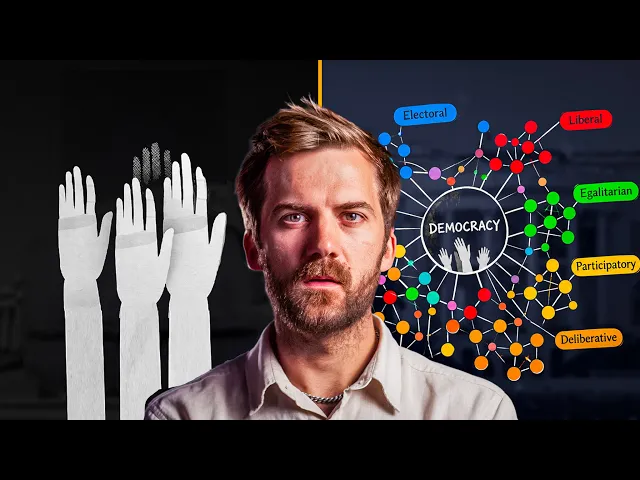
I don't get democracy
Johnny Harris
0:02 [Commentator] We're in a situation that we in America
0:04 never thought we would find ourselves in, that is, democratic backsliding.
0:08 [Commentator]...
0:09 for the people it robs and rules.
0:10 America was founded as a constitutional republic, not a democracy.
0:15 [Commentator] ...but this would certainly be one of them.
0:17 I think democracy is in trouble.
0:22 The average voter doesn't know how to vote,
0:25 and that's why democracy doesn't work.
0:31 (buttons clicking)- Hi.
0:33 Hi.
0:34 So listen, I know we've made videos
0:36 about fascism and oligarchy, all these words,
0:39 that we hear this stuff all the time, but we don't understand it.
0:41 Well, I have another one.
0:43 Okay.
0:45 Democracy.
0:47 I know it's like the most basic one.
0:50 Yeah, do you not know what it means?
0:51 I know what it means.
0:52 I know what democracy is, but I don't really know.
0:55 I mean, let me show you some of these clips.
0:57 Okay.
0:57 (buttons clicking)- Democracy means the right to vote for your leaders.
1:01 It's so simple.
1:03 Okay.
1:04 Well, no, I mean, I agree.
1:05 What is confusing about that?
1:07 I agree with that.
1:08 Okay, but look at this one.
1:11 Democracy is more than voting in an election
1:14 or getting registered to vote in an election.
1:17 Okay, okay, I get it.
1:18 Okay, so, right, democracy is not just voting.
1:21 Is that what you're trying to say?
1:22 No, no, no.
1:23 I have more.
1:24 Listen to this guy.
1:25 Democracy means that the majority is limited by your rights.
1:29 You know, the government can't censor you.
1:31 They can't throw you in prison.
1:32 There's certain things it can't do.
1:35 Okay, so it sounds like you're saying democracy means different things.
1:41 It seems to.
1:42 Like this started because I've been hearing people
1:43 use the word democracy all of the time.
1:46 People are saying that democracy is in trouble.
1:49 People are saying that the US actually isn't supposed to be a democracy.
1:51 It seems like when different people use the word democracy,
1:55 it sounds like they're talking about totally different things.
1:58 Should we just like edit in a montage right now of different
2:02 people using the word democracy in all sorts of different ways?
2:05 Yeah, I think that would be good.
2:06 Democracy means equal access to power.
2:09 Democracy means modernization.
2:11 Democracy means the people rule.
2:13 Democracy requires compromise.
2:15 Democracy means choice.
2:16 Democracy means nuance and differences in perspectives.
2:19 Democracy means you shut up.
2:21 The point of democracy is that we vote all the time.
2:24 Democracy simply doesn't work.
2:26 Democracy and inequality is completely at odds.
2:29 This is democracy manifest.
2:31 There is no democracy.
2:33 What is democracy?
2:34 (intense music)- So my first question was, does democracy have a useful meaning?
2:44 And then, instead of answering my question, Adam sent me this.
2:50 (upbeat music) And he said I can't open it.
2:57 So did you get the package?
3:00 I did get the package.
3:01 I have not looked inside, but I am increasingly curious about what
3:05 is going on here with these numbered boxes.
3:09 All right, so open up Number 1.
3:12 Okay.
3:13 (upbeat music continues) What?
3:16 What am I looking at here?
3:19 You are holding our first principle of democracy.
3:24 [Johnny] What?
3:27 I have no idea where this is going.
3:29 Okay, so basically what I've been doing the last few weeks is I've been
3:31 talking to like any smart person who will agree to talk to me about democracy.
3:34 And you came back with this?
3:36 (laughs)- What I learned, first off,
3:38 is the data actually does back up the thing that we are noticing, right?
3:41 Good.
3:42 People actually do use the word democracy
3:43 to mean a lot of different things, right?
3:44 So there's this study, this is from 2024, and it asks,
3:49 what do ordinary citizens mean by the term democracy?
3:51 In other words, what do you need for it to be democracy?
3:55 The answers are in this graphic that is extremely hard to read.
4:00 But basically, all the things on the left,
4:02 people rated these things from one to ten.
4:04 How important are they to democracy?
4:06 And the different shades of squares are different numbers, one to ten.
4:10 But one way to look at it is like, how many people,
4:12 for each of these, rated them six out of 10 or higher,
4:15 in terms of each thing's importance to democracy?
4:18 If we do that, we can take that data, flip it around,
4:19 and it becomes a bar chart that we can read, right?
4:21 So the most common answer of what is necessary for democracy is...
4:26 Free elections is what they say, which is not a surprise.
4:28 That, to me, is like the sort of quintessential feature of democracy.
4:33 But, very close behind it is gender equality.
4:36 Very close behind that is civil rights.
4:38 Close behind that is state aid for the unemployed.
4:41 And then taxing the rich and subsidizing the poor, not too far behind.
4:45 People often use democracy as a term
4:47 that means whatever they think is good government.
4:49 Which is what got us down this rabbit hole in the first place.
4:52 Honestly, this is where I get so confused because civil rights, gender equality,
4:55 taxing the rich, like, in my mind, democracy is like a system of government.
4:59 It's not like a bunch of good things.
5:02 So I don't really get it.
5:04 Yeah, I mean, this was confusing for me too, right?
5:06 And the study, it does seem to support the idea
5:09 that democracy means almost whatever you want it to mean.
5:11 But I think what I have found is that democracy actually means five things.
5:19 Is that what we're going to call this video,
5:20 "Democracy is Five Things?"- I mean, I don't think everyone would agree,
5:24 but of all the interpretations and answers that I have come across,
5:27 “democracy is five things,” for me,
5:30 is the version that I have found most helpful for understanding this.
5:33 And it starts with the literal definition of the word.
5:36 Do you remember what that is?
5:38 Yeah, yeah, yeah.
5:38 That's like the basic, people, to rule, or have power.
5:42 So it's like power to the people, the rule of the people.
5:46 [Adam] Yeah, that's the dictionary definition.
5:47 So the people rule.
5:49 The people have power.
5:50 As opposed to, say, a monarch having power over the people.
5:54 The problem is, that idea, of people having power, what does that look like?
5:59 That leaves open a whole lot of questions.
6:01 Which people govern?
6:02 How do people govern?
6:03 How do you know that they're governing and not somebody else?
6:06 What we're going to talk about in this video
6:07 is five ways to interpret that idea, of people ruling.
6:10 And it starts with the one that is in your hand right now,
6:12 which is going to take us back to that very first thing that we said,
6:14 which is, democracy is elections.
6:18 (upbeat music) So if we go back to that basic idea, right,
6:23 of the people ruling, people have power,
6:26 the best known ancient form of that was in...
6:29 [Johnny] Ancient Greece, question mark?
6:30 [Adam] Yeah, Athens, specifically.
6:32 Yeah, direct democracy where the people themselves, or I guess men,
6:37 would assemble in some form,
6:39 and they would sort of vote on governmental questions.
6:43 Yeah, and for a long time after that, even though it was a long time ago,
6:48 that was though of by many as, that's what democracy is.
6:50 Back in the 1700s, we have our friend James Madison, US founding father.
6:54 He says, "In a democracy,
6:56 people meet and exercise the government in person," right?
7:00 Because that was the definition of democracy
7:01 that he was working with, direct democracy.
7:04 And it confuses a lot of people today, right?
7:06 Because if you believe that the definition of democracy
7:07 basically never changed after that, we are not a democracy.
7:11 Because direct democracy would be like we all show up and hash it out,
7:14 and we don't all show up and hash it out.
7:17 Right, and, by and large, no large societies govern themselves that way today.
7:21 You don't really do that at scale.
7:23 What might sound more familiar is what Madison says
7:26 in the very next sentence in the same essay.
7:28 He says, "In a republic,
7:30 they administer government by their representatives," because
7:33 that obviously is what we do today.
7:36 We elect people to make government decisions on our behalf.
7:40 The people rule by choosing who rules.
7:46 And Madison said, "Well, I don't think that's democracy.
7:48 I think that's something else called a republic." But today,
7:51 political scientists, if those representatives are chosen by the people,
7:53 they call it electoral democracy.
7:57 Our first, most basic way of defining democracy.
8:01 Cool.
8:01 Nice.
8:01 I think we can move on to Number 2.
8:03 Actually, no.
8:03 So, sorry, we're not done yet.
8:05 So watch this clip.
8:06 Vladimir Putin is expected to win a further six years in power.
8:10 His only serious opponents are either in prison, in exile, or dead.
8:15 (laughs) Geez.
8:17 Okay.
8:17 Yeah, I see.
8:20 The idea here is that elections alone
8:22 are not enough to be an electoral democracy.
8:25 Yeah, because it seems like for it to be a legit electoral democracy,
8:28 you have to be choosing who rules.
8:31 But in Russia, as we just heard, it's not a real choice.
8:35 You're not actually choosing.
8:36 [Adam] The elections need to be real competitions.
8:39 Not like Putin eliminating all of his rivals and taking out any competitors.
8:45 That's the first thing.
8:46 And if there are elections,
8:47 but only some people can vote, that's also not enough either.
8:51 We need to have broad, equal voting rights.
8:54 A free press, also under this umbrella,
8:55 because, again, think about Russia, right?
8:57 It's a place where there's not a lot of freedom of the press.
9:00 It's like if you don't have a free press,
9:02 the information that you need to choose your leader is not available,
9:05 so it's not actually a choice.
9:07 It needs to be an honest, real choice, right?
9:09 This first principle, electoral democracy,
9:11 it's closest to what political scientists,
9:13 they have this word for it, it's the “thin” definition of democracy.
9:16 Like the bare minimum.
9:18 It's what most political scientists consider to be the base.
9:23 We consider electoral democracy essential
9:25 or fundamental for any kind of democracy.
9:28 There's no way to have a democracy unless you have elections.
9:32 That's...
9:33 Not everyone agrees with that.
9:34 We're going to come back to that idea,
9:36 but most Western political scientists agree with that.
9:39 And so what you're holding right now is, today, going to be our base.
9:42 It's our first and most important piece.
9:44 (upbeat music)- Working on this video, I've been thinking a lot about rights,
9:52 the rights that we have and what it actually takes to use those rights.
9:57 One right I've become increasingly interested
9:59 in is the right to have data privacy,
10:01 meaning to have some control over where my personal data ends up.
10:05 Turns out there's hundreds of data brokers
10:07 buying and selling all of our information,
10:09 things like our address, and our name,
10:11 and our phone number, and our shopping habits.
10:13 And it turns out you and I have a right
10:16 to delete that information from these data brokers' databases.
10:20 And even though we have this right,
10:21 doing it ourselves becomes incredibly cumbersome
10:24 because there's just so many data brokers.
10:27 That's why I use Incogni, who is the sponsor of today's video.
10:30 I've used them for literally years.
10:32 What I did is I signed up for Incogni.
10:34 I gave them permission to act on my behalf
10:37 to go make requests to remove my information from these lists.
10:41 And that's what they do.
10:42 They go out and they send removal requests to these data brokers over
10:46 and over so that as my name continually shows up on these lists,
10:49 Incogni is there helping me strip it away.
10:52 All I have to do is open up a dashboard and watch the progress
10:56 as it happens to see what they've removed and what they're still working on.
11:00 They've been successful on like 1,000 of these lists,
11:03 which is very satisfying to watch for me.
11:05 I'm on the Incogni Unlimited Plan, and I have their exposure scanner,
11:09 which actually scours the web and shows
11:11 me where my personal information is exposed.
11:14 I can choose what I want to be removed with the click of a button,
11:17 and they handle the removal.
11:18 And if I find a specific link myself that I believe my data is being
11:22 bought and sold on, I can send
11:23 it to Incogni through their custom removal feature,
11:26 and they'll work on removing it as well.
11:28 If this sounds interesting to you, and you want a big discount,
11:30 use the code JOHNNYHARRIS and get 60% off
11:33 the annual Incogni plan when you go to my link.
11:36 It's incogni.com/johnnyharris.
11:39 Use the code JOHNNYHARRIS.
11:40 You get a 30-day money back guarantee so you can try
11:43 it out and see if this is actually useful for your life.
11:45 Again, that's incogni.com/johnnyharris, code JOHNNYHARRIS.
11:48 The link's in the description.
11:49 Thank you Incogni for sponsoring today's video.
11:52 And now, let's get back to democracy.
11:54 Another reason, besides being the base,
11:55 that this is important is that when we look at countries around the world,
11:58 this criteria, electoral democracy,
12:00 this is like basically how we distinguish what
12:02 is a democracy from what is not a democracy.
12:04 Because a lot of countries have called themselves democracies,
12:07 or they've had “democratic” in their name,
12:09 but they're not broadly considered to be actual democracies.
12:12 [Johnny] The Democratic People's Republic of North Korea.
12:15 Right, exactly.
12:16 And they have elections.
12:17 You can Google North Korea elections, but they're not real.
12:20 You get one choice.
12:21 Or you have like the former East Germany, right?
12:23 German Democratic Republic, similar deal.
12:25 They had elections.
12:25 They were not actual choices.
12:27 Those “Democratic” names of those countries are just using a different concept.
12:32 It's a Marxist-Leninist concept,
12:34 a party that's supposed to represent the working class' interests.
12:38 The only thing is that that party
12:39 does not win power through competition or elections.
12:41 It's just kind of in charge.
12:43 What would a Western political scientist classify those places as?
12:49 Let me bring up this map, right?
12:50 This is using data from a project called V-Dem.
12:55 It's short for Varieties of Democracy,
12:57 and it's basically like a bunch of prominent political scientists,
13:00 they got together, and they decided to sort of try
13:02 to measure the amount of democracy in the world.
13:05 They were important to this project, so we're going to come back to them later,
13:08 but what the map is basically showing is,
13:10 it's color coding every country according
13:12 to this question of, how competitive are their elections?
13:18 So this first color is going to be all
13:21 the countries where there are no competitive elections, right?
13:24 So they might have elections,
13:25 but the elections don't even pretend to give you an electoral choice,
13:29 if they have them at all.
13:31 And we should say, this is not
13:33 our judgment of which countries are in which category.
13:35 Probably, people will disagree with some of these, right?
13:38 These are places that have elections,
13:40 but those competitions are just not completely fair
13:43 or free in the eyes of these scholars.
13:47 So these are not technically electoral democracies.
13:49 You got Russia.
13:51 You've got Iran.
13:52 [Adam] And then, finally, we have this set of countries,
13:55 which is what they deem countries with mostly free and fair elections.
13:59 [Johnny] Okay, wait, hold on.
13:59 What's this fourth category?
14:02 I have sneakily hidden the name of this fourth category,
14:05 because now you can open up drawer Number 2.
14:09 (suspenseful music)- Where is this going?
14:17 All right, so this is going to be our second principle, right?
14:21 And it's also going to be our first big step
14:23 into this brave new world of, what is democracy besides elections?
14:30 (suspenseful music continues)- Ah, yes.
14:34 Our good old friend, liberal democracy.
14:37 To explain this one,
14:38 I'm going to show you a YouTube comment that is very, very common.
14:42 You will see this posted under lots of videos, and I want you to read it to me.
14:47 [Johnny] "'Democracy is four wolves and a lamb voting on what
14:51 to have for dinner.' Benjamin Franklin." Did he actually say that?
14:55 Well, what does the quote mean to you?
14:57 [Johnny] Like democracy is like majority rule, and so if you're a sheep,
15:00 it's bad for you because the wolves will choose to eat you.
15:05 The point is usually that democracy is just
15:07 a way for the strong to dominate the weak.
15:09 To answer your question, Benjamin Franklin extremely never said it.
15:13 As far as we can tell,
15:14 the first use of this quote was in a newspaper column in 1990.
15:17 And I would say, typically, if you see a quote in a YouTube comment attributed
15:21 to Ben Franklin or like a famous historical person ever,
15:24 just assume that it's fake.
15:25 Like, the person posting it may not know that it's fake,
15:27 but assume that it's fake.
15:29 Okay, but the quote actually has some resonance to it in terms of, like,
15:32 if the majority gets to rule, the four wolves will always get to eat the sheep.
15:36 That kind of is democracy, right?
15:39 It is, but only in this really particular way, right?
15:43 Because what it is describing is what democracy
15:46 can be if you don't have any rights-- Yeah.
15:51 Any protections.
15:52 Any freedom.
15:52 Right, exactly.
15:53 Freedom, rights-- Freedoms.
15:55 Liberties, right?
15:56 And this is where we are going to get to the idea of liberalism,
15:59 the idea of individual freedom.
16:02 Liberalism.
16:02 Okay, this is a word that I've heard my whole life.
16:05 Liberal, here in the United States, also kind of means like, woke, like left.
16:09 Like, if you put liberal on an online profile,
16:12 it means that you are left-of-center here in the United
16:14 States and probably a lot of other countries.
16:16 This is something that I know you and I
16:18 have been both confused about for a long time.
16:20 This idea of, liberal democracy, does it mean woke democracy?
16:24 We're going to take a side quest because
16:25 in researching this, I realized I was confused about it,
16:27 and the reason that I think we're confused about it is because...
16:32 At a certain moment in its history,
16:34 liberalism really breaks off into two streams.
16:38 (energetic music)- So the short and oversimplified version,
16:44 just as a caveat here, right?
16:47 Liberalism was always about individual freedom, right?
16:50 And this question of what needs to be
16:53 done in order to protect that freedom in society?
16:57 Early liberalism was very concerned
16:59 with government that safeguarded individual rights.
17:02 So it was about a kind of a constitutional system.
17:05 [Adam] So a constitutional system is a system
17:07 that basically puts limits on what a government can do.
17:10 It's this higher law that no one is sort of above.
17:13 Because we're talking about what?
17:15 The 1700s, the 1800s.
17:17 And one of the big fears and risks that people
17:18 were aware of at the time was the big,
17:21 scary, oppressive king, maybe like a Napoleon type,
17:24 who just is sort of above the law.
17:26 Yeah, and another element of that at the time is that free
17:29 markets are considered one of the things that make us more free.
17:33 So if you want general prosperity,
17:35 if you want freedom for many people, then you advocate free markets.
17:41 And then, something happens.
17:44 (energetic music continues) The Industrial Revolution, right?
17:54 The Industrial Revolution happens, and it changes the world, right?
17:58 Like it changes the economy.
18:00 It changes where people live.
18:02 People move to cities.
18:03 It changes how people work.
18:04 People work in factories.
18:05 And it changes the stratification of wealth.
18:07 It creates massive wealth concentration at the top
18:10 and extreme poverty at the bottom.
18:12 The Industrial Revolution is totally transformative
18:16 and in some ways, disastrous, right?
18:18 And by the late 1800s, some people are beginning to feel like,
18:23 maybe this free market that we've been venerating, is actually like,
18:26 maybe it's a little bit dangerous if left untouched.
18:30 New liberals look at the situation and ask,
18:32 "How can these poor people really be free?
18:35 How can we allow the market to do what it's doing to these workers?
18:40 They're not being raised by this freedom, they're not becoming freer,
18:44 they're stuck." And so what the state
18:47 should do is provide conditions for freedom,
18:51 and that takes a little bit of intervention.
18:54 And so this is the big split, right?
18:57 Some liberals stick to their guns.
18:59 They say, "No, sorry, the market is not the problem.
19:04 The people's freedom still needs to be
19:05 protected from an oppressive state." But other liberals,
19:07 they call themselves new liberals, they say,
19:10 "No, it's the unregulated capitalist machine.
19:13 Industrial capitalism, this is the big threat to freedom.
19:16 And what the state needs to do,
19:17 what the government needs to do is put safeguards on that in order
19:21 to protect people's freedom."- And that's where
19:24 they get more of like a big-government liberal,
19:26 which is like left-of-center modern American politics.
19:30 We're already in a side quest, but let me sidebar even further, right?
19:34 In the 1800s, the new liberals are not the only
19:38 people noticing that industrial capitalism is causing some problems.
19:42 There are people, there are very well-known thinkers,
19:44 who are also noticing that, and offering solutions for that.
19:47 But to the new liberals who are pointing that out as a problem,
19:50 they want the government to protect people from capitalism,
19:52 but they're still basically just saying capitalism can be tamed.
19:56 It can be regulated.
19:56 It does not need to be dismantled, right?
19:59 Because after all, they are...
20:01 Goddamn liberals.
20:03 So you get this liberal split, right?
20:04 And I think the best way to see that today
20:07 is you look at the Liberal Party of Australia,
20:10 and you look at the Liberal Party of Canada.
20:12 These are two of the largest political parties in those countries,
20:15 and they have the same name.
20:16 But if you look at Australia's Liberal Party's platform,
20:20 it talks about things like free enterprise,
20:22 private property, minimizing the regulatory burden on business.
20:27 The platform of Canada's Liberal Party talks about things like a just society,
20:31 human dignity, equality of opportunity, diversity.
20:35 Wow, it's like two totally different
20:38 versions and interpretations of the word liberal.
20:41 But how does this understanding of “liberal”
20:45 help us understand what liberal democracy means?
20:48 Isn't that the point of the side quest?
20:50 The way to understand the liberal part of liberal
20:52 democracy is that it is closer to this one.
20:54 (suspenseful music) Really, it comes from the early 1800s meaning.
21:00 It's a system that limits the power of the government.
21:04 People need rights and freedoms that the state cannot violate.
21:09 Okay, so liberal democracy does not mean woke democracy.
21:13 It means a democracy, which is a voting thing,
21:16 that also gives people rights, even if they're in the minority.
21:21 Right, it means the wolves cannot vote to eat the sheep.
21:23 The sheep is a citizen.
21:24 Eating the sheep is illegal.
21:26 It means the government cannot throw you in jail for no reason, basically.
21:28 You have rights.
21:30 And if we go back to our diagram of the people ruling,
21:34 right, if electoral democracy says the people rule by choosing who rules,
21:39 liberal democracy says the people rule by staying free,
21:44 by having rights that no government can take away.
21:47 [Johnny] Yeah.
21:48 And partly because there are limits, checks,
21:49 right, on the power of the government.
21:51 No one in the government can get too powerful to act alone.
21:54 Like the fact that we are ruled by law
21:57 that protects us and not by someone's whims.
22:01 [Adam] Exactly.
22:01 Rule of law, like this basic thing that we all sort of take for granted, right?
22:05 It's actually, that's what you call a liberal democratic idea.
22:09 Some basic guarantees that constrains the government in between elections
22:14 so that you don't end up with an elected dictator.
22:17 Okay, so wait, this is a puzzle.
22:19 So now I have electoral, and I have liberal democracy, right?
22:26 That's what you got.
22:26 Kind of looks like we're building something now.
22:28 What else do we need to build this?
22:30 Go ahead and open up Number 3.
22:31 (energetic music)- What's this?
22:39 Well, what you were saying,
22:41 like what else do we need besides free and fair elections and liberal rights?
22:46 A lot of analysis of democracy does stop there.
22:50 You can vote, you have rights.
22:52 What more is there?
22:52 And that's kind of where I was.
22:54 But then I talked to this Harvard professor, and she was basically like,
22:57 "Okay, the law can say all of these things..."- You know,
23:01 you can say you've got a right on paper, but if there's no actual,
23:04 practical way to make it real, then it's just a fake right.
23:08 Think about how our elections in the US actually work in practice, right?
23:14 And we have made a video about this.
23:16 In the United States, we have these organizations called super PACs, right?
23:19 And what they do is they basically collect
23:21 and spend money to help a particular candidate.
23:23 And anyone can legally give as much money
23:26 to one of these organizations as they want.
23:28 And most Americans do not give any money at all in elections,
23:33 but some billionaires, including people you've never heard of, give
23:36 sometimes hundreds of millions of dollars.
23:39 Even though we all get one vote,
23:40 our ability to actually impact the democratic process
23:43 and decision making is actually not equal at all.
23:48 Right, it's an example of inequality
23:50 outside of politics translating into democratic inequality.
23:55 This is the idea that if the people really do have the power,
24:00 that means that the power needs to be equally shared among the people, right?
24:04 So the people rule by having equal access to that rule.
24:09 We're all equal, and we're equal
24:11 in this very basic way of being decision makers.
24:13 (upbeat music)- Egalitarian democracy.
24:20 Take me through it.
24:21 [Adam] First is just like, are your needs met?
24:24 People cannot really participate as free and equal citizens
24:29 in a democratic system unless they have a roof over their heads,
24:33 they have enough food to eat, they have some minimal education.
24:36 But one level up from that very basic idea, even if you aren't poor,
24:39 are you in a situation that limits access to your own rights?
24:44 You know, does your employer give you the day off on election day?
24:48 In America, in most states, somebody could be fired for expressing
24:52 political opinions that their boss disagrees with.
24:56 Egalitarian democracy basically says,
24:58 material conditions should not impede those things, right?
25:02 So one level up from that is this idea
25:05 of your democratic rights really being equal, right?
25:08 We all have one vote, but when it comes to the other ways,
25:11 like we talked about before with super PACs,
25:13 and there's lots of ways to influence democracy besides your vote,
25:17 are we equal in those ways?
25:19 Our little green guy, egalitarian democracy,
25:22 this is the tradition within democracy that is most opposed to oligarchy, right?
25:28 It's the one that says that extreme
25:30 inequality and democracy are each other's enemies.
25:33 Material inequalities, if they get too large, do undermine democracy.
25:39 Okay, that makes sense.
25:40 Egalitarian democracy.
25:43 You've got voting.
25:44 You've got liberal protections for everyone,
25:47 including people who are not in the majority.
25:49 And you've got equality in your political power.
25:53 (upbeat music) Okay, cool.
25:58 This thing's starting to come together.
25:59 Now what?
26:01 [Adam] So the next one, it basically says that representation,
26:04 can't mean just handing over power, and then shutting up.
26:08 We need to participate in our own rule.
26:13 When more ordinary people get to exercise
26:18 voice and influence over some set of decisions.
26:21 Okay, so this goes back to that one clip I showed you
26:24 where that guy explicitly says-- Democracy is more than voting in an election.
26:29 So go ahead and open up Number 4.
26:31 (upbeat music continues)- Democracy is not just showing up to elections.
26:41 What could it be?
26:42 (upbeat music continues) Particip...
26:45 Pa-pa-particip...
26:47 You say it first, actually.
26:49 Participatory.
26:50 Participatory.
26:51 This is participatory democracy.
26:54 So have you ever seen a protest and people are chanting something like...
26:59 Show me what democracy looks like.
27:01 [Crowd] This is what democracy looks like.
27:03 Show me what...
27:04 [Activist] Democracy looks like.
27:05 [Crowd] This is what democracy looks like.
27:08 Show me what democracy looks like.
27:10 This is what democracy looks like.
27:12 Yeah, every single one.
27:14 Every protest I've ever been to, people chant that.
27:17 Well, the confusion that I had, right, was like,
27:19 before we made this video, I was like, again, democracy is voting, right?
27:23 Yes, that's always my confusion as well when I hear that.
27:25 I think my interpretation,
27:27 why protesting is what democracy looks like, was always like,
27:31 we have the right to protest and that right,
27:34 which is more of like a liberal thing, is democracy.
27:37 We're showing off our democratic rights.
27:40 So what I know now is that we were
27:42 working with a kind of a thin definition of democracy.
27:45 Democracy is elections.
27:46 Maybe democracy is rights.
27:47 But what I was missing was that protesting, yeah,
27:51 it is a way to exercise our right to free speech and our right to assemble,
27:55 but it's also a way of telling our leaders what to do.
27:59 Okay.
27:59 Participatory democracy is protesting?
28:05 [Adam] Protesting, advocacy groups,
28:06 being active in a political party, joining a union,
28:09 like anything that might be called organizing or action,
28:12 that's a big part of what participatory democracy is.
28:16 Okay.
28:17 And, again, I'm thinking back to that clip.
28:19 It's about showing up in front of your school board,
28:22 going to the city council meeting.
28:24 [Adam] Like a town hall where officials hear
28:27 from citizens or any opportunity for public comment, right?
28:31 The places where regular people get to have
28:35 input on what the government is doing.
28:37 Okay, so when we vote on a referendum, like in Switzerland,
28:42 they have a really direct democracy because they vote on everything,
28:46 like a ballot initiative in California, right?
28:48 [Adam] Yeah, direct decision making.
28:50 That's the other big piece here.
28:52 Okay.
28:53 The idea here is, ideally, we elect leaders,
28:59 and they govern perfectly on our behalf, but that's an ideal.
29:05 I would love for there to be hundreds of thousands of empathetic,
29:10 non-self-interested elites who are making decisions
29:13 with my best interests for me and mine, right?
29:16 But like, show me a couple of them.
29:18 Yeah, like I guess, in theory,
29:19 our leaders that we elect are supposed to be our representatives, but...
29:25 So often these other tiers of decision
29:29 making and political leadership or agencies or whatever are not making decisions
29:33 in our best interests or effectively advancing our welfare,
29:38 either because they're trying to do other things,
29:40 like get reelected or raise political donations,
29:44 and we don't happen to have significant amounts of money
29:47 for that, or they just don't know what some people's lives are like.
29:53 Hey, there's something exciting happening over at newpress.com,
29:56 which is our platform for creator-led journalism.
29:59 It's the only place where you can watch videos like
30:01 this one a week early and without any ads or interruptions.
30:05 You won't want to miss this.
30:06 It's not just my videos.
30:08 It's also the incredible roster of creator
30:11 journalists that we have here at Newpress,
30:12 which is Max Fisher, Sam Ellis, and Christoph Haubursin.
30:15 You get access to these videos and more
30:17 for 60 bucks annually or five bucks a month.
30:19 That money goes directly to support this work.
30:22 It allows us to make more ambitious work, to tell more ambitious stories.
30:26 And it gets you all kinds of perks in addition to early and ad-free videos.
30:30 So head over to newpress.com now and sign up.
30:32 Click the link in the description to get started.
30:34 Thanks to all the supporters over at Newpress.
30:36 You really do make this work possible.
30:38 So I'm going to add this to our puzzle.
30:43 Participatory democracy, that adds to our elections, to our liberal rights,
30:50 to our equality to actually exercise those rights within the real world.
30:56 And now, our ability to actually participate,
30:59 to go to the city councils, to go out onto the street,
31:02 and make sure that our representatives
31:06 that we elect stand accountable to our interests.
31:09 (upbeat music) But wait, I have a question.
31:16 I had a conversation once with a Swiss friend of mine.
31:20 Switzerland is a place that like does direct democracy better than anyone.
31:24 They vote on everything.
31:26 And he was like, "Yeah, we vote on everything,
31:28 but like half the stuff I see on the ballot,
31:30 I don't even know what it is." And, you know,
31:33 like I hear that, I see that in California.
31:35 I see stuff on my ballot sometimes, and I'm like,
31:37 "I'm voting on this, but I don't actually know
31:39 what it is." It feels like not the healthiest thing,
31:41 even if, in theory, it sounds good.
31:44 I actually have an example, an American example,
31:46 of what you're talking about, right?
31:48 So this is a ballot question from 2025 in Ohio in the US.
31:56 And I am going to read it to you right now, okay?
31:59 [Johnny] Okay.
32:00 [Adam] "This proposed amendment would: 1.
32:02 Authorize the state to issue bonds or other obligations to finance or assist
32:07 in financing public infrastructure capital improvements
32:09 for local governments and other governmental entities.
32:12 Capital improvement projects would be limited
32:14 to roads and bridges..." "Employment opportunities
32:16 and improve the economic welfare
32:17 of the people of Ohio..." "Ensure public health,
32:20 safety and welfare..." "Any amount that could have been
32:22 issued in any prior fiscal year but was not
32:24 insured now later than 30 years after..."- Do you
32:28 have one of the All Maps Are Wrong posters?
32:31 So couple questions.
32:32 Do people even understand what they're voting on when
32:35 you give it to the masses like that?
32:37 And number two, who the hell is going to take the time to read all of that?
32:42 So those are exactly right questions, right?
32:44 It's this question first of like what is actually expected of us as voters,
32:48 but also like if we don't understand it, right,
32:51 how are we supposed to trust that anybody else does?
32:55 So you haven't just hit on one
32:57 of the major questions about participatory democracy.
33:00 This is one of the big questions that people have about democracy in general,
33:04 especially on YouTube.
33:06 The average voter doesn't know how to vote,
33:09 and that's why democracy doesn't work.
33:12 I mean, the idea is basically in practice, people are kind of idiots, right?
33:17 We lack all sorts of knowledge.
33:20 It's a very common sentiment.
33:22 And here's another very common YouTube comment that I want you to read to me.
33:27 Okay, "'The best argument against democracy is a five-minute conversation
33:31 with the average voter.' Winston Churchill."
33:35 (laughs)- Winston Churchill absolutely never said that.
33:40 As far as we can tell, it is from a message board post from 1992.
33:45 Anyway, the point of the quote is
33:48 that democracy itself has this fatal flaw, right?
33:50 And the fatal flaw is that people are stupid.
33:54 But the actual idea at the core of like
33:57 giving the masses the reins on the decisions,
34:01 the technical, difficult, complicated decisions of governing a country,
34:05 it has some big issues.
34:08 So it's a legit opinion to have, I think.
34:11 This is where we have another study that is going to be helpful to us, right?
34:14 This one is almost 50 years old, but it looms pretty large in the field, right?
34:19 And it asked a large group of people the following question.
34:23 "Do you agree or disagree with the idea
34:25 that the 1975 Public Affairs Act should be repealed?"- Wait,
34:30 sorry, what is the 1975 Public Affairs Act?
34:33 We'll get to that.
34:34 But, basically, 16% said, yes, repeal the 1975 Public Affairs Act.
34:39 18% said, no, do not repeal it.
34:42 A full two-thirds of people had no opinion whatsoever.
34:48 Okay, so I'm seeing here, it's just like sort of public ignorance
34:52 about what the 1975 Public Affairs Act is, which I feel that too.
34:58 Right, so can I tell you what it actually was?
35:00 Please.
35:01 Yeah, what?
35:02 There is no 1975 Public Affairs Act.
35:05 They asked about a fake law, right?
35:07 And that should actually change how you see these results a little bit.
35:11 [Johnny] Yeah, it totally does because two thirds
35:14 of the people said they didn't know because it didn't exist,
35:17 and they truly didn't know.
35:18 But then, you have one third of people who pretended to know.
35:23 It was shocking because you had
35:25 a legitimate survey where people responded to it,
35:28 and people were too embarrassed or just
35:32 didn't have the time to tell the interviewer,
35:36 "Oh, I actually don't know."- One of the major
35:38 takeaways from this study for political scientists,
35:41 it was not that people are stupid.
35:44 It's that when you ask people to weigh in completely cold on questions
35:49 like this, the problem is not that you're getting the opinions of dumb people.
35:53 It's that you're not really getting real opinions at all.
36:00 Our very expectations for what people know
36:03 and what they have informed opinions about is wrong.
36:06 That is exactly the problem with public opinion.
36:09 If regular opinion is going to get you lies,
36:12 then we need to actually educate people,
36:15 inform people, and give people the opportunity to actually engage.
36:19 In other words, the problem of the low- information voter is real, right?
36:24 But it's not this innate problem with democracy as a whole.
36:27 It just means that there's this one element
36:29 of it that we're not doing that well.
36:32 So in the same way that the wolves voting to eat
36:35 the sheep is a problem that liberal democracy can address,
36:39 the fact that we are all apparently dumb idiots is
36:43 a problem that the next principal of democracy can address.
36:46 The question is when people go and cast their ballots,
36:49 what are their decisions based on?
36:52 Is this time for me to open Number 5?
36:55 [Adam] Go for it bebe (suspenseful music)- Let's talk about it.
37:07 What am I looking at here?
37:08 [Adam] Okay, so this principle says that the people
37:13 ruling means the people making decisions together,
37:17 and it requires us to understand not just the issue at hand,
37:23 we actually have to understand each other.
37:25 It means that the rule of the people emerges from a public process.
37:31 To have the public actually deliberate and engage with each other before they
37:37 go to the ballot box or provide
37:41 their thoughts to their governments and policymakers.
37:45 They have to listen and not just decide.
37:48 [Adam] This is deliberative democracy.
37:50 (upbeat music)- You know, in contrast to participatory democracy,
37:56 which doesn't require you to necessarily engage with others,
38:01 you just participate,
38:03 or in electoral democracy, you just cast your ballot, in deliberative democracy,
38:07 the intent is that you actually engage with your fellow citizens.
38:11 So in my opinion, this might be the one where I think we're
38:16 faring the most poorly because when we engage with each other on politics,
38:20 it tends to look like this.
38:23 You're lying.
38:23 You're lying.
38:24 (people shouting over each other)- So give me evidence to prove that.
38:27 Can I say that you're a fat piece of (bleep)- You can call me fat all you want.
38:30 (people shouting over each other)- [Host] Guys, guys, guys, guys, guys.
38:35 You don't respect the constitution.
38:37 No!
38:38 Point of order, point of order.
38:40 Can you stop interrupting me?
38:40 I'm talking.
38:41 I'm talking.
38:42 Yeah, I mean, more and more I hear people say they hate politics.
38:46 Right.
38:47 And this is why.
38:48 It brings out the worst in us and it incentivizes us,
38:52 especially these days, to just like, dunk on other people.
38:55 And it's like, that's no fun.
38:56 And I understand why people opt out.
38:58 Instead of trying to make us smarter or more informed,
39:01 anytime people are engaging with each other on politics,
39:04 it feels like it's actually all about winning, right?
39:06 Not convincing, not listening.
39:09 We have been socialized to accept that there is a winner in debates
39:15 and deliberation is trying to get everyone to think about what others think,
39:21 what others' lived experiences are, and then,
39:24 reflect and figure out what our views on those issues are.
39:27 So nobody is winning.
39:29 I'm curious what that actually would look like.
39:32 What would it mean to be good at it?
39:35 In the case of Article 40.3.3 being replaced with a constitutional provision,
39:41 who would be the author or authors?
39:44 Wait, what's this?
39:46 So this is footage from Ireland from 2016,
39:49 and the group that you're looking at is
39:52 made up of 99 basically randomly selected Irish citizens.
39:56 The idea of randomly selecting a group of people
39:59 to form a body is called sortition, right?
40:03 This is an idea from ancient Athens.
40:05 It's related to how we choose juries.
40:07 So Ireland, at the time, had one of the world's most restrictive abortion laws.
40:12 It's comparable to the law in Idaho today.
40:16 But Ireland is not Idaho.
40:18 There was enormous pressure within the country to change the law.
40:22 But it was the kind of issue that, you might not be surprised to learn,
40:27 Ireland's politics, like, couldn't handle.
40:30 It was extremely divisive, extremely heated.
40:33 They couldn't figure it out.
40:35 So the country convened what they called a citizen's assembly.
40:40 It's those 99 people.
40:41 They got in a room, and they met on the weekends.
40:45 And over the course of a couple weekends, they basically acted like a big jury.
40:48 They heard evidence, testimonials.
40:51 They got to ask experts questions.
40:53 They argued with each other.
40:55 A ton of it was just recorded and made public on YouTube.
40:59 And in the end, the people in that room still didn't agree,
41:02 but it was like the country had had this national conversation in miniature,
41:08 and it helped break the political deadlock.
41:10 The Irish people have voted in favor
41:12 of scrapping a constitutional ban on abortion.
41:15 The point of the story is not “hooray abortion.” It's that this is
41:19 an example of a country being able to work through this logjam,
41:23 right, this gridlock,
41:25 and democratically decide something in a way that felt legitimate, right?
41:29 There was conversation.
41:31 It was a genuine sort of public discussion with multiple viewpoints,
41:35 but also expert input.
41:36 So there's opinions in the mix, but also like real facts.
41:40 What we're trying to get people to understand is
41:42 why people are on either sides of the scale.
41:46 And a lot of what deliberation is,
41:50 is thinking about what other people's lives are like.
41:56 [Adam] There was reflection,
41:57 so you begin to understand other people and why they believe what they believe,
42:01 and that also leads to more informed opinions.
42:06 And we're not saying,
42:07 I'm not saying that when people get into deliberation, people flip.
42:10 They don't go from supporting abortion
42:13 to against abortion in just one deliberation, but rather say, "Well,
42:18 I understand why the other side would vote the way they do,
42:23 and that's okay."- And then, this might be the most important part,
42:26 is that by the end of that process,
42:27 everybody in that room had been exposed to a ton of information,
42:33 multiple viewpoints,
42:34 which means that whatever their opinion was at the end of it,
42:36 they could justify it.
42:38 It was based on something, right?
42:40 And instead of watching politicians with pre-set opinions just bash heads on TV,
42:46 the country watched these regular people come together and figure it out,
42:50 and then the country voted.
42:51 I got a couple questions.
42:52 First off, they heard from experts, but who decides which experts?
42:57 Like whose story do they actually hear?
42:59 And then, the sort of broader question, it's like,
43:01 what legitimacy is there in giving 99 random
43:04 people the right to decide for the whole country?
43:07 So a citizen's assembly is not deciding, right?
43:10 Okay.
43:11 They made a recommendation, and then,
43:13 the entire country voted on a referendum and made the final decision.
43:16 At the same time, all of those questions that you have
43:18 are exactly the right questions to ask about a citizen's assembly, right?
43:22 And the answer to those questions are basically like,
43:23 well, the people who organized it chose the experts,
43:26 and they chose whose stories they heard,
43:28 and they chose what evidence was presented, right?
43:30 And the people who organize an assembly can have biases, for sure.
43:34 Absolutely.
43:35 That is a big vulnerability with this thing.
43:37 It's not perfect, so I don't want to over-romanticize it.
43:40 But I think a big part of this is that there weren't politicians in the room.
43:45 Politicians are from a certain class.
43:47 They're from an elite class, and their incentives are often not totally aligned
43:51 with like the majority of the people, you know?
43:54 And so when you have like just actually the majority
43:57 of the people represented randomly through this sortition thing,
44:01 I imagine you get a different set of incentives
44:04 from those people that you don't get when you have professional,
44:08 attention-seeking politicians as the ones making the decisions.
44:13 So deliberative democracy...
44:17 We talk to each other.
44:18 Boy, I'm in big favor of this.
44:20 We figure it out together, which I think is like,
44:24 that's the most enlightened version of what this was supposed to be.
44:27 (upbeat music)- And now my friend, the bomb is armed.
44:43 You have 10 minutes to answer the following riddle.
44:46 [Johnny] What...
44:47 What I want to add, right, what I think we should say is that even
44:52 though I think this is a powerful metaphor,
44:54 there are other ways to show the five dimensions, the five principles.
44:57 Like you could think of like character attributes,
44:59 like when you're building a video game character, right?
45:02 Each of these could be one slider that you can sort of move back and forth.
45:06 And the point being that we should try to shove
45:09 all of them as far to the right as possible?
45:12 This is the thing, right?
45:14 That in some ways, the five principles fit together in beautiful harmony,
45:20 but in other ways, they're not 100% compatible with each other.
45:24 In some ways, they actually work against each other.
45:26 Like think about if we were
45:29 to maximize opportunities for participatory democracy,
45:32 more town meetings, public comment opportunities,
45:35 who would show up for those meetings?
45:37 Think about that, right?
45:37 Like who has time to participate?
45:41 Yeah, I mean, old people, rich people.
45:43 I see what you mean.
45:44 If you max out one of these, like the participatory one, then,
45:49 you cut against the egalitarian one because people with the loudest voices are
45:55 often the people who have the most
45:58 economic resources and privileges outside of politics.
46:01 The point is just that the cube metaphor is not meant to be perfect, right?
46:05 The goal is not to do each of these things
46:07 perfectly and to have the perfect democracy as a result.
46:10 They're like ideals, but they're also trade-offs.
46:15 And the one other thing that is the other asterisk on this cube, right?
46:19 Do you remember what we said about the blue piece, the electoral piece?
46:23 It's the base.
46:24 It's like everyone has to have that to be a democracy in the first place, right?
46:29 Yes.
46:29 Yes.
46:29 And the truth is that, actually, not everyone agrees with that.
46:33 [Johnny] Wow.
46:34 How do you have a democracy without elections, and why would you even want to?
46:38 So the idea here, right, is that like by electing representatives and giving
46:45 them all the power in our society,
46:47 we've actually created like a class, a permanent politician class,
46:52 and some people call that a kind of oligarchy, right?
46:55 And they suggest that like randomly selecting people the way
46:59 that you choose people almost for a citizen's assembly,
47:02 but choosing those people to serve as our representatives,
47:04 might actually be more democratic.
47:08 Wow, so, actually, our leaders are chosen through
47:11 the sortition idea that they did in Ireland.
47:13 That is what a lot of people actually advocate for.
47:16 We need to stop having all elections,
47:18 and we need to choose all of our politicians
47:21 and leaders through a completely randomized lottery system.
47:25 One of the worst ideas I've ever heard in my life.
47:27 What are you afraid of if you do that?
47:29 That we might get bad politicians?
47:31 I think that's a bit of an extreme version, to just say our leaders will be...
47:35 no elections, leaders will just be chosen all randomly.
47:40 But the idea, at its core,
47:43 is that maybe electoral democracy isn't actually the base.
47:46 Like maybe it belongs here, but maybe it's just another piece.
47:52 Interesting.
47:52 Okay, so the cube isn't perfect.
47:55 It is a metaphor to teach us.
47:58 And these five principles...
47:59 Yeah, so these five principles are
48:01 actually V-Dem's five principles of democracy.
48:03 I just took it from them.
48:05 It's not the five commandments from God
48:07 or the five scientific laws of democracy.
48:09 It's just one way to look at it, right?
48:11 It is all of these things
48:13 together that express themselves sometimes in conflict,
48:16 but sometimes in harmony.
48:18 And if you have at least some version of all of them,
48:22 you have what I would call a democracy.
48:24 (suspenseful music) It's a nice cube.
48:31 I like it.
48:32 Where are you going to keep it?
48:33 I don't know.
48:34 I mean, it's kind of big.
48:37 Do you want it?
48:39 I do not.
48:40 (upbeat music)- Okay, well, I feel like we just covered a lot.
48:51 Five different ways to interpret this pretty vague but important thing.
48:57 And now we have this.
49:00 But I think one thing I've learned as we've gone through this is that, yes,
49:04 obviously, democracy can mean many things,
49:07 and maybe they all add up to one big idea,
49:11 but that there's really no single way to do democracy,
49:14 and that any given society might be very democratic in some ways and not others.
49:21 V-Dem, that organization that we mentioned earlier that we used for this video,
49:26 actually scores every country in the world
49:29 on these five dimensions that are here in this cube.
49:32 They do that every year,
49:33 and it's worth checking out if you want to explore that data.
49:37 So I certainly have a much better sense of what democracy means now.
49:42 And the more I learn about it, the more I realize that we've barely scratched
49:46 the surface of what it can do as a system, as an idea, as a tradition.
49:53 I came into this video wanting clarity on what this single word actually means.
49:59 And I think, ultimately, it comes down to a kind of faith,
50:03 a faith in people, that people can make good choices,
50:07 choices that benefit the collective,
50:10 and that we individual people deserve rights and freedoms to be ourselves,
50:16 to express ourselves,
50:18 that we should have an equal voice to decide how we are governed,
50:21 that we should be listened to, and that we actually
50:25 have a lot to learn if we listen to each other.
50:29 Democracy is a system that admits that we won't necessarily get it right,
50:35 but that if we keep trying, and keep talking, in the long run, we can.