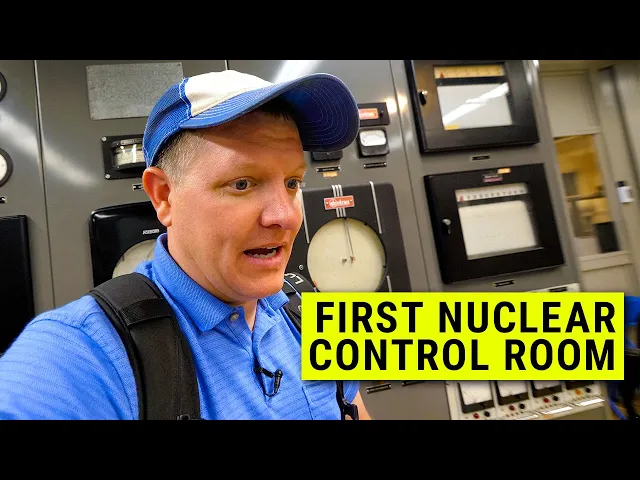
I Explored MORE OF the World's First Nuclear Power Plant (and How It Works) Smarter Every Day 306B
Smarter Every Day 2
0:00 Hey, it's me Destin.
0:00 Welcome to the second channel here, Smarter Every Day Two.
0:04 So this is the companion video to the main channel video about EBR-1,
0:09 Experimental Breeder Reactor One.
0:12 This is the first nuclear power plant
0:14 in the world to produce power for civilian use.
0:18 It's a really cool thing.
0:19 So that video, I highly recommend watching it.
0:22 Andrew, our tour guide,
0:23 took us around the whole facility, explained how everything worked.
0:27 I built some silly models that I think you'll enjoy.
0:30 So if you haven't watched that main channel video,
0:31 I recommend it before watching this.
0:33 This is the stuff that fell on the cutting room floor,
0:35 didn't quite make the main channel video,
0:36 but I think you'll really enjoy it if you're a nerd
0:39 like me and you want to go deeper into the details.
0:41 So before we get started,
0:43 I want to say thank you to everyone that support Smarter Every Day on Patreon,
0:47 patreon.com/smartereveryday.
0:48 That's a huge deal.
0:51 You let me make the videos I want to make, and I'm grateful.
0:55 It's a really big deal.
0:56 Also, I'm doing a whole series on nuclear power.
0:59 It's the nuclear power deep dive here on Smarter Every Day.
1:02 And if you want to be notified when I upload a new video in the series,
1:05 go sign up for email updates.
1:07 So if you go to smartereveryday.com/emaillist,
1:10 I'll put a link down in the video description.
1:12 I will send you an email like the old school
1:15 days when I upload a new video so that you can
1:18 know that it's up there and you can go check
1:19 it out because I don't really trust the YouTube notification system.
1:23 I think that's a really cool way for us to connect.
1:26 So email list.
1:27 Thank you to patrons, and let's go learn more EBR-1.
1:30 Interested people are interesting, and you're very interesting.
1:33 [A] I appreciate that.
1:35 [D] Yeah.
1:35 So what we have here.
1:36 [A] So once they pull the fuel rod out of the reactor,
1:39 they'd have to clean the liquid metal coolant off of it.
1:41 That would happen in the basement just below these disks.
1:44 Each of these silver disks lines up to a manhole and a pipe in the basement.
1:48 They'd feed the spent rods down into those pipes and flush
1:51 them with a solution of acetone and alcohol to clean them off.
1:54 Once they were cleaned, they'd have to use the secondary cask right
1:57 here to pull them out of the basement.
1:59 They If they can't use the same cask as before.
2:01 That cask still has some liquid metal inside of it, so they use a clean cask,
2:05 they pull them out of the basement and store them here on the rod farm.
2:08 This is where they would be stored
2:09 for long-term storage while they physically cool down.
2:12 [D] So they can just chill here?
2:14 [A] Yep, it's It's basically a giant block of concrete to active shielding.
2:17 [D] Is that a real sign?
2:18 Is that active for today?
2:19 [A] Yep, that's a modern sign.
2:21 There are a couple of areas in here that are fixed radiological areas.
2:25 The secondary heat exchanger is one
2:27 of those, which means they do have contamination.
2:30 This is probably one of the more contaminated areas,
2:32 but it's all completely closed up,
2:34 so none of that radiation can escape and get out here.
2:37 [D] I see.
2:38 [A] This is where they would just
2:40 store the rods while they physically cool down.
2:42 It would take a while.
2:43 In modern facilities, they have these in deep water trenches.
2:46 [D] I want to see this.
2:48 What is this?
2:50 [A] This is the hot cell, first of its kind.
2:52 This allows us to operate on those spent fuel rods safely.
2:56 The walls are made of 4 feet of high density concrete.
2:59 The windows are made of 4 feet of leaded glass,
3:01 the lead that's trapped in the glass lattice axis shielding.
3:04 And these mechanical manipulator arms on the outside would
3:06 allow us to control the arms on the inside.
3:09 Normally, there'd be a handle on the bottom so
3:11 you could grasp with the hands on the inside,
3:13 but they had to take those off because kids kept messing with them.
3:16 But this is the first set of mechanical manipulator arms ever built.
3:19 At the Hot Fuels examination facility,
3:21 our new version of this, they take 18 months to train on.
3:25 I can't imagine how long it would have taken these operators.
3:28 But once they figured it out, you can essentially,
3:30 do anything in that room you can on the outside with your hands.
3:32 It'll just take more time depending upon how much finesse the action requires.
3:36 [D] They could do things like take the lids off those beakers and stuff.
3:42 [A] Mm-hmm.
3:43 [D] Please not play with it.
3:44 This was a really cool museum exhibit until it wasn't,
3:46 until it got abused, right?
3:48 [A] No kidding.
3:48 It's still beautiful.
3:50 [D] Have you gotten to do it?
3:52 [A] No, unfortunately not.
3:53 Not for these particular arms.
3:54 [D] I'm sorry for you, Andrew.
3:56 I know that hurts.
3:58 [A] But these windows are pretty cool.
3:59 At the time, they did not know how to produce thick panes of leaded glass.
4:04 To get 4 feet of shielding,
4:05 they had to stack 34 panes of inch and a half thick glass.
4:09 Then in between each layer,
4:10 they filled it with mineral oil that matches the refractive
4:12 index of the glass so you can see straight true,
4:15 but it gives you a pretty cool effect if you shine a flashlight on it.
4:18 [D] Oh, does it do an infinite thing?
4:20 [A] Something similar.
4:21 [D] Oh, that is cool.
4:23 [A] Shows you each of those layers.
4:25 [D] That's really cool.
4:27 Can you angle it?
4:28 [A] Oh, which one?
4:30 [D] You can't shoot it at an angle.
4:34 It's only its internal reflection.
4:36 [A] On the left side here,
4:38 where we used to have a bit of an oil leak back in the day,
4:40 the leak's been solved,
4:41 but it gives you a pretty cool effect due to the oxidation of the various oils.
4:45 [D] Oh, so different layers or different colors.
4:49 That's cool.
4:52 Oh, I can see the oil.
4:54 Is that the top of the oil?
4:56 [A] Yep.
4:56 That's where we were able to stop the leak, I suppose.
4:59 [D] I see.
5:00 [A] Then behind us, we have one
5:02 of the few mistakes they made building this facility, a giant hole in the wall.
5:05 They forgot they'd have to take these arms off to repair them.
5:08 There simply was not enough room to do that.
5:10 When they realized that was an issue, they proposed a pretty simple solution.
5:13 Let's knock a hole in the wall.
5:15 It works just fine.
5:16 I mean, this wasn't a load-bearing section of the wall,
5:18 so they could knock a hole in it.
5:19 That way, whenever they have to repair the arms, they can take the wall apart,
5:22 get the arms off to repair them, and put everything back together again.
5:25 [D] That's awesome.
5:27 That's pretty fun.
5:28 What would they do in there?
5:30 Would they work with the rods?
5:31 [A] Two main things.
5:32 They were very curious to know what the uranium was
5:34 splitting into, so they would perform some chemistry in there.
5:37 They didn't know if it was splitting into a specific
5:39 set of elements or a whole range of elements,
5:41 so that's part of what they did in there.
5:43 But mostly, that was used as a shipping facility.
5:46 They'd chop the rods up, package them in radiation proof packaging.
5:49 That way they could be sent away to be recycled.
5:51 Unlike almost any reactor to come after
5:53 this, we used weapons grade uranium, 90% enriched.
5:57 You only split 5% of it before it It uses reactivity,
6:00 so you'd want to recycle the rest.
6:02 That's a lot of usable uranium.
6:04 This was mostly used as a shipping facility
6:06 so they could get it sent away safely.
6:08 [D] Oh, wow.
6:09 And so behind you here, is this how they would keep up with the different rods?
6:13 [A] Yeah, I always tell people they had
6:15 a very advanced system for keeping track of it.
6:16 A chalkboard.
6:18 [D] Works, man.
6:20 Empty pipe.
6:21 Is this the way it was left?
6:24 I mean, obviously, you probably don't have a rod in there.
6:26 [A] Yeah, this is the way it was left.
6:28 I'm pretty sure they did clean all the rods out,
6:29 but they They left it there just for posterity so people can get an idea
6:32 of how it was set up and how they would mark it all down.
6:35 That's so cool.
6:37 It's a unique system in that you don't
6:40 have to have anybody there while it's turned off.
6:42 It's a completely benign system when it's turned off.
6:45 The outside breeding blanket is going to go through a pretty intense heat cycle.
6:50 Every night, it would bring itself back down to room temperature.
6:54 In the morning, when they started the reactor back up,
6:56 it would raise in temperature to core temperature.
6:58 That means you're going to have defects in that outside blanket over time.
7:02 That's a pretty big heat cycle.
7:03 [D] What's the blanket made of again?
7:04 Remind me.
7:05 [A] It's uranium-238, and I think it had an outside of stainless steel.
7:09 [D] Okay, got it.
7:11 You would get defects over time.
7:12 [A] Yeah, and these two rooms were made
7:14 to inspect for defects and repair the defects.
7:18 [D] Wow.
7:19 Okay.
7:19 [A] We'll go in here.
7:20 Watch your head when you stand up.
7:21 There are a couple of short spaces on the inside.
7:23 [D] Okay.
7:31 All right.
7:32 It's very echoy in here, and those are some really big lamps.
7:37 What's up with that?
7:38 [A] Well, you probably noticed these windows block
7:40 a fair amount of light coming through them.
7:42 [D] I see.
7:43 [A] They had to perform the inspection from the other side.
7:45 They'd be controlling everything outside of that window.
7:48 They had to have very bright lights to give you enough to actually
7:52 see what the cracks/warping is when
7:54 they're operating that procedure for maintenance.
7:57 [D] That would hold the breeding blanket?
7:59 [A] Yeah, they'd open up bay door that goes into the reactor room.
8:01 They send in the big U-shaped grabbing device to grab the 8,500 pound blanket.
8:06 They bring it back in here, set it down on this turntable in the center,
8:10 and then slowly turn the turntable and inspect it for any defects.
8:14 [D] With a worm gear.
8:15 How would they inspect it?
8:17 They're looking through that window right there.
8:19 [A] From this window behind me.
8:20 [D] This window, okay.
8:21 Which is why the lamps are on that side.
8:24 [A] Yeah.
8:25 [D] Okay.
8:26 [A] They also have a mirror across on the ceiling
8:30 That essentially acts as a second set of eyes.
8:32 You lose a lot of depth perception looking through this thick glass,
8:35 so that would help them orient the machinery in the 3D environment.
8:39 Otherwise, you can't tell exactly where the machinery
8:41 is due to the warping from the thick glass.
8:44 They bring it in here, they'd set the blanket down.
8:47 If there were any warps or cracks, they'd pick the blanket back up and send it
8:51 to the next room using the tracks on the ceiling.
8:54 That would be the repair room.
8:55 Unfortunately, there's not much to see in there.
8:57 They basically took all of the repair equipment out, so not much to see,
9:01 but you can take a look at it through
9:03 a window when we go over to the other side.
9:04 That's cool.
9:05 [D] Have you taken mechanics and materials yet?
9:07 [A] Oh, absolutely.
9:08 [D] Okay, so you appreciate that like I do.
9:12 The amount of force that that little lip is taking, it's hard to see.
9:17 [A] A lot of shear force as well.
9:19 [D] Absolutely.
9:19 It's incredible.
9:21 That's awesome.
9:22 [A] All right, next we'll go around,
9:23 see the other side of the window where they operate these machines and take
9:26 a look at some systems they have holes cut in for us to look at.
9:29 [D] What is What is it?
9:30 [A] I'm not entirely sure.
9:32 I think this may have been one of the parts
9:34 that would allow them to pull particular bricks out,
9:37 but I can't see with any certainty.
9:40 [D] That makes sense.
9:41 Yeah, let's see.
9:42 We have some type of Yeah, I don't know.
9:46 Don't know.
9:47 [A] A lot of this is a black box because
9:50 it's not exactly easy to find documentation on the individual parts.
9:53 [D] Because was it classified at the time?
9:55 [A] Oh, yeah.
9:56 There are a couple of documents I found online,
9:58 and all over them have got They're crossed
10:00 out and they've got declassified on the cover.
10:02 It was very top secret at the time.
10:04 [D] Oh, wow.
10:05 You notice you have decimetres everywhere.
10:07 [A] Got to make sure the public's safe.
10:12 There are a couple of spots of fixed
10:13 contamination up to about 2,000 counts per minute,
10:16 which is much less than even house's smoke detector.
10:20 It's all well within safe levels,
10:21 but we keep the dosimeters up just to make sure everything remains safe.
10:24 [D] Do you wear one?
10:25 [A] I don't need to wear one, personally.
10:27 [D] Okay, interesting.
10:30 So this is where they would inspect the blanket.
10:32 [A] The window on the right is for the repair room.
10:34 The window on the left is to actually get it inspected.
10:38 If you spin this, you can see the turntable spin very, very slowly.
10:42 [D] Oh, you're actually turning it.
10:45 [A] It's down geared a lot.
10:48 That job would not be particularly fun.
10:49 [D] No, not at all.
10:51 This is the control panel that a person
10:54 would use when they are inspecting that blanket.
10:58 You're turning that thing.
11:00 That's actually turning that turntable that we were looking at earlier.
11:06 That's cool.
11:08 It's a linkage all the way.
11:10 Can you feel the friction in the linkage?
11:13 [A] Oh, yeah.
11:14 [D] That's pretty cool.
11:15 [A] If we come back here to the corner,
11:17 we'll take a look at the primary heat exchanger.
11:18 You can only get a good view of it from back here.
11:22 You stand right around here and point your camera up through that upper window.
11:25 That big tank up there is the primary heat exchanger.
11:28 It would exchange heat between the first there's two loops of liquid metal.
11:31 It's a lot smaller than the entire room we have for a secondary exchanger,
11:35 simply because there doesn't need to be an Argon jacket.
11:38 It's liquid metal to liquid metal, so it's much more spatially efficient.
11:42 [D] Awesome.
11:43 Talking about the dosimeters,
11:43 what is the hottest Are you seeing the area in EBR-1 right now?
11:47 I'm certain that within the reactor or some other decommissioned areas,
11:50 there are probably higher counts,
11:52 but as far as areas we can access, it only gets up to 2,000 counts per minute.
11:56 I guess it would make sense if the reactor itself would be the most.
12:01 Then one thing to look at is through this lower window.
12:04 [D] This one?
12:04 [A] This is a receiving tank that's cooling the reactor.
12:08 This is very close as far as the pipe systems are considered.
12:12 This is very close to the reactor.
12:14 This acts as something of a thermal battery.
12:17 If the reactor begins producing a bunch of excess heat,
12:19 it will travel down into the drain tank.
12:21 This is a thermal battery to help prevent emergencies, but it's not foolproof.
12:25 They would still have to scram it if the heat coefficient rose too quickly.
12:29 With the earlier core,
12:30 there were two dominating effects for the heat coefficient.
12:33 One of those was the bowing of the actual rods themselves.
12:38 For the most part, that was not the dominating force.
12:42 But if they slowed the coolant,
12:43 that would become the dominating factor, and it would overheat.
12:49 [D] Yeah.
12:50 The heat at which they, That's interesting.
12:54 The heat at which they would bring it up
12:56 and take it down mattered because of the dissimilar materials.
12:59 Is that true?
13:00 [A] Essentially.
13:00 They also have to make sure they're always pumping enough coolant through.
13:04 Otherwise, you'd get a differential thermal expansion
13:06 that would cause bowing in the rods.
13:09 [D] Got it.
13:10 Is this a modern sign?
13:12 [A] Yep.
13:15 That's one of the old access tunnels.
13:18 [D] That's cool.
13:19 Man, I love that lamp.
13:22 Isn't that cool?
13:24 Is that original?
13:25 [A] Yep.
13:27 [D] It's beautiful.
13:27 [A] Even the replacement parts have to be time period original.
13:30 It gives the facility manager quite a challenge.
13:32 [D] I can imagine.
13:33 It's incredible because it's a historic site, right?
13:37 Is it bad that I didn't even know this existed?
13:42 [A] No, that's normal.
13:43 I mean, we're out here in Idaho for a reason.
13:45 That was part of why we're out here was for secrecy.
13:48 [D] That makes sense.
13:50 [A] Especially back in the day.
13:52 [D] We going up?
13:53 [A] That's essentially all of EBR-1.
13:54 If there's anything specific you'd like to talk about,
13:56 we'll return to that area.
13:57 Or if you want to talk to the heat or talk about the heater engines outside,
14:00 we can go talk about those.
14:02 [D] The heater engines?
14:02 [A] Yep.
14:04 [D] Oh, the nuclear airplane?
14:06 [A] Yep.
14:07 [D] Yep.
14:07 Let's go.
14:08 [A] All right.
14:08 [D] Let's do it.
14:09 Let's do it.
14:10 Okay, this might sound dumb, but it's fun.
14:13 You know all this stuff I made for the main channel video?
14:15 I can turn it on and stuff does things.
14:18 This took an incredible amount of time to make,
14:21 and I'm a little sad because I don't know what else to use it for.
14:26 So this is what I've thought about.
14:27 I am constantly trying to think of ways to express
14:30 gratitude to people that support on Patreon at Patreon.com/smartereveryday.
14:35 I cannot imagine a situation in which you would
14:37 want to 3D print the heat exchange system for EBR-1.
14:41 However, the sprint right here, that took six hours on a Formlabs Form 4.
14:47 You should have seen, I didn't record a lot of that.
14:50 I got some footage here, I'll show you.
14:52 It took an incredible amount of time to get this right,
14:54 and then I would have to change it and then print it again.
14:57 It's awesome, but I really am that it's not going to be used again.
15:01 So what I would like to do is give you the patrons of Smarter Every Day.
15:04 If you support on Patreon,
15:05 I would like to give you all these 3D files because I think they're fun.
15:09 It's silly, too.
15:10 I've also got these files, the elements and stuff,
15:14 the turbans here and the pumps and stuff like that.
15:17 I've got the 3D files, and I would love to give them to you.
15:21 I look forward to seeing any of the prints you decide to make, but it'd be cool.
15:26 I did this on a Prusa XL.
15:26 I think I already said that.
15:27 But anyway, it's really fun stuff.
15:30 So this is a way of expressing
15:32 my gratitude to everybody that supports at Patreon.com/smartereveryday.
15:36 I'm constantly trying to figure out things to give the patrons,
15:40 but the patrons understand it's not transactional.
15:42 I get messages from time to time saying, Hey, just go make the next video.
15:47 And that's what I'm trying to do.
15:49 But I still want to say thank you.
15:51 So thank you so much to everybody
15:52 that supports on Patreon at Patreon.com/smartereveryday.
15:55 I'm going to give you the 3D files for the EBR-1
15:59 heat exchanger and all the little elements and stuff
16:01 if you want to print those out and make
16:03 a magnet and put it on your fridge or something.
16:05 Anyway, thank you so much.
16:06 I'm grateful to all your support.
16:09 How long have you been working here, Andrew?
16:10 [A] I worked here last summer as an intern.
16:12 They're only open for three months during the summer.
16:13 This is my second year out, so about five and a half total.
16:17 [D] Okay, that's cool.
16:19 It's cool.
16:19 Do you love it?
16:20 [A] I absolutely love it.
16:22 Outreach is an important thing to me.
16:24 A lot of people come in here a little bit afraid of nuclear energy,
16:27 and they leave understanding it a lot more.
16:29 [D] What is this?
16:30 [A] This is kind of a black box.
16:33 [D] What do you mean by that?
16:34 [A] On the left, we have the backup power generator.
16:36 The exhaust is connected to this.
16:38 I'm not sure for what purpose.
16:41 [D] Don't know what it does.
16:42 [A] I really couldn't tell you.
16:44 None of the training materials told me anything about this particular part,
16:47 and I can't figure it out.
16:49 [D] It looks like a muffler.
16:51 There's the diesel generator.
16:54 There's the diesel engine.
16:55 [A] This would power it if they had
16:58 an emergency and before they got the reactor set up.
17:00 [D] What is this?
17:01 [A] That is a test cask for the Three Mile Island transportation cask.
17:06 [D] They were just testing to see if they could rupture it?
17:09 [A] Yep.
17:10 [D] Yep.
17:11 [D] That's a good thing to test.
17:13 [A] No kidding.
17:14 [D] All right, so let's figure this out.
17:17 Diesel engine, generator, exhaust manifold.
17:23 I don't know.
17:24 Muffler?
17:24 What do you think?
17:26 [A] I have no idea.
17:27 Like I said, it's a very strange system.
17:30 I've had a lot of people come in here and try to troubleshoot it,
17:33 but no definitive answers yet.
17:37 [D] Combustion.
17:38 Superior Combustion industries, rotary burner.
17:42 I wonder if this is a Oh, shoot.
17:46 They have a word for when you burn your combustion gasses.
17:49 [A] Is it catalytic converter?
17:50 [D] You're right.
17:51 Catalytic converter.
17:51 I wonder if this is a big one.
17:53 [A] I've heard that that's one of the leading theories,
17:55 and it makes sense to me.
17:57 Well, it's putting the gasses in there is It's just burning all of it, maybe.
18:01 It's a guess.
18:03 I don't know.
18:04 And then this tank, any ideas?
18:05 [A] Yeah, this is the fuel tank.
18:07 [D] Oh, I see.
18:10 Amazing.
18:12 That's cool, man.
18:13 [A] All right, out to the heater reactors?
18:15 [D] Well, yeah.
18:16 One really interesting thing that happened at EBR-1 is,
18:19 toward the end of the life of the reactor, they decided to do some tests.
18:24 Some of the people that were working on the reactor,
18:26 they knew that a partial meltdown could have happened.
18:29 So they They mailed like old-school memo,
18:31 they sent a letter to Argonne National Lab who managed the whole thing,
18:36 and they said, Hey, we want to do some tests.
18:39 There's the possibility of a partial meltdown.
18:41 Can we proceed?
18:42 They said, Yes, you can proceed.
18:45 And a partial meltdown did occur.
18:47 Now, when we think nuclear power plant meltdown,
18:49 we think, oh, my goodness, the world's ending.
18:51 A hundred miles around this, you can't go there.
18:54 It was not quite like that.
18:56 It was a partial meltdown, and it was very safe the way they did because
19:00 there was a lot of safety systems built into EBR-1.
19:04 So I thought it was really interesting.
19:06 Andrew is going to tell us how that meltdown occurred.
19:09 And then after that, I found some archive video from Argonne
19:13 about how they tried to recover the uranium from the fuel rods,
19:17 and it's fascinating.
19:18 So they have that video.
19:19 Let's go watch it.
19:20 [A] And back in '55, nearing the end of the life,
19:23 or nearing the end of the facility's expected lifespan,
19:26 they wanted to run an experiment because they weren't sure exactly
19:29 what was going on with the temperature coefficient of the reactor.
19:31 It appeared to be negative, which is what you want for a reactor.
19:35 But when they decreased fluent flow,
19:37 they noticed that the reactivity would increase more than they were expecting.
19:41 So in '55, they ran an experiment to see what exactly was happening.
19:45 They shut the pumps off for a moment.
19:47 The power levels rose, and they had a partial meltdown.
19:50 They could have prevented the partial meltdown by doing a quick scram,
19:54 but there was a bit of confusion, and they did the slow scram instead.
19:57 It did partially melt down, but that wasn't a a huge issue.
20:00 It was not a safety concern.
20:01 They got it shut down safely, but they learned some interesting things.
20:05 There was a plate that was holding in position all the fuel rods,
20:08 and the different thermodynamic expansion of the rods had caused them
20:12 to bow because the plate wasn't expanding at the same rate,
20:15 and because of that, increased reactivity to a point
20:17 that they couldn't necessarily stop it in time.
20:19 [D] Okay.
20:21 Case of emergency, Scram.
20:23 What does Scram mean?
20:25 The name Scram derives from the 1942
20:28 at Chicago Pile the world's first nuclear reactor,
20:32 the Safety Control Rod Axe Man or Scram.
20:37 [A] That wasn't just anybody operating that Scram.
20:39 [D] That was the one in Chicago.
20:41 Wait, no, the Chicago Pile was here, wasn't it?
20:44 [A] No, that was in Illinois.
20:45 They built their first reactor in a squash court
20:48 under the football stadium at the University of Chicago.
20:51 It was operated using a single central control rod
20:54 hanging from a rope and a polly above the reactor.
20:57 They'd polly the rod up to start the reactor up,
20:58 polly it back down shut it down,
21:00 and it was tied off to a catwalk above the reactor.
21:03 That's not a system that's particularly easy to use in an emergency.
21:06 So they took one of the PhD physicists working there
21:09 and stuck them up on the catwalk to babysit the rope.
21:11 His entire job was to stand there and wait for anybody to sound the alarm.
21:15 If they did, he had an ax, and he was meant to chop the rope,
21:18 dropping the control rod and shutting down the reactor.
21:21 [D] So he was the safety control rod axe man.
21:24 That's awesome.
21:25 I love it.
21:26 [A] And in modern facility,
21:27 they'll tell you it's safety control rod actuator mechanism,
21:29 which is definitely more technically accurate,
21:31 but that story is completely true.
21:33 [D] Let's be real.
21:34 It's the axe man, that's great.
21:36 [Old Video Voice] On November 29th, 1955,
21:39 this reactor was subjected to a power surge,
21:43 which reached a probable peak value of nine megawatts.
21:48 Following this incident, which resulted in some melting of the fuel elements,
21:52 a temporary cave was constructed above the reactor tank to receive
21:58 the highly radioactive core assembly as it was withdrawn from the reactor.
22:07 With the core assembly out of the reactor tank,
22:11 the hexagonal can surrounding the fuel elements was removed.
22:15 Along with about one-fourth of the fuel elements.
22:19 The mountain core alloy had extruded into the coolant
22:22 channels and solidified into a mass surrounding the fuel section.
22:28 The solidified material was heavily covered with oxides of NAK,
22:33 sodium-potasium alloy.
22:34 The pyrophoric nature of the damaged core
22:37 was aggravated by the presence of entrained NAK,
22:40 and after several small fires were experienced,
22:43 it was They've tried it to transfer
22:45 the core to Argonne National Laboratory near Chicago.
22:49 [D] This video is fascinating.
22:50 The meltdown occurred here, and so there's NAK everywhere.
22:54 And so once they sent it over to Argonne,
22:56 they had to get the NAK off of the core,
22:58 and then they had to try to capture all the nuclear
23:01 material because they wanted to reprocess it and reuse it.
23:04 It's a fascinating engineering problem,
23:05 and they had to do a lot of the stuff remotely.
23:09 And so they use these really cool grippers to try to position the core,
23:13 and sometimes they would just pull in a thermocouple
23:15 wires to get parts of it apart.
23:17 It's a fascinating problem solving thing they had to do, and it's fascinating.
23:21 So go check it out.
23:22 I think I said fascinating twice there.
23:23 Whatever.
23:24 Second channel, nobody cares.
23:25 Go check it out on Argonne's YouTube channel.
23:28 It's amazing.
23:28 I'll leave a link down in the description.
23:30 You should totally watch this video.
23:33 Very cool stuff.
23:34 Hey, give me some propaganda over here real quick.
23:36 [A] All right.
23:37 [D] Tell me this.
23:39 Tell me why INL is so important.
23:41 I want to hear it from you.
23:42 [A] Basically, ever since we came out here,
23:45 we've had a huge economic impact on Eastern Idaho,
23:48 especially when you're in elementary school.
23:50 Everybody has a friend whose dad works out of the lab.
23:53 They can't tell you exactly what he does.
23:55 But generally speaking, those families are pretty well off,
23:58 and the INL grants them that ability.
24:00 You really wouldn't have these, I guess,
24:03 upper educational opportunities out here in Idaho without the INL.
24:06 We're not only for engineers.
24:08 We have five and a half thousand employees,
24:09 and that covers basically the whole spectrum of degrees.
24:12 We have environmental engineers We've got here, environmental sciences.
24:17 We've got surveyors and other people who are trying to take care of the land.
24:20 They basically perform every science you can imagine.
24:24 [D] Where are you going to school, Andrew?
24:25 [A] Out at Idaho State University in Pocatella.
24:27 Most of my professors work out here at the lab, so it works out fine.
24:30 [D] So you can go get some tutoring at lunch?
24:33 [A] Yeah.
24:34 [D] That's awesome.
24:35 All right.
24:36 So we're going to go see a nuclear airplane engine.
24:38 Is that what I understand?
24:40 [A] Yes, sir.
24:41 This is one of those pieces of history that really makes you question,
24:46 If everybody had their heads screwed on straight back in the '50s.
24:49 Okay.
24:52 In 1947, essentially right after the World War,
24:55 they planned on using nuclear power to power an airplane.
24:58 For a very similar reason that we
25:00 wanted to power our submarines using that technology.
25:02 You can have it operational a lot longer if it's a nuclear fuel.
25:06 In '55, they first test-fired a reactor that's meant to power a jet turbine.
25:12 It would be connected to just an off-the-shelf J47 jet turbine line,
25:15 and these are those two reactors here.
25:19 Okay.
25:21 On the left, we have HTRE2.
25:22 This was the first test reactor.
25:25 It's in an upright state because it was much easier for them to take
25:28 a look at everything and get in and screw around with parts that way.
25:31 [D] Yeah.
25:32 [A] While on the right, it's in a horizontal configuration.
25:35 That's the configuration they would have been
25:37 flying with, so it's much more compact.
25:39 [D] So these are both the same engine?
25:41 [A] The first- [D] Or a reactor.
25:44 [A] Yes.
25:44 Similar reactor designs.
25:46 The right has just modified it, made parts smaller.
25:49 That way, it's actually ready to fly in a plane.
25:55 [D] It's amazing.
25:56 This is a reactor or an engine.
25:59 What is this?
26:00 [A] It is essentially a reactor that is performing
26:03 the same function as fuel for a jet engine.
26:06 This just provides heat for the air.
26:08 That way, when it's leaving,
26:10 you've got thrust because it's had a lot of kinetic energy added to it.
26:16 In '55, they first powered on HTRE1.
26:18 They tested it a few times, added some modifications to it.
26:22 Then it was turned into HTRE2.
26:25 The second iteration was used as a materials test reactor.
26:30 They had a materials test reactor out here already,
26:32 but it didn't have a space big enough to test parts for the third iteration.
26:36 So they cut a hexagonal hole in the top of this reactor
26:40 and used it as a materials test reactor for a time.
26:42 [D] Is this how it was going to work?
26:46 [A] More or less, it would have been the biggest plane ever to exist.
26:50 The hangar they built for at the time
26:52 was the largest concrete structure in the world.
26:55 [D] Dude, that's awesome looking.
26:58 It's so good looking.
27:01 Look at the engine, man!
27:03 Look at it!
27:05 [A] There is a couple of downsides to this system.
27:07 [D] It looks great.
27:08 Let's be honest.
27:09 [A] Oh, it does.
27:10 [D] It also looks crazy.
27:11 [A] One of the biggest issues is
27:14 you're in taking atmospheric air into the turbine.
27:17 It would pass through the reactor to be heated up
27:19 and sent back through the other end of the jet engine,
27:23 which means certain constituents of the air, like Argon, would become activated,
27:27 meaning that this would be spewing radiation as it flew
27:29 And that's one of the reasons they shut the project down.
27:32 [D] That's the moronic part of it.
27:35 [A] Yep.
27:35 [D] I mean, they were innovators, man.
27:38 They were trying.
27:39 [A] Without a doubt.
27:40 [D] They were.
27:42 And this right here, clearly, they figured out it was bad,
27:46 cancels the nuclear bomber program effective immediately.
27:49 Okay.
27:50 [A] And the strange thing is,
27:52 they spent a billion dollars getting the two engines built and ready to go.
27:56 By the time they were ready to get a plane built,
27:58 they only needed 200 million more.
27:59 200 million more.
28:00 In the '50s, that was a ton of money.
28:02 But they decided, essentially because
28:04 the ballistics missile program was starting,
28:06 that it wasn't necessary to have a plane
28:08 loaded with nuclear weapons flying all the time.
28:10 So they shut the program down to focus on the ballistics missile program.
28:14 Got it.
28:15 [D] My grandfather actually worked for the ABMA,
28:19 the Army Ballistic Missile Agency.
28:22 I think that's what it was called.
28:24 It's cool.
28:25 So this just exists out here in the middle of Idaho, and you could see it.
28:30 I don't know if you're going to be working here at the time,
28:33 Andrew, but if you are, they can come talk to you, right?
28:36 [A] Absolutely.
28:36 [D] Andrew, it was a pleasure, dude.
28:39 It was awesome, man.
28:40 [A] By the way, I've loved your content for a long time.
28:42 I'm a big fan.
28:42 [D] Dude, I'm a real big fan of you, man.
28:44 You're awesome.
28:44 Let's go here in the light so we can...
28:46 Let's take a selfie in front of a nuclear...
28:48 [A] That would be awesome.
28:50 [D] Let's do that.
28:51 [A] You're actually a big inspiration for why
28:53 I took this job in the first place.
28:54 Science outreach is really important to me because of people like you.
28:57 [D] Whatever, dude.
28:58 You're an inspiration to me, Andrew.
28:59 Andrew, you're the boss.
29:00 You got a phone?
29:01 [A] Absolutely.
29:02 [D] Let's take a selfie.
29:02 That's great.
29:04 Look at that.
29:06 That's so good.
29:06 [A] Thank you so much.
29:07 [D] All right.
29:08 This is Andrew.
29:09 This is EBR-1, right?
29:10 [A] Yes, sir.
29:11 [D] Thank you so much, man.
29:13 Really appreciate it.
29:13 All right.
29:14 I hope you enjoyed this video on Smarter Every Day 2 the second channel.
29:18 If you're not subscribed to the second channel, feel free to consider that.
29:20 I would prefer you sign up for the email
29:22 list if that's something you're interested in.
29:24 I would be grateful for that.
29:26 Also, a huge thank you to everybody
29:28 that supports Smarter Every Day on That is what,
29:31 I can't explain how important that is because it decouples me
29:35 from all kinds of algorithmic stuff that happens on the internet,
29:39 and it lets me make really silly videos.
29:41 For example, this thing right here.
29:43 Do you know that it would have been way easier to make an animation?
29:47 That would have been way easier.
29:49 But I just really wanted to do it this way because I think that was really cool.
29:52 So this is the stuff I do with Patreon support.
29:55 And if you would like to do that, I would be grateful.
29:58 Patreon.com/smartereveryday.
29:59 Anyway, that's it.
30:02 I hope you enjoyed this video, and I'm excited to learn more about nuclear
30:04 power with you because I am learning a ton.
30:08 I'm Destin.
30:08 You're getting Smarter Every Day.
30:10 That's so funny.
30:11 The memory card ran out right as I was saying bye.
30:14 So I'm Destin.
30:15 You're getting Smarter Every Day.
30:16 Have a good one.
30:17 Bye.