Understand Real English: Movie References (That You’ll Hear ALL the Time!)
Adam’s English Lessons · engVid
0:00 Hi, everybody.
0:00 Welcome to www.engvid.com.
0:02 I'm Adam.
0:03 In today's video, I want to talk
0:05 to you a little bit more about cultural English.
0:08 Now, if you come to an English-speaking country,
0:11 you will notice that a lot of the things
0:13 people say are in reference to something from culture,
0:17 especially movies or music or things like that.
0:20 And if you're not familiar with these cultural things,
0:24 it may be very difficult to understand what they're trying to say.
0:27 So, today, I'm going to give you a few of these examples to show
0:32 you how people refer to movie situations
0:35 when they're talking about real-life situations, okay?
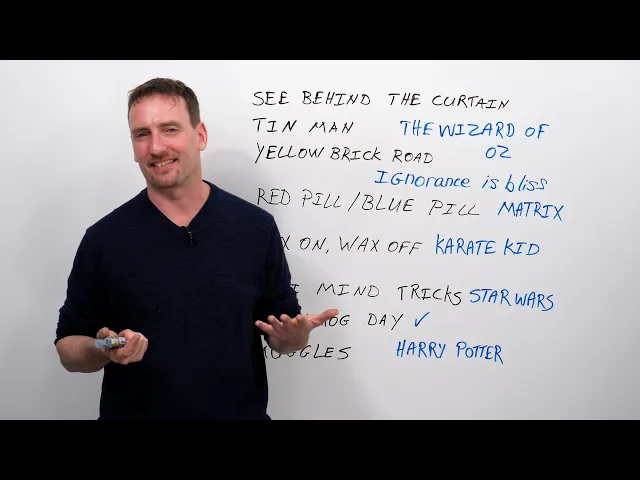
0:40 So, we're going to start with these three,
0:42 and I'm using all three because they all
0:44 come from the same movie, The Wizard of Oz.
0:47 Now, actually, I should write "The Wizard".
0:51 Now, this is a very famous movie from, I think, 1940s, maybe.
0:57 It's a very old movie, but even kids today watch this movie.
1:01 I personally don't know anybody who hasn't seen this movie.
1:05 So, it's the story of Dorothy who gets...
1:08 Tornado takes her house to, basically, Oz, the land of Oz,
1:12 and she has to find the wizard so he can help her go home back to Kansas, okay?
1:19 So, a few of the things that happen here.
1:22 At the end of the movie,
1:24 Dorothy finally reaches the Emerald City where the wizard lives,
1:28 and she goes to the wizard's office, I guess you could say,
1:32 or his studio, and there's a big, like, face, and it's, like, all lights,
1:37 and smoke, and shadows, and stuff, and he's telling her all these things.
1:41 And then Dorothy's dog, Toto, goes to a curtain and pulls the curtain,
1:45 and you can see a little old man pressing all
1:48 the buttons to make the wizard look big and powerful.
1:51 So, when you say "to see behind the curtain",
1:54 it means to see the truth of how something works,
1:56 and it's generally a little disappointing.
2:00 So, a lot of people believe that the government is made up of very strong,
2:04 very smart, very capable people, but if you actually look very closely,
2:07 if you look behind the curtain, you'll see that they're just regular,
2:11 everyday people who are greedy, and who want power,
2:14 and who are taking advantage of their situation.
2:16 So, you see the truth of a situation,
2:19 and that comes from the movie, very clearly.
2:23 Also, in the movie, one of the characters is the Tin Man.
2:26 He's made of tin, and he's always getting rusty,
2:28 so they always have to give him oil, but he goes with Dorothy to see the Wizard
2:33 of Oz because he wants to have a heart, because he's just made of tin, right?
2:38 So, sometimes if we refer to someone as the Tin Man,
2:42 basically what we're saying is he has no heart, right?
2:45 If somebody is very cold, or very unemotional, or like,
2:50 for example, if you see a dog, somebody kicking a dog,
2:54 and it happens, like, you don't care,
2:56 you don't get emotionally moved, then people will call you Tin Man.
3:01 "Come on, Tin Man, get a heart, go help the dog", or something like that, right?
3:04 But very commonly referred to in that particular situation.
3:09 And the Yellow Brick Road.
3:11 So, for Dorothy to get to the Emerald City,
3:14 where the Wizard is, she has to follow the Yellow Brick Road.
3:19 It's a road made of yellow bricks,
3:21 and it's the only road that goes all the way to the Emerald City.
3:26 But at the end of the Yellow Brick Road is all her wishes come true, right?
3:31 All the things that she wants.
3:33 So, "follow the Yellow Brick Road" means go on and try to get your dreams,
3:36 follow your dreams, there's something good
3:38 at the end of the process of something, right?
3:41 So, if you're...
3:43 Let's say you get a job, and you say you're starting at the bottom level,
3:47 and you're getting a little bit discouraged, and somebody will say,
3:50 "Don't worry, this is just the Yellow Brick Road.
3:52 At the end, you'll get everything you want, you'll get all your wishes", right?
3:56 So, these things...
3:58 These three situations are part of everyday English,
4:01 part of everyday dialogue, and they all come from the same movie.
4:06 Now, there are actually a lot of movies that are often referenced,
4:09 but I'm just going to give you a few examples,
4:11 and you can start paying attention to other movies.
4:14 The more popular the movie, the more likely there's something from the movie
4:19 that will stand out and people will repeat.
4:23 Next, we're going to look at the movie The Matrix,
4:26 with Keanu Reeves, and Neo, and Trinity, and all that.
4:29 And we talk about red pill, blue pill.
4:32 So, if you watch the movie, you know what I'm talking about.
4:35 If you haven't seen the movie,
4:37 there's a point where one of the characters offers another character a choice.
4:42 Take the red pill or take the blue pill?
4:44 If you take the red pill, you will see the truth of reality.
4:49 All the...
4:50 All the fake stuff will disappear, and you will wake up in the truth.
4:54 And the problem is, the truth is often ugly,
4:57 whereas the blue pill, you can go on living in your fantasy.
5:02 And fantasy, obviously, is fantasy, it's good.
5:04 Everything is good, nothing to worry about, life is beautiful, right?
5:08 We have an expression in English, it's ignorance is bliss.
5:19 And in fact, this expression is used in the movie,
5:21 but it's a very common expression.
5:23 Ignorance is bliss.
5:25 Bliss is peace, peacefulness.
5:27 Ignorance is peaceful because you don't have anything to worry about,
5:30 you don't see the ugly truth.
5:32 So, if somebody refuses to see the truth,
5:34 we can say, "Oh, this guy took the blue pill", right?
5:38 "Oh, he took the blue pill, he doesn't want to listen." This guy took
5:42 the red pill means he's ready to be an activist,
5:44 or he's ready to make some change.
5:46 So, if you're watching...
5:47 Let's say you're watching a particular news channel,
5:50 and most people realize that this channel is feeding the public a lot of lies,
5:55 but you continue to watch it and you continue to believe everything they say,
5:59 people might say that you took the blue
6:01 pill and don't want to face reality, the truth.
6:06 Next, "Karate Kid", also a very famous movie.
6:09 It's pretty old, I guess, I think it's, like, mid-1980s.
6:13 It's about a young boy who moves to California, and he goes to school,
6:18 and some kids are bullying him, and these kids are...
6:21 They know how to do karate, and they beat him up.
6:24 But the super, the person who takes care
6:27 of the building where he lives is a Japanese man, Mr.
6:31 Miyagi, he's also famous, Mr.
6:33 Miyagi, and he teaches him karate.
6:36 But he teaches him in a very unusual way.
6:39 He doesn't teach him actual karate moves.
6:41 He makes him do chores around the house.
6:44 He makes him paint the fence, he makes him sand his deck,
6:47 and then he makes him clean his cars.
6:50 He has, like, a whole collection of old cars.
6:53 So, he's teaching him how to put wax on the car.
6:58 So, he says, "Wax on, wax off." So, then Danny,
7:02 the kid, he just starts waxing, he goes, "No, no, no, no.
7:07 Wax on like this, wax off like that, and make sure you do it this way." And now,
7:13 basically, at the end,
7:14 you find out that he's teaching him karate by showing him particular movements.
7:19 This is one block, this is the other block.
7:22 So, by doing the waxing, he learns something very complicated.
7:26 So, we often say this, when something looks a little bit too simple,
7:31 it actually is leading to something very valuable.
7:35 Wax on, wax off.
7:37 Do whatever you're doing because eventually it's leading to something better,
7:40 and stronger, and bigger.
7:41 Okay?
7:42 So, a little bit interesting expression there.
7:47 Jedi mind tricks.
7:49 Now, I guess most people have probably seen
7:52 at least one or two Star Wars movies, but this is a very famous movie franchise.
7:57 And Jedi mind tricks are things that you do with your mind
8:02 to make other people do things
8:04 or make things happen that shouldn't happen naturally.
8:08 So, for example, if I go to a bar,
8:11 let's say I'm a big nerd and I'm not very good looking,
8:14 and I go to a bar, and there's a very beautiful woman there,
8:17 and I want to talk to her.
8:20 So, I'm there with my friends, and I say I'm going to go talk
8:22 to her, and they're thinking like, "There's no way.
8:24 She's way out of your league.
8:25 You can't have her.
8:26 She's too beautiful." So, I go over there,
8:28 and I talk to her, and she talks to me, and we're having a good time,
8:31 and we're having a few drinks, and my friends, they're very confused.
8:34 They don't know how I did it.
8:36 So, finally they think, "Oh, Jedi mind tricks." So,
8:40 I use a mind trick to convince that woman to talk to me and be with me.
8:45 Something that I shouldn't be able to do, I do.
8:49 People say it's unnatural, so I'm using some mind trick,
8:51 like I learned from the Jedis, from Yoda, or whatever.
8:55 Hope that's a little bit clear there, so.
8:58 Next, so Groundhog Day.
9:00 So, Groundhog Day is the actual name of the movie,
9:01 that's why I just put a check there.
9:03 In this movie, a character, he goes to a little town where they do groundhog,
9:09 so a little bit of background.
9:12 In North America, every winter, there's a day,
9:16 a special day called Groundhog Day.
9:19 A groundhog is like a small animal that lives in the ground in winter.
9:25 And one day in winter, the groundhog comes up and looks around, and we think,
9:30 if the groundhog sees its shadow and runs back into the ground,
9:35 that means another six weeks of winter.
9:38 If the groundhog comes up and doesn't see a shadow and comes out of the hole,
9:43 another six weeks until spring,
9:44 then if he doesn't see his shadow and comes out, spring is coming very soon.
9:50 That's the superstition.
9:53 In Groundhog Day, this character goes there and then goes to sleep at night,
9:58 and the next morning when he wakes up,
10:00 it's the exact same day, it's still Groundhog Day, and everything happens again.
10:05 And he goes through the day, he's all confused,
10:08 and then at night he goes to sleep,
10:10 and the next morning he wakes up, and it's Groundhog Day again.
10:13 The same day happens again.
10:15 And it keeps happening, and it keeps happening.
10:16 He lives the same day over and over again.
10:20 And at the beginning, he gets so frustrated, he tries to kill himself.
10:23 But even if he kills himself,
10:25 the next morning he wakes up, and it's Groundhog Day.
10:29 So finally he understands, instead of trying to kill himself,
10:32 he should take advantage of this extra time,
10:34 and he starts to learn to play the piano, and reads books,
10:38 and learns languages, and basically makes himself a better person.
10:43 Today, we use Groundhog Day when we're talking about routine and repetition.
10:48 So a lot of people, if I say to you, like,
10:51 for example, if you work in an office, do you like your job?
10:54 Oh no, it's like, it's Groundhog Day, I'm ready to kill myself.
10:58 Because every day is the same, the same, the same.
11:00 You get so bored, you're ready to shoot yourself in the head,
11:03 just to end the boredom and the monotony.
11:06 So, when something is repeating, and repeating,
11:08 and repeating, we call it Groundhog Day,
11:10 and it's usually in a negative way, not the better person kind of way.
11:16 And lastly, I think a lot...
11:17 Most people probably know what a muggle is.
11:19 It's from the movie, or from the book, I guess, originally.
11:22 Harry Potter.
11:24 A muggle is a person who doesn't understand magic.
11:28 So, these days, a lot of, especially young people,
11:31 say about somebody, if he or she is a muggle,
11:34 that means no imagination, no creativity,
11:36 maybe a little bit of a boring person, a little bit old-fashioned, etc.
11:40 So they don't like him, they stay away, and they go do their own thing.
11:44 Okay?
11:45 Now, again, this is not so much about English,
11:48 as much as it is about understanding English speakers,
11:51 because they do refer to these movies, they do refer to other cultural elements,
11:57 and if you're not familiar with these elements,
11:59 you might not understand what they're actually saying to you,
12:02 because it has nothing to do with English.
12:04 You can understand Yellow Brick Road,
12:06 but it means nothing to you unless you know this movie, The Wizard of Oz.
12:11 Okay?
12:11 So, pay attention to these kinds of references,
12:14 and if you're not sure what it means, don't be afraid to ask.
12:17 Or, even look it up in the internet, but again,
12:21 better to ask somebody who can explain it to you at the moment,
12:25 so you can see how it works in the context of the moment.
12:28 Okay?
12:29 So, that's it for today.
12:31 If you have any questions about any of these expressions,
12:33 please go to www.engvid.com and ask me in the comments section.
12:37 There's also a quiz if you're not sure how these work
12:39 and you want to test yourself a little bit more, so you can take the quiz there.
12:43 And that's it.
12:44 If you like the video, please give me a like.
12:47 Don't forget to subscribe to my channel,
12:50 and ring the bell to get notifications of future videos.
12:54 And come back soon, we'll do this again,
12:57 give you some more interesting English tips, I guess you could say.
13:01 See you then.
13:01 Bye-bye.