Say More Than “He’s good at...” | 15 Advanced English Idioms for Talent & Skill
Adam’s English Lessons · engVid
0:00 Hi, everybody.
0:00 Welcome to www.EngVid.com.
0:02 I'm Adam.
0:03 In today's video, I want to give you
0:06 some expressions to describe talented people or the opposite,
0:09 people who have no talents,
0:11 who are actually quite untalented or unskilled at something.
0:15 So, I'm going to start with the talented
0:17 expressions and then we'll switch to the other ones.
0:20 So, I'm going to start with "prodigy".
0:22 A prodigy is someone who exhibits very special skills or abilities in something,
0:27 but this person wasn't really taught or taught very little bit about something.
0:34 So, for example, and actually,
0:35 before I get into that, it's very common to use this word to describe kids,
0:40 children, because adults had enough time to learn something.
0:44 Kids pick something up or just have
0:47 a very natural gift with something for no reason.
0:50 So, for example, a child watches somebody playing chess,
0:54 has never played chess before, and suddenly he can play chess very well.
1:00 This is called a prodigy.
1:01 He wasn't taught, he just observed and was able to do.
1:06 And that's very rare to see in people, and we call them prodigies.
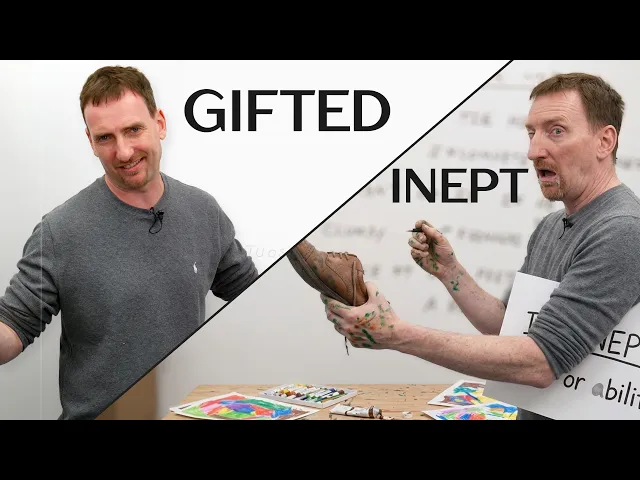
1:11 Somebody else can be gifted.
1:13 Now, gifted has a couple of uses.
1:16 For one thing, if you're very good at something,
1:19 like art or music or sports, we can say you are gifted.
1:23 You have special skills, special talents.
1:25 But we also use this word to describe someone who's very, very smart.
1:32 It's similar to genius, but maybe a little bit less than genius.
1:37 We would say gifted, especially for kids,
1:40 because a genius will always be a genius,
1:43 but a child is gifted until he or she proves to be a genius, right?
1:48 So, very, very smart or very capable at something,
1:51 which is another expression to explain the same idea, natural born something.
1:58 So, a natural born athlete has very good skills that come naturally, like,
2:04 I can't teach you how to be an athlete like this because
2:08 it's something that you are born with, or you're born to compete,
2:11 born to play basketball, born to be a writer, born to be a teacher,
2:17 born to be whatever it is that you do because you do it so well,
2:21 and you seem so naturally, you know, connected to that thing that you're doing.
2:27 So, both of these, natural born something, born to do.
2:31 Born to verb, natural born noun, just keep that in mind.
2:36 Now, especially when we're talking about
2:39 artists or musicians or even, like, doctors,
2:42 somebody who's very good with his or her hands, they have the gift.
2:47 The gift, again, some people say a gift from God,
2:50 other people say a gift from the universe,
2:53 other people just say gift, I don't want to get into all that as well.
2:57 So, if you have the gift,
2:58 it means you're very good at whatever it is that you're doing.
3:01 So, someone who's a very good cook, she has the gift or she has the touch,
3:06 she knows just how much spice to put in, she knows
3:09 just when to turn off the heat or turn up the heat,
3:12 she knows just when that smell is perfect and serves the dish,
3:16 or he, as the case may be.
3:18 Have the gift, the touch, or the eye.
3:20 The eye, again, especially for an artist, he has the eye,
3:24 he knows how to touch things, or a designer,
3:26 or a photographer, anyone who does anything visual,
3:29 he or she has the eye that touches the gift, and so on.
3:34 Now, "to hold one's own" means to be capable.
3:39 It doesn't mean especially talented, but it means can do, right?
3:44 So, if you say to me, "Oh, you're a pretty good artist", I can hold my own.
3:49 It's a little bit like showing some humility.
3:53 So, I'm not going to say, "Yeah, I'm a genius.
3:55 I'm the best artist you've ever seen." I can hold my own.
3:58 It means, yes, I can do it.
4:00 And usually, people who say that are pretty talented
4:04 if they can say this expression with a straight face.
4:08 "A jack of all trades" is a person who can do many, many different things.
4:13 Now, there's a full expression, "jack of all trades, master of none".
4:20 So, it goes...
4:22 It can be read in two ways.
4:29 If you only say somebody's a jack of all trades,
4:32 you think he's very talented, he can do all kinds of different things.
4:36 He can build, he can cook, he can write, he can teach,
4:40 he can play sports, all kinds of things he's good at.
4:43 But, if you say "jack of all trades,
4:46 master of none", it means he can do this well enough.
4:50 He can do that well enough.
4:51 He can't do anything very well.
4:54 So, be careful with this expression.
4:56 It can be used both ways.
4:58 And lastly, we have a "virtuoso".
5:01 Again, especially in music.
5:02 Somebody picks up a violin and plays it perfectly as a child, he's a prodigy,
5:07 and as he gets older, he becomes a virtuoso, which is similar to genius.
5:12 Somebody who's very,
5:13 very good at one particular thing and can do it very, very well.
5:17 So, here are all the good expressions.
5:20 Now, we're going to look at the other side of the coin, the flip side.
5:24 If somebody can barely tie his shoes...
5:27 Like, that's one of the first things,
5:29 the first big achievements a child has is tying his own shoelaces.
5:33 If somebody can barely tie his shoes means he can barely do anything,
5:37 even simple things very well.
5:39 So, when you say this about somebody,
5:41 you don't want that person to hear it because it's a little bit insulting.
5:45 Actually, a lot of these are a little bit insulting,
5:48 so be careful who you say them to or who you say them about.
5:51 So, if somebody can barely tie his shoes, again, two meanings.
5:54 One, he can't do much, or not very, very smart.
5:58 So, be careful about that as well.
6:01 Just general synonyms to "untalented" is "inept".
6:05 "Inept" or "incompetent" basically means can't do something well,
6:10 can't do something to a certain standard.
6:13 If someone is helpless, it means they can't really do anything by themselves,
6:17 so they always need help,
6:19 which is a little bit weird because the "less" is a little confusing.
6:22 But can't be helped.
6:25 Can't help themselves, I should say.
6:28 Now, somebody can do...
6:31 Somebody can play hockey amazing, just get on the ice and go.
6:35 Other people, like me, can't do it if they tried.
6:39 I can't play hockey if I tried,
6:41 which is a little bit of a strange expression because I can try.
6:46 It doesn't mean I'll do it well, but I can still try.
6:47 But this expression as it stands means it doesn't matter.
6:51 He just cannot do it.
6:53 So, I'm a terrible skater,
6:54 which is a little strange for a Canadian, I know, but it's true.
6:58 But I...
6:58 Not only can I not do it if I tried,
7:01 I couldn't skate well if you put a gun to my head.
7:04 So, if you put a gun to my head and said "skate or I will kill you",
7:08 I will die because I can't skate very well.
7:10 I really, really have no talent when it comes to ice skating.
7:13 But this is a very common expression.
7:16 He couldn't do something if he had a gun to his head
7:19 or a knife to his throat or any situation like that.
7:23 Now, when we're talking about physical abilities,
7:25 like doing something with your hands,
7:27 with your feet, etc., we can say a person is clumsy.
7:32 A "clumsy" means like maybe somebody trips all the time
7:34 or drops things all the time or break things all the time.
7:38 "Butterfingers" is similar, but imagine if on your hand you put some butter.
7:42 They would be a little slippery, right?
7:44 So, you're not going to hold anything.
7:45 Everything you're going to hold, you're going to drop.
7:47 So, somebody who drops things a lot, we call "butterfingers".
7:51 Just an expression that's nice to know.
7:55 Now, somebody who has two left feet.
7:58 If you have two left feet,
7:59 you're always going to turn to one side and you're going to trip
8:01 over yourself and you're not going to be able to do anything well.
8:04 This is especially common if we're
8:07 describing somebody's dancing ability or inability.
8:10 They have two left feet, but we can use it in other situations,
8:13 again, just to show that somebody's clumsy and can't do anything well.
8:18 And the same with all thumbs.
8:20 Imagine I have four fingers and a thumb.
8:23 If all my digits were thumbs, I wouldn't be doing anything very well, would I?
8:28 I wouldn't type well.
8:30 I wouldn't play baseball well.
8:31 I wouldn't do anything well if I had all thumbs.
8:35 Now, this is an interesting expression.
8:37 It doesn't mean necessarily "untalented".
8:39 It means "used to be talented, but now is not".
8:45 A "has been", especially for actors,
8:48 athletes, business people, anyone who was very,
8:51 very good at some point in the past, but now just can't do it.
8:57 So, a very famous actor tries to come back to Hollywood,
8:59 act in a movie, and it's like, "Oh, you suck." Right?
9:03 "You're really not good.
9:04 You're a has been." "Has been".
9:07 Somebody who was somebody now has been.
9:10 It was in the past, not anymore.
9:13 Right?
9:13 Again, not a very nice expression to say to somebody.
9:16 So, again, you're not going to meet
9:18 that many famous people anyway, so it's okay.
9:21 So, these are the untalented expressions.
9:23 We had the talented ones before.
9:25 If you're not sure about these, go to www.EngVid.com,
9:28 take the quiz, and test your knowledge of these expressions.
9:31 You can ask questions as well.
9:33 And if you like the video, give me a like.
9:35 Don't forget to subscribe to my channel,
9:36 and come back next time for more useful English tips.
9:39 See you then.