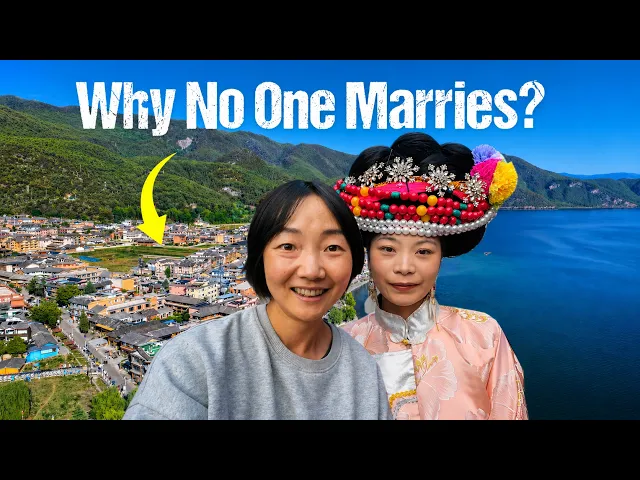
Inside China's MATRILINEAL Society Without Marriage 🇨🇳
Little Chinese Everywhere
0:00 Although here, neither men nor women marry.
0:02 My father is a member of another family.
0:05 But in his family, his most important role is...
0:13 In this video, we drove to the part of China
0:16 where many children grow up without even living with their fathers.
0:19 Families are run by women and uncles, and marriage,
0:23 as most of us know, it simply doesn't exist.
0:26 This is Lugu Lake, a beautiful region on the Yunnan and Sichuan border.
1:01 Hi, good morning, everyone.
1:02 Welcome back to the channel.
1:04 So now you see, I'm wearing a helmet.
1:06 I'm right in front of a motorbike shop in Lijiang.
1:10 So we just got a motorbike rented, and very soon,
1:15 I'll be leaving to explore a very mysterious place on the Yunnan
1:19 and Sichuan province border where you
1:22 will find China's last matrilineal society.
1:25 And that is to say, the women are the leaders of the family.
1:29 The kids take their name from the mom,
1:31 and there is a very interesting tradition called "walking
1:35 marriage." So the fathers don't stay with the mothers.
1:39 Whereas the fathers go to the mother's house, spend some time at night,
1:44 and then go back to their own sister's family.
1:47 So that's a very unique part of China.
1:52 So we got a 600 cc 625 Kove bike.
1:56 It's an adventure bike.
1:57 It's actually quite large.
1:58 I have to admit, it's been a while since I've ridden such a large bike.
2:02 But I think it should be fine.
2:03 It's definitely better equipped for this journey than
2:06 our bikes that we had on the Pamir Highway.
2:17 Let's go.
2:26 The altitude of Lijiang is more than 2000m.
2:29 I think it's around 2400 meters.
2:32 And the climate here is so good.
2:34 It's not too hot in summer and not too cold in winter either.
2:38 And in most cases, you get this clear, sunny weather.
2:45 We started in Lijiang in Yunnan Province.
2:48 The drive to Lugu Lake is less than 200 km,
2:52 but almost the entire journey is on mountain roads.
2:55 As we got closer to the lake, we stopped to pay the entrance fee.
2:59 Apparently only the Yunnan side charges admission.
3:02 If you enter from Sichuan, it's free.
3:05 Why certain fees are charged in China can be pretty confusing sometimes.
3:09 About 15 minutes later, after passing the gate, we reach the lake shore.
3:17 The place is so pretty.
3:18 The water is crystal clear, and the town of Daluoshui is quite modern.
3:23 There are plenty of nice cafes around the lake, even a KFC.
3:27 It was hard to imagine that one
3:29 of China's most unusual cultures had survived modernity.
3:36 Walking around the village, I noticed that many of the local women
3:39 dressed with a lot of style and confidence.
3:42 Meanwhile, the men seemed much less noticeable.
3:45 Flo suggested we need a lake view room.
3:49 I hesitated and said, "That'll probably cost over 1000 yuan." But guess what?
3:55 I checked online and found rooms for just over 300 RMB,
3:58 and somehow we even got an upgrade to a room with a balcony.
4:05 I'll give you a quick room tour.
4:06 So we have a very, very nice hotel.
4:10 It's pretty cool.
4:11 So two beds, and then there's a balcony with this amazing view of Lugu Lake.
4:18 And actually, interestingly,
4:19 the border between Yunnan and Sichuan is pretty much in the middle of the lake.
4:23 So the other side we are looking into Sichuan right now.
4:26 Just now we talked with the hotel reception,
4:28 and he told us that most of the villages
4:31 around the lake are Mosuo people's villages.
4:34 And the Mosuo people are the unrecognized ethnic group in China.
4:38 They were not officially one of the ethnic groups,
4:41 but those people are called Mosuo people,
4:43 with their distinct cultural characteristics.
4:47 And besides that, there are also lots of Yi people and Naxi people.
4:53 So we're going to stay here tonight,
4:56 and tomorrow we're going to find some villages
5:00 and dive deep into the culture of the Mosuo people.
7:29 Hey Flo, try this stir-fried rice cake.
7:31 You haven't eaten that.
7:32 What is that?
7:34 It's like sticky rice.
7:38 Sticky rice cake, fried rice cake.
7:41 Okay.
7:41 I'd like stir-fried rice cake.
7:43 I'd like a fried potato.
7:45 Yes, fried potato.
7:46 En.
7:46 Scan the code, please.
7:48 Thanks.
7:50 So I went to the neighboring store,
7:53 and the guy was so friendly, and he gifted me all of this.
7:58 I really wanted to pay,
7:59 but I actually refused it a couple of times, but no chance.
8:01 And he was so happy to have tourists here.
8:05 And he told me apparently there is a Laowai living in this city,
8:09 married to a Mosuo woman, and they have three children.
8:12 And also he recommended me a local coke.
8:15 I don't know where it's from.
8:16 Feichang Coke.
8:17 Wow.
8:19 Hmm, smells like Coke.
8:24 The shop has a long menu, but we just ordered two small, simple dishes.
8:29 One is the granny-potato, which is potato that is cooked until it's very soft,
8:36 and then Chao-er-kuai, which is stir-fried rice cake.
8:39 It's a very typical Yunnan dish.
9:07 One of the very important produce here is the dried apple.
9:10 Because the apple here is very sweet,
9:12 so the dried apple is also extremely, extremely sweet.
9:18 Can I have another piece?
9:20 I want to film it.
9:21 Sure.
9:21 En.
9:23 Thanks.
9:25 That is the dried apple.
9:27 And that is for sun protection?
9:32 We old folks wear this.
9:35 She said only old people wear it.
9:37 Ah.
9:38 Yes.
9:39 Smell it, it's nice.
9:42 This smells nice too.
9:44 Yes.
9:45 We'll get another bag of it.
9:46 I'll scan and pay you 40.
9:48 Thanks.
9:49 So young people, young people don't wear it.
9:52 They wear something nicer.
9:54 Ok.
9:55 OK, OK.
9:56 They wear something nicer.
9:59 Mine is for old granny only.
10:04 Hey, wait.
10:07 Good, yes.
10:08 Forty.
10:08 Can you scan it?
10:10 Go ahead.
10:14 We bought two bags of dried mushrooms.
10:16 That's some of the best products you can get here.
10:19 She must have picked them herself in the mountains.
10:23 Then we walked around the lake and saw quite
10:25 a few locals and monks walking around the prayer wheel.
10:36 It was peaceful.
10:37 The next day, in search of a village where the tradition "men do not marry,
10:43 women do not marry" is still alive, I went to the museum.
10:47 Actually, right now I am in the Mosuo Museum,
10:50 the museum here, and this is Guanzhang, the principal of the museum.
10:55 Come.
10:55 Make room for this lady.
10:57 Come here.
10:59 Thanks.
11:01 I'm going to have a cup of tea with them.
11:05 So here among the Mosuo people, it's said to be a matrilineal society, right?
11:06 What exactly is the situation like?
11:10 The father is just a giver.
11:13 He gives you something insignificant.
11:16 But the most important thing comes from your mother.
11:19 You are fundamentally from your mother.
11:22 Wait, what?
11:23 The Mosuo world view is astonishing.
11:27 A father only gives you something relatively insignificant.
11:30 The mother is the source of everything.
11:34 This matrilineal extended family, take me for example.
11:37 I live with my mother, my mother's mother,
11:41 my mother's siblings, my siblings, my sisters' children.
11:47 In one big family, three generations live under the same roof,
11:50 four generations, up to five generations at most.
11:53 All from the mother's side.
11:54 Yes, so terms like what we might consider very old-fashioned,
12:00 like "husband's mother," "wife's father," "wife's mother"—
12:06 the Mosuo only talk about generational status, not maternal or paternal side.
12:09 Mm hmm.
12:09 This is to achieve the ultimate harmony among people.
12:16 In this way, you live with your mother's side.
12:19 So you...
12:21 What about your father?
12:22 Does he come visit often?
12:26 Or help with work?
12:27 Or bring things?
12:29 Or...?
12:29 This is only natural.
12:32 Human nature is the same everywhere.
12:36 Although men don't marry and women don't marry,
12:38 my father is a member of another extended family.
12:42 But in his own family, he is an uncle.
12:48 All the household expenses, in the past, the men earned them.
12:53 Between two people, between two families,
12:55 there is only goodwill, care and affection.
13:00 So throughout their lives,
13:02 the two people don't have any conflicts, don't have any disputes.
13:05 Mm hmm.
13:07 So this kind of relationship, in human society,
13:10 is something people have always been searching for.
13:14 Listening to this, haha, it's pretty good.
13:15 Because there are very few conflicts, right?
13:18 No economic conflicts either,
13:21 none of those mother-in-law/daughter-in-law problems, none of that.
13:24 Mm, two people, two people are together purely for affection.
13:28 Mm.
13:30 At first it sounds almost ideal,
13:32 since there is no marriage, relationships are based purely on affection.
13:36 They said the society was once so harmonious that the courts
13:40 and police stations were practically growing weed in their courtyard.
13:45 The more I heard, the more unbelievable it sounded.
13:48 But do people still live this way?
13:50 Today, so I ask: where can I find a village like this?
13:55 The museum director told me that families like this can
13:57 still be found in many places around Lugu Lake,
14:01 especially in the nearby Yongning basin,
14:04 where he recommended going to a much smaller place instead: Lijiaju.
14:13 In search of China's last matrilineal village,
14:16 now we are heading towards Lijiaju,
14:18 which is on the other side of the lake, in Sichuan Province.
14:24 Sichuan Muli Tibetan Autonomous Prefecture.
14:26 It's about 40 kilometers away.
14:39 What?
14:39 Tobacco leaves?
14:41 Yes.
14:42 Yes, so right next to us in those farms are the tobacco leaves,
14:48 Yancao Ye, that is grown, 'cause Yunnan is very famous for its tobacco industry.
14:59 Hello, hello.
15:11 We are already in Sichuan Province, Yanyang County.
15:16 2 km away from the village.
15:18 The road is getting a little bit crappy.
15:20 The bridge is still under construction, so time to drive through the river.
15:28 Can you huh?
15:30 Can you Yeah, I think so.
15:31 Okay, go.
15:32 I walk, you go.
15:34 Ah, you walk over the bridge.
15:35 Yeah, I walk.
15:57 Can we stay here overnight?
16:00 Haha, wait...
16:02 accommodation...
16:06 I don't understand.
16:08 I don't understand.
16:11 Ah, let me make a phone call.
16:15 We stop in front of a rental house,
16:18 and I saw their family photos: five beautiful ladies together.
16:22 So this is perhaps the traditional family we are looking for.
16:27 Just one room is enough.
16:28 Just one room is enough.
16:30 For the two of them to stay.
16:31 You two can stay in that room.
16:32 Okay.
16:36 It's the same for you.
16:37 Okay, okay.
16:37 Okay, thank you.
16:39 Okay.
16:40 Thank you.
16:41 Can we eat here in the evening?
16:43 Yes, you can eat at home with us.
16:44 Okay, okay.
16:45 So you don't want lunch?
16:46 Right?
16:46 Right.
16:47 We don't need lunch.
16:48 You can have dinner together with us tonight.
16:50 Oh, okay.
16:50 We can chat together.
16:54 Hello, hello, hello.
16:57 Hello.
17:00 Haha, hello.
17:03 That's one of the sisters.
17:05 Are they leaving now?
17:06 Right?
17:07 Yes, going to work.
17:08 They're off.
17:09 Was that your older sister or younger sister?
17:12 Second older sister.
17:13 Did the oldest sister go out already?
17:14 The oldest sister went out.
17:15 She went to herd the sheep.
17:16 The oldest sister, the second sister,
17:19 and also a younger brother, one younger brother, and a niece.
17:24 Oh, and my older brother.
17:26 Hahaha, so where are your younger brother and niece?
17:29 The younger brother is at school.
17:31 The niece has gone out to work.
17:35 And is not here.
17:36 She lives in another city.
17:38 Working away from home, right?
17:41 I imagined a big, crowded family with many people,
17:44 but then I realized some members went to school,
17:48 some went to work, some went out herding the cattle,
17:51 leaving the big house quite quiet.
17:54 I was curious, of course,
17:56 but honestly I felt awkward asking them directly about their family situation.
18:02 The man hosting us, though, was clearly the brother,
18:05 and from what I could tell, there didn't seem to be any husbands around.
18:24 And I also want to give you a house tour,
18:28 because the houses here are very typical.
18:32 Normally they have three parts.
18:35 So this one is called Grandma's Room, so the house of the grandma.
18:41 It's where the oldest female lives,
18:45 and also the living room of the whole family.
18:48 That is the shrine.
18:49 So that's the spiritual center of the house.
18:53 There is a little shrine.
18:55 It's also a place where everyone prays.
18:58 And this is called Flower House.
19:00 So that's a living space.
19:02 There are two floors.
19:04 Women live on the ground floor, whereas guys live on the second floor.
19:20 Oh wow.
19:22 This shrine is like a small temple.
19:26 So on the wall of both entrances there are murals.
19:32 The doors are locked.
19:34 It's apparently a very important place.
19:37 But from here you can see what it looks like inside.
19:47 What year was this built?
19:48 How many years has it been?
19:52 It's been over 300 years.
19:54 Wow, a long time.
19:57 The murals next to it are very beautiful.
20:00 Yes, mm.
20:01 We don't know either.
20:02 Even my uncle can't remember.
20:04 He has no idea, even who painted them and who built them.
20:09 And those, my uncle...
20:15 They also have a garden kind of area here.
20:20 Every morning, we come here to burn incense.
20:22 Every family does it.
20:24 Every family does it.
20:26 Yes, burn.
20:26 Every morning, every family will burn incense.
20:31 Now we don't weave as much as before.
20:35 Not anymore.
20:36 In the past, was all the cloth for clothes woven by yourselves?
20:39 Mm.
20:40 Oh, you have to step on it.
20:57 Now it's more convenient.
20:59 Now there are machines, a lot more convenient.
21:01 Mm, in the past, there were no machines.
21:03 Yes, you're right.
21:05 Mm, now there are machines.
21:08 Do you have children?
21:10 Yes, how many?
21:11 Two children.
21:12 Are they away from home?
21:14 Mm, they've gone out to work.
21:16 Gone out to work.
21:17 So for you, your children, two children,
21:21 their father doesn't live with you either?
21:24 Doesn't live with me.
21:25 He's in the village.
21:26 Their father is not from this village, but another one.
21:31 A village down below.
21:33 Also a village.
21:34 He also has his sisters and their family.
21:36 That is, his nieces and nephews, that family.
21:40 He takes care of them.
21:42 His sisters' children.
21:45 And then your younger brother, older brother, takes care of your children.
21:51 Mm hmm.
21:52 The oldest sister, mm.
21:54 Whose children...
21:55 They are all the children of the family.
21:58 They grow up like that.
22:00 I see, it doesn't matter.
22:02 Mm hmm.
22:03 I felt a bit awkward asking such personal questions,
22:06 but the Mosuo people didn't seem to mind at all.
22:09 If anything, they were much more comfortable talking
22:12 about this family structure than we outsiders were.
22:16 So let me ask, for you now, the children live with the mother's family, right?
22:21 Mm, yes, yes.
22:22 So do you...
22:24 your children?
22:25 My children live in someone else's mother's family.
22:29 In the woman's family.
22:30 Also in the village.
22:31 Yes, yes, yes.
22:32 It's like this for everyone, yes.
22:33 The baby stays with the mother's side.
22:36 This is how our matriarchal system works.
22:39 So all the children take their mother's surname?
22:42 Take the mother's surname.
22:42 Yes.
22:43 But do you need to register your marriage Or not
22:46 at all The certificate is a must though I see,
22:49 certificate is necessary but how about life?
22:51 When it comes to life We don't live together she has her life,
22:56 I have mine Ah, I see.
22:59 So that means you take care of your (sisters' children),
23:01 and I take care of mine.
23:03 the kids in my family.
23:05 The children are all considered your children.
23:08 Wow, wow.
23:10 This is how our matriarchal system works here.
23:14 Is it like this in every village, or just this one?
23:16 Right now, this whole village is like this.
23:18 No one really got married.
23:20 Apart from this village, are there other villages like this too?
23:22 Over there, besides that area, that Lugu Lake area,
23:24 that Yongning area, they are all like this.
23:27 Yongning is also like this.
23:28 Ah, and that place up there, our Our Mongol Ethnic Township is also like this.
23:34 So they are all Mosuo people, right?
23:36 Ah, well, how to put it, Anyway, we are all the same ethnic group.
23:40 Over there they are Mosuo, over here we are Mongol,
23:42 but it's the same ethnic group.
23:45 The guys usually live on the second floor,
23:47 and here I see a picture of Genghis Khan.
23:51 So definitely proves that they believe that they have some Mongolian roots.
23:58 Beyond their family life,
23:59 the origins of most of the people are equally fascinating.
24:03 They follow Tibetan Buddhism,
24:05 so there's clearly a strong connection to Tibetan culture.
24:09 But when it comes to ethnicity, things get surprisingly complicated in Sichuan.
24:14 Most of the people are classified as Mongolians.
24:17 In Yunnan, they are usually considered as part of Naxi.
24:21 I honestly can't tell you exactly why.
24:24 The more I learned, the more confused I became,
24:28 and somehow that only made this community more interesting.
24:32 Look at this.
24:34 That is their cured pork fat.
24:35 So that's salted pig, one on top of another.
24:40 We make one each year.
24:41 One per year.
24:43 Sometimes two per year, sometimes just one.
24:48 But aren't some quite old?
24:50 Yes, some.
24:51 The two up there, more than 30 years.
24:53 More than 30 years.
24:55 Yes, after processing it.
24:57 And actually those preserved pork are primarily just fat.
25:03 This thing of yours, in the past, there was also a path here.
25:06 There's a well over there.
25:07 That water is salty, oh.
25:11 Go this way, head over there.
25:14 Okay, okay.
25:14 This house is very tall.
25:16 Mm, go down and walk over there.
25:17 Those are so beautiful.
25:21 You can drink it.
25:21 We've all drunk it.
25:24 They need to be careful, though.
25:26 You try it first, see.
25:27 You can try first.
25:28 After you drink it, then you drink.
25:32 Is it spring water?
25:37 Can we drink this?
25:39 Yes, you can drink it just like this.
25:40 You try a little bit first.
25:41 Don't take too much, just a little, don't take too much.
25:43 See if you can handle it.
25:47 Very interesting.
25:49 It smells like, I mean it tastes like a lot of minerals.
25:54 Oh, rust.
25:56 Rust, mm.
25:59 Yes.
26:00 If you're not used to it, it doesn't taste good.
26:01 We drink it on purpose.
26:02 Once you're used to it, you want to drink, want to drink this water.
26:06 Wow, wow, oh.
26:07 Not good, there's something wrong with my body.
26:09 It's good for digestion, oh.
26:11 Wow, this is, this is...
26:13 You can tell, there's a lot of that Look, even Pepsi made it here.
26:19 Want some?
26:20 Do you have any bottled water here?
26:22 Ah, yes.
26:23 Yes, I see it.
26:25 Hot water?
26:26 Uh...
26:26 Cold water, cold water.
26:27 Cold water.
26:28 How many?
26:29 Uh...
26:31 One, one.
26:31 One for now, we'll come back and buy more later.
26:34 Yes, yes, mm.
26:41 2 Yuan.
26:43 Thank you.
26:45 This is probably some of the most remote villages in China,
26:49 but still there are some nice roads.
26:52 There's internet, electricity, tap water.
26:59 That's their moving grocery store, moving market.
27:04 What do you have?
27:07 Mushrooms.
27:08 Ah, there are mushrooms, mm.
27:10 Okay.
27:14 Rice cake, roast duck.
27:17 Lamb.
27:23 Hey, according to the loudspeaker, they said they have Kaoya, roasted duck.
27:28 Maybe you should buy one.
27:31 That's crazy.
27:33 That's how they supply these remote areas.
27:36 It's really interesting.
27:39 He comes every day, and then the villagers just
27:41 pass by and buy their stuff and stock up.
27:46 Yeah.
27:47 Even though this is some of the most remote areas in China,
27:50 it is well connected.
27:53 There's a road, there's tap water, electricity, also internet.
28:01 No worries.
28:01 We just finished work, and now we are taking a rest.
28:03 Right?
28:03 Yes.
28:07 Thank you.
28:08 So here, whenever a family builds a house, will the whole village come to help?
28:14 Take one.
28:16 How many people live in this house?
28:17 How many people are in this family?
28:19 Mm, their family isn't large.
28:21 Oh, seven people.
28:22 Oh, seven people.
28:22 That's still small.
28:23 The smallest, the very smallest.
28:25 Around here, mm, in the past there were thirty or forty people.
28:31 They said seven people is a small family.
28:33 Like sometimes they have 20-30 people.
28:36 Twenty or thirty people.
28:36 Wow, so how big must the house be?
28:38 In the past, there were over thirty, almost forty-four.
28:41 Now, now they've split the family.
28:44 Thank you.
28:47 Bye bye.
28:53 Yeah.
28:58 After spending some time in a village,
29:00 I finally got to see the lifestyle I'd heard so much about here.
29:04 One's family business is everyone's business.
29:07 The village isn't rich, but there is a strong sense of community and trust.
29:12 In a place like this, it's easier to understand
29:15 why marriage never became the center of family life.
30:01 Fried potatoes, thank you.
30:03 You're welcome.
30:07 And then, Any dietary restrictions?
30:10 No.
30:15 For dinner we got two dishes.
30:16 One is Guo-Qiao-Mi-Xian, so it's rice noodles cooked in a boiling broth.
30:21 And also Zha-Yang-Yu, French fries in a Yunnan style.
30:25 So we are going to enjoy our dinner now.
30:28 We hope you enjoyed this episode and the mysterious, beautiful Lugu Lake.
30:33 And if you're interested in visiting China,
30:36 feel free to check our website, which is called littlechineseeverywhere.com,
30:41 on which we offer very practical travel
30:43 information for people who want to visit China.
30:46 So that's all for today.
30:48 Thanks for watching, and we'll see you in the next episode.
30:51 Bye bye.