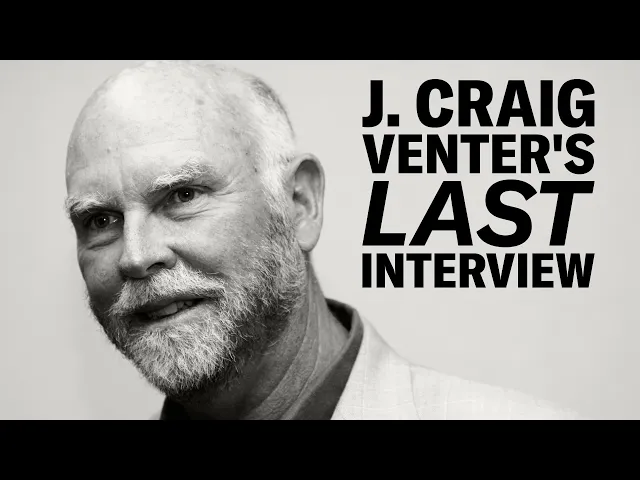
This man changed science forever. We spoke with him just a month before he died.
Scientific American
0:00 If you want immortality, do something meaningful while you're alive.
0:12 Question: How would you describe the current state of American science?
0:21 I'd say the best way to describe it,
0:23 it's an extreme flux, for all kinds of reasons, not just political.
0:28 AI has sort of entered the scene in a interesting way.
0:35 Maybe a little bit overhyped, but, uh,
0:39 that's certainly affecting how people think about the future in some areas,
0:44 but it's, it's so overhyped,
0:46 I think people are looking for miracle solutions there,
0:50 uh, that aren't going to occur.
0:52 When we made the first synthetic cell, uh,
0:55 about a quarter of the genes are of complete unknown function.
0:59 AI is worthless as a tool to identify the function of those genes.
1:05 As you know, if it's not part of the training set,
1:09 it doesn't exist in its world.
1:12 All these people that are talking about how AI is gonna design new genomes,
1:16 design whole new things, it, it can't take things outside of its repertoire.
1:23 For the first time in history,
1:26 my team has been able to define and quantitate the unknown.
1:34 Because, people just sort assumed we knew the function of most of biology, um,
1:41 and now we have an exact quantitation of how
1:45 much we don't know, uh, on each cell.
1:48 And it's gonna be different for each one.
1:51 But we do have a way to quantitate it now.
1:54 But, um, it's not something AI can currently solve for us.
2:02 As functions of these genes get sorted out in their role in biology,
2:06 then that becomes part of the training set for the future.
2:10 But that's just a, a side example of how
2:14 people are putting a little bit too much hype and hope and belief in, into a new
2:19 system that's supposed to do everything for everybody, right?
2:22 We're all limited by our training sets,
2:25 so we're in flux because of that, we're in flux because
2:28 of the funding and the competition and the political turmoil in the world.
2:34 And now, so much of science is dependent on open,
2:38 candid communication, across countries.
2:42 Open movement of, uh, people.
2:44 We're suffering a lot in the us uh,
2:48 medically because so many of our interns and residents come from overseas.
2:55 And so every hospital now, there's just huge wait logs,
2:59 huge wait times because we've blocked the manpower coming in.
3:06 And the same is true for science with postdocs and graduate students.
3:10 This is the fuel that feeds the future of science.
3:13 New young blood coming in and getting, educated and excited about the future.
3:19 So we're, we're shooting ourselves in the foot a little bit there,
3:24 and at the same time we're facing increasing competition,
3:29 at very substantial levels.
3:32 In the field of synthetic biology, China's outspending the U.S.
3:36 10 to 15 to one.
3:40 And, uh, as an example, my book about making the first synthetic cell,
3:45 "Life at the Speed of Light," uh,
3:48 I think it's in, maybe it's second printing in the U.S.
3:50 but it's like it's eighth or ninth printing in China.
3:54 It keeps, uh, selling it there much better and there's much more interest.
3:58 And the, the government there really recognizes
4:01 this is the future of industrial engineering,
4:04 it's the future of science is the future of manufacturing.
4:08 China's been a bit one way on data sharing.
4:11 With the human genome they suck data in, they don't allow data to go out.
4:18 And this is at everybody's loss, including their own.
4:21 Having a database of all Chinese, uh,
4:25 genomes and conditions, uh, will be of interest,
4:29 but it's the outgroups and the differences between all
4:34 the ethno geographic groups where all the discoveries will be made.
4:38 And we have the opposite problem in this country.
4:40 Our databases are mostly, western European males.
4:46 So we're all suffering from the lack of diversity,
4:49 and I, I know that's a dirty word now,
4:53 but, uh, for science and understanding biology and understanding the human race,
4:58 human potential, human disease, uh, that's essential.
5:04 Question: What do you think needs to change in American science?
5:09 Well, there, there's so many things that do need to change.
5:12 I, I think we're slowly getting back there.
5:14 We've seen where Congress is starting to get
5:17 a little bit of a backbone and, and put some,
5:22 uh, money and funding back into getting good, solid, basic science going.
5:29 We needed to make a lot of changes in science.
5:31 We need to make, still, a whole lot of changes in science.
5:36 I've been very vocal about my complaints about
5:39 the NIH does fund a lot of "me, too" science.
5:44 Back in 1995 Ham Smith, the Nobel laureate, and I wrote a grant,
5:49 and submitted it to NIH proposing our idea
5:54 for "shotgun sequencing" to sequence the first genome in history,
5:57 and it was turned down with extreme prejudice.
6:02 And even when we were, almost completely finished with the genome,
6:07 we had no doubt in our minds it was gonna work--the mathematics would work,
6:11 the assembly worked--and I wrote a letter to Francis Collins saying,
6:16 you should consider funding this just so NIH won't be embarrassed when
6:21 after you turned it down we went ahead and we're first in history.
6:26 And I still have the letter that I got back just saying that they
6:29 totally stand by the study section and they're certain that it won't work.
6:34 So the rest is history, as you probably know.
6:38 A short time later we published the first genome in history,
6:42 but what had happened because we proved an idea worked,
6:48 we then were flooded with funding from NIH and DOE
6:54 and other agencies to do more and more genomes.
6:59 So they'll fund an idea after it's proven to be correct.
7:07 But that's not how science works at its best.
7:09 We fund new ideas and take risk to get to those new ideas faster.
7:15 So I, I've said many times, the American public should feel outraged
7:20 they're not getting 10 times the discoveries,
7:23 uh, that they could be getting and should be
7:27 getting because we don't fund new ideas and new science.
7:34 Several years ago when the new NIH director
7:36 came in, he wanted to form a special award
7:40 for high risk research and he asked Sidney Brenner
7:44 and I to head up a committee to recommend, uh, some candidates for this award.
7:53 And we came up with 10 really top candidates.
7:57 NIH decided they were all too risky,
8:00 and didn't want to give them the award for high risk research,
8:05 because it sent the wrong message.
8:07 So it's just.
8:08 and Question: By risky you mean it won't pan out?
8:11 Or there's a chance it won't work?
8:12 Yes.
8:13 There are people like me that took chances.
8:16 We, we didn't know if it would work, for sure,
8:18 when we set out the sequence the first genome.
8:20 It's, it's what you do.
8:21 We're experimental scientists, you do the experiments.
8:24 Sometimes they work and sometimes they don't.
8:27 When they do, it's really a big deal.
8:30 Yeah, and sometimes when they don't, it's really a big deal, too.
8:33 I think it typifies this risk adversity and, and so,
8:38 you know, the Trump administration's not all wrong.
8:42 I think, things need to be fixed.
8:45 I, I think I could come up a lot
8:48 better ways to fix it than they've been fixing it,
8:51 but, uh, I think a lot of other people could, too.
8:54 But I think maybe we're getting back.
8:57 But it's, it's the overall philosophy
9:00 starting with our fundamental education system.
9:04 Teaching evidence-based decision making is a fundamental of science.
9:11 I mean, it should be a fundamental
9:12 of everybody's think critical thinking, right?
9:15 Otherwise you live in the land of conspiracy
9:19 theorists and you just make up whatever you want.
9:22 We seem to move more in that direction,
9:25 but, the evidence isn't always right and you can lead to wrong conclusions,
9:29 but that's why you gather more evidence, to do that.
9:32 And, uh, so you know what's missing more and more is opportunities
9:40 for young scientists to come in and be able to take these risks,
9:48 uh, try things, and, get rewarded or learn from the failure.
9:53 I, I, I claim I, I know a lot 'cause I've failed so
9:55 many times that I've learned more from the failures than from the successes.
10:01 Question: What a piece of advice,
10:03 would you give early career scientists right now?
10:05 You have to take risks.
10:07 If you're risk adverse, you're in the wrong field.
10:11 I mean, it's just, uh, it's a definition of doing an experiment.
10:16 You don't know the outcome.
10:18 My favorite job is being an experimentalist.
10:20 You know, I can ask questions.
10:23 and you try and get answers,
10:24 sometimes you get a different answer than you want, right?
10:27 And so being a fundamental experimentalist is the essence to me of science.
10:36 Asking questions and getting answers.
10:39 There's a gradient though, and this is what I think we fail at quite a bit.
10:47 I think I've been very lucky in my career
10:51 in having the ability to try and answer big questions.
10:56 Most people are afraid of trying to tackle big questions, right?
11:00 So that adds extra layers of fear.
11:02 But, uh, I don't know how much you know about my history,
11:06 but my science career started by getting drafted
11:09 and spending a year in Vietnam as a medic, and, uh learning that fundamentally,
11:16 the biggest thing I had to lose was my life.
11:22 Uh, and so that made me, uh, um, I was always a risk taker, but uh,
11:31 that sort of set the philosophy for the rest of my life and I wanted
11:38 to apply my skillset to honoring thousands of young men and women my age dying,
11:46 for a war that almost nobody believed in.
11:50 And I went back to school to get an education to try
11:57 and honor these people with doing something meaningful with my life.
12:01 I always tell people, if you want immortality,
12:05 do something meaningful while you're alive.
12:09 Uh, and, and that's the way to get immortality.
12:12 So, we have to build back the space.
12:16 The fundamentals are there because we have so many good people in science,
12:22 but they've also been corrupted by how scientists have to chase money.
12:31 To get grants and, a flawed review process generally,
12:37 not wanting to fund new science, um, new ideas.
12:43 So it sounds bleak.
12:46 Currently we're still hanging on maybe by a tooth to, uh,
12:52 leading the world in science.
12:54 In part, we have unique institutions and unique way of thinking in the U.S.
13:01 that almost does not exist anywhere else in the world, and that's philanthropy.
13:07 We have so many people that have made huge fortunes.
13:12 And a lot of them could do a hell of a lot more than they're doing.
13:18 But a lot of people are doing
13:21 amazing amounts with the fortunes they've inherited,
13:23 uh, developed, and that's the backbone of how we move things forward.
13:29 People think it's government funding.
13:30 Government funding sort of fills in the backbone, builds our infrastructure.
13:35 Without indirect cost I can't pay for my building,
13:39 my electricity, the, HR people, anything.
13:43 So it, it, the infrastructure of science is
13:47 just as critical as the funding for new ideas.
13:50 But we have a great combination of the two because people do believe,
13:55 to a great extent, in putting money in science.
13:58 We, we have more wealth out there now than in the history of the world.
14:05 I mean, we have, uh, several individuals wealthier than countries.
14:12 And, uh, they could do a thousand times more with their money,
14:17 and not even miss it.
14:21 Um, Question: What does give you optimism right now in the field
14:25 that the overarching like science and innovation here in the U.S.?
14:29 Well, is, is it 'cause people are excited about the new opportunities trying
14:34 to move things forward with the new mathematical tools and new computing tools,
14:40 it's hard to imagine how powerful the computes will be.
14:45 Uh, that gives us whole new ways
14:47 of looking at things and trying to combine things.
14:51 25 years after we sequenced the first human genome,
14:54 we now have whole new tools, uh, to start it over again the right way.
15:00 When we sequenced the first genome in 1999 and 2000, there was nothing to copy.
15:07 We actually had to do it.
15:08 We had to sequence it all and assemble into a genome sequence.
15:15 Since then, because of, uh, development of technology,
15:19 particularly with Illumina with short reads,
15:21 that revolutionized the cost of sequencing, but at the expense of completeness.
15:30 For the last 25 years, we've been missing over 60% of human heritability
15:36 because it's not in these short read sequences.
15:41 So now with new technology, like with PacBio and Oxford Nanopore,
15:45 we can get very long reads.
15:47 We can now for the first time, assemble full genomes.
15:52 And try and find the missing 60% of human heritability, understand human traits.
15:59 Uh, this has to lead to great leaps forward in medicine.
16:04 We all had these great dreams 25 years ago, and they got sort of subverted
16:12 by geneticists being sure that single letter changes,
16:16 explained everything in the genetic code uh, which they don't.
16:20 And uh, that just by doing short read sequencing
16:25 and layered on my genome or reference genome would solve everything.
16:29 So it's amazing it's taken 25 years to realize how faulty it's been.
16:37 And also, NIH chose just to fund sequencing
16:41 more genomes instead of: "what's the key thing?
16:45 How do we understand your body and your physiology?"
16:49 We have to understand your genetic code,
16:51 and we have to understand your complete phenotype,
16:54 and we have to put those two together.
16:57 So just sequencing more genomes tells us a lot about ancestry and history.
17:03 It doesn't tell you, uh, the shape of your face.
17:08 It doesn't tell you the spectrum your brain, uh,
17:12 will function at with all these different things:
17:16 susceptibility for environmental interactions, disease, wellness.
17:22 And this is where AI can be very helpful of being able to take all
17:28 the information we can know about an individual
17:30 and relating it back to their genome.
17:34 Only now we'll be able to do this tens,
17:37 hundreds of thousands, millions of times as the tools keep getting better.
17:43 But they all have to be developed.
17:45 But that's why I'm optimistic.
17:46 I see it being possible now for what we dreamt about 25 years ago is now doable.
17:53 Question: And is that how your field has changed
17:55 in the last few years in terms of the automation,
17:58 in terms of being able to do these full genomes?
18:00 Just in the last few months even.
18:02 It's like, it's, uh,
18:04 it's just really starting to change because we're still having
18:09 to change the fundamental thinking of the researchers in the field.
18:15 That, uh, the definition of a genome became its cost.
18:21 What does it cost to do a genome?
18:22 A hundred dollars, but it's not a genome, it's a collection of fragments.
18:28 Uh, now we can actually have complete genomes.
18:33 We can understand your mother's genome, your father's genome.
18:37 It's called the diploid genome.
18:39 And so that's the company we just started Diploid Genomics
18:42 to really start to understand humanity at its most basic level.
18:47 So yeah, it makes me very excited and optimistic about it.
18:50 We're, we're calling it Genome 2.0.
18:53 I never thought it would take 25 years to get here,
18:56 but, uh, some things move slower than others.
19:01 Question: And it's the technology that has,
19:03 in addition to kind of culture and how people think scientists think...?
19:06 It's the mathematical tools, it's the AI,
19:09 it's the, just the fundamental change in computing.
19:13 In 1999, I built the third largest civilian computer in the world.
19:19 It was one and a half tera flops that filled two giant rooms.
19:23 Now you can have a laptop that's much more powerful than that.
19:27 So, so, computing technology, memory, uh, the, large language models,
19:34 the new tools we have that can find associations
19:39 between things that the human eye can't readily discern.
19:45 So that gives me real optimism
19:48 for making major discoveries over this next phase.