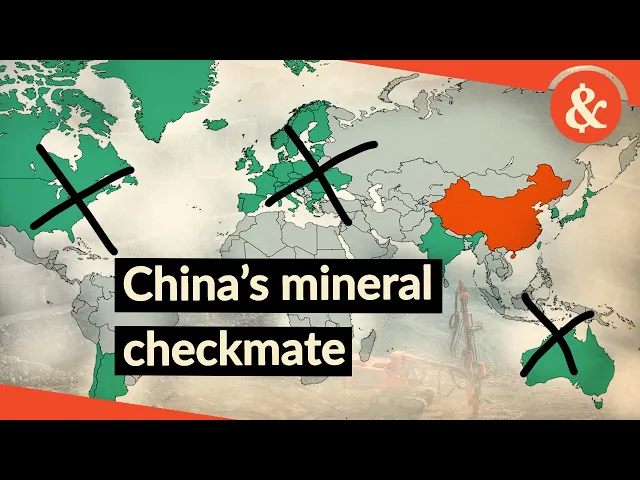
Why China's mineral monopoly can still be broken
Money & Macro
0:00 China has weaponized its critical minerals monopoly,
0:03 on which the entire Western industrial base depends.
0:08 According to the European Council of Foreign Relations experts,
0:11 Doctor Tobias Gherke,
0:12 This dependency is even worse than Europe's 2021 dependance on Russian gas,
0:18 which led to a massive energy crisis in 2022.
0:22 So if China cuts its critical minerals completely today,
0:25 our industry is not prepared.
0:28 Vast elements of our base industry in Europe, but also in other places,
0:33 rely on these UN access to permanent magnets, most importantly.
0:37 So if that would stop tomorrow, quite frankly, some of these industries,
0:42 like the automotive industry, would grind to a halt.
0:45 There would be no more production very quickly,
0:48 and that would have incredible cascading effects.
0:52 Imagine that 13 million people are employed in the car industry in Europe.
0:56 Imagine, 95% of them would stop production.
1:00 I mean, we are talking, an economic crisis of historic proportions.
1:05 No wonder governments ranging from Europe to the US to India,
1:09 are scrambling to reduce their dependance on Chinese
1:12 minerals like rare earths, copper and lithium.
1:16 But this will be incredibly hard.
1:20 China's mineral monopoly is protected by its massive scale,
1:23 massive government subsidies, lax environmental regulations,
1:27 and China churns out hundreds of thousands
1:31 of academics and PhDs in mining and geology.
1:36 And, you know, in Europe, it's a drop in the ocean.
1:39 And so, even if you're now wouldn’t want to reverse
1:43 this, you know that, the deck is stacked against us.
1:48 But there is hope for the West in the 1980s and 1990s,
1:51 the West dominated all of these industries, and China was able to break
1:55 through the Western monopoly through clever policies.
1:58 So can the West learn from China to take back its sovereignty?
2:02 Yes, absolutely.
2:04 In this video, I'll show you how they can do it in five steps.
2:07 But before getting into the specifics,
2:09 let's do a quick recap of why critical minerals are so important.
2:15 For simplicity, let's start with the critical minerals
2:17 that have been in the news the most.
2:20 We are discussing, critical minerals and rare earths.
2:24 Probably heard people talking recently about rare,
2:26 what is so special about these rare earths?
2:29 Sure.
2:30 The F-35 jet, state of the art US Navy destroyer nuclear attack submarines.
2:35 I found they all contain thousands of pounds of rare earths.
2:39 But what for the main product that is made
2:42 out of refined rare earths is our permanent magnets.
2:46 These are magnets that do not need
2:49 an external power source to generate their magnetic field.
2:52 They allow modern wind turbines,
2:54 for example, to transform wind into electricity.
2:57 They are at the core of loudspeakers, microphones, and all of our headphones.
3:03 The new Nintendo Switch to has super snappy
3:06 magnetic attachments that sound like this sounds good,
3:11 but perhaps more crucially,
3:12 modern cars cannot be made without permanent magnets.
3:16 They power your car's trunk sense or your car's steering system,
3:19 its air conditioning actuator,
3:21 the window lifting motor and for electric vehicles, even its entire motor.
3:26 So this is why it really matters to that.
3:29 China holds holds a global share
3:32 of earth refining and permanent magnet production, somewhere around 95%.
3:37 And worryingly, China has recently introduced
3:39 a licensing system that requires any firm
3:42 in the world to apply for a Chinese license to use these magnets.
3:48 And need to go to Beijing and say, hello, I'm Volkswagen.
3:51 I need that permanent magnet.
3:53 Do I get a license if Beijing says no?
3:56 Volkswagen.
3:57 Stellantis for the entire western car industry ground to a halt.
4:01 And even if they can replace all the permanent magnets all over Western cars,
4:05 that will be so expensive that they would soon be
4:08 crushed by competitors that do have a license from Beijing.
4:12 China has already shown that it is willing
4:14 to use economic weapons like this to devastate local industries.
4:18 For example, in 2023,
4:20 China no longer granted Chinese firms licenses to export graphite to Sweden.
4:25 It wasn't exactly clear why it did
4:27 this, but publications like The Economist have mentioned that it
4:30 may have been triggered when a Swedish free
4:32 speech group gave an award to a Chinese dissident.
4:36 Although the reason could also have been strategic for a while,
4:39 Sweden's promising battery startup Northvolt seemed like the only
4:43 company that could be competitive against Chinese producers.
4:48 But two years after China's ban,
4:50 Sweden's Northvolt shut its doors for good in Sweden only 10 to 15 years ago,
4:56 this would be unthinkable.
4:58 Back then, the dominant idea was
5:00 that the global free market just determines everything.
5:02 If a battery company wants to buy minerals and it is in short supply,
5:06 the price will just go up for everyone at the same time.
5:09 And the highest bidder, well, they will buy.
5:12 The only job of the government was still at the free market.
5:15 Function as efficiently as possible.
5:17 This logic no longer works today.
5:20 Governments are increasingly realizing their role is
5:23 no longer just about making markets efficient.
5:26 It's also about protecting domestic industries from foreign manipulation.
5:30 Therefore, governments have now been forced to think
5:33 carefully about critical minerals and critical materials more broadly,
5:37 which are defined as any materials that have,
5:40 number one, a high risk of supply chain disruption.
5:43 And number two, serve an essential function in one or more technologies.
5:48 By this definition, a rare earths are clearly a critical material.
5:53 China now has a massive power over
5:55 foreign manufacturing firms because it has a monopoly
5:58 or near monopoly in the two other parts of the supply chain mining and refining.
6:04 On average, China controls 54% of rare earth mining.
6:08 But far more importantly, it controls about 77% of rare earth refining.
6:14 This is the pattern that we see all across industries that power the modern,
6:18 increasingly electrified global economy.
6:20 For example, if we look at copper, which is the main conductor of electricity,
6:24 we can see that mining is relatively diversified.
6:28 Even though Chile, the Congo and Peru are the biggest producers.
6:32 But when it comes to refining, China is much more dominant.
6:36 But the West's critical material vulnerability is not purely limited to China.
6:40 Think, for example, nickel, which is a key input in steel production,
6:44 and it is one of the most promising metals to be used in batteries.
6:48 However, supply is not secure at all.
6:50 Given that Indonesia is the epicenter of global nickel
6:53 production and now also refining what you see, like China,
6:58 Indonesia has shown that it is more than willing
7:00 to use its nickel dominance as an economic weapon,
7:03 as it has banned all raw nickel exports
7:05 to ensure that it also dominates the nickel refinement industry.
7:09 However, so far, China has smartly moved in to make sure many
7:13 of the best Indonesian based nickel refineries are in fact Chinese companies.
7:19 But nickel is a rare exception where a country other than China dominates.
7:23 If you look at the most common element used in batteries,
7:25 lithium, we can again see that in mining.
7:28 Sure, China is a big player, but Australia is actually more important.
7:33 However, Australian mines largely depend on Chinese refining capacity,
7:38 making Western battery manufacturers again largely dependent on China.
7:43 This pattern holds for almost all critical minerals graphite,
7:46 cobalt, you name it.
7:48 Mining dominance is different for a mineral,
7:50 even if China almost always plays a big role.
7:53 But the real story is about refinery.
7:55 China dominates almost all critical mineral refinery,
7:58 giving it an insanely powerful economic weapon that it is now starting to use
8:03 to get both Western and non-Western countries like India to do what it wants.
8:07 But before we get to how the West can respond, this, of course,
8:11 raises the question why is China so dominant in mineral refinement?
8:16 Because it really wasn't always like this just a few decades ago.
8:19 In fact, after the Second World War,
8:21 the dominant rare earth player was actually the United
8:24 States thanks to the massive mountain pass mines in California.
8:29 So, ironically, as US Treasury Secretary Scott Bessent recently said,
8:34 the technology, especially in rare earth magnets, it's being used against us.
8:38 It was U.S.
8:39 technology, but Japan and Europe also played a major role.
8:42 France, Germany, Portugal,
8:45 Spain all of them had strong mineral mining industries and not.
8:51 So what happened?
8:52 How did the Chinese take over this strategic industry?
8:56 The answer actually consists of two parts.
8:59 The first part is Chinese strategy.
9:02 Interestingly, there are some rumors that China's
9:04 rare earth monopoly was a result
9:06 of a grand geo economic strategy set out already by Deng Xiapeng in 1992.
9:12 But according to Michaela Roibu.
9:14 I hope I pronounced correctly who was doing
9:16 her doctoral research on China's rare earth monopoly.
9:19 China's current dominance is probably and ironically,
9:22 a result of industrial protection by Japan and the US in the 1990s,
9:26 which excluded Chinese firms from obtaining
9:29 the know how to refine critical minerals.
9:32 Now to counter this, they were forced to attract a lot of foreign investment
9:37 and talent and knowhow into minerals
9:40 and to the mineral space, mostly from Europe.
9:42 And they did this by giving foreigners all sorts of juicy advantages,
9:47 like tax credits that gave lax environmental protection.
9:51 Crucially, the Europeans let them do this.
9:54 Why?
9:54 Well, two reasons.
9:55 The first is the increasingly dominant free market philosophy in the 1990s.
10:00 If European firms could produce more cheaply in China,
10:02 then of course they were free to do it.
10:05 The second reason was environmental protection.
10:07 You see, refining critical minerals is really a really dirty business.
10:12 You will need a lot of a big chemical mix to clean,
10:16 to wash off the actual mineral that you want.
10:19 The 1990s was also a time of rising environmental regulations in the West.
10:23 Western firms could dodge these regulations by moving to China.
10:27 And politicians were actually quite happy
10:28 to be rid of these highly polluting industries.
10:32 Bye bye.
10:33 However, just as with Western car firms moving to China,
10:36 the Chinese had regulations in place that all
10:38 foreign firms needed to set up local joint
10:41 ventures where they had to transfer knowledge to China
10:45 if they wanted to work cheaply in China.
10:48 The thing is, businesses care about profits in the next couple of years.
10:52 They do not strategize about competition in 40 years time.
10:57 So they happily moved their production to China.
10:59 But today, after 3 or 4 decades,
11:01 just as German car manufacturers now struggle to compete with the Chinese firms,
11:05 the rare earth mining and especially refinery
11:07 business is now dominated by Chinese firms,
11:11 giving the Chinese government their incredibly powerful economic weapon.
11:15 So, of course, Western governments are now struggling
11:18 to respond and actually, it may be too late.
11:21 For at least four reasons.
11:24 Environmental regulations, this is, number one,
11:27 are still much stricter in the West than in China.
11:31 Reason number two Chinese firms now have massive, massive scale advantages.
11:36 Reason number three Chinese firms in strategic sectors are
11:39 often heavily subsidized by the government if they need it.
11:44 And then finally, number four, China churns out hundreds of thousands
11:49 of academics and PhDs in mining and geology.
11:53 And, you know, in Europe it's a drop in the ocean.
11:56 And so even if you and I wouldn't want to reverse this, you know,
12:01 that the, the deck is stacked against us.
12:05 And yet the deck was also stacked against China in the 1990s,
12:09 when all of the knowhow and technology was in the West.
12:12 So what can the West learn from China?
12:14 Here's how the West should respond.
12:17 And actually, this is not just applicable to the West.
12:20 It's applicable to any country that wants to remain independent
12:23 in the new age of geo economics, where great powers,
12:26 including those in the West, I have to say,
12:28 will not hesitate to use economic weapons to achieve political goals.
12:33 Any country that wants sovereignty in this age
12:36 needs a grand geo economic strategy
12:38 in which they set themselves a goal for how independent they want to be.
12:43 Importantly, such a strategy is not just about critical minerals.
12:46 It considers minerals.
12:48 It considers oil.
12:49 It considers cloud computing infrastructure.
12:52 It considers an entire economy.
12:54 Having a ground geo economic strategy does not
12:56 mean every country should be independent in everything.
13:00 Giving it complete independence is often simply
13:03 impossible and in all cases extremely inefficient.
13:07 So any Western strategy should focus on achieving the right balance
13:10 between full free market type specialization and autarky for critical minerals.
13:16 This means the following step number one is
13:18 that Western governments should learn from China who is,
13:21 by the way, already stockpiling oil, grain and even pork.
13:24 Then, in the age of geo economics, every nation needs some buffers.
13:28 In this case of critical minerals, for the most part,
13:31 Western governments are already starting to do this.
13:33 Or planning to do this.
13:35 Step number two.
13:37 Most Western governments need to realize that gaining some more independence
13:40 from Chinese minerals can best be done in a big alliance.
13:44 Europe and Japan don't have many minerals,
13:46 but they do have some knowhow left and they have lots of money to invest.
13:51 Australia and Canada have lots of minerals,
13:53 but they almost completely rely on Chinese refineries.
13:57 Therefore, Western governments like Japan, Australia, Canada and EU,
14:00 the US and Australia and many more
14:03 are already forming mineral alliances between individual countries.
14:07 But in my opinion, these individual alliances are likely
14:10 much less effective than a concerted big group effort.
14:14 Just as NATO as a big alliance is far more
14:16 effective than a patchwork of defensive alliances between individual states,
14:20 and Mineral Alliance is also far more effective if it is big.
14:24 Still, even with a big, very big alliance, step number three is needed.
14:28 We know that Chinese industrial advantages are now
14:31 just too big for private Western companies to overcome.
14:35 On top of that, as Scott Bessent recently said,
14:38 any time anyone tries to stand up
14:40 one of these rare earths critical mineral facilities,
14:42 Chinese come in, they flood the market.
14:45 In other words, the Chinese state is actively
14:47 coordinating its industry to prevent foreign competition from rising.
14:52 Therefore, a free market approach just will not work.
14:55 Instead, governments need to study and copy China's industrial policy approach.
14:59 As a group, they should use industrial policy tools like subsidies,
15:02 price floors and tariffs to help the mineral,
15:06 mining and, crucially, refinery industries recover in allied countries.
15:11 On top of that, in step number four,
15:13 Western countries should use industrial policy
15:15 tools like subsidies and tariffs strategically
15:17 to speed up the development of alternative and recycling technologies as well.
15:23 And yes, this is already happening.
15:25 For example, France is building a massive magnet recycling plant in the south.
15:30 And when it comes to technological replacement, BMW,
15:34 BMV and Renault are already experimenting with the new
15:38 electric motors that do not rely on rare earths.
15:41 But these are just small initiatives.
15:43 There is no big strategic effort yet.
15:46 The potential of Chinese retaliation then brings us to step five.
15:50 Western countries should develop a portfolio of other
15:53 technologies and materials on which China relies,
15:55 and they should create a doctrine that determines what
15:58 happens if any ally faces a geo economic attack.
16:02 Because even mineral poor regions like Europe are not powerless.
16:07 Imagine Europe would say,
16:08 in response to China threatening to cut roads in Europe would respond and say,
16:14 and then we will cut off the maintenance
16:16 and servicing of Airbus aircraft in China.
16:19 It would be huge.
16:20 Similarly, like Russia did in 2020,
16:23 China holds almost all of its financial reserves in Western currencies.
16:27 So in this step five,
16:28 it's clear that there is enough leverage in the West to make
16:32 a doctrine that essentially makes clear in geoeconomic terms that if you do X,
16:36 I will do y, and our y needs to be very
16:40 large and painful because you want to escalate in order to de-escalate.
16:44 And while, of course, it is clear that when it comes to critical minerals,
16:47 these five steps are intended to counter China.
16:50 But I personally think Western countries should develop
16:52 their geo economic strategy not just to target critical minerals,
16:57 and also not just to target China.
17:00 We have to be honest.
17:01 China is not unique in using geo economic
17:03 weapons to get others to do what they want.
17:06 Under Trump, the US is doing this as well, and as we've seen throughout history,
17:10 the West has done this from time to time as well.
17:14 But yeah, that's my take.
17:15 Have I been unfair to China?
17:16 Do these steps make any sense?
17:18 Am I forgetting something?
17:20 Let me know in the comments below and if
17:22 you are interested in in-depth follow up analysis,
17:25 I highly recommend you check out our advertising sponsor,
17:28 The Economist, specifically,
17:29 I recommend you check out this, detailed analysis about how China's
17:34 licensing system is actually using America's own trade weapons to beat it.
17:39 Then follow up with this analysis about why China's power
17:41 over rare earths may not be as great as it seems.
17:45 And finally, how all of this so far means that arguably,
17:49 China is winning the trade war.
17:51 This kind of detailed, balanced analysis are exactly why I
17:55 highly recommend you subscribe to The Economist,
17:58 which now offers an exclusive 35% discount for Money Macro viewers.
18:03 Whether you prefer their app, podcasts and newsletters,
18:06 or whether you are like me and prefer
18:08 to catch up on the global economy during the weekend,
18:11 sitting down with a nice cup of coffee and the paper edition.
18:15 You'll always stay on top of the latest global developments,
18:18 no matter where you are.
18:19 So don't miss out!
18:21 Click the link in the description or top comment below,
18:24 or head over to economist.com/moneymacro
18:26 to claim your exclusive 35% discount today.