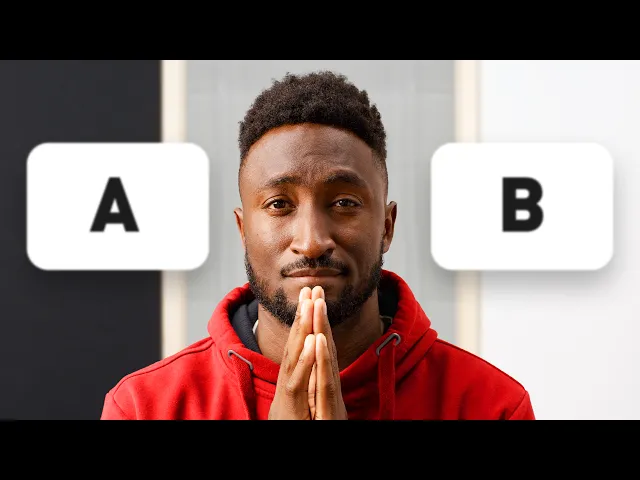
Dear YouTube!
Marques Brownlee
0:02 Often— I think about this a lot.
0:04 I think YouTube spends too much time chasing other platforms and competition
0:10 when they should just be doubling down on what makes YouTube, YouTube.
0:15 So anybody paying attention has probably noticed by now there's been
0:18 a lot of big changes to YouTube over the past couple years.
0:21 Some user-facing, some creator-facing, and some of them are great,
0:25 some of them not so much.
0:26 But this latest one, in my opinion,
0:29 is their craziest, riskiest, and possibly worst idea yet.
0:33 So I'd like to explain why straight to you, YouTube.
0:37 Because this past week YouTube announced that it would
0:39 be rolling out a feature called Video A/B testing.
0:42 And look, they talked about a lot of stuff.
0:45 They had a whole Made on YouTube event that they've
0:47 held annually for a few years, and it's great!
0:50 They tell us about a bunch of the changes coming to the site proactively.
0:54 They revealed some other stuff like custom homepages,
0:57 and new live stream features, and AI Shorts editing tools.
1:00 Some features I may not ever use, some features I might.
1:05 But this video A/B testing, I just think is a straight up bad idea.
1:09 Now, you've been able to A/B test thumbnails and titles for a little while now.
1:14 Actually, that started last year.
1:16 So YouTube shows one thumbnail to one part of the audience,
1:19 and the other thumbnail to the other part to see which one performs better,
1:22 and then lets you pick the winner.
1:23 And, you know, it took me a little while to warm up to that, but I've done
1:27 a handful of tests since then and I've learned
1:28 some things about what you guys like to click.
1:30 You can also A/B test titles.
1:32 I've tried that once or twice too.
1:33 but A/B testing the video itself...
1:35 seems like that's a little too far for me.
1:38 But look, there's a lot of smart people at YouTube.
1:42 This clearly made it through a lot of levels.
1:44 It got all the way to the top.
1:46 It got greenlit...
1:48 So, let me just show you how it was presented.
1:51 Here is a classic problem we've all had.
1:53 You shot two different opening hooks because you
1:55 weren't sure which one was going to perform better.
1:58 Now with Video A/B testing, you can just upload your cuts, Shorts or long-form.
2:03 YouTube tests them with real viewers and helps you
2:06 select the video cut that holds audience attention best.
2:09 So it looks a lot like that thumbnail feature that we've had.
2:12 But at the end it didn't show this.
2:14 But at the end, once the test is over, it'll,
2:16 it'll show a chart of the three different
2:18 retention graphs from all three versions of the video,
2:21 and let the uploader choose the winner based
2:23 on which one holds viewer attention the longest.
2:25 So I saw this and immediately had a bunch
2:27 of questions that were not answered by that.
2:30 Like, first of all, as a viewer, if I'm watching a video,
2:33 do I know if that video is part of an A/B test or not?
2:35 Probably not.
2:36 If I'm reading the comments on a video,
2:38 how do I know which version of the upload they watched?
2:41 And if someone's comment has a timestamp too,
2:43 does that break if I'm watching the other version of that video?
2:46 And how long after publish can creators be A/B testing a video?
2:50 And if I send a video to someone,
2:52 can I actually end up watching a different video than the one I watched?
2:56 And how different are the tested videos allowed to be from each other?
3:00 Like, I think this, you know,
3:02 "I shot two different cuts of the same intro and I'm not
3:05 sure which one to use." I think that's like the most generous,
3:08 innocent possible use of this feature, right?
3:11 Sounds like probably how it was pitched.
3:12 Like, MrBeast was probably like, "Hey, YouTube,
3:14 I'm trying to get 500 million views on my next video here, like,
3:18 this would be the perfect tool for retention maxing."
3:19 But what I've actually found over the past year
3:22 of thumbnail testing is that if I'm testing two
3:24 different thumbnails that have a very small difference between them,
3:27 like say, a slightly different size text or the arrow placement or something,
3:31 or even arrow versus no arrow, like,
3:33 the results are usually not statistically far enough apart to actually matter.
3:37 Turns out I don't really learn much from small differences.
3:40 But when the differences are way bigger,
3:42 like two completely different concepts for a thumbnail,
3:44 that's when the performance differences are
3:46 actually big enough to learn something.
3:48 So now applying the same logic to this, you know,
3:51 a small difference of like two or three
3:53 shots in a cold open or an intro sequence,
3:55 I don't think is going to make that big of a statistical difference.
4:00 So how big of a difference are the videos allowed to have?
4:03 In their own example in the presentation,
4:05 these videos are pretty drastically different lengths, if you ask me.
4:09 17 versus 19 minutes.
4:10 And also, this has got to break timestamps, right?
4:12 It has to.
4:13 So I got on a call with YouTube engineers,
4:15 to their credit, and I asked them all these questions.
4:19 And now I have for you some of the answers.
4:22 So first of all, it's sort of a not-so-secret secret that YouTube has
4:26 had this video replacement ability behind the scenes for a little while now.
4:31 And it's extremely limited use.
4:33 Like, almost no one gets to use it.
4:35 But if you have a contact with YouTube who will let you use it,
4:39 you have to have a very specific reason for using it,
4:42 like one specific factual correction or something.
4:46 The videos are otherwise identical,
4:48 but you need one thing to be changed to upload a new file to the same URL.
4:53 You might remember Apple uploaded some commercial a few years ago
4:55 that had a glitch in it and everyone was talking about it,
4:58 and then mysteriously the next day it was gone.
5:00 That type of thing.
5:01 The video you're using as a replacement has to be
5:04 like the exact same length as the file it's replacing, minus that one change.
5:10 Because changing a video is precious.
5:12 So the main thing I learned from talking to YouTube engineers is
5:17 that for rolling out this video A/B testing to everyone early next year is
5:21 that they plan on building essentially a semantic analysis model that can comb
5:26 through the entirety of both video files
5:29 that you upload and determine their similarity.
5:32 And then only videos with a high
5:35 enough similarity score according to that model,
5:38 will be allowed to run as tests.
5:40 So theoretically, completely different videos can't be run as a test.
5:44 And I hope, I hope...
5:45 this works.
5:46 I don't know how confident I am in it yet,
5:48 just because whenever I ask Gemini to look through YouTube videos for things,
5:52 it's not very good at it.
5:53 It usually just defaults to the transcript.
5:55 But at least it's something, right?
5:58 There's at least some sort of attempt to...
6:00 to limit how different the videos can be,
6:03 as determined by this bot looking at the story of the video.
6:07 And they'll also only allow A/B testing at the launch of a video.
6:10 So you can't just go running through old videos,
6:12 A/B testing and replacing them with different cuts.
6:14 That's just gonna be for new videos for a limited time at their launch.
6:18 But then the rest of my questions kinda don't really seem to have answers yet.
6:22 Like, I'm about 110% sure that comments
6:25 with timestamps will be confusing and kind of broken.
6:28 And also the uploader will not know which version of the video
6:31 the commenters are talking about or which one they watch.
6:34 The viewers won't know that they're watching a video being A/B tested.
6:38 And it's also possible that people...
6:40 might watch a cut of the video that loses the test,
6:42 and so then they might come back to watch it later...
6:45 and it's a different video.
6:46 And I think YouTube will never really tell exactly how it works,
6:49 but it'll always be a question to us,
6:51 like how well the similarity test score thing actually performs.
6:55 Like if, if one sentence in the video is different, but that one sentence...
6:59 changes the conclusion of the video in some way, will that flag it?
7:03 Like if, if I have two different cuts of the same video,
7:06 but one of them is like out of order from the other, does that change it?
7:09 We just will kind of have to wait and see.
7:11 I think this really comes down to is there's this sort of unspoken rule...
7:16 of community...
7:17 on YouTube...
7:17 that like we're all...
7:19 having the same...
7:20 experience...
7:20 together, we're all watching the same video.
7:23 That is what makes it a cultural phenomenon as we all saw the same thing,
7:28 even if it's slightly different packaging that got us there.
7:31 So letting people put up two or three different versions of the same
7:34 video at the same time just kind of fundamentally breaks that.
7:37 It just doesn't feel right.
7:39 But also, like I said at the beginning, I think this is part of a trend.
7:42 Like YouTube spends too much time in my opinion,
7:45 like responding to things that their competitors
7:47 are doing that they really don't...
7:49 I don't think they should.
7:51 Like years ago, getting rid of the public video dislike counter was framed as...
7:55 protecting creators...
7:56 But the reality is Facebook and Instagram and TikTok,
7:59 they don't show dislikes either.
8:01 So YouTube got rid of them too.
8:02 Even though the like-to-dislike ratio was a uniquely useful YouTube thing.
8:06 If you've been following the Waveform podcast,
8:09 and surely by now you've heard us talk about the new way...
8:12 that they're counting...
8:13 views here on YouTube.
8:14 I don't know if everyone's heard about
8:16 this, but they essentially now are counting views...
8:19 much more liberally as literally the first frame of a video loads...
8:22 that counts as a play.
8:23 Even though before, YouTube had a fairly sophisticated way of trying to measure
8:27 what a real view is and that made less views more valuable.
8:32 That meant like we saw a million views on TikTok and we
8:34 knew that that wasn't the same thing as a million views on YouTube.
8:38 We always knew that those things were different.
8:40 but again, not anymore.
8:42 And you know, there's all sorts of TV stuff that they're always responding to.
8:46 They seem obsessed with getting like late-night hosts on YouTube,
8:50 all of this stuff...
8:50 But you know, at the end of the day, I do think YouTube is still...
8:55 gonna do this video A/B testing thing.
8:58 So let me take this opportunity to talk
9:01 to my fellow creators who are also looking at this feature.
9:05 So, dear...
9:06 YouTubers, so I, I don't think most of us will ever...
9:12 need to use...
9:13 this feature.
9:15 In fact, I would go as far as saying most of us probably shouldn't.
9:18 You know, this is being framed as a tool to help you improve your videos.
9:22 But...
9:23 I think for 99.9% of creators, well, to be literal,
9:25 it's not actually helping you make better videos.
9:28 It's helping you find which version of your video has the best retention,
9:33 which doesn't necessarily mean it's a better video...
9:37 Hot take.
9:38 And there are so many examples of creative decisions...
9:41 that I have made and that so many others have made
9:44 in the video creation process that are
9:47 definitely not the best retention-optimized decisions.
9:50 But they're fun...
9:51 and creative...
9:52 and interesting and new...
9:54 and entertaining and characterful.
9:56 So there's always going to be like the top
9:58 0.1% of channels that are like all about mass appeal.
10:01 And that's fine.
10:02 But last time I checked, a lot of what makes YouTube fun is the stuff that is...
10:07 more niche down, that is not mass appeal by definition.
10:10 It's the cool, small hobby you found or it's the fun,
10:13 unique thing that you just discover that only
10:15 a few people are talking about that, that stuff, that's what makes it like fun.
10:19 I think if a lot of those channels and videos suddenly became like super,
10:23 you know, optimized retention-maxing and everything, like,
10:26 those would get a lot less fun to watch.
10:29 And so imagine if all the feedback anyone ever
10:31 listened to was just to have the best retention.
10:34 It's like, as you optimize...
10:36 over and over and over again, you just...
10:39 you start to trim out all of the other creative stuff
10:42 that happens to not be the most efficient way to tell a story.
10:46 So I guess what I'm trying to say is...
10:50 the skill of being a video creator on YouTube is...
10:55 not always necessarily about, like, the maxed out, most efficient,
10:59 optimized way to do everything,
11:01 but it's to find creative ways to share something...
11:05 or teach something or explore or explain something or review something.
11:10 So I just think making...
11:12 and finishing...
11:13 and publishing a bunch of videos...
11:15 is a better use of a creator's time than making one thing.
11:18 And then, you know, a whole bunch of different drafts of titles...
11:23 and thumbnails, and different cuts of the video
11:25 to try to optimize for, like, the last...
11:28 few percent, to squeeze out a few more
11:30 views from the average view duration being longer...
11:33 That's all.
11:34 I think just stand by your creative choices.
11:36 You made this video, this is the video you chose to make.
11:39 And now you get to share it, and you put it out, and you learn from it.
11:42 And maybe some go well, some don't go well.
11:45 You learn from the wins and the failures, and then you make the next thing,
11:48 and then you learn from that, and then you make the next thing...
11:52 That's the creative process.
11:53 Have conviction in what you want to share with the world.
11:56 But, you know, hey, maybe...
11:58 maybe this is just the...
11:59 old school...
12:00 YouTuber in me.
12:01 Old man yells at cloud.
12:03 It's very possible.
12:04 I just...
12:04 I feel like the...
12:05 video A/B testing, though,
12:07 is something a lot of us can agree we're not super interested in.
12:10 But...
12:11 let me know what you think.
12:13 Either way...
12:14 thanks for watching.
12:16 Catch you in the next one...
12:17 Peace.