New shape discovered!
Stand-up Maths
0:00 Breaking Maths News!
0:01 Some of you will have seen the headline,
0:04 "New Shape Found That Cannot Pass Through Itself."
0:06 And I know some of you have seen it, because you've all e-mailed me.
0:09 I mean what a year to have declared,
0:11 "The year of breaking maths news." When this Noperthedron was discovered,
0:16 everyone started e-mailing me;
0:19 two people walked up to me in real life to tell me about it;
0:22 one of them had printed out the paper to show me,
0:25 so thank you everyone for alerting me to the breaking maths news.
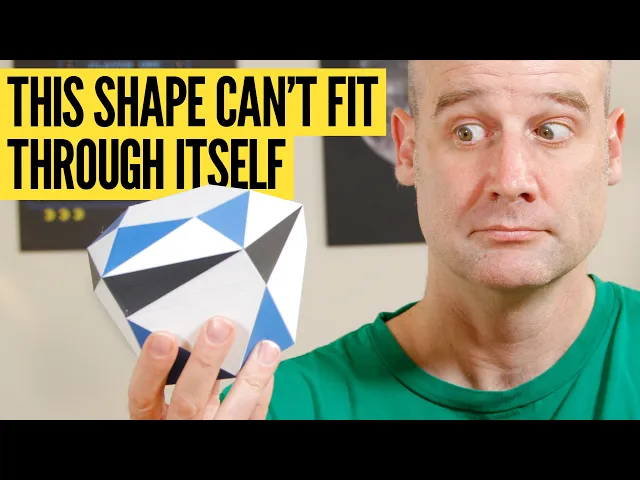
0:29 But, I've got some terrible news: this, this is not my Nopert.
0:34 This is my Nopert.
0:37 [Shopping channel music plays] I say my Nopert,
0:50 not as in I discovered it, Tom 7 discovered this.
0:53 My Nopert, just as in, this is the one I vote to be Nopert.
0:58 I believe in this Nopert.
0:59 Look at that, it's got a pentagon top and bottom.
1:02 I think, I think it's really neat, check it out.
1:04 I, I, um, added the colours myself just to make the faces more obvious.
1:08 Twenty vertices, twenty-seven faces,
1:10 this shape cannot go through itself, probably...
1:16 To expand on the word "probably" and "cannot go
1:19 through itself" we need to go back to the cube.
1:25 Which I also 3D printed, as, like, as the greatest misuse of 3D print-time ever.
1:32 But, you know, sometimes you just, you just need a really precise cube.
1:37 First-up, we're going to talk about what it means to be a Nopert.
1:40 Indeed, we're gonna recap what it means to be Rupert.
1:43 And some of you will already know this.
1:45 I wrote about this in a book back in 2014;
1:47 the, the idea of being Rupert has been around for a while.
1:50 And the question was: Prince Rupert, centuries ago wondered,
1:55 could you fit a cube through itself?
1:58 And so here, I've also 3D printed another copy of the cube,
2:01 slightly more complicated this one.
2:03 And it's exactly the same size, so if I line them up: look at that, boom!
2:06 Exactly the same in every dimension, these are identical cubes,
2:10 other than this one has a removable piece.
2:12 Because we can fit this cube through a cube exactly the same size.
2:17 If I remove that section, there, there's a cube shaped hole and so,
2:22 while it seems counter-intuitive, it is possible to fit a shape through itself.
2:27 Or, at least, that used to be counter-intuitive.
2:31 Turns out there's loads of room to fit a cube through a cube.
2:34 So if I, very carefully,
2:35 align this so you can look straight down the, like, the diagonal axis there.
2:39 You're looking at the projection of the cube
2:41 that is a hexagon, that's kind of fun.
2:43 And it turns out that hexagon is bigger than that square.
2:46 In fact, you could fit a square 3.5% bigger by length through that hexagon.
2:53 Oh, if you went off-axis slightly,
2:55 there's actually another projection that's ever-so-slightly bigger.
2:58 And you can fit a cube that's 6% bigger by length through a smaller cube.
3:04 So, um-um, the Rupert property is just:
3:07 "are there two projections of a polyhedron, convex,
3:11 such that one of them can fit entirely
3:13 inside the other one?" And it turns out- yeah,
3:16 if something's not a sphere, if you move it around its projection changes.
3:19 Some of the projections are big, some are small,
3:21 turns out small things can often fit inside big things.
3:25 So, I mean for the longest time I was like, "oh, would you believe it:
3:27 a cube fits through a cube!" And after a while everyone's like, "oh yeah,
3:30 actually it's quite obvious that a cube fits
3:32 through a cube." A couple of years ago,
3:34 2021 I think, I did a video about this where,
3:36 for Halloween, I put a pumpkin through a pumpkin.
3:39 So I bought the two most identical pumpkins I could find in the shops
3:43 and then I cut a hole through one pumpkin that would fit the other pumpkin.
3:46 So pumpkins are Rupert, although not convex.
3:49 Anyway, the point is the story went from being,
3:52 "ooh isn't it amazing that you can fit a cube through itself,
3:56 that's stunning." And eventually kind of became,
3:58 "oh turns out it's quite easy to fit shapes through themselves."
4:02 And now it's gone full cycle and everyone's like, "oh my goodness!
4:05 Can you believe there are shapes that don't fit
4:08 through themselves?" So that's the world we live in now.
4:11 I mean a decade after I wrote "Things to Make and Do in the Forth Dimension",
4:15 the fact has inverted.
4:17 So after centuries of showing that shapes are Rupert,
4:20 it was only this year that humans managed to prove that there is a convex,
4:25 polyhedron that is "not Rupert" or "Nopert".
4:29 And I actually saw this one coming because I was
4:33 in New York to do "An Evening of Unnecessary Detail" last July.
4:38 And I caught up with Tom 7 and he'd already sent me the paper he was working on.
4:42 And we talked about how he was trying to research shapes that were Nopert,
4:47 and he'd found this one at that point.
4:49 And he was working on a way to prove that, definitely.
4:53 Now, I'm not gonna lie: this video,
4:55 you don't need to watch this, you can go and watch Tom 7's excellent video.
5:00 [Tom] So this one is Nopert No.
5:03 214, or potential Nopert No.
5:06 214.
5:06 [Matt] The only issue is, it's an hour and eighteen minutes long.
5:10 And I love, I love Tom's videos,
5:12 they're incredible, you should go and watch that video.
5:15 But I know a lot of you aren't gonna watch that video.
5:17 And so I thought I would make a Rupert video,
5:21 'cos my video is just gonna go through Tom 7's video.
5:25 Um, so I'll recap some of it and then you should really go watch the rest.
5:29 Er, but to explain the Nopert journey, Tom 7 first got a bit distracted
5:35 when he saw an interesting sentence on Wikipedia.
5:38 [Tom] I was reading about the dodecahedron,
5:41 which is my favourite, er, Platonic solid.
5:44 Maybe even my favourite solid.
5:46 Er, and it came, the Wikipedia page, at least at the time, contained a puzzle.
5:52 [Matt] On the Platonic solid page, Tom had come across the statement that all
5:56 five Platonic solids have the Rupert property.
5:58 And on the page for Archimedean solids,
6:00 which arguably contains the Platonic solids, It has the mysterious,
6:03 puzzling sentence that, "at least ten of the Archimedean
6:07 solids have the Rupert property." Why some?
6:11 Which got Tom wondering, are there shapes that don't have the Rupert property?
6:16 [Tom] And I found a claim, a conjecture,
6:20 that every convex solid has the Rupert property.
6:24 Which would be amazing.
6:25 We can do this for eleven of the thirteen Platonic/Archimedean,
6:30 er, Platonic and Archimedean solids.
6:33 But there's like two that we, somehow, didn't check.
6:35 [Matt] It is weird that we have shapes
6:38 of unknown Rupertness that are Archimedean solids or Catalan solids.
6:42 After Platonic solids, with their regular faces and vertices,
6:47 Archimedean solids, they're up there as well;
6:51 they've got identical vertices and every face is a regular polygon,
6:55 but you can mix and match the polygons.
6:59 Then you've got the Catalan solids,
7:01 the duals to the Archimedean solids; they all have identical faces.
7:05 These are blockbuster shapes.
7:08 And yet there are three Archimedean solids and two
7:12 Catalan solids for which we just don't know.
7:15 And that seems strange.
7:18 So Tom 7 put together a numerical solver to take
7:21 a polyhedron and work out a Rupert solution for it.
7:25 And for all the solutions that we already have,
7:28 he found them in milliseconds, just was churning them out.
7:31 And the ones we couldn't find,
7:34 he couldn't find with billions of attempts, trillions of attempts.
7:39 Which means, either the solutions are really obscure or just there aren't any.
7:46 [Tom] Sometimes this happens, there's a phase change between,
7:50 like, two cl-two classes of problem.
7:52 And so, mathematically you know this, it's not
7:55 enough to have that empirical evidence and say, "well,
7:57 it can't be solved." But it is suggestive
8:00 and it kind of taunts you because y-you kinda know.
8:04 So, err, yes that was part of the suspicion,
8:08 is that it's very easy to solve them.
8:11 [Matt] This is a shape that came out of Tom 7's code.
8:15 'Cos once he had a solver he could then pair that up with a generator
8:21 that's producing random polyhedra and then see
8:24 if he could produce or evolve a Nopert.
8:28 And he found loads of candidate Noperts via this method,
8:31 the best of which is candidate number 2 1 4, the 214th Nopert.
8:37 It's the best in that its only got twenty
8:41 vertices and 27 faces and that's the fewest of all, candidate Noperts out there.
8:47 And I like it because it's got this cool,
8:50 kind-of pentagonal, rotational symmetry.
8:51 I think it's a really cool shape.
8:53 And Tom 7 tried literally trillions of different possible alignments
8:56 of this shape with itself and none of them went through,
9:00 his solver could not find a solution to this.
9:02 And the solver's very good.
9:04 Now that doesn't prove that is is Nopert,
9:07 but it makes it exceedingly likely that it is.
9:11 But in maths, we want a proof.
9:13 One avenue Tom 7 explored to find a provably Nopert polyhedron was
9:20 to look at the family of prisms that go from "manhole cover" to "churros".
9:28 [Tom] This really simple case.
9:30 So take an n-gon and extrude it.
9:33 And if you extrude it a very shallow amount,
9:36 then you get a "manhole cover", as I call it.
9:38 And we know that, you know,
9:40 "manhole covers" that aren't round can fall through themselves;
9:43 it's just, it's proof by idiom.
9:45 And then there, er, if you extrude it a lot, then you get a, a "churro",
9:48 as I call it, which is a long one; and you can stick that through its own side.
9:53 And, possibly, there's a s-,
9:54 a simple point at which they s-, they don't have solutions.
9:58 And if that's the case, then this could be a really good route to proving
10:02 the existence of simple Noperts that no one ever thought to check.
10:06 [Matt] Here are Tom 7's solutions for the 5-churro.
10:08 And on the horizontal axis, we have how long the churro is,
10:12 and each of these lines is an integer.
10:15 So this is a length of 1, or a 'd' of 1,
10:18 where 'd' is the length of the sides of, in this case, the pentagon.
10:22 And, as you can see, as the length goes up to 2,
10:24 to 3, to 4, what you have here is the quality of the solutions.
10:28 So, sometimes the numerical solver is finding a very high-quality solution.
10:33 That means that the residue, what's left after the shape's gone through itself,
10:36 has reasonably, ahh, for some definition of "thick" connectors.
10:40 Down here, they're not as good, but still connected.
10:43 And, because it's a numerical solution,
10:45 sometimes it finds one of these, sometimes it finds one of these, depends how
10:48 it randomly orientates the two shapes and occasionally
10:50 they're a little bit better or worse.
10:51 Overall you can see two, very clear trends:
10:53 it often find the "drain-hole cover" solution here;
10:56 Particularly when the churro is very thin, the drain-cover arrangement.
11:00 And it sometimes still finds solutions like that when it's much-much longer,
11:05 but once it does get long, it's way more likely to come in through the side.
11:09 You can see here, these are the churro solutions and they take over.
11:12 And Tom 7's theory was maybe there's a gap in between.
11:15 But no, they cross here and, in this case exactly (well,
11:18 pretty much) on one, and there's a seamless handover.
11:22 So there's always a solution.
11:23 And you may have noticed this extra spike, here.
11:25 That's a different class of solution;
11:27 that, I don't think it's been investigated yet.
11:30 So if you want to go down another maths-hole, you can start to look at this.
11:33 And, we can look at the other churros.
11:35 If we go up one, to a 6-churro: ahh, hey, look at this!
11:38 We get all these extra spikes,
11:40 we still got the "drain-hole cover" solution here,
11:43 we still got the "churro solution" there.
11:45 But we now got, I mean in this case, three new bonus ones.
11:48 And that's way more pronounced on an even-'n' "churro".
11:51 So when we go up to seven, this is much closer to the five,
11:54 there's still a spike there but now not as clear.
11:57 And we got the classic handover.
11:58 Ooh, look, there are other, small,
12:00 sub-spikes down here, and we went back to five,
12:02 you can see they're down there as well; isn't that interesting?
12:04 But all the even ones have a whole bunch of spikes.
12:08 So eight, oh, it's always half as many,
12:10 so eight has these four extra spikes here.
12:12 The nine looks like the classic odd-case.
12:15 And then ten, five spikes appearing here.
12:18 So I'm imagining these are when you've got the "drain-hole solution",
12:23 these are some orientation effects that we're seeing,
12:27 but again, I'm purely speculating.
12:29 Oh, what's going on down here?
12:30 And as we go up to more and more complicated churros, approximating a cylinder,
12:36 you can see these patterns continue but start to get, you know, whoa- so messy!
12:40 As well as prism churros, Tom 7 also looked at anti-churros.
12:45 These are like a prism,
12:46 but instead of rectangles on the side, you use triangles.
12:49 And check out the 5-anti-churro, look at all of this!
12:53 There's so many more complex solutions happening down there.
12:56 Is this still the "drain-cover solution"?
13:01 I mean, we don't know, what's going on here?
13:02 There's still, you know, a thing's crossing at about 1, in this case.
13:06 The even ones, now, look at this!
13:09 Now the fact that this is so covered means,
13:13 because it's numerical we're not getting exact coverage.
13:16 I would say, in theory, this should be block covered;
13:18 which means there's a continuous series of solutions
13:21 for any given 'd' up to some threshold, which is the top of this.
13:25 And just the number of numerical solutions that Tom 7
13:27 ran means that we've got this kind of spotty coverage,
13:29 but it should be a lot, erm, more thorough.
13:31 But you can see there's another one here,
13:32 we get these extra spikes appearing there.
13:34 Look at these: seven, eight, nine.
13:37 Ooh, there's a lot we don't know about how you intersect anti-churros.
13:43 So, if you want to look into this, go for it!
13:45 But the point is, for all our original churros,
13:47 there's always something going on, there's no point where it's gonna hit zero.
13:50 So, while there's other interesting stuff going on, we're gonna
13:53 need a different method to try and find a Nopert.
13:57 [Matt] So when you, ooh-err!
13:59 [Business Matt] Mind if I borrow this?
14:00 [Matt] Yeah, fine...
14:01 [Business Matt] Excellent.
14:02 I meant the desk.
14:03 [Matt] Oh, unbelievable.
14:04 [Business Matt] Because this video is brought to you by Bambu Lab,
14:07 the 3D printer we used to print all
14:10 these fantastic objects to explain the Nopert property.
14:14 Yes, I use my Bambu Lab X1C printer,
14:17 which is so quick and easy to use, to print the cube you saw before.
14:24 Of course, the Rupertable cube where the middle bit comes out.
14:29 And, because it can take multiple filament colours at once,
14:33 I could print the Nopert with different colours for each of the faces.
14:39 And if you're looking for inspiration of what to print,
14:41 you can head over to Maker World;
14:43 look at all of these fantastic models and, of course,
14:47 Tom 7 has put up their full set of .pac models.
14:51 You can open them up in Bambu Studio, oh look at this!
14:54 There are Platonic, and Archimedean and Catalan
14:57 solids and you can print them all out.
15:01 I mean, what home is complete without a full set of these wonderful shapes?
15:07 Fun fact, as well as these, I did try to print out the churro example,
15:12 with a very long pentagonal prism.
15:14 And I added in these support structures,
15:17 because I knew the walls would be so thin.
15:20 But I, I totally printed it too small and so there're little tiny gaps there.
15:25 But you can, you kind of get the idea,
15:27 like that will like up there, er, and slide through.
15:30 And I had a lot of fun in Bambu Studio arranging the negative
15:34 one of these to get the correct hole and add that in.
15:38 And it were, it was a fun learning experience,
15:40 n-not quite good enough to be in the main video, though.
15:43 So do check out Bambu Lab printers!
15:46 Hey, I am gonna balance these, it will really annoy Regular Matt.
15:48 Erm, they are a trouble-free,
15:50 3D printing experience and if I can use it to print this, you can too.
15:56 Link in the description.
15:58 [Matt] Ok, back to the, what happened here?
16:00 Oh my goodness, those are fragile.
16:02 Back to the video.
16:04 Given there are so many ways to arrange a shape in 3D space;
16:09 I mean, uncountably, infinitely many ways.
16:11 How can we search them all, how would we prove that something is Nopert?
16:17 Well, if you look at all the orientations of a shape,
16:21 all we really care about are the 2D projection and the convex hull.
16:25 Like, the collection of points and edges that are around the outside.
16:28 And as I move this around, if I was to move it like a very-very small amount;
16:34 the same edges from your point of view, would always be on the outside.
16:38 And if I do a big enough movement,
16:40 one of the edges might pop behind and so you can no longer see it.
16:43 And so you could classify every possible projection by unique sets
16:49 of which vertices are on the convex hull in a specific order.
16:54 [Tom] I was tying to visualise what is the solution-space like here.
16:58 And, so what that, erm, what the snub-cube,
17:01 the textured snub-cube that's in the thumbnail of the video.
17:05 What that is, is I take all the different ways of looking at the snub-cube.
17:10 And a different way is basically, like,
17:12 what is the shape of its shadow, erm, topologically?
17:16 So which points from the snub-cube are
17:18 on the shadow and in what order, that convex hull.
17:21 And there's, oh I forgot the number, 32 or so different ways of looking
17:26 at the snub-cube that are fundamentally different.
17:28 [Matt] And he coloured in a snub-cube to show that.
17:31 There are 36 different colours on this snub-cube and each one,
17:35 if you're looking straight at it towards the very centre of the snub-cube,
17:39 that's the particular collection of vertices that are
17:41 around the outside of its 2D projection.
17:43 Now I just think it's an amazing visualisation.
17:46 And that's a way to kind of tame
17:50 and contain the collections of possible projections.
17:53 So what do we do with these 36 different
17:56 classifications of types of arrangements or projections of the snub-cube?
18:01 Well Tom 7 realised, if you've got your kind of target
18:05 "outer" snub-cube and then you've got the moving,
18:08 hopefully "inner" snub-cube, you've now got 36^2 pairings.
18:15 So that's 1296 ways you can arrange the pair of them together.
18:21 And then within that, I mean you can fix one and the other one relative.
18:25 You've still got all its orientations and you can translate it.
18:30 So, actually there's still seven different variables within each
18:36 of those 1296 combinations and you've gotta check all of them,
18:41 even though they're continuous.
18:43 If you've got seven different continuous variables
18:45 and you want to search that entire space; you can think of it as a 7D cube.
18:51 I mean, thinking about it that way is not helpful.
18:54 But if you want to divide it up, it is kind of helpful.
18:56 What Tom 7 did was realise if he could take different chunks
19:03 of 7D volume and within them cover the entirety of the 7D cube.
19:07 He can show that the entire search place does not contain a solution
19:11 and each of individual chunks he just had to be able to show,
19:15 instead of doing individual points within them,
19:18 that the entire sub-volume wasn't possible.
19:20 It was a very clever way to go about it
19:23 and if you want it explained much better than I just did,
19:26 check out Tom 7's video, link below.
19:29 [Tom] The main thing to realise is that the extreme values of the output,
19:32 which is what we are trying to compute,
19:34 will happen at extreme values of the inputs.
19:36 But not necessarily in the same order.
19:38 If I have the interval 2 to 3 and I multiply it by an interval that's just -1,
19:43 then I get -3 to -2, so they get swapped around.
19:46 So I basically compute all the end points and do a min and a max over those.
19:49 [Matt] Spoiler for Tom 7's video, he was beaten.
19:52 When I spoke to Tom in New York,
19:54 he was still working on it, wasn't aware anyone else was doing it.
19:57 Him and his buddies were crunching away to get the whole proof together.
20:02 And then I got an e-mail from him in September this year saying,
20:06 "someone else had found a Nopert." And they
20:09 were doing exactly the same style of proof,
20:13 by pairing up the different possible orientations and going through it all.
20:16 However, whereas Tom 7 was trying to prove that a snub-cube,
20:22 an already existing famous shape was Nopert.
20:26 These other mathematicians, this is perfectly valid, came up with their own,
20:30 custom shape that made the proof easier to show that it was Nopert.
20:35 And that's the Noperthedron that you saw reported in the media.
20:40 And if you read any of the articles,
20:42 at least the ones I saw, they didn't go into a lot of depth.
20:46 Now, you can look up their paper on The ArXiv if
20:49 you want to go through in excruciating detail what they did.
20:52 But, because their technique was so close to what Tom 7 was doing,
20:56 if you watch Tom 7's video it's the best explanation
20:59 I've seen to how you'd go about proving something like this.
21:02 Oh and the reason that their Noperthedron was better,
21:06 was they got the space down to a 5D hypercube and they
21:11 tackled the issue of the diagonal where you have very similar orientations.
21:16 So the shapes coming at each other almost exactly
21:19 match and that's just very hard to deal with.
21:22 Thanks for watching my video that does just go through Tom 7's video.
21:27 So I guess in the analogy, this is my video here,
21:31 and it's gone through Tom 7's video.
21:33 But now we've got what's called "the residue",
21:35 the bit that wasn't part of the whole.
21:38 These are all the bits in Tom 7's video that I didn't talk about,
21:41 there's some really good stuff in there, I'm gonna link to it.
21:44 I know it's long, you should watch it and enjoy it.
21:46 Like a lot of maths videos on YouTube,
21:49 I mean due the nature of maths, can be a bit of lacking in personality.
21:53 Let's say, Tom 7's videos have the opposite problem.
21:58 If you want to watch a different one, I mean his video about harder drives,
22:03 that makes the most sense in terms
22:04 of audience overlap with people watching this one.
22:06 But I like his, his ridiculous chess algorithm video is
22:12 the one that got me into his channel in the first place,
22:14 so I highly recommend that one.
22:16 Erm, I'll link to it below.
22:17 And please, if someone can prove that this is definitely Nopert, I really want.
22:23 For me, I mean I know I said this is "my Nopert",
22:26 but I really want this to be the smallest provably-Nopert, convex polyhedron.
22:34 So, if we could prove that, that would be incredible.
22:37 Er, I will link to everything I've mentioned in this video, er, below.
22:41 Er, please do check it out and go watch Tom 7's videos.
22:44 Thanks for watching my summary of one of his.
22:49 That in there.
22:55 It's just a little bit rough on that one edge, there.
22:58 Look at that!
23:00 Push.
23:03 Slides right through.
23:05 Woo.
23:08 And I'll do a bit of this.