How Sports Predicted "The Everything Bubble"
How Money Works
0:00 Okay, so have sports become a big dumb investment bubble?
0:03 It might sound like a silly question because well,
0:06 everything has become a big dumb investment bubble,
0:09 but sports in particular are going through
0:11 something of a truly unprecedented value boom.
0:13 And perhaps the only reason we aren't really noticing it is because
0:17 none of us are in the market for a professional sports team.
0:20 Last month, a truly nightmare rotation of Bob Iger and Jared
0:23 Kushner's little brother's Thrive Capital agreed to purchase the LA Lakers
0:27 for a record-breaking 122.5 billion just a year after it was
0:31 sold the last time for a previously record- setting $10 billion.
0:35 Across the wider market for these teams, the NBA index, if you will,
0:39 has returned 2,88% returns over the same period that even
0:43 a record bull run from the S&P 500 returned a measly 687%.
0:48 But there is one problem with this.
0:50 Sports teams are terrible businesses.
0:53 They are capital inensive with massive overhead, run on razor thin margins,
0:58 are subject to arbitrary rule changes by governing
1:00 bodies directly exposed to wider market volatility.
1:03 They are illquid.
1:04 And there is also the additional variable
1:06 that if your team doesn't actually win,
1:08 it can slowly bleed value even if the rest of the business is run flawlessly.
1:12 Now, back in the day, none of this really mattered.
1:16 Even prestigious sporting leagues ran on pretty shoestream budgets.
1:19 The players made decent money, but nothing that far out of the ordinary,
1:23 and the whole thing was held together by fan support,
1:26 a sprinkling of sponsor dollars, and a dream.
1:28 Of course, over the last three decades,
1:30 that has made way for billionaires spending hundreds of millions
1:33 of dollars to play Fantasy League with better graphics.
1:36 The regular operations made some money, lost some money, but overall,
1:39 they were largely a vanity asset rather
1:41 than something that was a purely financial play.
1:44 But today, even that is changing.
1:45 A lot of sports teams are getting
1:48 too valuable for even regular run-of-the-mill billionaires.
1:50 They have become institutionalized assets that are
1:53 the investing domain of private equity,
1:55 public companies, and even sovereign wealth funds.
1:57 Infamously, one of the key signals of investing
2:00 mania is an uptick in fraud surrounding an asset.
2:03 And we will get to that.
2:04 In the meantime, this has clearly been bad for sports fans.
2:07 But if this really is such a terrible business,
2:10 why are people desperately paying so much to get into it anyway?
2:14 The Los Angeles Lakers are being sold [music] to American businessman
2:17 Josh Kushner and Bob Iger for a record-breaking price over 12 billion.
2:21 New at 11.
2:22 Clippers owner Steve Balmer is now apologizing [music] to the franchise
2:26 and its fans after the team lost five first
2:29 round draft picks and became the subject of a federal
2:32 investigation over Cristiano Ronaldo has signed for Saudi side Al Nasa.
2:36 They have now confirmed it.
2:39 Saudi Arabian club Al-Hilal [music] have agreed
2:41 a deal now with Paris San to sign Neymar.
2:45 When our Karen Benzema was reluctant to discuss his Real Madrid
2:49 future amid speculation he could also move to Saudi [music] Arabia.
2:52 The controversial live golf league is
2:54 funded by Saudi Arabia's public investment fund.
2:56 The [music] Saudibacked Live Golf League on the verge of collapse
3:00 with Saudi Arabia's public investment fund
3:02 pulling its funding after this season.
3:05 Okay, so back in my younger and more vulnerable years as an investment banker,
3:09 a surprising number of the transactions we
3:11 handled were entrepreneurs selling their businesses or pulling
3:14 money out of it so that they could go and buy a sports team.
3:17 And while I never worked on anything anywhere close
3:19 to the scale of something like the Lakers deal,
3:22 the general rule is still the same.
3:24 Sports teams are terrible businesses, but they are great investments,
3:28 which I know doesn't sound like it makes much sense, but [music] let me explain.
3:33 The actual operations of a sports team are usually pretty thin financially.
3:37 Most of the money coming in from sponsors,
3:39 league revenue share, broadcast deals,
3:41 and even government incentives gets paid straight back out to athletes,
3:45 coaches, trainers, front office staff, accommodations, and travel.
3:48 And that is partly by design.
3:50 Most team owners are already very wealthy men who get
3:52 into this as a hobby rather than an investment play.
3:55 And they usually don't mind burning money if
3:57 it gives them a better shot at a championship.
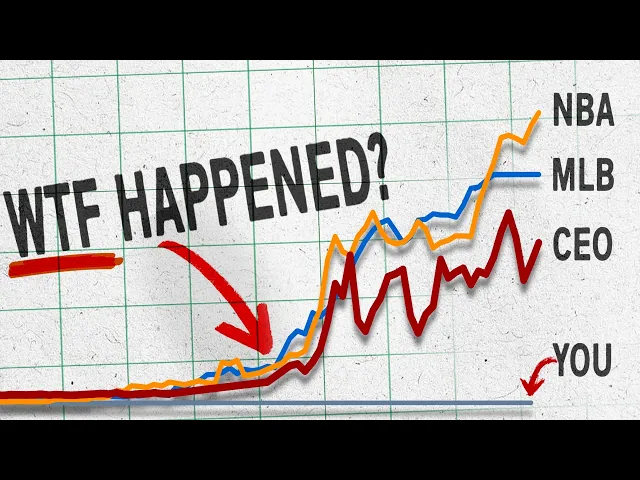
4:00 We have all heard the statistic that the pay
4:03 for top CEOs has grown exponentially since the 1980s.
4:06 But for not completely unrelated reasons,
4:08 the pay of top athletes has done basically
4:10 exactly the same over exactly the same time frame.
4:13 Because these days there is just a lot more money slloshing around
4:16 these teams all trying to buy an edge wherever they can find one.
4:19 We just don't really notice this as much for two reasons.
4:23 The first is that CEO pay is easy to track because it's public information.
4:27 Every listed company has to disclose what it pays its executives.
4:30 So every year somebody gets to put out
4:32 a chart showing the ratio blowing out again.
4:35 The second is not to defend the CEOs here or anything,
4:38 but we just generally don't care as much
4:40 when a top athlete gets a huge contract.
4:42 Sports are one of the last truly meritocratic outlets we have left.
4:46 Your daddy can't guarantee you talent,
4:48 and teams pour over massive amounts of data to make
4:51 sure they are paying the right price for the right players.
4:53 So, when a back office says a guy is worth $700 million over the next 10 years,
4:58 it's a lot harder to argue that he isn't.
5:01 Now, remember both of these points because
5:03 they are going to be important for later.
5:05 But the point is owners are largely trying to put
5:07 as much money as they can on the field
5:09 to increase their chances of winning rather than purely
5:12 watching the bottom line on what is still a business.
5:15 In extreme cases, these owners will go above and beyond
5:18 the limits they are supposed to be operating under,
5:20 specifically just to try and spend more money than they should
5:23 be allowed to as some kind of paid to- win move, just on a much bigger scale.
5:28 Steve Balmer is the uh current poster child for this.
5:31 The NBA, alongside most other professional leagues,
5:34 has salary cap rules which were put
5:36 in place specifically to stop people like him,
5:38 who is as wealthy as every other team owner combined just
5:41 buying a dream roster of players and dominating the championship every year,
5:46 which would be fun for basically only him.
5:48 Anyway, to try and get around these rules,
5:51 the Clippers introduced their star player, Qui Leonard,
5:54 to a green banking startup called Aspiration,
5:56 a company Balmer himself had put $50 million into.
6:00 Aspiration then signed Vonard to a $28
6:02 million endorsement deal that according to the former
6:05 employees who eventually talked required him to do
6:08 absolutely nothing except keep playing for the Clippers.
6:11 Aspiration has since gone bankrupt for its own separate fraud related issues.
6:14 And the good news is that just this month the NBA finished its investigation,
6:18 took five first round picks off the Clippers along
6:21 with a $30 million fine and a suspension for Balmer himself.
6:24 But the point still stands, which is that to Balmer,
6:27 the financial performance of this team was borderline meaningless.
6:30 Balmer is worth over a hundred billion dollars.
6:33 He does not need the money this team throws off.
6:36 He just wants to win.
6:37 And he was willing to burn a fair chunk of his own cash through a company
6:40 that turned out to be a house of cards to give him a better chance of doing it.
6:44 The end result of this is that it means every
6:46 other team in the same league is competing against a guy
6:48 who is perfectly happy to operate at a loss indefinitely
6:51 to keep as much money as possible on the court.
6:53 that is very hard to keep up with.
6:56 So there is a general competitive push across the whole industry
6:58 to run everything else as lean as it can possibly go.
7:01 Which as it turns out means even in good years
7:04 the business side of a sports team just doesn't return much money.
7:07 And in a lot of years it doesn't return any at all.
7:10 On top of this sports teams do not do well in a downturn.
7:14 Big sponsorship deals are usually one of the first
7:17 line items that companies cut when money gets tight.
7:19 And the same goes for households buying tickets to games
7:22 or paying for a service to watch them live.
7:24 If it's a choice between paying the mortgage and buying nosebleleed seats,
7:28 hopefully most people are going to make the correct choice.
7:31 So, all of this combined is why these teams are terrible businesses.
7:35 But there are four reasons why they are fantastic investments.
7:38 The first is that even the people who do buy these teams
7:41 as an actual investment don't necessarily care
7:43 how many tickets or jerseys they sell.
7:45 All of that is means to an end.
7:48 And the end is the one and only sale that actually matters,
7:51 which is a sale to the next rich guy in line who wants
7:54 his own childhood team and is willing to pay a premium for it.
7:57 I don't know if you have noticed,
7:59 but the number of very wealthy people around the world has
8:01 gone up by a significant amount over the last two decades.
8:05 When Forbes put out its billionaires list 20 years ago,
8:08 there were fewer than 800 names on it.
8:10 This year, there were more than
8:12 3,400 collectively sitting on around $20 trillion.
8:14 Every one of those new names is a potential buyer for one of these teams,
8:19 and the more of them there are, the more of them are going to be competing
8:22 for the same handful of trophy assets on the demand side.
8:24 At the same time, on the supply side,
8:26 the number of teams in most leagues is very carefully controlled,
8:30 usually with a strong nudge from the existing owners who
8:33 get to vote on whether anybody new is allowed in.
8:35 So, there is a level of artificial scarcity here,
8:38 even for a buyer who just wants a team
8:40 and doesn't even care about what team they get.
8:42 But of course, for a lot of buyers, if they grew up watching the Clippers,
8:46 they are going to want to buy the Clippers.
8:48 Buying a sports team is kind of like making a bet that there will
8:51 be a greater number of billionaires
8:52 in the future with a greater amount of money,
8:55 all chasing the same limited supply of these trophy assets.
8:58 And well, yeah, over the last 30 years in particular,
9:01 that's been a pretty good bet.
9:03 But even if somehow this doesn't work out
9:05 to make this bet a little bit safer still,
9:08 the second reason these teams are such
9:10 a great asset is how tax effective they are.
9:12 The usual buyer of one of these teams is someone who
9:15 founded a company or otherwise built up a lot of equity
9:18 somewhere and is looking for a project after they step back
9:20 from the business that made them rich in the first place.
9:23 Now, getting hands-on with the team you grew up watching
9:26 is a fun purchase for a lot of these guys, but it's also fully amvertisable.
9:30 When someone purchases a sports team here in America,
9:32 almost all of the value of that transaction
9:35 gets assigned to intangibles like trademarks,
9:37 goodwill, broadcasting rights, player contracts,
9:39 league memberships, and franchise rights.
9:40 Those can all be written down on paper over 15 years,
9:44 which makes it look like the team is
9:46 running a much bigger loss than it actually is.
9:47 And that paper loss can be deducted against the owner's other income,
9:51 even though no actual cash has left their account.
9:53 Now, to be fair, this is how depreciation works in every other business.
9:58 If you buy a factory full of machines,
10:00 those machines wear out and you get to expense their depreciation.
10:04 The difference is a factory machine really does
10:06 actually wear out and need to be replaced.
10:08 The Clippers right to be one of the 30 teams in the NBA very much does not.
10:13 For a long time, Congress actually agreed
10:15 and sports teams were specifically excluded from these write-offs.
10:19 But then in 2004, after some lobbying for Major League Baseball,
10:22 they were added back as a part of a tax bill signed by George W.
10:26 Bush, who, in a totally unrelated fun fact,
10:28 used to be a part owner of the Texas Rangers.
10:30 So, for someone who is effectively retired off a big pile of shares they
10:35 are slowly selling down each year or taking
10:37 dividends out of a company they built,
10:39 this is a very effective way to make a very large tax bill a lot smaller.
10:43 ProPublica did a great piece on this a few years ago,
10:46 specifically looking at, well, Steve Balmer again.
10:49 In the year they looked at, Balmer reported making $656
10:53 million and paid a federal income tax rate of 12%.
10:56 LeBron James, who is playing in the same building,
11:00 paid 35.9% and the woman pouring beers at the concession stand,
11:04 paid 14.1% on her $44,000.
11:06 Over the period they looked at, the Clippers had
11:10 reported around $700 million in losses to the IRS,
11:13 while the team's own leaked league financials showed it was mostly profitable.
11:18 I will leave a link to their report because
11:20 it's worth reading in an infuriating kind of way.
11:22 But the point is, even outside of the passion tied up in these teams,
11:25 it can just make sense to have one in the portfolio.
11:28 Now, that's great and all, but honestly,
11:30 today it's gotten to such a point where a lot of these teams
11:34 are starting to get beyond the reach of even the world's richest individuals,
11:37 and all the tax perks in the world don't really
11:39 matter if they can't afford them in the first place.
11:41 So, it's time to learn how Winnie works to find out what has turned
11:45 this big dumb investment bubble all the way up to 11 over just the last decade.
11:49 This video is sponsored by Kotti.
11:51 If you have ever tried to learn to code,
11:53 you know the hard part is sticking with it past week one.
11:56 Kotti is built around that problem.
11:58 It is free to start and when you sign up,
12:00 it asks a few questions and builds a personalized learning journey around you,
12:04 so you are not waiting through a 40-hour
12:06 course to find the part you actually need.
12:09 The lessons are short and hands-on.
12:11 You write real code in an in-app terminal
12:13 right in your browser or on your phone.
12:15 And when you get stuck, the built-in tutor gives you a hint that nudges you
12:19 towards the answer instead of just handing it to you.
12:21 It is also gamified in a way that actually works.
12:25 You earn XP, keep up streaks, and collect badges,
12:27 which makes it a lot easier to come
12:29 back tomorrow instead of falling off for a month.
12:31 It works on the web and on iOS and Android,
12:34 so you can keep your streak going from anywhere.
12:36 If you have been meaning to finally learn to code,
12:39 click the link in my description and start your first lesson today.
12:43 A few minutes a day adds up faster than you would think.
12:50 Okay, so the third major variable shaking up the market
12:53 for these assets has been the merely uber rich billionaires
12:55 making way for entire countries who are also throwing money
12:58 at sports to try and develop their own local events.
13:01 This has come primarily from the Gulf States,
13:03 who have had endless oil money to develop their own leagues
13:06 and pay whatever it takes to get soccer players past their prime.
13:09 In 2023, Saudi Arabia's Sovereign Wealth Fund bought 75% stakes
13:13 in the four biggest clubs in its own domestic league.
13:16 And those clubs went on to sign Neymar
13:18 and Kareem Benzema to line up alongside Cristiano Ronaldo
13:21 for the kind of money that European clubs who do
13:25 eventually have to balance their books simply could not match.
13:28 The same fund bankrolled Live Golf,
13:30 which started up in 2022 by offering established players
13:33 guaranteed contracts reported to run well into the nine figures.
13:36 They allegedly offered Tiger Woods somewhere in the region
13:39 of 700 to $800 million just to show up.
13:43 He said no, but understandably a lot of other people said yes.
13:46 This has garnered the somewhat reasonable accusation
13:49 that these countries with, let's be honest,
13:51 not the best humanitarian record are just sportswashing their image.
13:55 They are paying to engineer a situation where when golf fans,
13:58 MMA fans, or football fans think of Saudi Arabia,
14:01 they think of the events it puts on rather
14:03 than anything else that might be a little less flattering.
14:06 Now, it's also possible that the rulers of these countries just have
14:09 a lot of money and genuinely want to develop their own sports.
14:12 Who's to say?
14:13 But regardless of what the real motivation is,
14:15 it's still a lot of money entering
14:17 the market for a pretty limited pool of talent, which has in turn forced a lot
14:21 of legacy leagues to compete on salaries and perks,
14:24 further thinning out margins that were already razor thin to begin with.
14:28 Well, at least that was true up until recently.
14:31 The special military operation in Iran has
14:33 constricted fossil fuel export revenues to these countries.
14:36 In April, the Saudi fund announced it was
14:39 re-evaluating its priorities and backing away from Live Golf.
14:42 And earlier this month, Liv filed for bankruptcy,
14:44 owing millions of dollars to its own players.
14:47 So, a lot of the events that were only ever built
14:49 on seeing a bigger number than the other guy are now languishing,
14:52 which is one of the first variables starting
14:54 to make this whole thing look a little shaky.
14:56 But then there's the fourth big variable.
14:58 And yeah, you have probably all been thinking it.
15:01 It's the rise of sports gambling.
15:03 In 2018, the Supreme Court struck down the federal
15:06 law that had kept sports betting confined to Nevada.
15:09 And within a few years, the majority of states had legalized it.
15:12 Most of them with an app you can use from your couch.
15:15 Betting on sports has now well and truly
15:17 penetrated the global market to the point
15:19 where even if it is technically illegal in your home state or country,
15:22 almost anybody who wants to place a bet can
15:24 place a bet from the comfort of their own couch.
15:27 Last year, all 50 state attorneys general
15:29 signed a letter asking the federal government
15:32 to do something about the offshore books
15:34 that serve everybody the legal ones can.
15:36 The money has in turn flowed indirectly through to these teams
15:39 through increased sponsorship spending or through
15:41 lucrative promotional contracts with individual players.
15:43 This kind of marketing is obviously very highly targeted at this particular
15:48 audience of mostly young men who already clearly have an interest in sports.
15:52 Additionally, as dystopian as it is,
15:54 if people have their rent money riding on a game,
15:57 they are a lot more likely to watch that game in the first place,
16:00 which means higher ratings and higher ratings are the only
16:02 thing a broadcaster is really paying a league for.
16:05 And well, yeah.
16:06 Speaking of broadcasters, there is also even more money coming
16:09 in from streaming services who want to get their hands
16:12 on a slice of the live sports market because
16:14 it's a very effective way to lock in subscribers.
16:16 People will normally cycle through streaming services to watch
16:19 whatever show happens to be on whatever platform that month.
16:22 But if a streaming service has their sport of choice broadcast live,
16:25 they are much more likely to stay loyally subscribed for at least
16:28 the entire season and then probably forget to cancel afterwards.
16:31 Even if they never see a direct return on the investment,
16:34 these companies are now spending tens of billions of dollars
16:36 on exclusive broadcasting rights to try and lock in this audience.
16:40 The NBA's latest deal with Disney, NBC,
16:42 and Amazon runs for 11 years and is worth around $76 billion,
16:46 more than double the annual value of the old one.
16:50 Netflix bought NFL games for Christmas Day,
16:52 and Apple bought every single Major League Soccer game for a decade.
16:55 Almost all of that money flows straight through
16:57 to the leagues and the teams that own them,
17:00 who in turn use this revenue to put even more money into the competition.
17:03 Now, I don't want to get too wishy-washy here,
17:06 but taking a step back from the specifics of all of this new funding,
17:09 there's also the much bigger point that sports are one of the last
17:12 things we have left that are broadly popular across a wide audience.
17:16 Of course, the NFL or the World Cup isn't for everybody,
17:19 but most people are still aware they are happening,
17:21 and they are one of the few outlets left to reach a genuinely broad audience
17:25 before everybody scuries back into their endless selection
17:28 of TV shows and hyperoptimized online echo chambers.
17:30 Part of the reason we like these events is that they are meritocratic.
17:34 If you know ball, it doesn't matter where you came from.
17:37 If you are the best,
17:39 you get rewarded for being the best, and that's kind of nice.
17:43 But it's also kind of a business opportunity in it and of itself.
17:46 All of the points so far really only apply to big
17:49 professional teams making their money off paying fans and advertisers,
17:53 but turning sports into an asset is happening
17:55 at the bottom of the talent pile, too.
17:57 Private equity has targeted youth sports particularly hard.
18:00 Buying up travel leagues, tournament operators,
18:02 and training facilities because people are starting to realize these games
18:06 are some of the last ladders left out of mediocrity.
18:09 Even if these kids never go pro, sports feature heavily on college applications,
18:14 and investment firms know that parents are going to be willing
18:16 to pay whatever it takes to give their child that opportunity.
18:19 Elite travel teams already cost thousands of dollars
18:22 a season before you count the hotels and flights,
18:25 and the firms buying them up are counting on that number going up.
18:28 The tragic irony is this might be undercutting the meritocracy
18:31 that made these sports so enjoyable in the first place.
18:34 If only wealthy families can afford the coaching, the equipment,
18:37 and the travel to reach the next rung up the ladder,
18:40 that excludes a lot of potential talent that never
18:42 got the opportunity to find out how good they were.
18:45 Your daddy still can't buy you talent,
18:47 but he can absolutely buy you a spot on the travel team
18:50 that the kid with actual talent is never going to try out for.
18:53 But hey, what else is new?
18:55 Go and watch this video next to find out
18:57 how this exact process has become so widely accepted,
19:00 it's formed its own weird little cult in Silicon Valley.
19:02 And don't forget to like and subscribe to keep on learning how money works.