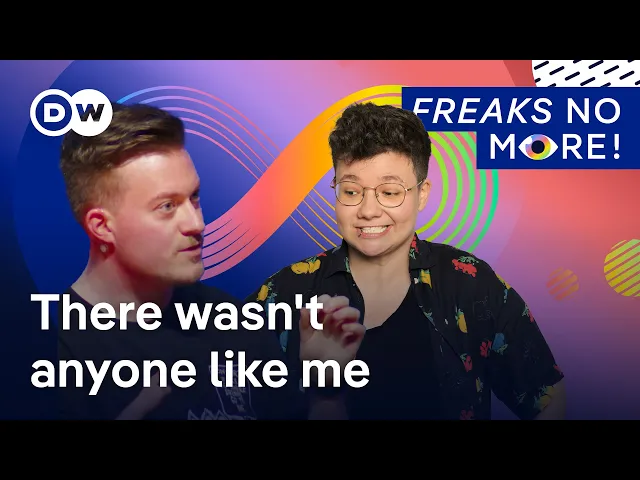
Why were disabled people always the villains on TV? | Freaks No More!
DW Podcasts
0:00 seeing disabled people just as monsters.
0:02 This is the reality I grew up with.
0:03 Then I was being bullied by being ignored.
0:07 Why weren't there any disabled characters in my Sesame Street?
0:11 What do [music] you want kids to take
0:13 away from seeing a character like you on TV?
0:16 I want them to feel seen.
0:18 We just want to be there.
0:19 We just want to have access.
0:20 We just want to have a drink.
0:25 Freaks No More.
0:29 Hi everyone.
0:30 I'm Vicky and this is our video podcast show Freaks No More.
0:34 The show we debunk myths about disability and show you hopefully how you
0:38 can be a bit more kind to the people who experience the world differently.
0:42 And as you can see today, we are not in a studio.
0:44 We are here at the Voices Festival of Journalism in Italy.
0:48 On a huge on a big stage with a big screen behind us.
0:52 And it's our very first uh recording in front of a live audience.
0:55 So, thank you for being here.
0:56 Our guest today is uh someone who makes sure that more people can be
1:00 seen and represented in the stories that we see on our screens every day.
1:04 He's born with a physical disability and uses his personal and professional
1:08 experience to push for better representation and inclusion in the media.
1:11 You're the diversity manager of uh the German
1:13 broadcaster NDR and you help create Ellen,
1:17 the first character with a disability um in the German version of Sesame Street.
1:21 So, I'm very happy to welcome René Schär.
1:24 Hi René.
1:25 Thank you for the invitation.
1:26 The first question that I want to ask you is well,
1:28 you're now speaking in a big stage in front of a a lot of people
1:32 and in the same time you are actively
1:34 advocating for diversity every day as a diversity manager.
1:38 So, how did your love for media start?
1:40 Was there a moment where you said, "I want to do this"?
1:43 Indeed, there was a radio moderator and he
1:46 got to my school and founded a youth radio.
1:50 And this is how I started becoming a member of the media
1:54 uh family uh and there I literally found my voice.
1:59 And I mean, from that moment on, when you were small,
2:01 when you were a kid, and you said, "I want to do this." At that time,
2:04 did you see a lot of representation of disability on screen,
2:08 on TV shows, movies?
2:10 Not at all.
2:10 Like, um if you remember the host I was trilogy,
2:16 the James Bond villains, um horror movies,
2:20 these are all examples of stereotypes of disabled people, visibly disabled,
2:26 scarred people who are so angry that they want to see the world burn.
2:31 This is the reality I grew up
2:32 with, seeing disabled people just as monsters and freaks.
2:36 And freaks, yes.
2:38 And now, how has it changed?
2:39 I mean, you helped create Elmo,
2:41 the first uh character with a visible disability on Sesame Street.
2:44 So, you actively want kids to see themselves represented on screen accurately.
2:48 So, do you think it has changed, and how has changed?
2:51 Disability mainstreaming is the goal, so that we normalize being disabled,
2:57 um and not being othered anymore.
2:59 And oftentimes, we get reduced on our disability.
3:02 Yes, we are disabled, and I identify myself as disabled,
3:06 but it's just one part of life.
3:08 And um I'm also a creative, or sporty,
3:12 or, you know, having blond hair, red hair, brown hair.
3:16 It's just one aspect of life.
3:18 So, maybe as a kid, you didn't see much of yourself represented on screen.
3:21 But, how was it in your personal life?
3:22 Did you feel like you were in a supportive environment?
3:26 Did you feel like you belonged, really?
3:27 In my personal life,
3:29 there were no other disabled people who would identify themselves as disabled.
3:35 Of course, there were grandparents who, just by being old,
3:40 can't take steps anymore, something like that.
3:42 But, they would just see themselves as old, not as disabled.
3:47 And being othered, being bullied,
3:50 is an experience I have made in the fifth class.
3:53 I got into a new group.
3:56 Uh a lot of those kids knew each other already.
3:59 They were sporty and interested in football.
4:02 And I'm not a football guy at all.
4:04 I was more creative um and and culturally
4:07 interested than I was being bullied by being ignored.
4:13 So, when I spoke up, nobody reacted.
4:16 And what do you think that that teenage you,
4:19 that young René, needed the most in this moment?
4:23 When I was 18, 19, I visited for the first
4:27 time a meeting of other people with um limb difference.
4:32 Just this moment of seeing other people like you and to see older people
4:38 with the same disability and seeing little
4:41 babies with the same disability changed my perspective.
4:46 We're coming from little towns, from big cities,
4:49 from the northern part of Germany,
4:51 from the southern of Germany, uh being white, being black,
4:55 but we all share the same experience of discrimination.
4:59 And I mean that othering and that discrimination, ableism,
5:02 also comes from the fact that until recent times we didn't
5:05 have many role models that we could see uh on screen.
5:09 People with disabilities being represented fairly and accurately on screen.
5:12 Actually, what we usually do in our show,
5:14 we have a big spinning wheel behind us where we
5:16 have fun facts about the topic that we're talking about.
5:19 We couldn't bring the big spinning wheel on stage here today,
5:22 but I have prepared for us these cards uh with facts
5:26 about how people with disabilities are currently represented on TV.
5:30 Okay.
5:31 So, choose a color.
5:31 Pick one.
5:32 Uh 46% of disabled people feel
5:35 that their identity group is underrepresented on TV.
5:39 Yes.
5:39 So, this is a study that actually this is
5:41 actually done uh among people with disabilities in the US.
5:44 A bit less than half actually feel that their identity groups are
5:47 not very well represented on the programs that they see on TV.
5:50 Pull one more Okay.
5:52 See what it says.
5:53 Non-disabled characters are significantly more likely to be shown as leaders.
5:58 So that's something that comes also from a study
5:59 done in the US actually on children television and that's
6:02 probably also relevant for you because you were actively
6:05 involved in the creation of Ellen and Sesame Street,
6:08 a program meant for children.
6:10 Mhm.
6:10 And this comes exactly from statistics about children programming.
6:13 So disabled characters are not very likely to be shown as leaders.
6:17 No, but often we are pitiful and are to be cared for.
6:21 Pull another fact and let's see if it's
6:23 a bit more optimistic one maybe or maybe not.
6:25 In 2024, no disabled characters are represented
6:29 in leading roles in children television in the US.
6:33 Well, that's not very optimistic one either.
6:35 So yes.
6:36 one.
6:36 Not a single.
6:37 Not a single one.
6:38 Yeah.
6:39 What you're doing with Ellen is very different actually.
6:42 Can you tell me a bit more about how
6:43 Ellen started as an idea cuz you helped co-created?
6:46 I just had these thoughts about feeling lonely,
6:50 thought about my my childhood and thought about Sesame Street because
6:55 it's the one children's television show which I grew up with.
6:59 So it's very dear to my heart.
7:00 And I thought about why weren't there any disabled characters
7:04 in my Sesame Street and the next thought was Wait a minute.
7:08 Sesame Street about it.
7:09 I can do about yeah,
7:11 something about it because these are my colleagues at NDR because
7:14 my corporation is responsible for the German version of Sesame Street.
7:18 So I called them and asked if we want to talk
7:20 about the representation and the diversity of the Muppets of the puppets.
7:26 And was everyone on board with your idea and were like, "Great, great idea.
7:29 Let's do it." or did you kind of
7:30 They were confused because the first response was, "Sure,
7:35 we could talk, but what do you want from us?
7:38 Our Muppets, they are red, green, yellow, orange.
7:42 We are colorful.
7:44 We are diverse and That should be enough, you know.
7:48 Yeah, yeah, yeah.
7:48 And a few weeks later, they called up and said, "Hey,
7:52 we have the 50th anniversary of Sesame Street
7:56 in Germany and we thought about adding a new character.
7:59 Would you like to be part of development?" And yeah,
8:03 that was the greatest thing in my life.
8:05 And what has been the feedback so far you received from parents,
8:07 from kids, from people that watch Sesame Street?
8:10 Oh, it was a love storm.
8:13 It was a candy storm.
8:15 I received a message from an older lady who didn't want to identify
8:20 herself as disabled because she feared to be pitied and feared the stereotypes.
8:27 And through Elin, she found the courage to apply for this card,
8:34 for this official acknowledgement by state that you are disabled.
8:40 And I personally received so many messages of kids, of parents [snorts]
8:45 who feel seen.
8:46 I know that there are at least five other Elins
8:50 in Europe who really exist and are using a wheelchair.
8:56 So, they feel represented by having a sister on television.
9:02 What you do with Elin is absolutely beautiful.
9:05 You actually encourage kids to see themselves as who they are on screen.
9:08 What a lot of people don't get about disability,
9:10 people might think it's so far away from them, from their life.
9:14 But the reality is any one of us really can become disabled at any point.
9:18 Over I guess 95% of disabilities you get
9:22 in the course of life because of you getting older,
9:25 because of incidents or illnesses.
9:29 And you mentioned to me actually something that affected you a lot.
9:32 Your mom became disabled after an accident.
9:35 Yes.
9:36 Can you share a bit more about that?
9:37 What happened and how did it really affect you?
9:40 I'm being born with a limb difference um and thought
9:44 before this accident that I knew everything about disability.
9:49 And then I got a call by my mom.
9:53 It was an unusual time.
9:54 There was an 85-year-old driving in his SUV and he
10:02 uh drove into her car and her hip broke six times.
10:08 Every ligament in her right leg ripped apart.
10:11 First of all, thank you a lot for sharing
10:13 that story because it's something really brave to reveal about you,
10:16 your mom, your personal life.
10:17 Um I'm wondering after that your realization maybe that wait,
10:21 you were born with a physical disability,
10:23 but someone can actually become become disabled.
10:27 Any one of us can become disabled through for example an accident.
10:30 How did you feel like people reacted to you and your mom?
10:34 So, fast forward uh 5 years later, uh she lives.
10:39 She has a beautiful life.
10:41 She can't work anymore.
10:43 She uses a walker.
10:45 When you with your mom or your parents, you want to do great stuff,
10:48 like going to the theater or to the cinemas.
10:52 In any case, every time missing accessibility is a topic.
10:57 So, in the public places that you visit, they're not accessible.
11:00 Yeah, not at all.
11:01 And we need to plan for extra time.
11:04 We need to have extra energy just to deal
11:08 with the world which is not built for my mom.
11:10 We're talking about what needs to change on television,
11:13 what needs to change in broadcasting, what needs to change in real life.
11:16 There's a new draft for a bill on accessibility in Germany,
11:21 but um the draft is incomplete.
11:24 There are giant loopholes for the private sector,
11:27 so for companies, so that they don't have to change anything.
11:32 We just want to be there.
11:34 We just want to have access.
11:35 We just want to have a drink.
11:37 Just want to exist and be seen for who you are.
11:40 I just want to go to the cinemas, to the doctor, to have a piss on the toilet.
11:45 So, I started a petition for this reason and I
11:49 started it a week ago and now we're over 30,000 signs.
11:55 Congratulations.
11:56 Maybe a round of applause for that because it affects really [applause]
11:59 that is how people like Rene can affect their lives daily, you know,
12:04 through protesting, through advocating for rights,
12:06 and through seeing injustice and actively working for it.
12:10 I want to come back to Ellen.
12:12 What do you want kids to take away from seeing a character like Ellen on on TV?
12:17 I want them to feel seen, that they never ever ask themselves if they belong.
12:25 And if they are right where they are.
12:27 Thank you so much, Rene, for this beautiful conversation.
12:31 Round of applause.
12:33 And thank you so much for being our first live audience of Freaks No More.
12:38 If you want follow us on YouTube, follow us on Spotify,
12:41 on Apple Podcast, wherever you get your podcasts from.
12:44 And if you want to ask any questions to us,
12:46 to our audience, we have an email address freaks@dw.com.
12:49 So, write to us and also if you have any questions for Rene.
12:52 Bye from me and [music] remember be kind, be patient, and be understanding.
13:00 Freaks No More.