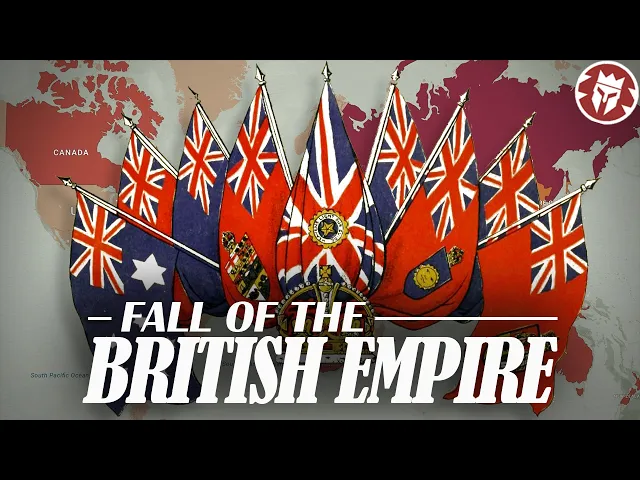
Why the British Empire Fell Apart - Won Two Wars, Then Lost Its Empire
Kings and Generals
0:11 It is commonly said that the British Empire was a dominion upon which “the sun
0:17 never set.” You may be rolling your eyes
0:19 after hearing this overused cliche once again,
0:22 but that does not make it any less true.
0:25 At the height of its power,
0:27 the British Empire ruled over about 20% of the global population,
0:31 25% of the planet Earth’s land mass,
0:35 and, of course, dominated the oceans with its mighty navy.
0:39 Despite that, the Imperium which once covered the globe is today no more,
0:45 reduced to Britain proper and a handful of small overseas territories.
0:50 Unlike most Imperial States, the British Empire was not toppled by a rival
0:55 Empire or dismantled by rebellions from within.
0:58 So, how did it disappear?
1:00 Today, we are going to discuss how it all unravelled.
1:04 Welcome to our video on the history
1:07 of and reasons behind the sunset of the British Empire.
1:16 GRADUAL DECLINE AND WW1 Empires rise and fall,
1:52 and those with the aspiration of global dominance are not an exception.
2:01 Whether it was the Roman Empire,
2:03 the Caliphate, the Mongol Empire, the Spanish Empire, or the Russian Empire,
2:07 no titan of history has ever escaped its inevitable downfall.
2:12 Empires prosper and expand on the ruins of old empires,
2:16 reach their peak, and then decline slowly or rapidly due to hubris,
2:22 economic problems, the revolts of subjugated peoples,
2:25 costly wars, or the emergence of new competitors.
2:28 In most cases, the collapse comes from a combination of all these factors.
2:33 When global empires are at the zenith of their glory,
2:36 the extent of their influence and power is
2:39 so huge that their eventual decline seems inconceivable.
2:42 This was the case for the British Empire at the height of the Victorian era.
2:48 Throughout the latter half of the 1800s,
2:51 Britain was winning wars, keeping competitors at bay,
2:54 and controlling global trade through its vast
2:57 Empire and uncontested control of the oceans.
3:00 Consequently, London was the capital of the global financial system.
3:05 However, by the late 19th century, there were already signs of trouble.
3:10 The historian Denis Healey remarked that, "As early as 1880,
3:14 the British Empire was producing an economic
3:17 return lower than investment in Britain itself,
3:19 while the British taxpayer was paying two and a half
3:23 times more for defence than the citizens of other
3:26 developed countries to preserve it." Sustaining a domain as vast
3:30 and scattered as this required a substantial amount of money.
3:34 Still, the financial might of the British Empire made it possible,
3:38 albeit at the expense of the colonies and the British working class.
3:41 However, Britain would not be able to stay on top forever.
3:45 At the turn of the 20th century,
3:48 the United States and Germany had overtaken Britain in steel production.
3:52 On the eve of World War I, the United States was responsible for nearly
3:57 a third of the global industrial output.
3:59 At the same time, Germany’s industrial production
4:02 rate had also surpassed the British Empire.
4:05 Nevertheless, the British pound sterling
4:08 remained the dominant global reserve currency,
4:11 and British citizens held substantial foreign investments worldwide,
4:14 including in the United States.
4:16 The money being generated in Berlin and Washington
4:19 was flowing back to the City of London, and Britain seemed as powerful as ever.
4:25 However, the outbreak of World War 1 changed this drastically.
4:30 The immense scale of this incredibly brutal conflict
4:34 stretched the greatest European powers to their limits,
4:37 and Britain was no exception.
4:39 As the war dragged on, it became clear that none
4:42 of the European powers had been prepared for such a prolonged conflict.
4:47 Not only did Britain finance its own war efforts,
4:50 but it also lent over 500 million
4:52 pounds to France and Russia throughout the conflict.
4:55 Moreover, the ongoing cost of trench warfare made Britain
5:00 increasingly reliant on the United States for crucial wartime imports,
5:04 such as food, weapons, and raw materials.
5:07 To purchase these products, they required large amounts of American dollars.
5:13 Thus, in order to acquire these dollars,
5:15 Britain began selling off its state-owned foreign investments in Canada,
5:19 the United States, Latin America, Egypt, and other countries.
5:24 Simultaneously, it pressured private British banks and citizens to sell
5:28 their investments and buy government debt with the proceeds.
5:32 By 1916, all of this had become unsustainable for the British Empire.
5:36 By the end of the war,
5:38 the United Kingdom owed over 4 billion dollars to the United States.
5:42 Although the British emerged victorious in the First World War,
5:46 it came at an immense cost.
5:48 This was the moment when London and the British Empire began to lose
5:52 their status as the global financial center to New York and the United States.
5:58 The overall debt of Britain soared from the pre-war number
6:02 of some 650 million before 1914 to over 7.4 billion in 1919.
6:09 In the 1920s, a whopping 44% of government
6:13 spending was allocated to interest payments on war borrowing.
6:18 These factors began to render the Empire
6:21 increasingly unrealistic for Britain to sustain.
6:23 DOMINIONS Of course, Britain’s victory in the Great War came in large part due
6:28 to the resources and manpower it had
6:31 extracted from its colonies during the fighting.
6:33 By the time the war ended, there was an expectation among the colonies that it
6:38 was now Britain’s turn to give something back.
6:41 These expectations varied from region to region,
6:44 but generally consisted of some degree of autonomy and self-governance,
6:48 accompanied by a clear roadmap of eventual independence.
6:52 The British Empire had actually granted
6:55 so-called “responsible government” to white settler colonies,
6:58 such as Canada, Australia, New Zealand,
7:01 and South Africa, well before the Great War.
7:04 Canada was the first to achieve the status
7:06 of a Dominion in the British Empire in 1867,
7:09 which essentially meant that Canada was now
7:12 governing itself and had its own parliament.
7:15 However, it was still formally part of the British Empire,
7:19 which was responsible for Canada’s defence and foreign policy.
7:22 Australia and New Zealand received the same status in 1907,
7:27 while the Irish Free State became a dominion in 1922.
7:31 This status became formalized with the adoption
7:34 of the Statute of Westminster in 1931, as these colonies became de facto
7:39 independent and part of the British Commonwealth.
7:42 Dominion status was perceived somewhat differently by different colonies.
7:46 Ireland saw this status as a compromise
7:49 and a stepping stone for eventual independence.
7:53 In contrast, Canada and Australia were happy
7:56 to have the fully recognized status of self-governance,
7:59 but were also keen to remain within the common defence
8:02 sphere of the British Empire and be protected from foreign threats.
8:06 Not all colonies saw their demands for self-government
8:09 fulfilled by the British after World War I.
8:12 This was particularly true for India, the crown jewel of the Empire.
8:17 In 1917, the British government adopted the Montagu-Chelmsford Reforms,
8:21 which resulted in a slight increase in Indian representation in the government.
8:27 However, these amendments fell well short
8:29 of giving full self-governance to the Indian people.
8:32 In 1919, the Indian demands for autonomy were reaching their peak
8:36 when the British colonial army killed 400 Indian protestors in Amritsar.
8:41 The bloodshed of that massacre made it clear
8:45 that Britain had no intention of letting India go,
8:48 for it was just too valuable for the Empire.
8:51 Nevertheless, by choosing a heavy-handed approach,
8:54 Britain was only delaying the inevitable.
8:57 Different scenarios unfolded in Egypt and Iraq,
9:00 where Britain was forced to recognize the independence
9:03 of both Arab countries under pressure from widespread unrest.
9:08 However, their independence was quite limited,
9:10 as the British army remained in Egypt and Iraq
9:13 to maintain control over their domestic and foreign policies,
9:17 as well as key strategic interests, such as the Suez Canal.
9:21 WW2 However, all of this was bound to change as another global war loomed.
9:27 By then, Britain was still perceived as a global superpower,
9:30 as its vast empire was still intact.
9:33 However, the British Empire was lagging
9:35 hopelessly behind countries like the United
9:37 States and Germany in terms of industrial output and military might.
9:41 Meanwhile, the United States had by this point completely overtaken
9:45 Britain as a premier naval power and a global financial center.
9:50 Britain was utterly defeated in Europe during
9:52 the early stages of the Second World War.
9:55 It was unable to stop the German march on Poland,
9:58 Belgium, the Netherlands, or Norway,
10:00 and managed to withstand the German attempt on the British Isles only thanks
10:05 to the professionalism of the British Royal Air
10:07 Force and the resilience of the British people.
10:10 Arguably, the biggest blow to the prestige
10:12 of the British Empire during the Second World War was
10:15 its complete defeat at the hands of a smaller
10:18 Japanese force during the siege of Singapore in 1942.
10:22 Churchill called the fall of Singapore "the worst
10:26 disaster and largest capitulation in British history.”
10:30 The historian Raymond Callahan added that “The fall
10:33 of Singapore was a pivotal event with enormous consequences.
10:36 Not only was it a military defeat, it was a shattering blow to Great Britain's
10:42 prestige and marked the decline of the Western
10:45 era in Southeast Asia.” The British strategy throughout
10:48 World War II was to defend its home island,
10:51 prevent the German and Japanese capture of its colonies wherever possible,
10:55 and wait for the Americans to eventually land in Europe.
10:59 Even in his historic Finest Hour speech,
11:02 Churchill openly admitted that, “Even if, which I do not for a moment believe,
11:08 this Island or a large part of it were subjugated and starving,
11:12 then our Empire beyond the seas, armed and guarded by the British Fleet,
11:16 would carry on the struggle, until, in God’s good time,
11:19 the New World, with all its power and might,
11:22 steps forth to the rescue and the liberation of the old.” In short,
11:27 Britain was no longer powerful enough to fight the Germans on its own.
11:32 By 1941, Britain was facing bankruptcy and had to rely
11:35 on the United States to support its war effort through the Lend-Lease program,
11:39 with the Americans providing the lion’s share of financial aid,
11:44 amounting to approximately 31.4 billion dollars.
11:46 By the end of the war, Britain decided to retain some of the Lend-Lease goods,
11:54 estimated at 650 million dollars.
11:56 Moreover, it secured a loan worth 3.75 billion
12:00 dollars in July 1946 to keep the economy afloat.
12:04 Overall, Britain had to repay roughly 7.5 billion dollars to the US and 2
12:10 billion dollars to Canada to cover
12:12 the debt borrowed during and immediately after WW2.
12:16 This debt was only fully repaid in 2006.
12:20 Of course, Britain had won the war and defeated the Nazis,
12:24 but it had lost its status as a superpower along the way.
12:28 Its economy was practically bankrupt, and its infrastructure,
12:31 including in the industrial sector, was badly damaged.
12:35 England’s prestige and, as they call it now, aura, was all but gone.
12:40 The British Empire had stepped down from the invisible
12:43 throne of global power practically without a fight,
12:46 becoming the junior partner of the United
12:49 States in its struggle against the Soviet Union.
12:52 In February 1947, Britain acknowledged that it lacked the resources
12:56 to defend Greece and Turkey against the Soviet threat.
12:59 In response, the future American Secretary of State
13:03 Dean Acheson pithily remarked that, “The British
13:06 are finished.” THE LOSS OF COLONIES The rise
13:08 of national consciousness in many British colonies,
13:10 paired in some instances with an inability
13:13 or unwillingness to suppress it by force,
13:15 meant that the disintegration of the British Empire had become
13:19 a matter of time in the post-World War II era.
13:22 Britain was unable to suppress independence
13:24 movements in Africa and India because maintaining
13:27 military and civilian infrastructure in far-flung lands
13:31 was becoming too burdensome for the British,
13:34 against the backdrop of the economic problems they were experiencing.
13:38 Consequently, the British government hoped for a peaceful
13:41 divorce which would lead the newly independent former colonies
13:44 into the British Commonwealth and keep them within
13:47 the British sphere of influence and system of defence.
13:50 This was especially important during the era of the Cold War,
13:54 when the West and the Soviets were engaged not only
13:57 in military and economic competition but also in a struggle for influence,
14:02 forced to win the hearts and minds of third-world
14:05 countries to bring them into their spheres of influence.
14:08 The sympathies of Cold War-era global opinion
14:11 were firmly on the side of anti-colonialism; therefore,
14:14 Britain’s insistence on maintaining its colonial Empire would have hindered
14:18 the efforts of its American partners to gain more allies.
14:22 Worse, it could have led to strong anti-colonial
14:25 rebellions that the Soviet Union might have intervened in.
14:28 Due to these geopolitical concerns,
14:30 the United States was both privately and publicly
14:33 pressuring the British to relinquish their colonies.
14:37 In 1947, US President Harry Truman said,
14:41 “The old imperialism—exploitation for foreign profit—has
14:44 no place in our plans.” Therefore, Britain did not really have much of a choice.
14:49 The first domino to fall was the most important one.
14:52 After ignoring or suppressing the Indian
14:55 aspirations of independence for decades,
14:56 Britain was no longer in a position to avoid it.
15:00 In March 1946, British Prime Minister Clement
15:03 Attlee made a speech in parliament clearly
15:06 demonstrating that Britain had no intention to force
15:09 India to stay in the British Empire: “India is today in a state of great
15:14 tension and this is indeed a critical moment… It
15:17 is a time emphatically for very definite and clear
15:21 action… Let us all realize that whatever the difficulties,
15:25 whatever the divisions may be,
15:27 there is this underlying demand among all the Indian
15:30 peoples… Is it any wonder that today she claims,
15:33 as a nation of 400,000,000 people that has
15:36 twice sent her sons to die for freedom,
15:39 that she should herself have the freedom to decide her own destiny?
15:43 My colleagues are going to India with the intention
15:46 of using their utmost endeavours to help
15:48 her to attain that freedom as speedily and fully
15:51 as possible.” Attlee gave clear instructions to Lord Mountbatten,
15:54 the last Viceroy of India.
15:56 Get Britain out, and if possible, keep India united.
16:00 In August 1947, India indeed became independent,
16:04 but contrary to Britain’s hopes, it was divided into two parts.
16:09 Although both India and Pakistan formally joined the Commonwealth of Nations,
16:13 they ultimately left the British sphere
16:15 of influence and its concept of common defence.
16:18 Even after India's independence,
16:20 Britain hoped to delay the disintegration of its Empire.
16:24 The British government was making promises of self-government to its colonies,
16:28 telling them to wait until London decided
16:30 that they were ready to govern themselves.
16:33 In addition, Britain continued to invest in its remaining colonies,
16:37 hoping that the extraction of their resources would alleviate its economic woes.
16:42 Still, the stalling efforts of the colonial overlords were for naught.
16:47 India’s independence had galvanized independence
16:49 movements in other British colonies.
16:51 Ceylon, Burma, and the Palestine Mandate left the British Empire in the 1940s,
16:57 while Sudan, Ghana, Malaya, and Cyprus followed suit in the 1950s.
17:02 At the same time, Britain suffered a major embarrassment when
17:06 attempting to continue projecting its power on a global scale.
17:10 In 1956, Egypt’s President Gamal Abdel Nasser
17:13 announced the nationalization of the Suez Canal,
17:17 the strategic waterway linking trade between
17:19 the Indian Ocean and the Mediterranean Sea,
17:22 which was co-owned by British and French investors.
17:26 Britain was outraged and decided to invade the Suez
17:29 Canal and depose Nasser with France and Israel.
17:33 On October 29, 1956, they invaded Egypt.
17:36 Although the joint force quickly gained the upper hand on the battlefield,
17:40 the invasion immediately turned into a diplomatic disaster.
17:43 The UN, the United States and the Soviet Union condemned the invasion,
17:48 and the threat of crippling sanctions were levied.
17:51 President Eisenhower pressured the International Monetary Fund
17:54 to stop the financial assistance to Britain.
17:58 Only nine days after the invasion's launch, Britain was forced to withdraw.
18:02 This was a decisive blow to Britain’s waning
18:05 prestige and its claim to remain a global force.
18:09 Britain was not sitting at the table of global superpowers anymore and had
18:13 been reduced to a secondary role in the global game of geopolitics.
18:17 By the end of the 1970s,
18:19 the vast majority of the remaining colonies had become independent.
18:23 The disintegration of the British Empire was complete.
18:26 CONCLUSION In the present day, the United Kingdom still has sovereignty over
18:31 14 overseas territories scattered throughout the world,
18:34 including Gibraltar, Bermuda and the Falkland Islands.
18:37 However, these tiny islands are a far cry
18:40 from the Victorian glory days of the peak British Empire.
18:43 Once the most powerful nation in the world,
18:46 the British Empire declined and ultimately
18:48 collapsed under the weight of economic problems primarily caused by its
18:53 participation in two resource-draining world wars,
18:56 the emergence of wealthier and more militarily powerful competitors,
19:00 and the inevitable drive of colonies towards independence.
19:03 The United Kingdom’s attempt to maintain its
19:06 former colonies within its sphere of influence
19:08 through the creation of a global British-led
19:10 coalition of former colonies has also failed.
19:14 Today, Britain maintains close relations with several former colonies,
19:18 including Australia, New Zealand, and Canada.
19:21 However, this group of states is part of the American-led coalition,
19:26 where Britain is a junior partner.
19:28 More videos on the rise and fall of Empires
19:31 both ancient and modern are on the way,
19:33 so make sure you are subscribed and have pressed the bell button to see it.
19:37 Please consider liking, subscribing, commenting,
19:39 and sharing- it helps immensely.
19:41 Our patrons and YouTube members can watch more than
19:44 200+ exclusive videos- join their ranks via the link
19:47 in the description or by pressing the join
19:50 button under the video to watch these weekly videos,
19:52 learn about our schedule, get early access to our videos,
19:55 access our private Discord, and much more.
19:58 This is the Kings and Generals channel, and we will catch you on the next one.