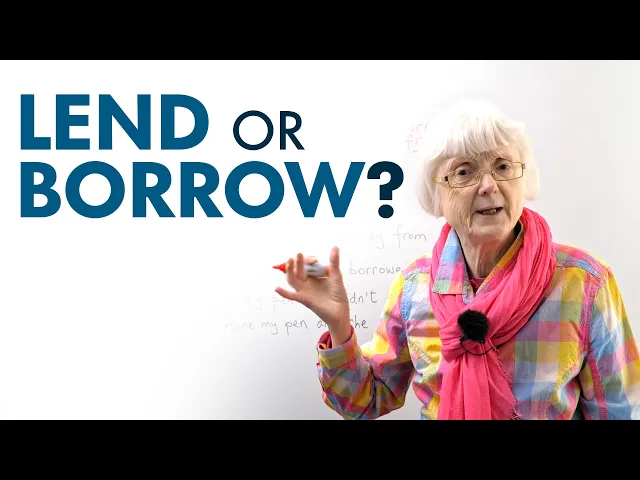
“LEND” or “BORROW”? What’s the difference?
Learn English with Gill · engVid
0:00 Hello.
0:00 I'm Gill at engVid, and today we have
0:04 a lesson on lending and borrowing.
0:08 When do you say "lend" and when do you say "borrow"?
0:13 I know it can be a little bit confusing.
0:16 Okay, so I hope this lesson will help to clarify.
0:22 So, I've started with a quotation which says,
0:29 "Neither a borrower nor a lender be." That's
0:35 about money.
0:35 I mean, you can lend and borrow
0:38 things other than money, but this is a piece
0:41 of advice spoken by a character in a play.
0:45 You may recognize it if you know your Shakespeare.
0:51 It's from Hamlet, and it's a character...
0:54 It's a father talking to his son, and the
0:58 son is about to go away to another country, and the father is giving him some...
1:04 What he thinks is good advice.
1:07 "Neither a borrower nor a lender be." That's why the word order
1:11 is a bit strange because it's a poetic line from a Shakespeare play.
1:18 So, anyway, that's just a little introduction to the idea that
1:22 you can be a borrower and you can be a lender,
1:26 and they're different in some way.
1:28 So, how are they different?
1:30 Well, let's have a look.
1:32 So, somebody might say, "Could you lend me
1:38 your pen, please?" And someone else might...
1:45 Or they might say...
1:47 The same person might say, "May I borrow your pen, please?" But
1:53 they're asking the same thing here, but the
1:57 construction is just a bit different.
2:00 They're saying, "Could you lend me your pen?" So they're
2:06 asking for the pen to be given to them.
2:11 Or, "May I borrow your pen?" So, it depends on
2:17 who is doing the action.
2:20 So, I hope this will
2:23 also help to show.
2:25 So, you lend something to somebody, you give temporarily, you give
2:33 something to someone, they take it from you,
2:37 they borrow from you, you lend to somebody,
2:42 that person borrows from you.
2:44 Okay?
2:45 So, the direction is from this person to that person.
2:51 This person is giving, lending, and this person
2:57 is borrowing, taking, temporarily, because
3:02 they're supposed to give it back again later.
3:07 Okay?
3:08 So, "Could you lend me your pen?" or
3:13 "May I borrow your pen?" It means the same
3:16 thing, but it depends who is doing the lending
3:21 or the borrowing.
3:22 So, let's just try a little
3:25 example here so that you can work out which...
3:30 Which word belongs in the gap.
3:33 So, "I never ______ money to anyone." Or, "She is always
3:39 trying to ______ money from people." So, remember
3:44 we've got "to" and "from" here, which is a
3:49 clue.
3:49 You lend to, you borrow from, so that should help you to work out how to fill in
3:57 these two gaps, which one is "lend" and which
4:02 one is "borrow".
4:04 Okay.
4:05 So, "I never ______",
4:08 so it's to do with giving.
4:14 "I never give/lend." Okay?
4:18 So, "I never lend money to anyone, but
4:26 then another person, she is always trying to
4:33 take/borrow." Okay?
4:36 "Borrow".
4:37 "She is always trying to borrow money from", so this is "to",
4:46 "lend to", and this is "from", "borrow from".
4:51 Okay?
4:52 So, those prepositions help you sometimes to work it out.
5:00 So, okay, I hope that's clear.
5:02 But then in the
5:04 past tense, we just have to be a bit careful
5:08 with the past forms because "to lend" is an
5:13 irregular verb, so the past form of "to lend"
5:18 is "lent".
5:19 "I lent", "you lent", "he lent".
5:23 It's the same for all, all the pronouns, singular and
5:29 plural.
5:30 "We lent", "they lent".
5:32 It's the same all the way through, but it's irregular.
5:37 So, we've got "lend" with a "d", then "lent" with
5:41 a "t".
5:41 But then "borrow" is a regular verb,
5:44 so you just put "ed" on the end.
5:48 "Borrowed", "borrowed".
5:49 Okay?
5:51 So, again, we've got two sentences here with gaps, so it's the same situation
6:00 said in two different ways.
6:03 So, "Yesterday, Anne _____ my pen" and didn't return it.
6:10 "Yesterday, I _____ Anne my pen" and she didn't
6:15 return it.
6:16 So, which word goes in which gap?
6:23 So, one person does the lending and another person does the borrowing.
6:29 So, "Yesterday, Anne", and this time you haven't
6:32 got the "to" and the "from" to give you a clue,
6:37 so...
6:38 Because they don't always appear, so you have to just work out.
6:43 So, "Anne did something with my pen", so what did she do?
6:50 She took it, didn't she?
6:53 "You gave it, but she took it", so "Anne borrowed...
7:04 Anne borrowed my pen", she did the borrowing,
7:08 the taking, and she didn't return it.
7:12 So, then it's the other one in this gap.
7:16 "Yesterday, I lent", "I gave", "I lent Anne
7:23 my pen", and she didn't return it.
7:26 And if you put the name of the person immediately after,
7:32 you don't say "I lent to Anne", I just...
7:35 "I lent Anne", you don't need the "to" in there.
7:42 So, that means you don't always have the little prepositions to help you
7:48 to know which it is.
7:51 So, "Anne borrowed", "I lent", "I gave", "She took".
7:56 Okay.
7:58 Right, so I hope that helps to give you a way of
8:02 working out whether to use "lend" or "borrow".
8:06 It's all about what direction it's going in,
8:10 giving or taking.
8:11 Okay?
8:11 And "to" or "from".
8:15 Right, so if you'd like to do a quiz on this topic, just go to the website,
8:22 www.engvid.com, and see how you do.
8:24 I hope that's been helpful.
8:26 Thank you for watching.
8:29 I hope to see you again soon, and bye for now.
8:32 Bye.