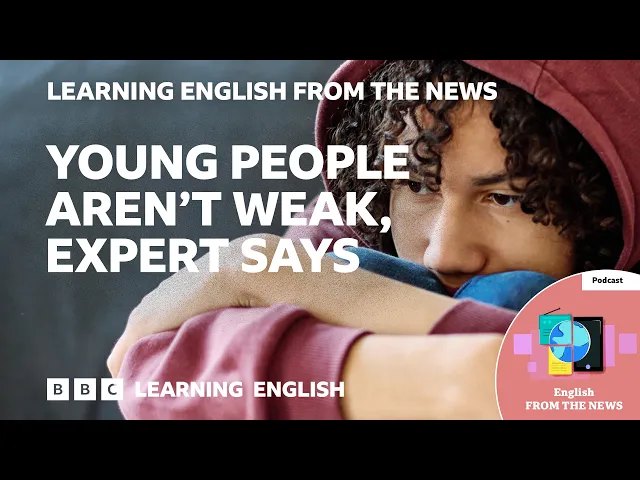
Mental distress is a real issue, says new review | BBC Learning English from the News
BBC Learning English
0:00 From BBC Learning English.
0:01 This is Learning English from the News, our podcast about the news headlines.
0:06 In this programme: Young people are not weak, says head of official review.
0:11 Mental distress in young people is a real issue.
0:19 Hello, I'm Georgie.
0:20 And I'm Neil.
0:21 In this programme we look at one big news story
0:23 and the vocabulary in the headlines that will help you understand it.
0:27 You can find all the vocabulary and headlines from this episode,
0:31 as well as a worksheet on our website, bbclearningenglish.com OK, Neil.
0:36 Let's hear more about this story.
0:44 An independent review into mental health in the UK has found
0:48 a rise in mental distress among children and young people with anxiety,
0:53 depression, self-harm and eating disorders among the most common issues.
0:57 Head of the review Professor Peter Fonagy says
0:59 that accusations that young people are too sensitive are wrong.
1:03 He says it is now "harder to be young" due to challenges
1:07 such as economic and employment uncertainty and problems caused by social media.
1:12 Let's have our first headline.
1:14 There is no 'snowflake generation'- it's just harder to be young now,
1:19 says author of mental health review,
1:21 that from The Independent, a UK news website.
1:25 And that headline, again from The Independent:
1:28 There is no 'snowflake generation'- it's just harder to be young now,
1:32 says author of mental health review.
1:34 So this headline quotes Professor Peter Fonagy, head of the review,
1:39 who says there is no 'snowflake generation' and we're
1:42 interested in this word 'snowflake' here, aren't we, Georgie?
1:46 Yes we are.
1:47 So snowflake is a slang word.
1:49 It describes a person who is seen as overly sensitive or fragile.
1:53 They might be someone who is easily offended.
1:56 And of course, this makes sense, doesn't it?
1:59 Because if you imagine a real snowflake, they are very fragile.
2:03 They melt as soon as you touch them.
2:05 Yes.
2:06 In the headline, snowflake is a modifier.
2:09 A snowflake generation means a generation of snowflakes.
2:12 This generation of young people are accused of being snowflakes because they
2:17 are perceived to be more sensitive and less able to deal with stress.
2:21 But Peter Fonagy says that the accusation is wrong.
2:25 His view is that young people face many challenges that make life harder.
2:29 Yes.
2:30 Now, snowflake is a derogatory word meaning that it's used as an insult.
2:34 So be careful when calling someone a snowflake as it can sound rude.
2:43 We've had snowflake,
2:45 a slang term to describe someone seen as too sensitive or easily offended.
2:52 For example, they called him a snowflake
2:54 when he said he found the joke offensive.
3:00 This is Learning English from the News, our podcast about the news headlines.
3:05 Today, we're talking about findings that show
3:07 a rise in mental distress among young people.
3:10 The review into mental health, ADHD and autism concludes that about one
3:15 in four 16 to 24-year-olds is now struggling.
3:19 Some are unsure about the new data
3:21 as some of the sources rely on self-reporting.
3:23 There is also an argument which says that the higher mental
3:28 distress numbers could be because of changing attitudes and greater awareness,
3:32 so more people feel able to report their problems.
3:36 The head of a children's mental health charity, Hope 4 More,
3:39 has agreed with Peter Fonagy's view that young people are not snowflakes.
3:43 She said that many children were struggling
3:46 because of factors like the education system,
3:48 social media and the impact of the Covid-19 pandemic.
3:52 And our next headline is about this.
3:54 This one is from BBC News.
3:56 Young people have it tough, says charity boss.
4:00 That headline again from BBC News.
4:02 Young people have it tough, says charity boss.
4:06 So Neil, we've heard that Peter Fonagy thinks it's harder to be young,
4:09 and here in the headline it says young people have it tough.
4:13 Do they have similar meanings?
4:15 Well yes.
4:15 Both convey a very similar meaning.
4:17 Tough in this context means hard or difficult.
4:21 If you have it tough, it means you face difficult circumstances.
4:25 The view that young people have it
4:27 tough is because of the things we've mentioned,
4:29 things like economic uncertainty and social media.
4:32 The opposite of having tough is have it easy,
4:35 meaning you experience good life circumstances.
4:38 Yeah.
4:38 So for example, some say teachers have it easy because they get long holidays,
4:43 but they do work very hard during term time.
4:46 Be careful though, because not all adjectives work with this structure.
4:50 The most common expressions are have it tough, have it hard,
4:53 have it easy, have it good and have it bad.
4:57 Yes.
4:57 And you might also hear it with 'got', for example,
5:00 she's got it easy or she's got it tough.
5:06 We've had 'have it tough'- experience difficult life circumstances.
5:13 For example, single parents often have it
5:16 tough balancing childcare and work by themselves.
5:24 This is Learning English from the News from BBC Learning English.
5:28 We're talking about a rise in mental distress among young people.
5:32 Figures from the UK's National Health Service
5:34 show the number of children and young people
5:37 in contact with mental health services in England
5:40 has risen by 50% in the past five years.
5:43 Some people have questioned whether we are treating people who
5:46 have temporary life stresses as if they have a medical problem.
5:50 But head of the recent mental health review Peter
5:53 Fonagy says this generation of young people has real,
5:57 serious challenges that he would not wish to have had when he was their age.
6:02 OK, let's have another headline.
6:04 Professor Peter Fonagy:
6:06 How to help young people forge emotional resilience and wellbeing.
6:10 And that's from Tatler, a British magazine.
6:13 And that headline again from Tatler.
6:15 Professor Peter Fonagy:
6:17 How to help young people forge emotional resilience and wellbeing.
6:21 So emotional resilience is how well you can adapt to stressful situations,
6:26 and wellbeing is the state of feeling happy or comfortable.
6:30 Peter Fonagy wants to help young people forge these things.
6:34 Georgie, what can you tell us about this word forge?
6:37 Well, in this context,
6:38 forge means build or develop something strong through hard work.
6:42 The literal meaning of forge might help us understand it better.
6:46 Yes, forge, in a literal sense, comes from metalworking.
6:50 You melt the metal and then hit it into shape using a lot of effort,
6:54 and you end up with something strong.
6:57 You can forge things like a career path,
6:59 forge a new identity, forge a bond with someone,
7:02 and these all just mean that you build these things through hard work.
7:08 We've had forge- build something strong with hard work.
7:14 For example, he forged his career
7:16 as an actor through hard work and determination.
7:21 That's it for this episode of Learning English from the News.
7:24 We'll be back next week with another news story.
7:26 And if you like our podcast, sign up to our email newsletter to get
7:31 the latest from BBC Learning English every week.
7:33 There's a link in the notes below this episode.
7:36 Bye for now.
7:37 Goodbye.