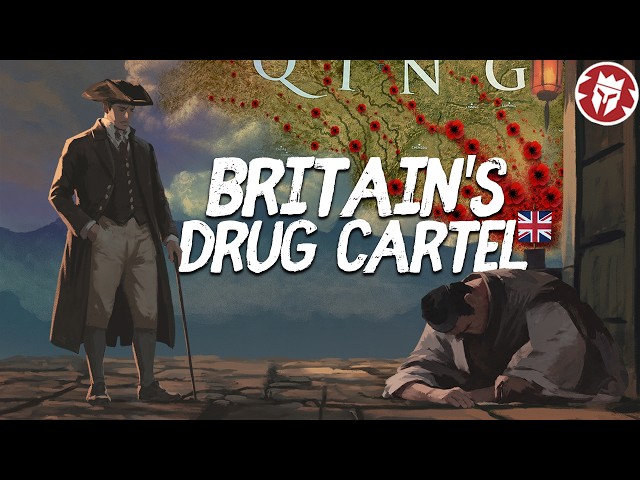
How a Company Hooked China on Opium - Tea Led to the Opium War
Kings and Generals
0:06 Throughout the 19th century, the continent of Asia was subject
0:09 to the greatest corporate takeover in human history.
0:13 With an army of lobbyists,
0:15 compromised MPs and the largest corporate paramilitary ever conceived,
0:19 the executives of the British East India Company extended
0:23 their tendrils ever further across the massive Indian subcontinent,
0:28 often in defiance of the British
0:31 government’s attempts to regulate their activities.
0:33 India, however, would not be the only ancient civilisation
0:38 to fall prey to the English merchant’s profit-driven ambitions.
0:43 In this latest installment in our series on the British East India Company,
0:47 we will explore an important side-story in John Company’s adventures in China,
0:52 and examine how the most powerful corporate monopoly
0:56 in the world manufactured the most destructive opioid crisis ever recorded.
1:06 The Company Enters China European Civilisation had been
1:48 aware of the existence of China since ancient times.
1:52 For countless centuries, Chinese silks, porcelains,
1:55 and teas were the pinnacle of exotic luxury among the European nobility,
2:00 even as the land they came from remained wreathed in mist-shrouded mystery.
2:05 From antiquity to the middle ages,
2:08 direct contact between Europe and China was extremely limited.
2:13 Some few intrepid explorers like Marco Polo and Odoric
2:17 of Pordenone braved the long and treacherous overland journey across
2:22 the silk road into the Middle Kingdom and returned
2:26 to their homelands with fabulous stories about the exotic orient.
2:30 By the dawn of the 16th century, as naval technology improved,
2:34 the explorers of Europe cast themselves off into the open
2:38 ocean in search of a direct sea route to Asia.
2:42 Much like in India and the Malay Archipelago,
2:45 it was the Catholic Portuguese who arrived in the Middle Kingdom first,
2:50 followed, as was typical, by their Protestant Dutch Rivals.
2:54 Much like in the rest of Asia, the English were relative latecomers in China.
2:59 When traders of the East India Company had first come
3:03 upon the shores of the ancient Middle Kingdom in 1699,
3:07 they encountered a land now under the rule
3:10 of the young and energetic Qing Dynasty.
3:13 Like the Mongols before them, the Qing was a so-called conquest dynasty,
3:18 founded by the Manchu people from beyond the Great Wall,
3:22 who had subjugated the land of the Han Chinese only a few decades prior.
3:27 Although primarily known in western histories
3:30 for its eventual subjugation to European powers,
3:33 the Qing Dynasty that the British East India Company first opened
3:37 formal relations with was the most powerful Empire on the globe,
3:42 whose professional military and sophisticated bureaucracy governed
3:45 over a third of the world economy, a third of the entire world’s population,
3:50 and around 10% of the earth’s entire landmass.
3:54 Much like when they first arrived in India a century prior,
3:58 the British East India Company arrived in China not
4:02 as conquerors but as supplicants to an immensely powerful Imperial regime.
4:08 By 1715, John Company had established its first permanent
4:12 trading post in China in the port city of Guangzhou,
4:15 known to the English as Canton.
4:18 And it was there they would remain confined.
4:21 Like its Ming Dynasty predecessor,
4:23 the Qing Dynasty was an inwards-facing Empire.
4:26 Beyond a system of ritualised tribute with its surrounding satellite states,
4:30 it placed a relatively low priority on international commerce.
4:35 While society back in Britain was being quickly consumed by a Chinese tea craze,
4:41 the Chinese had no pressing need for Western products.
4:46 Pianos, cutlery, spectacles, clocks,
4:48 and other western curiosities were gimmicks that the discerning Chinese
4:53 literati were unimpressed by and had no practical use for.
4:58 As such, the Empire limited foreign trade to Canton,
5:01 where the only payment they accepted in return for tea
5:05 was the valuable international currency of the time: cold, hard silver.
5:09 Forced to sink exorbitant amounts of silver bullion into China
5:14 to satiate the British public’s unending demand for their cuppas,
5:18 the East India Company’s venture
5:20 in the Celestial Empire was a loss-making enterprise,
5:23 one that they would eventually turn a profit
5:27 on by manufacturing the worst opioid epidemic in history.
5:31 The Opium Trade Begins If there was one thing that Pablo Escobar,
5:35 El Chapo, and the British East India Company all understood,
5:38 it was that there was nothing that created demand like addiction,
5:43 and no law that could stop them from meeting that demand.
5:47 By the early 18th century,
5:49 the Portuguese discovered that when presented as a recreational drug,
5:53 opium sourced from India could be sold in China at a considerable profit.
5:59 By 1773, this trade secret had been discovered by the British,
6:03 and as it so happened,
6:05 the East India Company had just annexed the entirety of Bengal,
6:09 a region with large pre-existing opium fields.
6:13 The company expanded these opium fields tenfold,
6:15 seizing up all the most fertile farmland in a region which
6:19 had just suffered a catastrophic famine and repurposing it for drug cultivation.
6:25 In the ensuing decades,
6:27 thousands of company-owned poppy plantations sprang up across occupied India,
6:32 employing millions of impoverished Indian labourers.
6:36 If cutlery, pianos, and cuckoo clocks weren’t to the Chinese people’s liking,
6:41 company executives reasoned, then let them enjoy dreamflower.
6:45 Between 1730 and 1830, the amount of opium entering the Celestial Empire
6:51 increased from 200 crates per year to over 10,000.
6:56 Where before silver had flowed into China, now it was draining out,
7:02 all while an epidemic of addiction swept across
7:06 every level of Chinese society and paralysed the nation.
7:10 This hollowing out of a civilization is
7:14 described vividly in Paul French’s City of Devils,
7:17 a nonfiction book set in Shanghai
7:20 at the climax of China’s century of humiliation.
7:23 “They are slaves to the foreign mud.” French wrote
7:26 of the masses of opium addicts that thronged the city.
7:30 “By day they beg, walking the city, scrounging coppers.
7:35 By night, they smoke… Their complexions are grey.
7:38 Their skin bleached, with the consistency of papyrus.
7:42 People consider these addicts neither dead
7:46 nor alive… The undead victims of opium.
7:50 Ghosts.” As the British East India Company flooded poison into China,
7:56 the Imperial Court in Beijing took measures to counteract their influence.
8:00 Edicts were issued to restrict the sale of opium from the 1780s onwards,
8:05 with a full ban on the narcotic issued in 1796,
8:09 during the final year of the great Qianlong Emperor’s 60-year-long reign.
8:15 Unfortunately, this ban did little to prevent opium
8:18 from flooding in through China’s porous coastal borders.
8:22 To avoid compromising their legal foothold in Canton,
8:25 the East India Company circumvented Chinese law.
8:28 Rather than selling opium to China themselves,
8:32 they outsourced the transportation of their product to private smugglers,
8:36 who worked in cooperation with local Chinese
8:40 officials to disseminate dreamflower throughout the Empire.
8:43 Corruption among the Chinese was rampant.
8:47 European opium entered the country through the province of Guangdong,
8:51 a southern frontier region nearly 2,000 kilometers
8:54 away from the Imperial capital of Beijing.
8:57 In the birthplace of Cantonese culture,
8:59 the local elites had long expressed their autonomy with a saying:
9:04 Heaven is high, and the Emperor is far away.
9:08 Rather than work to destroy the opium trade as the Emperor had instructed,
9:13 southern Qing officials got in on the racket.
9:16 The merchants of the Co-Hong,
9:18 a commercial guild assigned by the Emperor to regulate European trade,
9:22 ironically became major collaborators in illegal trafficking.
9:25 Key smuggling hubs sprang up on the islands of Lintin and Whampoa,
9:31 where western traders maintained floating opium
9:35 depots aboard great de-masted hulks just offshore.
9:38 In doing so, they maintained the legal pretense of not
9:43 technically selling opium on Chinese soil as Chinese buyers came alongside,
9:48 loaded crates of opium into inconspicuous little seacraft,
9:52 and melted away into the Pearl River Delta.
9:55 The moral bankruptcy of the East India Company was
9:59 enabled by the endemic corruption of the Chinese bureaucracy,
10:02 which enriched itself as its ancient civilization was wasted away.
10:07 The Company Loses Its Monopoly As was to be
10:10 expected of the largest megacorporation in the world,
10:13 the British East India Company was ruthless
10:16 in smothering any competition in its market.
10:19 Since the company’s founding in the Elizabethan era,
10:22 it had held a charter guaranteeing it a monopoly over all British trade in Asia,
10:28 a privilege it guarded jealously,
10:30 especially when it came to the illegal opium trade.
10:34 By law, all opium grown in occupied India was considered company property,
10:39 and no private businesses were permitted to cultivate the drug.
10:43 The freelance smugglers the company relied
10:46 on to run opium into China had no choice
10:49 but to buy their product at company auctions where
10:52 the price was set at whatever the company pleased.
10:56 At the dawn of the Napoleonic wars, however,
10:59 the East India Company began losing its
11:01 exclusive privileges over the exploitation of the East.
11:04 With the French Emperor choking off trade to Britain,
11:08 smaller British companies who had previously
11:10 traded with Europe were put under strain,
11:13 compelling them to push for the right to expand into Asia.
11:17 Moreover, times had changed since
11:19 the company’s founding two hundred years earlier.
11:23 Influenced by generational economists like Adam Smith,
11:26 chartered monopolies like the East India
11:29 Company were increasingly viewed as inefficient,
11:32 corrupt, and incompatible with Britain’s
11:35 emerging industrial and commercial economy.
11:38 Parliament no longer saw a justification
11:41 for allowing one corporation to control profitable trades,
11:44 including opium, when competition could expand commerce and revenue.
11:50 In 1813, a Charter Act passed by Parliament ended
11:54 the East India Company’s exclusive commercial privileges in India,
11:58 while maintaining its monopoly over trade with China.
12:02 In 1833, the Government in India Act repealed
12:05 the exclusivity of the China trade as well.
12:09 Henceforth, the East India Company was relegated
12:12 to a primarily administrative body governing its territories in India.
12:17 However, it remained in possession of vast
12:20 tracts of state-run poppy fields in Bengal,
12:23 and continued to profit immensely from the opium trade,
12:27 especially as new British trading
12:29 houses like the infamous Jardine-Mathesons built
12:32 greater opium-smuggling networks in China than the East India Company ever had,
12:38 increasing the demand for the narcotic to unprecedentedly high levels.
12:42 China Fights Back By 1838, the number of Chinese addicts was estimated
12:48 to be anywhere from four to twelve million.
12:51 It seemed as if there was no one in China
12:54 capable of stopping the flow of opium into the country.
12:58 That is, until the arrival of Lin Zexu.
13:02 Lin Zexu was a Special Imperial Commissioner
13:05 acting on behalf of the Daoguang Emperor,
13:08 ordered to put an end to China’s opium crisis by any means necessary.
13:14 An incredibly well-respected figure, he was known to his people as “Blue Sky'',
13:19 who considered him as pure and incorruptible as the heavens.
13:22 Commissioner Lin’s first course of action was
13:25 to write a letter to a young Queen Victoria,
13:28 imploring her to recognise the immorality of the opium trade.
13:33 After receiving no response, the official laid down the iron fist.
13:37 Coming down upon Canton with an army at his back,
13:41 Lin Zexu cleaned house, arresting over 1,700 Chinese opium dealers.
13:45 He next laid siege to the foreign quarter of the city,
13:51 isolating the European opium tycoons there from the outside world.
13:55 Lin could not arrest or kill these foreign nationals
13:58 without igniting a war he was hoping to avoid,
14:02 but he nevertheless demanded they surrender their opium stockpiles.
14:06 When they refused, the commissioner cut off their food and water supply.
14:11 The tense standoff was resolved by the arrival of Charles Elliot,
14:15 British Chief Superintendent of Trade.
14:18 A moral opponent of the opium racket,
14:21 Elliot convinced the merchants in Canton to hand
14:24 over their drugs to the Chinese authorities,
14:26 promising the British government would compensate them for their loss.
14:30 So it was that product was turned over,
14:33 and Lin Zexu had over 1.2 million kilograms of opium burned
14:39 in massive bonfires whose sickly sweet smoke billowed up to the heavens.
14:45 Back in Britain, however, parliament refused to pony up,
14:49 claiming that it was not their responsibility
14:51 to bail out the losses of private traders.
14:54 Instead, the British Government opined, if they wanted compensation,
14:57 they should seek it from the Chinese government.
15:00 To that end, opium tycoons such as Jardine and Matheson began
15:05 baying for a conflict with the Qing regime that would force
15:09 Beijing to pay for the confiscation of a narcotic that it
15:13 had been illegal to import into China in the first place.
15:17 Ultimately, the power of corporate lobbying successfully swayed foreign policy,
15:20 and, on the 4th of September, 1839, the British Empire officially joined the war
15:26 on drugs on the side of drugs.
15:30 Why China Lost the Opium War The First Opium
15:32 War was one of the most lopsided conflicts ever fought,
15:35 inaugurating the Chinese ‘Century of Humiliation’ and revealing just how far
15:41 the industrialized West had pulled ahead of the East in the arms race.
15:45 Yet only a century earlier,
15:47 the Great Qing Dynasty had possessed one of the largest
15:51 and most well-organised gunpowder militaries in the world.
15:54 With the elite, multi-ethnic military households
15:57 of the Eight Banners as its spearhead,
16:00 the imperial forces of the Qing had conquered vast swathes of Inner Asia,
16:05 bringing the Tibetans, the Uyghurs,
16:07 and most of the Mongol Tribes under the rule of the Imperial Manchu Dynasty.
16:12 So how did the armed forces of an aggressively expansionist Empire
16:16 that had doubled the territory of its
16:19 Ming Dynasty predecessor decline so thoroughly?
16:23 One major factor was a phenomenon
16:26 all too familiar to modern consumers: inflation.
16:30 In the decades before the onset of the opium crisis in China,
16:34 an exploding population and an inflow of foreign silver
16:37 into the country resulted in a rise in commodity prices.
16:41 The hereditary military families of the Eight
16:44 Banners were paid a stipend of rice,
16:46 cash and land which had been set at the beginning of the dynasty
16:50 and failed to keep up with the rising cost of living.
16:54 As generations of military families
16:56 grew increasingly impoverished, soldiers protested,
16:59 went on strike, ran away or took civilian jobs.
17:03 Both the army and navy atrophied, while the reputation of the military
17:08 bureaucracy declined until it became a dumping
17:11 ground for poor officials unable to make it into the civil service.
17:16 Corruption and neglect hollowed out every branch of the armed forces.
17:21 Deeply unqualified garrison commanders embezzled funds
17:24 and lived lavish lives immersed in art
17:27 and poetry while their soldiers drilled with ancient bows and rusty swords,
17:33 neglecting artillery practice for lack of ammunition.
17:37 Moreover, Chinese civilization had long been a bastion of social conservatism,
17:42 with state policies dominated by a state Confucian philosophy which was far too
17:48 pleased with its own prestigious ancient
17:52 lineage to prioritise meaningful adaptation or innovation.
17:56 This, combined with economic stagnation and a rotting military bureaucracy,
18:01 meant that all it took was a handful
18:04 of British warships and rifle regiments to lay
18:06 bare the true extent of China’s enfeeblement
18:09 and expose it to the vultures of the West.
18:13 East India Company in the Opium War It
18:15 is hard to overstate how vast the technological
18:17 gulf between British and Chinese warships was
18:20 at the onset of the First Opium War.
18:24 After completing the conquest of Taiwan,
18:27 the Qing navy had faded into irrelevancy.
18:30 Coastal pirates remained a significant threat,
18:32 but rather than combat this problem by modernising the Emperor’s fleet,
18:37 the Imperial Ministry of Finance slashed
18:39 the naval budget while passing shipbuilding laws
18:43 aimed at preventing fishing and merchant
18:45 ships from being converted into armed vessels,
18:48 reasoning this to be a cheaper way to eliminate piracy.
18:52 This left the Qing navy impotent as pirate warlords like the infamous
18:57 sea queen Qing Shih arose anyway and dominated the South China Sea,
19:03 while European navies pulled ever further ahead in the arms race.
19:07 By the time the British Royal Navy sailed into the Pearl River Delta in 1839,
19:14 there was no contest.
19:15 British ships-of-the-line like the HMS Wellesley and HMS Melville
19:20 carried more cannons than entire fleets of Chinese junks,
19:24 capable of firing far more accurately and at longer range.
19:28 However, the deadliest warship brought into the Opium
19:31 War belonged not to the Royal Navy,
19:34 but to the largest corporate paramilitary in the world.
19:38 Indeed, the East India Company were, predictably,
19:40 enthusiastic participants in the war for drugs,
19:44 contributing to the war effort with a detachment
19:48 of Indian Sepoys and a secret weapon: The HEICS Nemesis.
19:54 Especially commissioned for war with China,
19:57 the company vessel Nemesis was the world’s first all-iron steam ship.
20:02 A symbol of the industrial revolution,
20:05 her metal hull made her impervious to Chinese cannonfire,
20:08 while her shallow draught and coal-powered
20:11 engine allowed her to traverse deep up
20:13 the low waters of the Pearl River Delta in any wind or weather,
20:19 blasting her way deep into Chinese territory largely unchallenged.
20:23 In her first engagement at the Second Battle of Cheunpi,
20:27 the Nemesis single-handedly defeated a fleet of fifteen war junks,
20:33 destroying eleven and emerging unscathed.
20:36 Bewildered and terrified by this iron
20:39 demon and its supposedly supernatural powers,
20:42 the Chinese named the Nemesis “devil ship.” The destructive mark
20:47 that this industrial behemoth left in its
20:50 wake demonstrated how outclassed the aging
20:53 and inefficient bureaucracy of the Qing Dynasty was by the sheer
20:59 depth of capital and spending power
21:01 possessed by the world’s largest megacorporation.
21:03 Conclusion Signed on the 29th of August, 1842,
21:09 the Treaty of Nanjing marked the opening
21:12 bookend to China’s century of humiliation,
21:14 and the first of many unequal treaties that the Middle
21:18 Kingdom would be forced to sign by Western powers.
21:22 A massive financial indemnity was placed on the Qing government
21:26 to compensate for the opium that Lin Zexu had seized.
21:30 The edicts which had kept Western traders confined to Canton were abolished.
21:36 Four additional so-called treaty ports were
21:39 opened to European and American business,
21:42 where westerners would enjoy extraterritoriality and exemption from Chinese law.
21:48 Most importantly, the British Empire gained
21:51 the crown jewel of its Asian possessions: the island of Hong Kong.
21:56 Naturally, opium continued to flood into China,
21:59 and its trade was made officially legal after a second
22:04 and more destructive opium war was concluded in 1860.
22:08 The proliferation of the poisonous poppy
22:11 throughout China continued for over a century,
22:15 destroying countless millions of lives before being finally dismantled
22:19 after the rise of the Chinese Communist Party in 1949.
22:25 By then, the private corporation which had begun
22:28 the opium trade in the first place was long gone.
22:31 It is here that we will conclude our retelling
22:34 of the British East India Company’s ignominious adventures in China,
22:38 wind back the clock to the year 1857, and return to India,
22:44 where the biggest rebellion ever mounted against British rule was brewing.
22:50 Our series on the British East India Company will
22:53 soon conclude with the First War of Indian Independence,
22:56 so make sure you are subscribed and have pressed the bell button to see it.
23:00 Please consider liking, subscribing, commenting,
23:03 and sharing, it helps immensely.
23:05 Our patrons and YouTube members can watch more than 300 exclusive videos.
23:10 Join their ranks via the link in the description or by pressing
23:14 the join button under the video to watch these weekly videos,
23:17 learn about our schedule, get early access to our videos,
23:20 access our private Discord, and much more.
23:23 This is the Kings and Generals channel, and we will catch you on the next one.