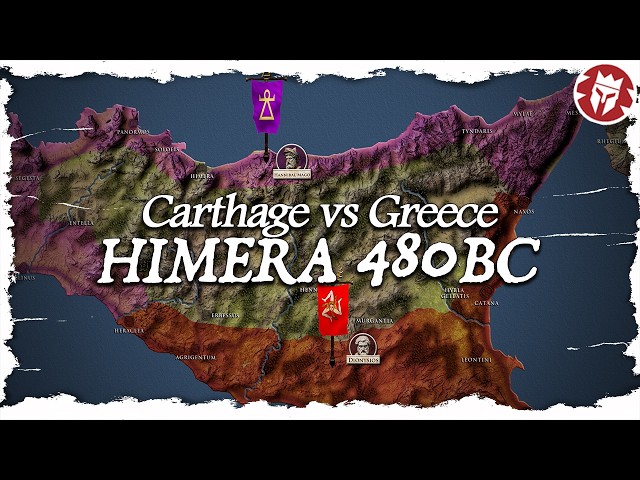
Carthage vs Greece: The War Before Rome - Sicilian Wars DOCUMENTARY
Kings and Generals
0:06 The merchant city of Carthage is a titan of ancient history,
0:10 best known for its immortal struggles
0:12 with and ultimate destruction by the Roman Republic.
0:16 However, the Punic Wars were not
0:19 the first recorded conflicts that Carthage fought.
0:23 Centuries before the rise of Hannibal Barca,
0:26 the North African power engaged in a series of conflicts
0:30 with the Ancient Greek world known as the Sicilian Wars.
0:34 Occurring between the 6th to 3rd Centuries BCE,
0:38 these wars sprang forth from a chaotic web
0:41 of alliances between Greek and Phoenician colonies on Sicily,
0:45 and featured the rise of formidable figures
0:48 like Hannibal Mago and Dionysios of Syracuse,
0:51 who are often overshadowed among the other
0:54 great leaders of Punic and Hellenic history.
0:57 What drove the naval titans of Magna Graecia
1:02 and Carthage to clash for centuries on Sicilian shores,
1:06 and how did their struggle change the course of history?
1:09 Welcome to our first episode of the Sicilian Wars,
1:13 discussing the background, sources, and outbreak of armed conflict between
1:19 the Carthaginians and the Greeks of Syracuse.
2:13 Before we begin our survey of the ancient Sicilian Wars,
2:16 we will briefly discuss the unevenly spread
2:19 sources we will be using to interpret them.
2:22 The two ancient authors who provide us with the bulk
2:25 of the information about the Sicilian Wars are Diodorus Siculus and Plutarch,
2:30 both of whom lived during the time of the Romans,
2:34 centuries after the wars took place.
2:37 Diodoros was from Sicily himself,
2:39 which likely gave him access to some local sources.
2:43 However, the Sicilian wars only make up a small portion of his works,
2:47 leaving us with a lack of crucial detail
2:50 in various parts of his accounts of the conflict.
2:53 Plutarch, on the other hand,
2:55 utilized history as a means to impart lessons on moral and ethical conduct,
3:00 and thus his biographical accounts of the individuals who fought
3:04 in the Sicilian wars lack the objectivity of a pure historical analysis.
3:10 [1] Unfortunately, both of these authors are Greco-Roman,
3:14 meaning no surviving sources written
3:16 by the Carthaginians have survived into our time,
3:19 leaving us with a one-sided interpretation of their struggle with the Greeks.
3:24 Each of the Sicilian Wars was a product of unique geopolitical circumstances,
3:30 but they occurred within a common historical,
3:33 geographical, and ethnological context.
3:35 Sicily, the main theatre of the conflict, was coveted by all the belligerents
3:42 for its rich mineral and agricultural resources.
3:45 Moreover, its location as an island in the center
3:49 of the Mediterranean made it an ideal hub for trade.
3:54 Indeed, Sicilian cities had maintained trade links with places such as Sardinia,
3:59 Iberia and Cyprus as early as the Bronze Age.
4:03 Between the 10th and 8th Centuries BCE,
4:06 Sicily was simultaneously colonized by both Greeks and Phoenicians,
4:10 who lived alongside the indigenous Elymians, Siculians, and Sicanoi populations.
4:17 The geographical fragmentation of the island meant that no
4:20 one colony ever gained the power to conquer the others.
4:25 Nonetheless, the Greek city of Syracuse,
4:27 located in the southeastern part of Sicily,
4:31 eventually became prosperous enough to emerge as a regional hegemon.
4:36 Meanwhile, far to the south in modern day Tunisia,
4:40 a small Phoenician colony called Carthage was slowly evolving into an oligarchic
4:46 republic with great mercantile and military
4:49 power.[2] Initially a colony of Tyre,
4:52 Carthage gradually separated from its mother colony in the 6th Century BCE.
4:57 It established its own colonial empire throughout Sardinia,
5:01 the Maghreb, Iberia, and, of course, Sicily.
5:04 Other Phoenician and Hellenic cities were soon drawn
5:07 into the influence of either Carthage or Sicily,
5:11 forming alliances with one to protect themselves from what
5:14 they feared as the colonial ambitions of the other.
5:18 These overlapping alliances on the canvas of Sicily
5:22 would drive the story of the Sicilian Wars.
5:24 Prelude to the First Sicilian War:
5:26 The earliest account of Graeco-Phoenician conflict in Sicily occured
5:30 in what would later be the city of Lilybaeum
5:33 in 580 BCE after some Greek colonists attempted to settle
5:38 in the traditionally Phoenician west coast of the island.
5:41 By the end of the 6th Century BCE,
5:45 the geopolitics of Sicily had shifted as cities
5:48 like Gela and Syracuse came under the rule
5:51 of tyrants who took advantage of divides between old
5:54 and new citizens or between aristocrats and the people.
5:58 These tyrants were as despotic as they were ambitious,
6:02 and ultimately clashed with one another.
6:05 The tyrant of Gela, Hippokrates,
6:07 was the first to try to create an Empire in Sicily.
6:12 After capturing the Catanian plains,
6:14 he attempted to besiege Syracuse before withdrawing
6:17 after threats of a Corinthian naval invasion.
6:20 After he died in 491 BCE in a battle against the Sikels,
6:26 Hippokrates was replaced by Gelon,
6:28 a man who had the backing of the Gelan military.
6:33 In 485 BCE, Gelon also managed to seize control
6:37 of the city of Syracuse with the help of the Gamoroi,
6:40 a group of powerful landowners whom the local tyrant had disenfranchised.
6:45 Gelon assisted the Gamoroi in retaking power[3] and used
6:49 his military might as a security guarantee for the new order.
6:54 Gelon’s expansionist gains allowed him to amass a larger
6:58 army with which he consolidated control over southern Sicily.
7:02 He also formed a marriage alliance with Theron,
7:05 the tyrant of the city of Akragas.
7:08 Together, the two began to expand and consolidate their rule over Sicily.
7:13 These two Dorian Greek cities were
7:15 opposed by Ionian Greek and Phoenician cities,
7:18 such as the urban centers of Rhegion and Himera,
7:22 who formed a marriage alliance pact
7:25 of mutual defence against Syracuse and Akragas.
7:29 Carthage, for its part,
7:30 had responded to the rise of Gelon by allying with various Phoenician,
7:35 Greek and indigenous Sicilian cities in order
7:38 to protect their commercial interests on the island.
7:41 One of these allies was the local tyrant Terrilos,
7:45 who had a close personal relationship with the Carthaginian ruler Hamilcar Mago.
7:50 In 483 BCE, the Tyrant Theron invaded and ousted Terrilos from Himera.
7:57 Duly thrust from his city, Terrilos fled to Carthage and invoked his alliance
8:03 with Hamilcar as a means to regain his throne.
8:07 Hamilcar acquiesced, hoping to secure control over Sicily and knock out
8:12 the rising hegemon of Syracuse as a geopolitical obstacle.
8:16 According to Greek propaganda,
8:18 the primary reason Carthage went to war with Syracuse
8:21 was that Carthage and Persia were allegedly in an alliance,
8:25 with the intention of dividing the Greek
8:28 cities between their respective spheres of influence.
8:31 However, this is unlikely, and more immediate geopolitical factors
8:35 are a more compelling and straightforward
8:38 reason for Carthage’s decision to go to war against Syracuse.
8:42 Regardless of the reason, Hamilcar raised a large and impressive army of around
8:47 50,000 soldiers and initiated a naval expedition to Sicily.
8:52 The skirmishing and politicking of the 6th Century were
8:56 now going to explode in the First Sicilian War.
9:00 The Battle of Himera:[4] Three years later and after much preparation,
9:04 Hamilcar’s 50,000 troops landed in Sicily,
9:06 where some of the local Greek cities joined forces with them.
9:11 This pattern of Greeks allying
9:13 with Carthaginians to fight alongside other Greeks
9:16 and vice versa is a recurring theme that would persist throughout the wars.
9:21 The Sicilian wars were not ethnic conflicts per se,
9:24 and many Greek factions often sided
9:27 with Carthage due to their geopolitical interests.
9:30 After initially trying to land at Akragas,
9:34 Hamilcar moved to Panormos so as to prioritize
9:38 the restoration of Tertillos to the throne of Himera.
9:41 Along the way, a storm ruined his heavy chariot transport vessels,
9:45 leaving him with mostly an infantry force of Libyans,
9:49 Phoenicians, Iberians, and many other mercenary groups.
9:53 In the meantime, Gelon began making
9:56 preparations to face the Carthaginian advance.
9:59 Hamilcar arrived at Himera three days after resting in Panormos,
10:04 and immediately began operations to besiege the city.
10:08 He set up a camp by the sea to the northwest of the city
10:13 as well as a camp for his troops on a hill to its west.
10:17 Himera had requested and received help from Theron,
10:21 whose army was camped behind the polis.
10:25 The Carthaginian elite units left the hill camp and marched towards the city.
10:30 In response, the Himeran troops moved out of the walls to meet them.
10:34 We lack details of this siege, but from what we can attest,
10:38 it involved a pitched battle in which Hamilcar’s troops
10:41 managed to defeat the defenders outside the city walls.
10:45 Having won a skirmish but not succeeded in taking the city,
10:49 Hamilcar tried to provision his massive army
10:52 by sending foragers around the region to collect food.
10:55 Realizing Hamilcar’s army was too large for him
10:58 to dismantle with his own forces alone,
11:01 Theron sent a message to ask for help from Gelon.
11:06 The Gelo-Syracusan tyrant assembled his force,
11:09 which the primary sources claim comprised 50,000 infantry and 5,000 cavalry,
11:14 and initiated his march towards Himera.
11:17 After an indeterminate amount of time,
11:19 the Syracusans arrived outside Himera and captured the Carthaginian foragers.
11:25 Thereafter, the Syracusans began a standoff with the Carthaginian
11:29 troops from the hill camp outside the city walls.
11:32 The Carthaginians were situated on a foothill,
11:35 which gave them an advantage in terms of terrain.
11:40 We are given two accounts of the battle.
11:42 According to the one by Herodotos, the battle began at dawn,
11:46 and the two sides began to clash on the sloped plains outside of Himera.
11:51 Although we are given precious few details about this melee,
11:54 what likely happened is that the two sides fought each other to exhaustion,
11:59 with the tides of battle changing with each passing hour.
12:02 By the evening, the Greeks were on the offensive
12:06 and managed to breach into the Carthaginian camp.
12:09 Hamilcar jumped into the sacrificial fire
12:12 and the Carthaginians retreated from the region.
12:15 According to Diodoros's account,
12:16 the Carthaginian allied city of Selinos had sent
12:20 a letter to Hamilcar before any battle began,
12:23 stating that itwas planning to send aid in the form of cavalry.
12:28 This letter was intercepted by the Syracusans,
12:30 who sent a unit of their own cavalry to the Carthaginian sea camp.
12:34 As they expected, the Punic troops there
12:37 had been expecting some allies to arrive,
12:39 and we can imagine their surprise when they realized they
12:43 had in fact let in their Greek enemies into the camp.
12:47 The Syracusan cavalry began to rampage through the Carthaginian
12:50 stockade and set fire to their ships on the water.
12:54 Diodoros claims that it was here that Hamilcar perished,
12:58 possibly by suicide or by the hand of his enemies.
13:02 At the same time, the rest of the Greek troops marched up the hill
13:06 to the land camp and began a long battle with the Carthaginians stationed there.
13:11 Upon seeing the fire coming out of their sea camp,
13:16 the Carthaginian troops fighting by the land camp panicked,
13:19 and fell into disarray.
13:21 The Greeks pushed them inside the hill camp and began to loot the wooden fort.
13:26 For Gelon, victory seemed all but assured,
13:28 only for triumph to be put in the balance once more.
13:32 The Iberian mercenaries in the hill camp
13:35 regrouped and nearly pushed Gelon’s troops out.
13:38 However, at that moment,
13:40 Theron pushed out of the walls of Himera and rushed towards the Punic hill camp.
13:45 He entered from the back of the hill camp and surrounded the Iberians,
13:49 and alongside Gelon, initiated the final killing blow on the enemy.
13:54 The battle thus ended in the massacre of most of the Carthaginian troops.
13:59 The remnants of the Carthaginian army fled
14:02 into the hills or to sea aboard their surviving ships.
14:06 Among them, only one soldier among the original host of 50,000 made it back
14:11 to the city of Carthage to tell his people of the disaster they had faced.
14:17 So it was that the Carthaginian invasion force ended in disaster.
14:23 The Aftermath of the First Sicilian War:
14:25 The Carthaginian state was understandably extremely concerned
14:27 by the military disaster they had suffered in Sicily.
14:31 Fearing that the Greeks of Syracuse and their allies
14:34 would retaliate by launching an invasion of their city,
14:38 Carthaginian leaders began negotiations by sending emissaries to Gelon.
14:42 Gelon seemed content with his control of Himera
14:45 and did not try to attack Western Sicily.
14:48 According to traditional accounts, it was Gelon’s wife, Demarete,
14:52 who asked him to treat the Carthaginians with magnanimity.
14:57 [5] Gelon appears to have acquiesced,
14:59 as the eventual peace deal enforced no unusual punishment
15:03 nor any major loss of territory by the Carthaginians.
15:07 Gelon’s restraint remains an enigma,
15:10 but he likely understood that Syracuse could
15:13 not overstretch itself and that they would
15:15 face fierce resistance if they attacked Carthaginian
15:18 allies on the western side of the island.
15:21 Instead, the Carthaginians paid 2,000 talents as war damages to Gelon.
15:26 More importantly, a sphere of influence was
15:30 demarcated much like in Cold War Europe,
15:33 with an ‘Eastern Bloc’ controlled by Syracuse,
15:36 and a ‘Western Bloc’ under Carthaginian influence.
15:40 The Carthaginians thanked Demarete for advocating leniency
15:44 on their behalf by presenting her with a golden
15:47 crown and constructing two major temples in which
15:50 the peace treaty was to be housed in Carthage.
15:54 Gelon, for his part, celebrated his victory by building a temple
15:58 to the Greek Goddess of Victory, Nike, in Syracuse.
16:02 He also sent gifts and promoted his accomplishments in sanctuaries in Greece,
16:07 portraying himself as a pan-Hellenic champion
16:09 against the supposed barbarity of the Phoenicians.
16:13 However, his efforts to improve his image were
16:17 not successful in the democratic cities of mainland Greece,
16:21 which despised tyrants.
16:24 With their ambitions in Sicily now limited,
16:27 Carthage regrouped and began to expand its empire in North Africa.
16:32 The elite family running Carthage at the time,
16:35 the Magonids, continued to dominate the political scene,
16:38 as Hamilcar’s son Hanno warred on the harsh
16:41 terrains of North Africa against the local Amazigh tribes.
16:45 We know nothing about these wars, but we do know that the Carthaginians left
16:50 Sicily mostly alone for the next seventy years.
16:54 In Sicily itself, the divide in spheres of influence persisted,
16:59 with Syracuse attempting to solidify itssphere of influence by installing
17:03 allied tyrants in many poleis on their side of the island.
17:07 By the 460s BCE, regional blocs of pro- and anti-Syracusan poleis had emerged.
17:15 The instability that Syracuse was facing within its
17:19 territorial sphere was not seized upon by Carthage,
17:23 as there was no firm geopolitical alliance that they
17:26 could exploit or use as a pretext for another invasion.
17:29 Between 415 and 413 BCE,
17:32 the city of Athens invaded and tried to besiege Syracuse,
17:37 only to suffer one of the worst
17:40 military disasters ever recorded in ancient history.
17:43 By that time, the Punic invasion of Sicily had become a distant memory,
17:48 albeit one which had lingered as a looming threat.
17:52 However, war from North Africa would return to Sicily’s
17:55 shores at the end of the 5th Century BCE,
17:59 and a completely different geopolitical environment would emerge.
18:03 Conclusion: The First Sicilian War marked a spectacular
18:07 opening to an incredible drama that would span centuries.
18:10 The people of Zeus and the people of Baal,
18:14 both equally skilled traders and sailors,
18:16 were people whose societies were firmly entrenched in geopolitical adventurism.
18:21 As the alliances wax and wane upon the island of Sicily.
18:26 As Phoenicians, Greeks, and indigenous Sicilians hedged their bets,
18:30 they would inevitably clash once more in great battles of titanic proportions.
18:35 By the end of the 5th Century BCE, the Mediterranean had profoundly changed,
18:41 and new actors would emerge onto the scene,
18:45 setting the stage for the Second Sicilian War.
18:48 We will cover that and all later conflicts between
18:51 Carthage and the Greeks of Sicily as this series continues.
18:55 To ensure you don’t miss that, make sure you are
18:58 subscribed and have pressed the bell button to see it.
19:01 Please consider liking, subscribing, commenting,
19:02 and sharing- it helps immensely.
19:05 Our patrons and YouTube members can watch more than
19:08 200+ exclusive videos- join their ranks via the link
19:11 in the description or by pressing the join
19:14 button under the video to watch these weekly videos,
19:17 learn about our schedule, get early access to our videos,
19:21 access our private Discord, and much more.
19:23 This is the Kings and Generals channel, and we will catch you on the next one.