This Homesteading Family of 7 Grows Food on SOLID ROCK!
Anne of All Trades
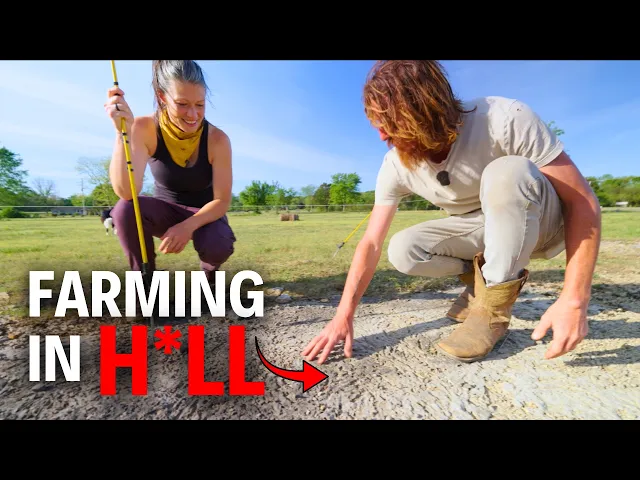
0:00 Stick this into the ground.
0:01 Step on it.
0:02 [music]
0:02 Really try to get it in.
0:04 Oh my god.
0:04 Oh no, I'm so sorry.
0:05 I just bent your pole.
0:07 You really see how bad it is.
0:08 Oh.
0:09 So, I guess what we really have to talk about [music] then
0:11 is if you need the best soil to grow the best food,
0:15 how are we making good soil [music] when
0:17 this is where we're starting on top of bedrock?
0:21 We're here in Middle Tennessee with Jasmine and Ryan from
0:26 [music]
0:25 Little Farmland and they're growing food
0:27 for their family of seven on solid bedrock.
0:31 Join us for a tour of their farm
0:33 where they [music] have turned literally nothing
0:35 into something truly incredible in the most
0:39 hellish conditions I've ever seen anyone successfully farm.
0:44 Okay, Jasmine, [music] give me the tour of the things
0:46 that you are like, yeah, this is like
0:49 potatoes.
0:49 Let's [music] go.
0:52 All right, so right here,
0:53 this row goes to about the end of where that bed is there.
0:58 Yeah.
0:58 We grew over 200 lb of [music] sweet potatoes.
1:00 We still have sweet potatoes that we're eating from last year's harvest.
1:05 [music]
1:04 That was grown from slips.
1:05 And so, if you want you want to come down?
1:07 Yes, I do.
1:08 So, if you look, [music] this this is what's after having wood chips.
1:14 And do you see that?
1:15 This is dirt.
1:16 I mean, now it's soil.
1:18 Yes.
1:18 [music] And so, not only did it create soil for us,
1:21 which we scooped from here and put into our beds,
1:25 Amazing.
1:25 but it it served [music] us to grow 200 lb of sweet potatoes,
1:27 well, more than, and it was in
1:30 straight chips.
1:30 I hear people complain about sweet potatoes, being like how they're finicky.
1:34 Yeah, being like hard and I'm like this is the easiest thing for us to grow.
1:37 [music] And right now it doesn't look like much, the grass has taken over,
1:40 but there was no grass here when we had the sweet potatoes.
1:43 It managed [music] all the weeds for us.
1:45 Even this row next to us, the walking path, didn't have as [music] much grass.
1:50 It still did up to the bed, but it it was just wonderful.
1:53 You literally just put down wood chips and [music]
1:55 put sweet potatoes directly in it and no compost,
1:58 no soil, directly on Fraggle Rock [music] and you got food out of that.
2:04 Essentially.
2:04 This row here is going to be jam-packed with tomatoes.
2:08 Also, I'm just going to run to the other side because you stay there.
2:11 Adam, this is how many tomatoes it takes to feed a family of seven.
2:16 Well, I mean, there's not tomatoes here yet, but you can imagine that there will
2:19 be tomatoes growing here and that's incredible.
2:21 Okay.
2:22 What do we have here?
2:24 This is all going to be our squashes.
2:26 [music]
2:28 Squashes?
2:28 Yep, but all companion planted.
2:29 I don't like everything that's just single.
2:32 So, it's going to have the dill and it's going
2:34 to have [music] all the other things that work together.
2:37 Radishes and stuff like that, but we don't eat radishes.
2:39 [music] Ha, we just use them.
2:42 It's like kale.
2:43 We use it as a trap plant so the bugs will
2:45 eat that [music] plant instead of eating the food we actually like.
2:49 I love this woman.
2:55 I am excited about the grapes.
2:56 the grapes.
2:58 The kind of like the theme of how we do things as you've seen,
3:01 we we make regenerative systems [music]
3:03 throughout our entire garden and homestead.
3:07 Yep.
3:06 And we also go for things that are resilient in and of themselves.
3:10 So, I don't baby our plants.
3:13 Yeah.
3:12 I learn how to prune them properly and set them up when they start
3:15 so that they can take off and do their thing and take care of themselves
3:20 Yeah.
3:19 from then on out.
3:20 And so, this these grapes are literally
3:22 planted on what we scraped from right here.
3:25 This leading pathway.
3:27 We scraped it with the tractor,
3:28 dumped it in this corner, put some logs up against it
3:33 to stop that from eroding.
3:34 Exactly.
3:35 So, this year we're really focusing on beautifying the function.
3:40 Yeah.
3:39 Cuz at first, like I told you with the blackberries, it was just survival.
3:43 Like, get us get some plants to survive.
3:46 And then as years went on, we went
3:47 on to companion planting and figuring out what weeds were useful,
3:51 what weeds weren't useful, and then the ones that weren't,
3:54 how can we make them useful?
3:55 Hence the grass.
3:57 And then now we're thinking, how can we make things more beautiful?
4:01 Love that.
4:02 But because you feeding your family first was what was most important.
4:07 You just were like, what will grow
4:09 with the least amount of input be effort, soil, etc.
4:14 I love that.
4:22 [music]
4:21 I am making soil from the wood chips.
4:24 Bringing in soil way too expensive, [music] especially at such a large scale.
4:29 So, I need to make my own.
4:31 Yeah.
4:31 So, this is how you're making basically free soil.
4:35 This plus [music] some other things we're going to talk about.
4:37 This is This is This is the bulk of our operation.
4:40 Without [music] this, we wouldn't be able to change anything around here.
4:42 They've sat here for about 6 months to break down.
4:45 We're in a kind of a drought right now in Tennessee.
4:47 Major drought?
4:48 It hasn't rained in a long time,
4:49 but you can still see them when we dig inside of [music] them.
4:51 You don't even have to go very far.
4:53 No.
4:53 And there's moisture there.
4:54 There's probably [music] like seven semi trucks worth
4:57 of wood chips within my current eyesight alone.
5:00 [music] So, your whole goal in moving to Tennessee was so that you
5:13 could grow nutrient-dense food for your family
5:16 because that's your number one priority, right?
5:18 Number one.
5:20 And you moved here and you had literal bedrock and nothing on it.
5:23 So, you would have had to bring in like
5:28 [music]
5:27 you said what?
5:29 50 dump truck loads of soil if
5:32 Just in this garden space.
5:33 But you couldn't afford to, so you've made it.
5:35 And as we're walking through this garden that was
5:39 previously rock and is now feeding seven people every day.
5:43 What are you doing?
5:43 Like like you work full-time, so what's the efficiency involved?
5:48 Tell me everything.
5:49 [music]
5:49 So, this is a big big row.
5:51 You'll see I'm kind of wasting a lot of space for a lot of gardens, but I
5:56 say.
5:55 But, I do this intentionally because for one,
5:58 the weeds would start to take over.
6:00 Two, I have to actually I have to grow my own soil before I grow my food.
6:05 And so, I use the aisles to break down the wood
6:08 chips because a lot of moisture stays in them and then
6:11 I can scrape that up off of the bedrock and then
6:15 put them in a big piles and let them compost down more.
6:18 So, with every year, I get more soil to grow my garden to grow
6:21 more food and it's all free in that case.
6:23 From your wasted space in the aisles here.
6:25 And this also allows you to use machines, right?
6:27 Do you have a tractor or
6:29 Yeah, I use a tractor in every row that I have except for between this.
6:33 But, every row that I have is big enough for the tractor bucket.
6:36 So, I just put it down and scrape through.
6:38 And this is where Ryan has one benefit I'd actually like except for, you know,
6:42 all this non-benefits that come with it.
6:44 But, he's on bedrock.
6:45 So, when he wants to scrape his row,
6:47 all he has to do is put the tractor bucket down and all
6:50 of the weeds and all of the soil and everything else just comes with it.
6:54 And so, if we were to actually walk over to your compost pile here,
6:57 you're going to see, I think, one of the main things that people
7:01 tell me using wood chips doesn't work cuz these exist.
7:05 So, what are you doing with this?
7:09 Crabgrass is hated by all of us here, especially in Tennessee.
7:11 And uh this this just becomes part of the breakdown process,
7:15 giving me more soil.
7:16 So, you've never had these popping up because you used in your compost.
7:20 No, never in my compost.
7:22 Because you know how composting works.
7:23 Anything that was once alive plus enough of something that was
7:27 less recently alive plus moisture and time and heat turns into soil.
7:32 And so, you're literally using the one thing that grows
7:34 on Fraggle Rock here to make more soil every year.
7:38 Yeah, that's what I'm using.
7:39 So, I do get some soil brought in by make by being
7:43 a good neighbor and good friend and sometimes they'll bring me soil.
7:45 So in here I actually put a bunch of clay down
7:49 in the bottom underneath some of these because these wood chips,
7:53 I know a lot of people are afraid of clay,
7:54 but the wood chips help break down the clay really quickly.
7:58 The clay keeps a lot of moisture which
7:59 helps these beds from drying out too quickly.
8:02 Because some of them I do raise up just because I need
8:05 the space and I want beauty not just piles on the ground.
8:09 You raised them up.
8:10 This is a really important tip that I think
8:13 I don't want to just let you gloss over here.
8:15 As good as wood chips are at holding on to moisture when it's,
8:19 you know, a giant pile of wood chips,
8:21 what's going to happen if you make a giant pile
8:24 of wood chips like in a raised bed or something else,
8:26 you need something to slow the water down a little bit.
8:29 And like putting clay underneath your wood chips
8:32 to help the wood chips break up the clay,
8:35 but also to help slow the water flow, that's brilliant.
8:38 It's like one of those nuanced things that that people are not thinking about.
8:42 There's a lot it's this but there's also a lot of structure.
8:44 So if I take over here,
8:45 one problem I had in the past is sometimes the wood chips break down too fast.
8:49 So then I end up having to replenish too quickly because they shrink too much.
8:53 So for these beds I actually wanted to put
8:56 a good amount of thick terrible clay because
9:01 I need to put T-posts in here and it's not easy to do with just wood chips.
9:04 Yeah, cuz the T-posts will just fall over.
9:06 Yeah.
9:07 And so especially when the winds pick up.
9:11 Mhm.
9:10 So I put clay in here on purpose to keep the moisture.
9:13 So cuz on bedrock it just leaves.
9:17 Yeah.
9:17 And then wood chips on top of it and we could turn
9:19 this I'm not actually afraid of clay because I get so many wood chips.
9:23 Yeah.
9:23 What do we have going on here?
9:25 Who's this?
9:25 Uh this is Mercy.
9:27 Mercy and what does Mercy do?
9:28 Livestock guardian.
9:30 They actually keep coyotes away and deer.
9:32 I hear people having deer problems all the time.
9:34 Once I get got guardian of dogs I've just
9:36 I've never had a deer on my property, period.
9:39 [music] They're too afraid to come in.
9:41 Well, finally people are always like,
9:42 "How do you have your garden unfenced [music] and not have,
9:45 you know, things constantly eat your garden up?" Well, there's your answer.
9:52 Okay, Ryan.
9:54 I can see already you're a man after my own heart.
9:56 Look at this beautiful hutch you have made.
10:01 Tell me about the rabbits.
10:02 Honestly, they're a big part of the operation
10:03 because we have to turn we're making soil.
10:06 Yeah.
10:05 Soil doesn't just come from wood chips.
10:07 We have to add nitrogen back into the wood chips.
10:09 We have to do a lot of different stuff.
10:10 So, the poop from the rabbits falls underneath and we get to turn this back
10:15 into our compost piles making really rich soil when we put it into the garden.
10:20 I [music] will tell you right now that this is the one turd
10:25 [music]
10:25 to rule them all for gardeners.
10:26 If you were were to take this straight
10:28 from here and put it directly on your garden,
10:30 you've got a fertility source that's not going to hurt your plants.
10:33 It's gold.
10:34 [music]
10:34 But it It's even better when you mix it into wood chips, yeah.
10:42 So, we've looked at a bunch of brown things so far.
10:44 [music] Let's look at some things that are actually like
10:46 like Walk and talk and tell me what this is.
10:48 This is our medicinal herb garden.
10:52 Yep.
10:51 And uh this is where it's my wife's favorite spot.
10:54 And as cool as this looks out here,
10:56 this actually looks much cooler in their kitchen because
10:59 they have an incredible herb and tea and spice
11:03 rack that's [music] all stuff that have come out
11:04 of here and it's dried and you're I drank tea,
11:08 kombucha, [laughter] like all this stuff that came out of just right here.
11:11 right here.
11:12 And most of this, not all of it, but most of it is meant to grab and eat
11:15 or [music] grab and use like catnip being used
11:20 cats.
11:19 Not for your cats, but you can use it and it actually works.
11:22 [music] The same compound that uh cats
11:25 are attracted to is the compound that keeps
11:29 [music]
11:28 that keeps mosquitoes away.
11:29 Technically, it works better than DEET.
11:33 What?
11:33 And it goes straight on your
11:34 [music]
11:34 straight on your body.
11:36 Adam.
11:36 My favorite from this garden is marshmallow.
11:38 That's not a marshmallow, you silly goose.
11:41 It's the root.
11:42 The root from this plant is what they actually
11:44 used to use for the marshmallow that we eat today.
11:47 It's not used anymore, but that's what it was for.
11:49 It's technically called the soothe-all.
11:51 They would use it for everything.
11:53 It's a medicine.
11:55 This is apple mint.
11:58 Yeah.
11:57 I put it right here so that it didn't spread.
12:00 I still find apple mint almost all the way over toward the rows.
12:04 It It really is aggressive.
12:06 Oh, yeah.
12:06 Mint is one of those things that if you plant it outside of, you know,
12:13 Alcatraz, it'll grow.
12:16 I think he seems to have made a friend.
12:18 Yeah.
12:18 Adam's No, it's very, very cute.
12:21 Oh my gosh, you're giving me puppy fever.
12:25 I want you to come herd my cows with me.
12:28 Look at this thing.
12:30 Popping back to our farm for some quick,
12:32 practical application tips because with soil making
12:35 being the main topic of this video,
12:37 we probably need a little more context about what
12:39 it actually takes to make soil when we have none.
12:42 Which, at its most simple form, is organic material.
12:47 That doesn't mean something you have to buy from a store.
12:49 That's things that were once alive that used to have water in them.
12:52 So, wood chips, straw, hay,
12:55 a lot of the things we're going to see a ton of over at Ryan's house.
12:58 Plus water plus time.
13:01 And though our ultimate goal is to get
13:03 to a garden that doesn't need any watering, that doesn't need any weeding,
13:08 all of the claims that we talk about all the time with lazy gardening,
13:11 the way that we get there does, in fact, involve some water.
13:16 And I think that's the main way that most
13:18 people first establishing their lazy gardening systems go wrong
13:22 is that they think that all they have to do
13:24 is put some wood chips or some hay down,
13:26 and that's good, but then their cardboard never dissolves.
13:30 Their wood chips aren't actually doing their job,
13:32 and their soil ultimately becomes [music] hydrophobic, afraid of water.
13:37 And that is the exact opposite of what we need.
13:39 Because I so infrequently need water for my garden,
13:42 but I definitely do need it on demand,
13:45 this is why I absolutely love Hoselink, the sponsor of today's video.
13:49 [music] Cabbage worms, aphids, whiteflies,
13:53 do not stand up very well to a nice steady stream of water.
13:58 [music] So, you might want to use a hose as pest control.
14:02 Or if your compost pile mid-cook needs
14:05 a little bit more moisture to become active again,
14:08 if you need a little extra water support for the very pathetic-looking
14:12 seedlings you started before you left for a trip and forgot about,
14:15 this is a fantastic hose reel system that is 90 ft long.
14:20 It is full flow, which means you're
14:21 not going to have restricted water [music] flow.
14:24 Also, I don't know if you've ever been snapped by a quick
14:27 reel that didn't work as smoothly as this, but it's not fun.
14:31 This thing is gentle as a spring breeze.
14:34 [music] But equally as cool, when I'm done with my garden chores,
14:38 I can just pivot this little thing right on over
14:41 and pull the hose over to do some farm chores, too,
14:46 [music]
14:45 like filling that little jerk Lucy's bowl.
14:48 And then it all packs away very neatly,
14:51 and I don't have to think about hoses or water
14:53 again until the next time that I need it.
14:55 We also love this company because of how
14:57 they align perfectly with how we invest in tools.
15:00 They have a 5-year warranty,
15:02 and each part and piece on this thing is individually replaceable,
15:06 so you don't have to replace the whole unit if one piece breaks.
15:09 The Evolve Reel is built with heavy-duty UV and frost protection,
15:13 and they're all manufactured down under, mate.
15:17 Quick aside, I was going to do this entire
15:19 ad spot [music] in my favorite Australian accent,
15:22 but Adam says that it is the worst Australian accent he's ever heard.
15:26 So, if you'd like to make your homestead
15:27 chores a whole lot easier, dare I say lazier,
15:32 check out the link in the description and use
15:34 the code 2026 [music] Ann for a discount.
15:37 Now, back to Ryan and Jasmine's Little Farmland.
15:43 The blackberries hold [music] a special place even
15:45 though they're probably one of the most plain things
15:48 we have in our garden compared to like horehound
15:51 and motherwort and yarrow and all this other stuff,
15:53 but the blackberries have the the significance
15:57 to us personally because when we first moved here,
15:59 like what's on the other side of the fence, we planted them in that.
16:02 Can you imagine the naivety it took to have planted that?
16:07 And they all died uh reasonably.
16:10 And so, the fact that we've come this far and now
16:12 can grow them is really exciting um for us because like
16:18 we were talking about growing things that are native and that thrive
16:21 in in this Tennessee environment is really a big goal.
16:26 Yeah.
16:26 And one thing if I can take you over here
16:28 You can take me anywhere.
16:29 I I All I want is your excitement.
16:32 Well, this is my my favorite place in the world is my garden with my family.
16:36 So, if you have another like 3 years, we'll be done talking about my plants.
16:43 Perfect.
16:42 If you see around my bigger plants, you don't see a lot of grass.
16:45 And I actually hadn't haven't weeded the grass out of that area.
16:49 It's only in the bare spots where the grass starts to grow up and come in.
16:52 So, the goal here is essentially to get all of my plants
16:56 thriving so well that the grass won't be an enemy.
17:00 It will just be something that my plants are overcoming anyway.
17:04 Oh, 100%.
17:05 want to weed and [laughter] I don't want to have
17:07 to deal with them in my beds or in rows or anything.
17:09 And so, growing plants that are thriving enough
17:13 that they take care of it for me, that's that's where I want to be.
17:16 So,
17:17 That's on our way.
17:18 Yeah, most people would come down and would
17:20 like want to get these from every root
17:23 and every root structure because this is like
17:25 we've been taught that this is the enemy.
17:27 But, one of the big things,
17:28 not only is this like a big part of your composting system,
17:31 it's also what's holding the soil or like at least
17:36 even the wood chips in place and not washing downhill.
17:40 Yes.
17:40 Um so, you need the root structure.
17:42 You need even your worst enemies and then you just
17:45 find a way to work with them instead of against them.
17:46 And that is what makes gardening in hell,
17:50 excuse my language, I think a lot more possible.
17:53 [laughter]
17:54 I mean, it's becoming heaven.
17:55 It's becoming heaven.
17:57 Like I'm sorry, I actually That [laughter] was
17:59 not in any way a dig on your property.
18:00 I'm just like I just think that like from what I've heard
18:03 from you both is it it has not been an easy journey.
18:06 And one thing that I admire most about you guys is how resilient
18:12 and persistent and how you can still find hope amidst so much adversity.
18:17 Because boy, howdy is that inspiring?
18:19 I mean, you guys didn't have any idea what how
18:23 much hardship you were in for when you moved here, right?
18:26 No, but we're grateful for it, to be honest.
18:29 Like even just experiencing the freedom and the joy of being here and then
18:33 being able to build something and grow something is just thrilling, you know?
18:38 It's hard, but it's thrilling.
18:40 Okay, Ryan, one of my favorite things about you is your frugality.
18:43 So, where did you
18:45 get this?
18:45 This is Harbor Freight.
18:47 Yes, and like I mean,
18:49 comes comes See how big and cool this thing is from Harbor Freight.
18:55 And this thing was only, cuz honestly,
18:57 you get a much tinier one for the same price.
18:59 This was only 800 bucks.
19:01 And you've now had it in service for 5 years?
19:04 5 years.
19:05 Incredible.
19:06 Tell me what's happening on these shelves here.
19:08 So, shelves I made from scrap lumber and then hardware cloth.
19:11 And then everything on here soil blocking.
19:13 I do soil blocking for a few different reasons.
19:15 For one cost, it's way easier I mean it's way cheaper to grow
19:19 in the soil blocks because you only germinate in just these tiny little blocks.
19:24 And those tiny little blocks, if they don't germinate, it's okay.
19:27 It's you're not wasting a bunch of soil.
19:29 And then they're just way better for your plants once you bring them
19:33 outside cuz there's little almost no
19:36 almost no at all transplant transplant shock.
19:39 And I mean also it's way easier to keep them moist.
19:41 Like you can see what's going on.
19:43 And they turn out better.
19:45 Yeah.
19:45 And so I don't just buy this stuff from here.
19:46 Some of this will actually come from my compost pile.
19:49 Amazing.
19:50 Sifted.
19:50 Yes.
19:50 What do we have in here?
19:51 Peppers, tomatoes?
19:53 Peppers, tomatoes, Mexican tarragon which I'm excited about.
19:57 Also this is this a rhubarb?
19:59 That's rhubarb, yes.
20:00 Yeah, see I told you we're doing it this year.
20:01 And then my this is actually something I'm very excited about.
20:05 This is called butterfly pea.
20:08 P E A, not P E E.
20:10 The flowers can go into water whatever drink and it turns the drink blue.
20:15 And then if you add acidity to it like lemon, it will turn it purple.
20:18 Oh, one thing I'm really excited about.
20:22 In the legume family?
20:24 Moringa?
20:26 No.
20:26 Hey Jazz.
20:28 What's this fun plant that you planted
20:30 in the pots and you're really excited about?
20:33 Moringa.
20:33 Oh, this citrus is really cool.
20:36 Hey Jazz, what's the orange?
20:38 While he's looking for Jasmine, I would love to just pop in and say
20:42 that this is one of my favorite things about you guys
20:44 is that you share so much of the things like
20:47 so much of the things that you do on the farm.
20:49 Like she's really into the herbs and the garden and is
20:52 doing just as much thinking ideating all that stuff as you do.
20:56 So like how do you make it work?
20:59 We delineate tasks a lot.
21:02 Yeah.
21:01 We also help each other.
21:03 Cuz we make we we make almost everything from scratch.
21:05 We're a literally from scratch household and well, we even grind our own wheat.
21:12 The only way to do it is to delineate tasks and share in the responsibility.
21:16 And did we mention that you have five children and full-time jobs?
21:22 [laughter]
21:21 So, there's kind of a lot going on around here.
21:24 Uh so, what is What were we just looking at?
21:27 Calamondin.
21:28 That's like a tiny little citrus and you can eat the entire thing, peel and all.
21:33 And the the peel is a little bit sweet
21:36 to offset how incredibly tart and juicy the inside is.
21:41 And you just got that from a neighbor you traded bread bread with?
21:44 Yes.
21:44 A lot of my my connections have made
21:46 been made just by either being neighbors or plants.
21:50 The love of plants.
21:51 I love plants and I love children and I love food.
21:54 [music]
21:55 So.
21:55 And boy, how do you am I glad
21:56 that we're friends with Ryan and Jasmine because aw, shucks.
22:02 Anyway, well, we're not crying in this video.
22:04 I already said so.
22:05 Let's uh talk some more about plants.
22:11 And this whole bed is asparagus.
22:12 [music]
22:13 Do I remember it that you literally just have asparagus growing in wood chips?
22:18 Yes.
22:18 [music] And that these are only 1-year-old crowns.
22:20 That's right.
22:21 Yeah, and we actually don't care about the beetles
22:24 or we don't [music] burn or do anything crazy with it.
22:26 We just let it grow.
22:29 For the Farmer Adams among us, this was previously [music] an asparagus stalk
22:33 that then grew up and turned into a fern.
22:36 If you've never [music] seen it outside the grocery store,
22:38 far more importantly, there's a cow back there.
22:42 Hi, buddy.
22:43 How many cows do you have?
22:45 We have five.
22:50 This is it.
22:51 So, this isn't like someone's home foundation
22:54 that you're trying to graze your cows upon?
22:56 Look, you can actually see
22:58 [laughter]
22:57 this is from the years and years of breakdown
23:00 from all those microbes and stuff that eat through the rock.
23:04 Yeah.
23:04 So
23:04 This is bedrock.
23:05 This is bedrock.
23:06 So what when we go to take this stick and try to stick it in the ground,
23:08 it might go a little bit, but then I'm probably just hitting a slab this big.
23:12 Not everything is this shallow, obviously, cuz you can see grass,
23:18 [music]
23:17 but there's no telling how deep that soil goes to get to this point.
23:21 I mean, I think the best evidence is the fact
23:24 that like all of your posts look like this.
23:28 I've had to buy many different posts.
23:30 Is that on?
23:31 Because I feel like that's
23:32 not on.
23:32 I wish it was on.
23:35 [laughter]
23:34 Cuz I don't want her doing that.
23:36 That's a bad habit, ma'am.
23:38 habit.
23:38 Well, now you're just turning it into a game.
23:42 I am probably the most stubborn person I know,
23:45 and if I were farming on this, I would have given up a long time ago.
23:48 How are you feeding cows if this is your grass?
23:52 She said this is the worst part.
23:53 Yeah.
23:54 Not all of it is this bad.
23:55 It's It's shallow, so it doesn't the grass doesn't grow tall.
23:58 Yeah.
23:59 But luckily, I cut hay for my neighbor
24:03 Okay.
24:03 for trade.
24:03 I'll do it for him, and he'll give me a bunch of hay,
24:05 so I could feed later in the season and earlier.
24:08 And also, on top of that, we are bale grazing.
24:12 Yep.
24:11 So it's very very similar to what we're doing in the garden.
24:14 We're making soil from the inner organic matter, adding cow poop,
24:19 and that's going to break down and add nutrients.
24:21 Not just nutrients, but also matter back on to this area, growing the soil.
24:27 [music]
24:28 Absolutely.
24:27 Aw, those dogs are so cute.
24:29 I can't even handle it.
24:34 In our family, we love fruit way [music] more than vegetables.
24:39 Peach!
24:39 So, and we love perennials, so you'll see those.
24:41 Great.
24:41 This is going to be a hedge of blueberries [music] and rosehips,
24:45 nice, Jerusalem artichoke and elderberry.
24:48 This will be root vegetables,
24:50 and then peppers we have going on, and I have a cabbage
24:54 Look Look little cutie.
24:56 It is cute, cuz I want [music] to make one batch of sauerkraut.
25:00 That's all I need.
25:01 And then I have crown heads of figs at the end.
25:05 [music]
25:04 And then we also have goji and then my mints and my lemon balm and all
25:08 that jazz are are starting and going
25:11 to go in these [music] little head pieces here.
25:14 These two rows are actually watermelon and hops
25:17 and a lot of climbing loving plants.
25:20 You also mentioned earlier and I didn't want
25:22 to gloss over it that you plant luffa, which for those of you who are
25:28 still buying your little scrubbies from the store,
25:30 did you know you could plant a squash gourd that could then be your sponge?
25:36 Yes.
25:36 And have you heard of soapwort?
25:38 I have soapwort [music] growing and you can actually
25:41 No.
25:41 [laughter] You You can actually wash it it suds up.
25:45 It's actually a soap plant.
25:48 Wow.
25:48 Super cool.
25:48 Okay, then we have black raspberries growing all along this edge here.
25:53 Amazing.
25:53 And a ton of passion fruit comes in naturally.
25:55 We don't plant any of it,
25:56 but it comes back every year along [music] that fence line.
25:59 I have my medicinal herbs and garlic and my culinary herbs.
26:03 And this is a children's bed.
26:05 It's all grass now, but this This is a bed
26:09 for the children to grow whatever they want in it.
26:11 We'll amend it [music] for them with compost, but
26:14 I love that you get the kids involved and they
26:16 can just do whatever they want and learn alongside us,
26:20 cuz how else are we going to teach them?
26:22 Yeah.
26:23 [music]
26:22 Ryan told me how bad it was when, you know,
26:26 years ago and he's like, "You just have to see it.
26:28 You just have to see it." I [music] have now seen it and I
26:31 am so blown away by your persistence and also like you've [music] made it work.
26:38 And now you're making it beautiful and I'm like so excited for all of it.
26:41 Ah, this makes me so happy.
26:48 The question that really begs to be asked is
26:52 where are all of these wood chips coming [music] from?
26:55 Everybody has trouble troubles with chip drop.
26:58 Yeah.
26:57 So, I just called around every arborist I
27:00 could [music] and luckily this is my neighbor.
27:03 And I do a lot for him, too.
27:05 I let him dump some of his wood here
27:07 and then we'll do a lot of trade for like that.
27:09 That's also really useful for me.
27:11 Look at all the
27:12 Yeah, you can Yeah, you can stop [music] the things from washing away
27:15 in the rain by putting a giant heavy log in front [laughter] of it.
27:18 Exactly right.
27:19 Convenient.
27:19 And uh so we just came from another
27:21 neighbor just [music] befriending a bunch of people.
27:23 We talk a lot about the importance of community if you're
27:25 going to farm or or garden or do anything [music] long-term.
27:28 And actually me knowing you and the person that you are,
27:33 [music]
27:32 you are a helper.
27:33 You always look for the way that you can help
27:35 someone else first before you ever ask for anything from them.
27:38 [music] I mean, this guy has showed up to help
27:41 butcher chickens when I got in over my head.
27:44 He's helped me shear my alpacas.
27:46 That was a trauma bond we shan't soon forget.
27:49 [music]
27:48 Um yeah, you exude kindness and you embody that so much.
28:02 All right.
28:03 Are you okay with [music] us showing your real kitchen in your real life?
28:06 Like sometimes there's dishes in the sink and that's okay.
28:08 [music] If you were talking to the you
28:12 of 5 years ago before you moved to Tennessee,
28:15 before this is what your life looked like, what would you most want her to know?
28:25 Gosh, I don't know.
28:26 There's so much.
28:29 [laughter]
28:29 It's that miracles can happen.
28:31 I honestly um the the [music] thing I think
28:36 of the most about being here because we moved
28:41 from the desert is that God can make
28:44 a way when there [music] seems to be no way.
28:46 Yeah.
28:46 Because it really did seem like there was no way
28:49 for me to be doing all this [music] stuff with a family
28:53 and land and animals and none of that seemed [music]
28:57 like it was in within reach for a long stretch.
29:00 And so, the fact that God made a way for us to be able to do it was just huge.
29:07 Yeah.
29:08 All right, Ryan, come on.
29:09 Come back in.
29:11 Would you say you're living the dream?
29:15 Yes. It's way harder than I thought.
29:18 [laughter]
29:17 I think that that's the lesson here.
29:18 But I think so.
29:19 But yeah, I would I would take this over not being able to do this.
29:23 I would I would take our position right where we're at
29:27 [music]
29:26 and still be able to bring on our own food,
29:29 raise our own cows, even in this hardship because because that's what we want.
29:34 [music]
29:36 Yeah.
29:35 So, even in this terrible rock, I'll do it all over again.
29:44 [music] [music]