Why DON’T We Have THIS On Every Aircraft?
Mentour Now!
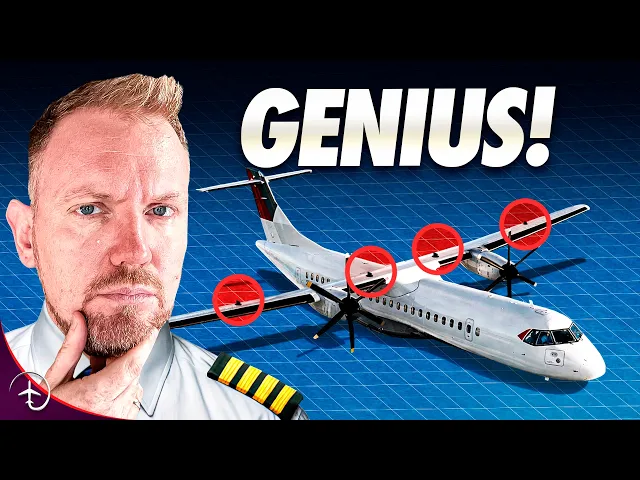
0:04 Can a small, aerofoil-shaped device like this revolutionize aviation safety?
0:11 And if so, how?
0:15 Aircraft stalls, as in where an aircraft wing or its stabilizer
0:18 exceeds its critical angle of attack and effectively stops producing lift,
0:23 is, thankfully, incredibly rare in commercial aviation.
0:27 But they do still happen,
0:29 and we saw a very tragic example of that not too long ago,
0:32 with the loss of Voepass Flight 2283.
0:37 Now, airframe icing is often found to be a factor in these types of events,
0:41 even though stalls can happen for other reasons too,
0:45 and they can be quite hard to predict, especially when icing is involved.
0:50 But what if we already have the technology
0:53 needed to avoid these types of events?
0:56 Why wouldn't we use it?
0:59 Good decision making always depends on having the right information,
1:03 since that helps dispel confusion during stressful situations,
1:07 and can therefore stop an accident sequence from becoming fatal.
1:12 So what we are going to talk about today is exactly that, a way
1:16 for us pilots to get the right information about what our aircraft is doing,
1:21 and how we need to react in response.
1:26 Now, we recently made a video about the Lockheed C-130,
1:30 and how it is possible for an aircraft that had entered
1:33 service in the 1950s to not only be still in service,
1:36 but actually still be in production over 70 years later.
1:41 And while we were researching that video,
1:44 we found an interesting anecdote about its development,
1:47 which is very relevant to today's story.
1:51 You see, in the 1990s,
1:53 Lockheed was testing out the newest version of the C-130 called the C-130J.
1:59 This J-model had new avionics and no flight engineer in the cockpit,
2:03 but most importantly, it also came with a new set of engines and propellers.
2:09 Now, when Lockheed's test pilots first flew this new version,
2:13 they discovered that it had a strange issue.
2:16 For some reason, it initially refused to stall at the speeds
2:19 where the previous models would definitely have done so.
2:23 So the test pilots therefore ended up
2:25 flying the aircraft just slower and slower,
2:28 expecting it to give them some type of light buffet in the controls,
2:31 which usually is what warns us pilots of an impending stall,
2:35 but instead they got nothing.
2:38 Now, that might sound like a good problem to have, but actually it isn't,
2:43 because when the test crew then flew even slower than
2:47 that, the aircraft eventually stalled very suddenly and without warning,
2:51 whilst also doing a snap roll,
2:54 something that is extremely dangerous in an aircraft like this.
2:59 So what was going on then?
3:01 Well, it turns out that those new propellers with their six blades
3:05 were cleaning up the airflow over the wing a little bit too well,
3:09 and that meant that the airflow on the upper
3:12 side of the wing remained attached for longer, effectively delaying the stall.
3:18 But like that snap roll that had shown them,
3:20 this also made the plane's behavior less predictable when it slowed down,
3:25 and that was something Lockheed couldn't ignore,
3:28 since handling characteristics like that could cause
3:31 the aircraft to enter into an uncontrollable spin.
3:34 Now, addressing this problem took some time,
3:37 which added significant delays to the C-130J's program, and in the end,
3:41 Lockheed decided to just fit a stick pusher to it,
3:44 to keep its crews from slowing down to unsafe speeds.
3:48 And to really understand why this is so important,
3:51 we need to talk about how wings work,
3:53 and how we pilots keep track of how well our aircraft are flying.
3:58 In simple terms, the air flowing over
4:00 an aircraft wing's curved upper surface will accelerate
4:03 to a speed that's higher than that of the air on the underside of the wing,
4:08 and that speed differential means that a low pressure would be created
4:12 on the upper side of the wing and a high pressure on the lower.
4:16 This, together, to some extent, with Newton's third law of motion,
4:19 creates the lift that we use to keep our aircraft flying.
4:24 Now, I am simplifying things a little bit here,
4:26 because in reality some people are still arguing that we
4:29 actually don't really know exactly how wings generate lift,
4:33 but that's a whole other discussion.
4:36 What I want to focus on here is actually what happens to the airflow over
4:40 the wing when it's subjected to a higher angle in relation to the oncoming air.
4:46 That angle, specifically the angle between
4:48 the wing's chord line and the oncoming airflow,
4:51 is what we refer to as the angle of attack.
4:55 And we measure this using something called angle of attack sensors, or vanes,
4:59 which on most modern airliners are basically short metal
5:03 vanes that stick out from the side of the fuselage,
5:06 a little bit like weather vanes,
5:08 but installed vertically instead of horizontally.
5:12 Now, as the wing's angle of attack
5:14 changes and the oncoming air changes direction,
5:16 these vanes then swing up or down,
5:19 and their position is continuously recorded internally
5:22 to give us the correct angle of attack.
5:25 There are generally two or more of these, usually
5:27 located near the nose of the aircraft,
5:30 not on the wings, and that's worth remembering.
5:33 So, as Ben explained in a recent video, as the angle of attack increases,
5:39 the amount of lift that the wing produces then increases,
5:42 until the smooth airflow on the upper side
5:44 of the wing becomes turbulent and eventually separates.
5:48 When that happens, the lift that the wing can produce drops really quickly,
5:52 causing the aircraft or the wing to stall.
5:56 Now, one reason why the wing might be using a high
5:59 angle of attack is because the plane is flying really slowly,
6:02 but it is not that simple.
6:05 The aircraft could also be in a steep turn,
6:08 or its crew could be pitching sharply upwards,
6:11 both of which could cause the affected
6:13 weight component pulling on the aircraft to increase.
6:17 Now, you might have heard of this as the aircraft pulling a lot of Gs,
6:21 with one G being equal to the earth's gravity,
6:24 and if the effective weight is higher,
6:26 then the wing needs to produce more lift to compensate,
6:29 which leads to a higher angle of attack.
6:33 Again, it is a little bit more complicated than
6:35 that, but I hope you understand what I mean.
6:39 Anyway, this is where we get to an issue
6:41 that is a little bit of a hot topic among pilots,
6:44 especially when the pilots are coming from different backgrounds.
6:48 In the airline world, we typically keep the aircraft safe
6:51 by referencing mainly to our airspeed and attitude.
6:56 We pilots and the aircraft manufacturers know what speeds we
7:00 should be using for each phase of flight and configuration,
7:04 and our primary flight displays include symbols on our airspeed tape
7:07 that tells us what speed is too slow for the current flap configuration,
7:11 for example, but, of course, those speeds assume that we aren't making
7:15 very sudden maneuvers or very steep turns,
7:18 which would increase the G load on the wings.
7:22 But even if we would do that, modern flight
7:25 displays will react and warn us for that as well.
7:27 So pilots with a civilian background are often
7:30 quite happy with just these type of indications.
7:34 But on the other hand,
7:35 pilots with a military background generally prefer to have a direct
7:38 reference to the angle of attack instead of just to the airspeed,
7:42 and that since, as many of them often point out,
7:45 a wing can stall at any airspeed, but will only stall at one angle of attack.
7:51 The reason a lot of military pilots in particular
7:54 think this way is because many military jets, like fighters for example,
7:58 operate at much broader speed ranges than airliners do,
8:02 but more importantly, they are also flown more dynamically,
8:05 by pulling Gs for example, which pose even greater demands on their wings,
8:10 and can increase the angle of attack very very suddenly.
8:14 And also on top of that, fighters tend
8:16 to have much simpler and less effective flaps and slats.
8:20 Now that might not apply to all military jets,
8:23 or at least not to the same extent,
8:25 but it is important enough that military pilot training generally
8:28 puts a lot of emphasis on referencing their angle of attacks,
8:33 which is why airline pilots with a military background still tend
8:36 to value angle of attack considerably more than other pilots do.
8:41 This is actually so prevalent that in aircraft like the Boeing 737 that I fly,
8:46 an angle of attack indicator is available
8:48 as an option for their primary flight displays,
8:51 and airlines that have a lot of former military
8:54 pilots in their rosters always tend to pick that option.
8:59 But is it actually true that an angle of attack
9:02 indicator always tells us what our plane's wings are really doing?
9:07 Or to put it another way, do wings really stall at only one angle of attack?
9:13 Well technically yeah, they do, under normal circumstances,
9:18 which actually doesn't say much since we don't design aircrafts
9:22 and their systems or our procedures to operate only under normal circumstances.
9:27 Now I'll get back to what I mean by that in a second,
9:29 but it actually brings me to a really important point.
9:33 You see, researching these kind of videos requires a huge amount of work.
9:37 My team and I need to jump between technical manuals,
9:40 articles and expert interviews,
9:42 and that can quickly lead to just too much information.
9:47 And that's why I have started using today's sponsor,
9:50 the Plaud Note Pro, as my professional research partner.
9:55 Now this is an AI note taker that's truly multimodal.
9:59 So when I'm researching a complex case,
10:02 like I did in a recent video about an MD-11 accident,
10:06 I can use it to record audio, snap photos and jolt down notes simultaneously.
10:12 And if I hear a critical detail during the interview,
10:16 I will just press a button to highlight it,
10:18 and the AI will note the 30 seconds before
10:21 and after to make sure that nothing gets missed.
10:24 Plaude then turns everything into clear summaries,
10:28 a mind map to visualize the logic, and a to-do list for next steps.
10:32 And there are over 7,000 templates for different professional users.
10:38 Now one of my favorite features is the Ask Plaud, where I can ask things like,
10:44 what was the key issue with the MD-11, and then instantly get an answer based
10:48 on an over hour long interview with an expert.
10:52 On top of that, the hardware in itself is really impressive.
10:57 With an AMOLED screen, four built-in microphones for clear recording,
11:01 and over 50 hours of continuous recording on a single charge.
11:06 And Plaud also meets strict global privacy standards like SOC2 and GDPR.
11:12 So to learn more, scan this QR code
11:15 or check out the link below in the description.
11:18 It is really useful.
11:20 Thank you Plaud.
11:21 Now back to the video.
11:23 So let us now look at the angle of attack a little bit more closely.
11:27 Like I already said,
11:29 any given wing will always stall at the same angle of attack,
11:32 called the critical angle of attack, except when it doesn't.
11:39 If the wing would be contaminated, for example,
11:42 well then the airfoil will basically get a new shape,
11:45 effectively causing it to behave like a completely different wing.
11:49 And depending on the type of contamination,
11:51 it could therefore stall at angles of attack that vary
11:54 by as much as six degrees away from what would be expected.
11:59 This could also happen if, for some reason,
12:01 the wing is at a different configuration than it should be,
12:05 meaning if the flaps are slats, or maybe even both,
12:08 aren't where they are expected to be.
12:10 Because that would, effectively,
12:12 again be a different wing with a different critical angle of attack.
12:17 The same also goes for an aircraft that is flying in the ground effects,
12:21 where the angle of attack could vary by a couple of degrees or so.
12:25 And on top of all of that, there's also something called stall hysteresis,
12:30 which basically means that after the wing has stalled and the pilots push
12:34 the nose down in order to reduce the angle of attack and then recover,
12:38 the airflow won't simply reattach itself to the wing
12:41 when the angle of attack returns into the normal range.
12:45 In reality, the angle of attack may need to be reduced even further,
12:49 often another five degrees below the critical angle
12:53 of attack in order for the airflow to resume.
12:57 And that matters, because in a scenario
12:59 like that, when the pilots begin to recover,
13:01 the stall warning might initially stop activating at a certain angle of attack,
13:06 leading the pilots to assume that the plane is no longer in the stall,
13:10 which won't necessarily be true.
13:13 Then there are also other,
13:15 more technical reasons why the wing might stall before
13:18 or after the angle of attack that the pilots would expect,
13:21 a failing angle of attack sensor, for example.
13:26 Now, of course, modern aircraft have safeguards like redundant sensors
13:30 and other systems to warn us if our data isn't reliable.
13:34 But for some situations like that post-stalled hysteresis, for example,
13:39 redundant angle of attack sensors won't really help since
13:43 they will all be reading the same angle of attack,
13:46 but without telling us the whole story.
13:49 So the whole point that I'm trying to get to here is that even though angle
13:52 of attack is a very useful parameter to help
13:55 us determine if a wing is about to stall, it is only a proxy parameter.
14:01 It doesn't directly tell us what the wing
14:03 and the airflow around it is actually doing,
14:06 especially if the wing is contaminated.
14:10 Now, in the vast majority of cases,
14:13 with redundancy anti-ice and de-icing procedures,
14:17 the angle of attack information is absolutely fine.
14:20 But the thing is that there is a direct
14:23 way to actually see what the wing is really doing.
14:26 And at least for test aircraft, this is far from a new idea.
14:30 You might have seen videos of aircraft being tested
14:32 with banks of strings or tufts attached to the top surface
14:36 of the wing to visualize what the airflow looks like
14:39 as the aircraft flies at higher and higher angles of attack.
14:44 As that happens, the turbulent layer at the back
14:46 of the wing will start to move forward,
14:48 and you can see how those previously straight tufts
14:52 then start swirling around in the now turbulent air.
14:56 Well, what if we could put something else on the top surface
14:58 of the wing permanently to provide us with similar information as that?
15:04 Would it be possible to use something like that to replace
15:06 or at least complement the angle of attack sensors?
15:11 This finally brings us to the device that I want to look at today,
15:15 the Airfoil Performance Monitor, or APM.
15:19 Now, I should make something completely clear before I go any further.
15:23 This video is not sponsored by Marinvent,
15:26 which is the company that's developing APM.
15:29 We have been in contact with them and we've
15:32 done so for the last couple of weeks,
15:34 and they have provided us with some more information,
15:36 including testing results that we were able to verify
15:39 with the help of others in the industry.
15:41 But we have chosen to showcase this system here because we thought that it
15:47 deserves more exposure among other innovations
15:50 and solutions that could potentially save lives.
15:54 The APM sensor sits in an aerodynamically shaped housing,
15:58 and it's designed to be placed on the upper side of the wing towards the rear.
16:03 The sensor then has two orifies or holes at the front,
16:06 plus one opening in the rear that serves as a static port,
16:09 and on top of that, it also has
16:11 electrical heating to keep it from freezing over,
16:13 as well as a drain hole to get rid
16:15 of any water that might have gotten itself inside.
16:19 Now, the reason that this sensor needs to be located far
16:22 back on the wing is because at high angles of attack,
16:25 that's where the airflow begins to separate.
16:29 So, in flight, air flowing through the two holes in the front
16:33 of this unit is used to determine
16:35 what the company calls the turbulence intensity parameter.
16:40 This is defined as a ratio of the turbulent
16:43 airflow component to the mean airflow velocity, and in simple terms,
16:47 that means that the turbulence intensity tells us
16:50 how disrupted the airflow is over the wing,
16:52 and therefore, how close it is to stalling.
16:55 And then several of these devices can be placed on the wing if it is necessary.
17:00 Now, this isn't a new idea.
17:02 In one form or another, APM has been in testing since back in 1979,
17:07 and it was actually test flown for the first time in 1984.
17:12 Since then, it has been worked on in several wind tunnels,
17:15 as well as being flight tested in aircraft, as varied as the Grumman AA5,
17:20 the Lockheed T-33, the Piper PA-30, the Cessna 421,
17:25 the ATR 42 and 72, and the Fokker 100, among others.
17:31 In previous years, the company that developed
17:33 the system licensed it to BFGoodrich,
17:36 who planned to market it as Stall Warning Plus.
17:40 But according to the company, those plans then fell through after 9/11,
17:45 when the industry went into crisis mode and any
17:48 investment of new safety systems became a very low priority.
17:53 So the technology then everted back to the patent holder,
17:56 which is Marinvent in Canada.
17:59 Now, in testing, this device has demonstrated
18:02 that when the aircraft has an uncontaminated wing,
18:05 the turbulence intensity information that it generates
18:07 is consistent with angle of attack information.
18:11 But the really interesting part is what happens when the wing is contaminated.
18:16 Again, that would usually be due to icing, but it could also be from dirt,
18:20 loads of dead bugs, or even structural damages like dents.
18:25 Unlike the angle of attack data,
18:27 which wouldn't change at all with contamination,
18:30 the APM sensor shows the turbulent airflow that the contamination causes.
18:35 So, in practice, the aircraft's systems would then be programmed to warn
18:40 pilots about an impending stall at a given value of turbulence intensity,
18:44 instead of at a certain angle of attack.
18:48 This means that if an aircraft would
18:49 be flying with a dirty or contaminated wing,
18:52 that turbulence intensity would increase earlier,
18:55 and the pilots would then be warned about it.
18:58 Now, that alone makes this device really interesting to me,
19:01 but it also has a couple of other tricks up its sleeve.
19:05 You see, that same early warning about high
19:08 turbulence intensity would also be given in other conditions.
19:11 For example, if the aircraft's flaps and slats aren't configured properly,
19:15 causing the airflow to start separating earlier
19:17 than programmed during a takeoff, for example.
19:21 And another really neat trick is that the APM
19:23 can tell us that the wing is contaminated before rotation,
19:27 while we're still accelerating at relatively low speed during takeoff,
19:31 and that is a really big deal.
19:35 You see, sometimes, luckily very rarely,
19:38 mistakes can be made during the de-icing procedure,
19:41 or de-icing could be mistakenly skipped,
19:43 or the fluid could be outside of its effective time.
19:48 But when we're on the ground and rolling for takeoff,
19:51 because of the nose-low attitude of most aircraft,
19:53 the wing won't really be starting to work until we try to rotate.
19:58 So our usual sensors can't really tell us
20:01 if anything is wrong until we reach that point.
20:06 But since the APM sensor monitors airflow continuously,
20:10 if there is contamination over the wing in front of the sensor,
20:14 it can detect that at air speeds as low as 55-80 knots,
20:20 which is low enough to allow us to then
20:22 safely reject the takeoff when we get the warning.
20:25 Also, remember what I said earlier about what happens to a wing after a stall?
20:30 Hysteresis?
20:32 But just to recap, once the airflow is detached from the wing in a stall,
20:36 the angle of attack might have to be brought much lower than
20:38 the point where the wing stalled to get the airflow back in place again.
20:42 And normal angle of attack indications can't
20:45 offer much feedback on when that actually happens.
20:48 But by contrast, the APM sensor will track the return
20:52 of normal airflow over the wing exactly when it happens,
20:55 so pilots won't need to guess when their wings are working properly again.
21:01 More generally though, when the information from the APM sensor is
21:05 combined with that from an angle of attack vane,
21:08 pilots can get feedback on wing contamination as they fly.
21:11 And if needed, APM can then also be
21:13 used to verify the function of other sensors.
21:17 This system could also be really useful for pilots of unmanned aerial systems,
21:21 like big, fixed wing drones for example, because the pilots that are operating
21:25 those don't really get any seat-of-the-pants feedback,
21:29 like pre-stall buffet, for example, so APM could potentially fill in that void.
21:35 But by far the main benefit of this system from my point of view is
21:39 how it could help pilots handle an aircraft
21:41 that is unintentionally flying in icing conditions.
21:45 The reason that this and wing contamination
21:47 in general are such big threats in aviation
21:50 is precisely because they can undo many
21:53 of the protections that our aircraft are built around.
21:56 So a system that directly measures and tells us what our wings
22:00 are doing independently of other existing safeguards is just a really,
22:05 really interesting idea.
22:07 Now in the end, I want to get back to where I started this video.
22:11 Good decision making is made possible by giving
22:14 pilots the right information when things go wrong,
22:17 and any system that can provide us pilots
22:19 with more nuanced and earlier information is definitely worth pursuing.
22:24 And I think that APM might be one of those.
22:29 Now we would like to start making more videos
22:32 like this, showcasing innovative ideas that could make aviation safer.
22:36 So please let us know if you know of any other serious candidates
22:40 for this, and also let us know what you thought about this one.
22:44 Did we miss anything?
22:46 I also want to take this time to highlight some of the best
22:49 and most heartwarming comments that we received on our last video.
22:53 Please know that we love hearing from you guys, and we take your comments very,
22:58 very seriously, so please continue sending them in.
23:02 My team now consists of around 15 people at any
23:05 given time working across all of our different channels,
23:08 and that's only made possible thanks to our fantastic sponsors,
23:12 as well as my awesome Patreon crew,
23:14 some of whom you can see scrolling by right now.
23:19 Now if you want to help our mission to make aviation safer,
23:22 then please scan this QR code
23:24 or go to patreon.com/join/mentourpilot and sign up.
23:30 My name is Petter Hörnfeldt and you're watching Mentour Now!
23:33 Have an absolutely fantastic day, and I'll see you next time.
23:36 Bye bye!