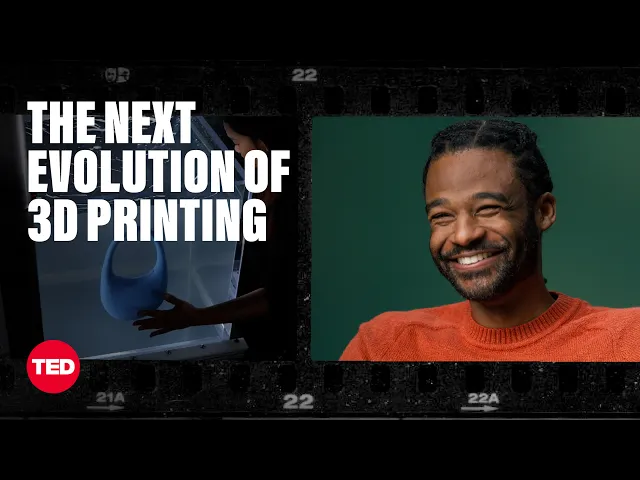
The Gravity-Defying Future of Manufacturing | Schendy Kernizan | TED
TED
0:04 I’m Schendy Kernizan.
0:05 I'm creating a new way of manufacturing objects.
0:09 I'm part of a company called Rapid Liquid
0:12 Print that is rethinking how products are made.
0:16 3D printing— for those who are not familiar with it— has
0:18 been a technology that's really taken off in the past 30 years.
0:22 Traditional manufacturing was using a method
0:24 that's just been so outdated, not digitized.
0:28 3D printing became kind of the new way of making that.
0:30 People said, "Oh, this is going to replace traditional manufacturing."
0:34 But the issue is that you need to build on a platform.
0:37 So you always need a surface that you're
0:39 starting with in order to create an object.
0:41 And the more complex that geometry becomes,
0:45 gravity starts to become a limitation of what you can make.
0:48 And in order to circumvent that, you need to actually
0:51 create supports— and then you need to remove those supports.
0:53 So it's really kind of a manual effort
0:56 of cleaning those pieces that are then discarded.
0:59 And it's quite wasteful.
1:00 So 3D printing has almost become kind
1:03 of this system that's great for prototyping,
1:06 but hasn't really created that bridge from prototyping to production.
1:10 We solved that by printing inside of this gel
1:13 that holds the shape that you're drawing.
1:16 You're able to eliminate gravity.
1:20 Think of the ability of, you know— if I have an idea in my mind,
1:24 and I have a pencil, can I draw it in space and then have that shape there?
1:29 So you go on the computer, you draw the geometry that you want,
1:32 and that information gets sent to the printer.
1:34 And as the machine is moving— think of your arm
1:38 moving that pencil around— the material is coming out of it,
1:41 and the machine knows how fast or how slow it needs to go
1:45 and where it needs to be drawing it inside of the tank.
1:48 The gel is mostly water that’s been transformed into gelatin.
1:52 And think of hand sanitizer consistency where it can move,
1:56 but it has structure to itself.
1:58 And the viscosity is strong enough where whatever you
2:02 extrude inside of it doesn't just pull out the bottom.
2:06 And when it's done, you just let it there until it fully cures.
2:11 You're literally doing calligraphy in space.
2:13 You're able to make parts faster.
2:15 You can customize the colors that you want.
2:17 You can blend colors, create gradients of colors.
2:20 And instead of having this mold that you then need to discard or put
2:25 away because your design is different the next time that you build something,
2:29 with this gel, it's reusable.
2:30 So you can extract that part,
2:32 you rinse it with water and you're reusing the gel to make more parts.
2:36 So it's a reusable process and sustainable way of making things.
2:40 As human beings, anything I touch, even from your phone case,
2:43 usually having some kind of flexibility and give to it
2:46 feels more relatable than having a hard surface that you're touching.
2:51 Early days, there was another research group at MIT
2:55 that was doing a lot of prosthetics, orthotics.
2:58 They saw our process and thought, "Hey,
3:00 this could be actually beneficial for us." And that led
3:02 us to talk to more clinicians out there, more people in that space.
3:05 People said customization would be really beneficial,
3:08 but [they] don’t have a way to do that easily.
3:10 Most of the time, what's really pushed on the patient is to wear,
3:13 you know, small, medium, large, because it's faster and easier to do.
3:17 The downside to that is that you're being
3:19 squeezed into something that doesn't fit you well.
3:21 So we started printing and testing parts for them.
3:24 And I remember seeing the first time they showed us pictures of their patients
3:29 trying something that we had printed in our garage at the time and hearing how,
3:34 like, "This is the best fit I've ever had.
3:36 This really feels great on my body.” That patient needed such
3:41 a custom solution and being able to scan [a] patient in the morning,
3:44 print in the afternoon and have something ready the next day,
3:47 it was exactly something that they were
3:49 looking for that they couldn't do before.
3:52 I think myself and others in the world,
3:54 we would love everything to be customized to our bodies and our needs.
3:58 Making mass customization more accessible to people is how I see the future.
4:03 There are a lot of industries that can benefit from this, from toys to fashion,
4:08 how cars are made, rockets were made,
4:10 consumer goods and things that we interact with.
4:12 Ways that we grow things or make things are going to be different.
4:16 One of the things that I dream about is the idea
4:20 that we can create new things that will inspire further travel, for example,
4:24 in space, or even habitats in space we can kind of explore
4:28 in and come up with new solutions that maybe we haven't thought of.
4:32 It does excite me to see that people want to use this tool
4:35 to push their industry forward and try new things that they couldn't do before.