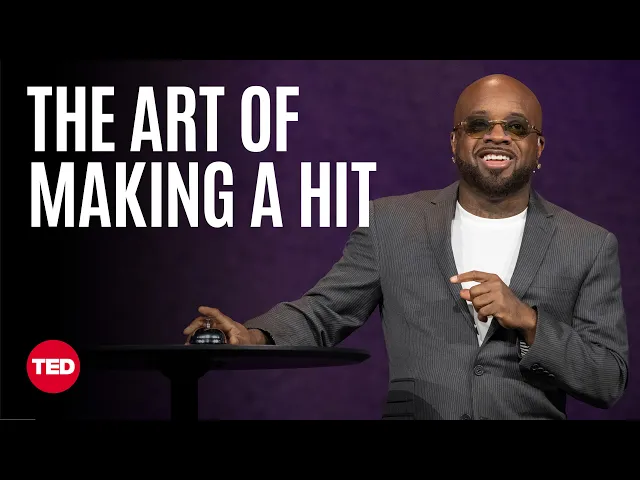
Jermaine Dupri on the Art of Making a Hit | On the Spot | TED
TED
0:03 What's up y'all?
0:04 (Cheers) Who here is not from Atlanta?
0:09 OK, well, welcome to Atlanta.
0:12 Let's get started.
0:14 What do I love most about producing?
0:17 It's almost like having a baby for me.
0:19 Like, you go in the studio, and it's not an idea that, you know,
0:24 most people will be looking around the studio
0:26 trying to figure out what we're going to do.
0:29 And then we get an idea,
0:31 and then we start making that idea come to life.
0:33 And depending on how long it takes, you know,
0:36 sometimes it takes five minutes, sometimes it takes two days to get this,
0:41 but it’s still like making a baby— well it’s not like making a baby—
0:45 (Laughter)— but you know what I’m saying.
0:48 Yeah, so, that's what it feels like, though.
0:52 It's like, that's how I feel when I make music.
0:56 I watch it go from, you know, nothing to something,
0:59 and then I give it to you guys,
1:01 and then y'all have to digest it.
1:02 So it's a trying process.
1:05 But that's the one thing that I love about watching, you know,
1:08 watching it grow from the bottom up.
1:11 So that's my first little question.
1:14 How has Atlanta played a role in my success?
1:18 Well, I'm from College Park.
1:19 Who was from Atlanta here?
1:21 (Cheers) Alright.
1:23 For anybody that's not from Atlanta, that's the South Side,
1:26 that's where I come from.
1:27 And I feel like Atlanta,
1:30 when I first started making music with Kris Kross
1:33 and even earlier in '91, '92,
1:37 the whole city was building at this time.
1:41 The music scene prior to me was here,
1:44 we had like, S.O.S.
1:45 Band, Brick, Peabo Bryson—
1:47 y'all know who I'm talking about?
1:50 OK, make sure.
1:53 So we had a cool music scene here,
1:55 but it still was,
1:58 you know, in the birth.
1:59 And I just feel like my success came with the growth of this city.
2:04 That's why I feel like I'm the mayor.
2:07 I am the mayor, but, yeah.
2:09 But, yeah, you know,
2:11 I feel like people watched me grow and they watched the city grow,
2:15 and they came to the city.
2:17 And that's why I created "Welcome to Atlanta,"
2:19 because I felt like,
2:22 I saw people taking other cities more serious than this city.
2:27 They used to have this shirt and they had hats and all of this,
2:30 they would have Detroit, LA, Tokyo and London.
2:33 Y'all remember these shirts?
2:35 Oh, y'all don't.
2:36 Huh?
2:36 OK, maybe I'm older than all of y'all.
2:40 Damn.
2:41 (Laughter) OK, well, anyway,
2:43 they had these shirts that they used to sell at the airport,
2:46 and they used to say this, and I used to go to the airport,
2:49 and I'd see these shirts all the time.
2:51 I’m like, damn, why they don’t put Atlanta on these shirts?
2:54 And it felt like the city wasn't doing what it needed to do.
2:58 So I just kept pushing, working,
3:01 trying to create artists and create music
3:03 and bring more and more people to the city
3:05 and show how beautiful this city is.
3:08 And so I'm happy to see everybody here today.
3:12 Because this is what I wanted.
3:13 I wanted this.
3:15 (Applause) So that's that.
3:18 What's my formula for making songs?
3:20 Anybody in here that want to make music?
3:24 (Cheers) Oh, over here on the left side, somebody is screaming.
3:28 OK, so my idea of making music is that once you get a hit,
3:35 you have to follow whatever it was that you did to get to that hit.
3:40 So, like, the first time that I did "Jump,"
3:44 I don't know how I made it, but I made it,
3:47 and you guys liked it.
3:49 And then I started tracing back what I did to get to that song
3:56 and I realized that, you know, you can't.
3:58 I couldn't really just, like, do exactly what I did to get to that song,
4:03 but I had to find the little different things
4:07 that the crowd liked
4:09 or the people liked
4:10 or what was really, really interesting about the song.
4:13 So say, for instance, like,
4:15 with “Jump,” the hook over and over again,
4:18 "Mac Daddy will make you--"
4:20 Audience: Jump.
4:22 Jermaine Dupri: See what I’m saying?
4:24 Yeah.
4:25 So what I had to figure out is,
4:27 how do I make other songs
4:30 that have that same lasting impression on people?
4:35 And you have to—
4:37 It's almost like baking a cake.
4:38 I know I keep saying babies and baking cakes, but anyway,
4:41 yeah, this is really like baking a cake,
4:44 because when you bake a cake,
4:47 every time you bake the cake, you do basically the same things.
4:52 Whether you put different icing on the cake,
4:54 whether it's a lemon cake or it's a red velvet cake.
4:58 Whatever it is, you go into baking that cake the same.
5:01 And for me, when I go in the studio
5:04 without me telling the people that I'm in the studio with,
5:07 I basically do some of the same things over and over again.
5:11 I'm going to give you an example.
5:12 I had a little song that came out last year called "Made for Me."
5:16 That was by Muni Long.
5:18 Y'all know that song?
5:19 OK.
5:21 Yeah, it won a Grammy or something like that.
5:23 (Laughter) And in making the song, she called me one day and she was like,
5:31 "Jermaine, I think"— we made the song prior in the studio, and she was like,
5:36 "Jermaine, I think the beat needs to have
5:38 a little bit more bounce to it."
5:39 Now, my initial making of the beat,
5:43 I didn't put this bounce that she's talking about in the record,
5:46 just because I don't try to make all my records sound the same.
5:49 But I was watching TikTok
5:54 when she sent the message to me
5:56 and I saw that they did a mash-up of Mariah Carey and this group,
6:01 this artist named Yeat,
6:02 and they put Yeat over top of "We Belong Together."
6:05 And these kids was dancing to the beat.
6:07 And I'm like, OK.
6:08 Because people always try to make me seem like I'm old.
6:11 (Laughter) These young kids dancing to my beat.
6:14 So I'm like, OK, so they like the beat, they love the beat.
6:17 So then I start thinking
6:18 about why everybody loves the Mariah Carey record beat
6:21 and what I did to the beat
6:23 and what the hi-hats were doing in that beat.
6:27 I said, OK, I'm going to take that same thing
6:29 and I'm going to put it in "Made for Me."
6:33 And sure enough, it became a number-one record.
6:37 It sounds easy.
6:39 It's not easy, but it's just like making a cake.
6:41 Like I said, it's just something that you have to put in there.
6:44 And if you see it happen one time, it can happen again.
6:48 You just have to know how to grab it and catch it.
6:51 I'm pretty good at that.
6:53 All right.
6:54 How do I know what's cool?
6:57 Person in audience: You are cool.
6:58 (Laughter) JD: I must say, I don’t.
7:04 I'm going to say that I don't.
7:05 I don't know what's cool, I just try things.
7:09 So if you go back to, like, Kris Kross,
7:12 one day, one of the Chrises came to my house
7:14 and he had a jumper on, a Girbaud jumper,
7:17 and the jumper was bigger than me, right?
7:21 And you could basically turn yourself around inside the jumper.
7:24 And I said, "You should put it on backwards."
7:28 And, you know, he looked at me like,
7:31 "What's wrong with you?"
7:32 (Laughter) And the other Chris looked at me like,
7:36 "Yeah, what's wrong with you?"
7:37 And I was like, "Just do it.
7:39 Why don't you do it, why not?"
7:40 And this was before "Jump" came out.
7:44 And I was like, "You just put it on backwards."
7:46 And, you know, I don't know why he did it, but he did it.
7:50 And I said, "Let's go to the mall."
7:53 And we went to Lenox Square.
7:55 And when we walked through Lenox Square,
7:57 I kid you not, the whole mall seemed like they saw something
8:00 that they'd never seen before.
8:03 And I was amazed because I'm like,
8:06 this ain't nothing, but he just put his jumper on backwards.
8:11 But what I learned in that process was that it was the coolest thing
8:15 that they had ever seen in their life.
8:18 So to answer your question, I don't know,
8:21 but I'll try something
8:23 that I don't believe somebody else is doing.
8:25 And it normally turns out to be the coolest thing, you know?
8:30 Alright.
8:31 (Applause) Thank you.
8:35 What's next?
8:36 What song do I want y'all to remember me for?
8:38 Oh, what a song.
8:41 Let me think about this.
8:44 I could say I ain't made it yet, but...
8:49 I will say "We Belong Together"
8:51 because it was the song of the decade.
8:53 And it's like, when you go in the studio and make music,
8:57 that's one of the things you do not forecast.
8:59 "I'm going to make a song that's going to become song of the decade."
9:03 That sounds crazy, right?
9:06 So I would say "We Belong Together."
9:09 Alright?
9:10 (Applause) Here's my lightning round.
9:15 Hip hop or R&B?
9:17 A fun fact is that I'm a real hip hop guy.
9:20 I started out breakdancing, I hated R&B music,
9:22 so I'm going to go with hip hop.
9:26 Working with legends or rising stars?
9:29 I would say new stars would be my answer.
9:32 Legends always got ego.
9:34 (Laughter) Reality TV or docs?
9:38 Docs.
9:39 Because I have a new documentary.
9:41 (Laughter) It's called "Magic City."
9:46 It's on Starz.
9:47 (Applause) Alright.
9:50 Rhythm or melody?
9:53 I'm going to go with the melody
9:54 or depending on whatever I'm drinking that night,
9:59 it might be the rhythm, but the melody most of the time.
10:03 Oh, who mentored me?
10:04 Now I was mentored, I'm sure, by my father.
10:09 But not really mentored for the music business,
10:12 just more or less showing me around and showing me how to be.
10:15 And then I started watching other people from afar,
10:19 like Teddy Riley, Quincy Jones, Berry Gordy,
10:25 Andre Harrell, Russell Simmons,
10:28 all of these guys, I just watched them from afar
10:30 and they basically are the ones that mentored me
10:34 without me actually talking to them.
10:36 I am a person that usually forecasts things
10:40 that I want to see happen in my life.
10:43 And I saw this on YouTube one day,
10:46 people up on stage, talking at TED talk,
10:49 and I was like, "I'm going to do that."
10:51 (Cheers and applause) And I'm here.
10:57 Thank you.
10:59 (Applause)