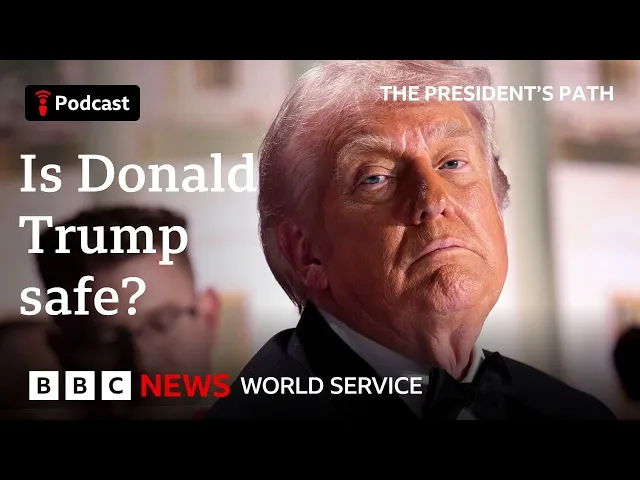
How safe is US President Donald Trump? - The President’s Path podcast, BBC World Service
BBC World Service
0:00 I think the visit broadly kind of had rave
0:03 reviews from from both sides of the political spectrum.
0:06 The window of what is acceptable and allowed in terms
0:09 of how you speak about politics and your opponents has so shifted.
0:14 Has America have we have everyone kind of become
0:17 desensitized to the fact that gun violence or, you know,
0:21 attacks like this at major events are now
0:23 just par for the course in American society.
0:33 Hi guys.
0:33 Good to see you both in this week, I suppose,
0:36 which has been all about what we're about every day,
0:39 which is the relationship between the US and the UK,
0:42 given that we work for the BBC in DC.
0:46 Yeah, we'd have to say a very, very.
0:48 Different, different sort of week.
0:49 There was a lot more, uh,
0:51 color and pomp and pageantry at the white House than I'm used to.
0:53 It was really kind of unlike anything I've seen
0:55 in the three years I've been at the white House.
0:58 And so interesting to see Washington transformed to welcome the royal couple.
1:03 And just how excited, you know,
1:05 seeing some of these members of Congress who have been, you know,
1:08 veterans in the halls of the Capitol for years,
1:10 getting really excited to see the king and queen.
1:13 And I think that is a testament, especially with the King's address to Congress,
1:17 to what that relationship means to many of them,
1:20 even though it is under strain right now.
1:22 It's so interesting.
1:23 You mentioned that to me because I was
1:26 fascinated by all the images that, you know,
1:28 very high flying people were posting
1:30 on their social media who were at the garden
1:32 party that the British Embassy hosted for the King and Queen on Monday.
1:36 And it was people just jostling to get as near as they possibly
1:40 could to the King and Queen
1:42 Democrats standing shoulder to shoulder with Republicans,
1:45 all trying to just get that photograph,
1:48 exchange those few words, get that handshake.
1:51 And it was really rare to see.
1:52 I think the visit broadly kind of had rave reviews
1:56 from from both sides of the political spectrum in the U.S.,
1:59 and that's something we don't see very often.
2:01 There's not much that people in Washington seem to agree upon.
2:06 And this kind of seemed like a moment
2:08 where everyone was very enthused to see the King.
2:10 I think many people interpreted the King's
2:14 Speech to Congress quite, quite differently,
2:16 but they still ended up coming away from it, very positive about it,
2:20 which I think kind of speaks to the strength of of the King's Speech
2:22 and just what kind of a a masterful move of soft diplomacy this ended up being.
2:28 That's what I found actually most interesting,
2:30 particularly about the King's remarks to Congress,
2:32 is that Republicans and Democrats I spoke
2:34 to came away from this with very different readings,
2:37 you know, for the Republicans.
2:39 One lawmaker telling me I didn't hear anything in that speech
2:42 that would indicate that there are strains in the UK, U.S.
2:46 ties.
2:46 And yet Democrats I've spoken to have said,
2:48 listen to what the King said about Ukraine.
2:50 Listen to what the king said about the Royal Navy, about the environment.
2:55 All of these things are really opposite
2:57 to many points of President Trump's agenda.
3:00 And yet he managed to deliver that message
3:02 in a way that didn't seem to ruffle President Trump's feathers.
3:05 And in a way that caused rounds of applause from both Republicans and Democrats
3:11 to some of the things that they wouldn't ordinarily applaud to at all.
3:14 And for me, the stinger was when the king
3:17 was talking about the Magna Carta and how, you know,
3:20 so much of American modern law is based
3:23 on that codified by Supreme Court rulings and the line.
3:25 He said that executive power should be subject to checks and balances.
3:30 And the Democrats went absolutely crazy applauding that.
3:33 And indeed, many of the Republicans did as well.
3:36 Speaking to Democrats afterwards, they said, I mean,
3:39 we had Congressman Richie Neal on the special program we had.
3:41 He said, no, I interpreted that absolutely as a jibe at President Trump,
3:45 that he is the executive power that is not subject to checks and balances.
3:50 When I spoke to Republicans about it,
3:52 they had interpreted as a salute to Congress that Congress
3:56 had a roll of checks and balances on any executive power,
4:00 and they weren't interpreting it as a direct slight on the current president.
4:04 I think quite a few Republicans that have
4:07 spoken out after the speech also kind of they
4:10 kind of put it in contrast to the faults
4:12 they see with Prime Minister Keir Starmer.
4:15 One one congressman said, for example,
4:17 that he came away with the speech thinking that the king
4:20 is someone who's proud of of Britain and proud of British history,
4:24 as opposed to what he termed being kind of a leftist weenie,
4:28 was his phrase for for Keir Starmer.
4:31 So I think it was quite interesting to see that, you know,
4:33 also there was kind of British impression,
4:35 American impressions rather of British domestic policy.
4:39 And they kind of separated the king completely from that equation.
4:43 Um, I thought it was quite interesting to see those kind of reactions.
4:47 Um, but I think everyone was, was very happy, especially President Trump.
4:51 Yeah.
4:52 One analyst said to me this week,
4:54 President Trump is the compartmentalized in chief.
4:57 He's someone who can clearly separate,
4:58 separate out what he sees as a truly strong and deep friendship with the King.
5:03 I mean, how many times did he praise the King to no end?
5:06 And the Queen this week saying they're excellent people?
5:08 And he even said, I wish we had someone like this in our country,
5:12 which I'm sure didn't have everyone so pleased.
5:14 In the U.S.
5:15 there's a reason we don't have a monarch here, of course,
5:17 but I think he means more to the character
5:19 of the king and what he sees as, again, a deep friendship.
5:23 And yet I think he can look at that apart
5:26 from what he sees as real weak leadership from the Prime Minister,
5:29 Sir Keir Starmer, who, of course,
5:30 is under his own intense domestic pressure at the moment over the firing
5:35 or the appointing originally of the former UK ambassador to the U.S.,
5:39 Lord Peter Mandelson, and his ties to the late sex offender Jeffrey Epstein.
5:44 But he has equally come under that pressure from President Trump.
5:48 As we know.
5:48 We've talked about it in recent weeks on the pod
5:50 that President Trump has been very critical of the British prime Minister.
5:54 And I think even with this very successful royal visit,
5:58 that pressure is not going to change.
6:00 And I think about just the way he talks about, um,
6:02 some of the other European leaders,
6:04 leaders of NATO countries where he says, oh, they're great people.
6:07 They're wonderful people.
6:08 Um, especially if he's with them one on one,
6:11 but their policies, he can criticize and take apart.
6:14 And I think he does see them as, as separate things.
6:18 Yeah, absolutely.
6:19 And I, I think the British government as well in advance,
6:22 and during this visit were really eagerly briefing that, you know,
6:27 the king is the head of state.
6:29 He's not the head of government.
6:30 They're very different.
6:31 You can have very warm relationships between
6:32 the king and the president and a whole
6:35 other relationship on a political level between the king and the Prime minister.
6:39 But when you look at some of the reaction
6:41 to this visit below the political level,
6:43 I was listening to a bit of Ben Shapiro's pod.
6:46 He's, of course, a very influential
6:49 conservative right wing pod podcast show host.
6:52 He has millions and millions of followers.
6:54 He actually put out an episode that said something
6:56 along the lines of King Charles shut the f up.
7:00 And he had interpreted the speech as a lecture to the American people about
7:04 all these things that were great about the UK and not so great about America.
7:09 So I thought that was quite an interesting take on everything that we had seen.
7:13 I suppose the real um,
7:15 tell will come with the next post on Truth Social that we see
7:19 from President Trump when the king and queen
7:22 are wheels up and they're no longer,
7:24 you know, in this country and the president is no longer hosting them.
7:27 And when he's going to give some sort of final
7:31 opinion on how the trip went and what it means now.
7:34 During the the actual appearance at the white House,
7:36 Trump when Trump was speaking,
7:38 he he very much stuck to the script, which is something off the top of my head.
7:42 I only recall really seeing a few times in which he
7:45 didn't deviate kind of at all from from the written script.
7:49 But then when he was in more kind of those informal settings when he
7:53 was in the Oval Office with reporters following that, I think was the day after.
7:57 Um, then, you know, you already started to see those comments.
8:00 He said, for example,
8:02 that the king would have wanted Great Britain to participate
8:05 in the war in Iran without providing any evidence.
8:08 Of course, I think, you know, he was very much kind of in his his best behavior.
8:13 And, you know, he's not someone shy
8:14 about sharing his opinions about anything or anyone.
8:17 Yeah.
8:17 I think about it as the sheen almost wearing off from the pomp and pageantry
8:21 of the King and Queen's visit and what is left at the end of that.
8:25 Well, as we as things stand now, President Trump is still engaged,
8:30 albeit in a cease fire with Iran in this ongoing war with Iran.
8:34 The Strait of Hormuz is still closed and the U.S.
8:37 continues its blockade, which, as we've discussed here in the past,
8:40 President Trump deems as very effective
8:42 and says he's satisfied with the status quo.
8:45 But the Iranians, you know, he keeps saying all they need to do is cry, uncle.
8:49 And they haven't given way in negotiations.
8:52 And that leaves President Trump, again,
8:55 fairly alone on the world stage when it comes to his allies,
8:59 who have still refused to join him in this fight against Iran.
9:02 And that includes the UK.
9:04 And so as the king and Queen will be back in the UK
9:08 in the coming weeks and President Trump is facing again the Prime Minister,
9:12 Sir Keir Starmer, with whom he has differences over this war.
9:15 I wonder how quickly that message will will pivot again.
9:19 And we saw the King address that a number
9:21 of times in that speech to Congress, didn't we,
9:24 talking about the international community, talking about strong alliances,
9:28 talking at length about NATO,
9:30 about the transatlantic relationship between Europe and the US,
9:35 not just the UK, that there were all these other partners,
9:37 including those in the Commonwealth, which was a, you know,
9:41 I think a pretty direct reference to Canada,
9:43 because obviously the relationship there is
9:45 quite strained between the US and Canada.
9:48 Again, at that at that top, top table personal level between the Prime Minister,
9:54 Mark Carney, and President Trump.
9:55 And so, you know, I think the King didn't pull his punches in that regard.
10:00 So I'd be really interested to know.
10:02 And of course, we all will.
10:03 We'll never find out.
10:04 But in those private moments, did the King press those points?
10:08 Because although he has to be above politics as the head of state,
10:13 this visit came on the say so of the British government.
10:16 His speeches would have been written largely
10:18 by the British government with some input from the King.
10:21 But all of the words had to be approved
10:24 and were gone over each of them several times.
10:27 So did the King carry on with that type
10:30 of conversation when they were behind closed doors, particularly, I think,
10:35 around the issue of the Royal Navy and the British troops.
10:37 Of course, the King,
10:38 a veteran of the Royal Navy and something that's very close to his heart,
10:42 I think he would have been putting up quite a strong defence of that.
10:45 And although we don't know what was said
10:47 in that meeting when the door is closed.
10:50 I think if there was any messenger that the British government could have
10:52 hoped for, it would be the King just on a on a personal level.
10:57 Trump is is such a committed Anglophile and he's such a fan of the royal family.
11:02 Even his.
11:03 Even his kind of criticism of Prince Harry, for example,
11:07 has been quite muted compared to his criticism of other public figures.
11:10 Uh, you know, I think the the president seemed to me
11:14 to be much more receptive to that discussion, uh, with the king.
11:19 And just based on the remarks he made before the king arrived,
11:22 then he would be necessarily with a foreign prime minister, a foreign president,
11:27 who comes to the Oval Office and does a kind of much
11:30 more straight to business meeting of the kind we see quite often.
11:33 I think the president just given his enthusiasm for for British
11:38 culture and the institution of the monarchy, I think, you know,
11:42 he's he's much more receptive to hearing
11:44 from from King Charles than he is in from many, many other public figures.
11:49 Yeah.
11:49 And there were a few really important gifts and gestures made by the king.
11:54 But you have to remember that, of course,
11:57 just before the King and Queen arrived here,
11:59 this came at a point of another moment of massive pressure here in the U.S.
12:03 political pressure, and also another sign of political
12:06 violence coming to the surface here in the U.S.
12:09 and, you know, all of us, the three of us,
12:10 were at the white House Correspondents Dinner.
12:13 And after that terrible incident there,
12:15 there were real questions as to whether the royal visit would go ahead.
12:18 The Palace worked with the white House on this and making sure
12:21 that they felt the security arrangements
12:23 for the King and Queen's visit were adequate,
12:26 and that the visit could go ahead without any issues.
12:29 But it was just a reminder, again, that, you know,
12:32 this comes at such a fraught time for the president.
12:35 We've seen that through the course of this week with just a number of stories,
12:38 these massive political developments from the Supreme Court ruling
12:44 on redistricting in Louisiana to another indictment of James Comey.
12:48 All of this happening in the backdrop of this pomp and pageantry.
12:52 Yeah, I felt I don't know about you guys, but I was at the white House.
12:55 I was at on Capitol Hill.
12:57 I was at Arlington Cemetery.
12:58 A few of the spots that the king was
13:00 at, and I felt there was an extra level of nervousness,
13:04 um, in the wake of the shooting on Saturday night.
13:07 You know, thankfully everyone was fine.
13:09 And bar one Secret Service agent, nobody was injured.
13:13 And all of the law enforcement personnel, you know,
13:16 acted so quickly and that individual never got
13:19 into the ballroom where we were all seated.
13:21 But nevertheless, it was, um, an attack.
13:25 You know, that person is now charged
13:27 with an assassination attempt on President Trump.
13:29 It's the third that he has suffered during this last couple of years.
13:34 And I felt that there was a nervousness around I mean,
13:38 even on Capitol Hill the other day ahead of the King's
13:41 arrival and all the barricades and security were there,
13:43 a few people had stopped trying to, I guess,
13:46 take a photo of the king arriving and the personnel
13:49 around really screamed at them to move on.
13:52 You cannot stop here.
13:53 Keep going, keep going, keep going.
13:55 They just didn't want anyone, anywhere in any sort of place
13:59 that perhaps it wouldn't be a controlled environment.
14:02 And I do think that was hanging over the whole visit.
14:05 Um, not least because most of the people who were reporting
14:08 on the visit were there on Saturday night and, you know,
14:11 have all been working non-stop ever since.
14:14 Um, and, you know, it must be front and center for the president as well.
14:19 I completely agree.
14:20 I think part of that nervousness was
14:21 the fact that many of those congressmen, for example,
14:24 or many of the white House staff that were there to receive the king,
14:27 were also were also at the dinner.
14:29 And there actually was a very brief, um,
14:31 I'm not sure I want to call it a security incident,
14:33 but there was an attempted fence climbing
14:35 at the white House during the King's visit.
14:38 And, um, just from what I've heard afterwards,
14:41 the response was a little More aggressive
14:44 and a little stronger than than your average fence climber.
14:48 That's something that happens, you know, with some regularity.
14:52 I just think the the nervousness also kind
14:55 of was in part because now it's brought
14:58 back this conversation about political violence in the wake
15:01 of that incident at the Hilton in Washington.
15:03 Of course, there was Charlie Kirk, and there's been several other incidents.
15:06 And that's a conversation that I think,
15:09 unfortunately for the white House and for members of Congress,
15:13 was taking place literally the day before the King arrived in the United States.
15:18 That's kind of a very uncomfortable conversation to have,
15:22 especially when you have such a prominent foreign guest.
15:25 Yeah, absolutely.
15:26 Not only, of course,
15:27 the question of how political violence happens in this country,
15:31 but the rhetoric that is used and this kind
15:33 of finger pointing on both sides of the aisle,
15:35 Democrats saying, well, that rhetoric is coming right from the top.
15:38 Look at the language President Trump himself has used just, I think,
15:42 a week and a half ago now,
15:44 saying he would wipe out an entire civilization in Iran.
15:47 And of course, how he has spoken about
15:49 his critics or who he considers to be his opponents.
15:51 And then, of course, criticisms of President Trump.
15:54 We heard many of his supporters saying, look, if you call the president a Nazi,
15:59 if you call him Hitler, if you say he is a terrorist,
16:03 that is inspiring more people to take up
16:06 violence against who they see as their political opponents,
16:10 opponents, including President Trump.
16:12 And I think what is difficult to see underneath all
16:15 of this kind of back and forth that we've had this week,
16:18 and we've had it in our programs, of course,
16:20 with Democrat and Republican strategists, as we usually do,
16:24 is just how the window of what is acceptable and allowed in terms
16:29 of how you speak about politics and your opponents has so shifted.
16:34 And, you know, I just was remarking, listening to the the defense secretary,
16:39 Pete Hegseth, talking in his first hearing
16:41 on Capitol Hill since the war had begun,
16:44 talking about Democrats and some Republicans in Congress who oppose
16:48 the war in Iran being the biggest adversary at this point.
16:53 And so not the Iranian regime, but indeed those lawmakers.
16:56 And those are the types of statements that I think we've started
17:00 to hear more and more and perhaps started to normalize in a way.
17:04 But at the same time, they are obviously a real escalation of words.
17:10 What I've thought notable this week as well, in the wake of that attack,
17:14 is usually a debate springs up about gun control, about access to guns.
17:19 Who has them, where they came from, where they got them.
17:22 But the debate in the immediate aftermath
17:25 of this attack has been about security.
17:27 And as you guys are saying, political rhetoric, you know,
17:31 should there have been more security at the hotel,
17:33 should it have been in a different place?
17:35 There hasn't been a conversation about this individual purchasing the guns,
17:39 which we're told according to what's
17:42 been presented by the acting Attorney General.
17:44 Todd Blanch and the U.S.
17:46 attorney here in D.C., Jean Jeanine Pirro.
17:49 Is that they were purchased in California
17:51 and that this individual who's accused,
17:53 Cole Allen, then traveled by train right across the country.
17:58 But yet the conversation has focused on the security at the hotel.
18:02 And, you know, we've all been there for a few years now.
18:05 The security, to my mind, anyway,
18:06 and obviously I'm not an expert in these matters,
18:09 but as the consumer experience, let's say, of security was the same,
18:14 just showed a ticket that doesn't have your name on it to get into the hotel,
18:17 you didn't show any I.D.
18:19 and you went through those metal detectors pretty close to the ballroom,
18:24 relatively speaking.
18:25 I mean, it is a floor up, but it's still pretty close to the doorway.
18:31 I mean, where the individual was intercepted was the top of a staircase.
18:34 When you come down to the bottom of those stairs, you are at the door.
18:37 You don't have to walk across a big
18:39 long distance of a lobby or anything like that.
18:42 But yet the security worked.
18:44 The law enforcement personnel that were there,
18:46 even though he sprinted through them,
18:47 according to that video that the president shared, they did intercept him.
18:52 They pinned him down.
18:53 They did fire some shots.
18:55 They took his shirt off to make sure he
18:57 didn't have any kind of ballistic vest on or anything.
19:00 Um, so it worked.
19:01 The president wasn't hit.
19:02 No one in the room was hit.
19:04 Uh, the vice president, all the cabinet secretaries,
19:07 in addition to all the members of Congress
19:09 and then the lowly journalists, of course.
19:11 Um, but it's just been funny to note that that's
19:14 where the conversation has sat and not about the gun rights,
19:17 which is what we usually expect.
19:19 And to me, I've been asking myself the question has,
19:22 has America have we have everyone kind of become
19:25 desensitized to the fact that gun violence or, you know,
19:29 attacks like this at major events are now
19:32 just par for the course in American society.
19:35 And I think we're kind of beginning to to see
19:38 the, the conversation kind of as an extension of the conversation.
19:41 You just mentioned, the conversation about what events are actually
19:45 a good idea and what is possible going going forward.
19:49 I had the misfortune, I suppose,
19:52 of being at the assassination and Butler assassination attempt in Butler,
19:56 Pennsylvania, when Trump was on the campaign as well.
19:59 And immediately after that, you saw a review
20:01 about whether outdoor rallies were were a good idea.
20:05 And I think especially now as we're ramping up
20:07 to a to a midterm and then eventually to the, the following election,
20:12 uh, there's a conversation to be had.
20:14 And I think a white House official told us this week has already been had
20:18 about kind of reviewing what events the president
20:21 and other senior officials would be like.
20:24 And I think there's a separate conversation happening on Capitol Hill because,
20:27 you know, I didn't think about this at the time,
20:30 but many of the the rank and file congressmen
20:34 that and members of Congress rather that were in the room.
20:38 They didn't get the.
20:41 The same kind of immediate evacuation as the the more senior level
20:46 cabinet members or the senior leadership of the Republican Party was there.
20:51 Many of them were kind of waiting around with with some of us.
20:55 And, you know, I've read an account
20:56 this morning of of Jared Moskowitz, a Democrat.
20:59 He had to ask another congressman if he could kind
21:03 of tag along as he was being removed from from the ballroom.
21:07 And then, of course, there's the conversation about whether President Trump
21:12 needs to even even be at such events.
21:15 We heard him almost immediately start to talk about the building,
21:19 a ballroom at the white House, which is is not clear how that would have helped,
21:22 because it was a private event of which he was a guest.
21:26 But there's all sorts of these questions
21:28 now about what events actually make sense
21:30 for prominent politicians to to take part
21:33 in, and what more what more can be done.
21:35 I've been thinking about that hallway a lot.
21:36 Actually, this morning I actually I didn't realize this at the time, but I,
21:40 I found out I had just missed the, the incident
21:42 by a few minutes because I had gone to the restroom and someone I met on the way
21:47 there ended up being stuck in the hallway, uh, kind of where Wolf Blitzer was.
21:52 So I think, you know, all those steps are going to have to be,
21:55 uh, re reviewed before any sort of big public.
21:58 Well, it wasn't public, but big event takes place in which
22:01 the president and cabinet members are all there.
22:04 Yeah.
22:04 And that interesting anecdote that you mentioned about Jared Moskowitz,
22:07 the Democrat from Florida,
22:08 I think he was tagging along with Steve Scalise, who's the House majority whip,
22:13 who, by the way, um, was on hand for a shooting at a, uh,
22:17 I think it was a practice for a congressional baseball game in 2017.
22:20 So just a reminder of, you know,
22:23 the continuing pattern of gun violence and how elected
22:25 officials have said that they are more at risk now,
22:28 particularly with the sharpening of political rhetoric
22:31 than they have been in the past.
22:33 That's that's something we've heard lawmakers raising alarm bells about.
22:38 But I think what is important to note is, you know, two things.
22:41 One, and as you both have said, look,
22:44 the security worked in the Hilton, of course,
22:46 because this individual was stopped at the same
22:49 time with a little bit more planning and coordination.
22:52 Had it not been just one person, had it been several armed people,
22:56 it could have been a very, very or far more serious incident.
22:59 Of course, it was very serious as it was somebody
23:02 with the intent to assassinate the president and members of his cabinet,
23:06 but he was thankfully stopped and saved for that Secret Service agent.
23:10 As you said, Katrina, who was injured.
23:12 There were no further injuries, but it could have been much worse.
23:14 And that's why these questions about security are so critical.
23:18 And I think, number two,
23:19 President Trump said this himself right after the incident.
23:22 He said, you know, you can create a secure perimeter,
23:24 but if you have, as he called him, one whack job,
23:27 one person intent on doing harm as a lone wolf,
23:30 somebody like the alleged shooter here who
23:33 we understand didn't have a criminal record.
23:35 It is very difficult to stop that person.
23:38 And so that brings you back to the question,
23:40 do you then prevent the president from doing
23:43 indoor events or outdoor events after a certain size?
23:46 As we know, Butler, Pennsylvania was an outdoor rally,
23:50 and that is not something that I anticipate the president will be willing to do.
23:53 He loves those rallies.
23:54 He really gains strength and inspiration from them.
23:58 And as the midterms creep up on us, I you know,
24:02 we have heard that the white House wants to send him out on the road.
24:04 And I can't imagine that they would dial that back in any significant way.
24:09 We are unfortunately, out of time for today,
24:12 but it's been a pleasure as always seeing you guys.
24:21 If you enjoyed this episode of The President's Path,
24:23 then like and subscribe to our YouTube channel.
24:26 We would love to hear from you.
24:27 So please leave us a comment below or email us on path@bbc.co.uk.