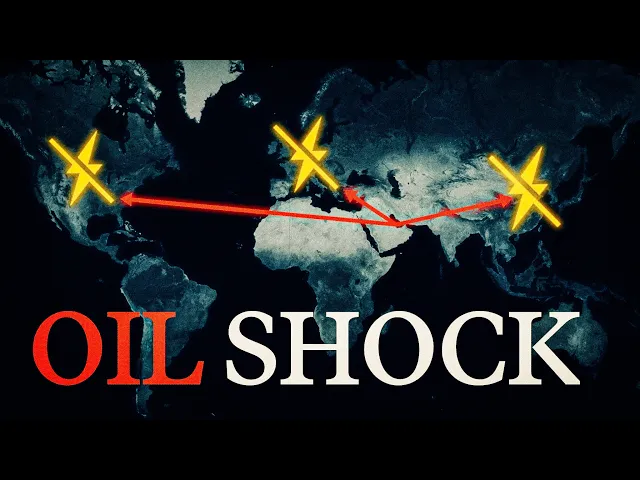
The Iran oil shock is about to hit
Max Fisher
0:00 The Iran War was supposed to blow up the world economy.
0:03 The war in Iran has sent the price of oil and natural gas soaring,
0:07 putting pressure on just about everyone.
0:09 [Reporter] Ship traffic has slowed to just a dribble,
0:11 and the longer it stays disrupted,
0:13 the more pressure builds across the entire global energy system.
0:18 But it's been a month of really severe fighting.
0:20 (curious music) And a near total shutoff of oil and gas out of the Middle East.
0:26 And most of the world seems basically fine?
0:32 Like, you look out your window and what you see is not Mad Max.
0:35 (intense music) What you see is more a normal variety bad economy.
0:40 [Reporter] Attacking at least three ships moving through the Strait of Hormuz.
0:43 [Reporter #2] And that translates to prices at the gas pump now at levels
0:46 not seen since the start of the war in Ukraine four years ago.
0:49 So, what's going on here?
0:51 Was the doomsaying all wrong?
0:52 Are things basically fine?
0:54 To figure this out, we're going to answer the question,
0:56 what actually happens when the world's
0:59 largest oil-producing region goes to zero?
1:01 Like physically, step by step,
1:03 from the moment the tap turns off, how does that work?
1:06 How does that ripple down the supply chain to your gas pump,
1:09 to your grocery store?
1:10 How long do the lights stay on?
1:12 How long do planes stay in the air?
1:14 And look, I will spoil the ending for you.
1:16 The fine that you see out your window right now is fake.
1:20 It's a mirage.
1:21 I don't care where in the world you are,
1:23 there is a 100-foot tidal wave rising above your head.
1:26 And once you see why it's rising and what's going to happen when it hits,
1:30 you will not be able to miss it.
1:32 (curious music) The thing we are talking about has a name, an oil shock,
1:41 and we are right now in the biggest oil shock in history.
1:44 Think of it like a bomb that's exploded very far away.
1:47 We see the flash, but the shock wave hasn't reached us yet.
1:51 Today, we're going to answer what happens when that shockwave hits,
1:54 what it's going to do, what will change, how it's going to play out,
1:57 which also means asking why it's taking so long to reach us,
2:01 where we're in this weird lull right now.
2:03 As promised though, we're going to start by tracing what
2:05 actually happens when the oil spigot goes from on to off.
2:09 And the first thing you need to know is something that seems simple,
2:12 seems obvious, but it turns out to be really, really important.
2:18 This is an oil tanker.
2:20 And the thing to know about an oil tanker is that it's really, really big.
2:23 Four soccer fields long, carries 2 or 3 million barrels of oil,
2:27 and it weighs more than a skyscraper, all of which makes it slow.
2:31 10 or 15 knots.
2:33 That is, no joke, the speed of a bicycle.
2:36 Our global energy supply lines move at the speed of a Schwinn.
2:40 And let me show you on this globe why that's important.
2:43 If you biked all day, how much of this globe do you think you could cross?
2:47 Like, maybe the width of the point of this pen, right?
2:51 Maybe, if you worked really hard.
2:53 Okay, now imagine hopping on your 12-speed starting in Dubai.
2:57 Where's Dubai?
2:58 Here we go.
3:00 Starting in Dubai.
3:01 And now imagine that you have to bike out of Dubai all the way down here,
3:07 down the coast of Africa, down, down, down across the Cape of Good Hope,
3:11 back up the other coast of Africa, all the way across the Atlantic,
3:15 through the Caribbean,
3:17 before finally arriving at the deep water oil port in Louisiana.
3:22 That would take forever on a bike, right?
3:25 Which remember is the speed that these oil tankers go.
3:28 Like, that is how our oil travels, as if it were on a bike.
3:31 And maybe you see where I'm going with this.
3:34 (curious piano music) This is a map
3:37 of global oil flows put together by JP Morgan.
3:39 Don't worry about all this text.
3:40 We'll explain it in a minute.
3:42 These red lines show the oil coming out of the Middle East,
3:45 going out to the rest of the world.
3:46 This is the stuff that's been cut off.
3:48 Here it is back in December before the war.
3:50 There it goes, the oil is flowing.
3:52 But remember, it moves at the speed of a bunch of bicycles.
3:57 So, now it's January,
3:59 and the oil is just finally breaching parts of Asia and Europe.
4:03 And we're into February before it hits the US.
4:05 And then it hits refineries in South Korea that then sends
4:08 it on down these pink lines to Australia and New Zealand.
4:12 So, when the war starts and the oil stops flowing,
4:15 there's actually still a ton out there,
4:18 taking its long, lazy little bike ride around the globe.
4:21 That's a big part of why things seem weirdly normal.
4:24 For most countries, the oil shutdown has not reached us yet.
4:27 We're still getting shipments that were sent out before the war started.
4:30 So, when do those shipments stop?
4:32 If you look at that map again,
4:34 it says most deliveries to the US will stop around April 15th.
4:37 In Europe, they stop around April 10th.
4:40 Asia, April 1st, so it's just getting started.
4:42 But here in parts of Africa, it's March 20th.
4:45 We're already well into it.
4:47 And to be clear, these places aren't out of oil.
4:49 Every country has emergency stockpiles.
4:51 So, let's see what that looks like.
4:53 Gas lines are the first thing to show up, not enough fuel at the pump.
4:57 And these are already everywhere.
4:58 South Africa, Pakistan, Vietnam, a bunch of places.
5:03 In Laos, they ordered schools close for one day a week,
5:05 so there'd be fewer people on the roads.
5:07 The Philippines and Ethiopia did the same thing for government offices.
5:11 And Sri Lanka is making everybody take every Wednesday off of work now.
5:15 There are also restaurant curfews,
5:17 mass flight cancellations, air conditioning shutoffs.
5:20 It's not that these countries are running out of oil.
5:22 I mean, they are, but that's not the real issue exactly.
5:26 (curious intense violin music) Imagine this is the global oil supply.
5:30 It's all sold in one big market,
5:33 and that means all the producers sell to that same global supply.
5:37 And then all the oil-consuming countries buy from that same supply.
5:41 You could also call these exporters and importers.
5:43 It's the same idea.
5:44 Anyway, the Iran War cut off one-fifth of global supply, about this much.
5:50 So, when delivery stops showing up at those countries
5:52 we talked about they can actually buy from other producers,
5:57 but they've got to do it
5:58 by outbidding whoever would've bought that oil otherwise.
6:01 And that pushes up the price for everyone.
6:05 And that's even hitting places like the US,
6:07 where we are still receiving oil from before the war started.
6:10 Countries whose shipments ran out are creating this big surge in demand.
6:14 So, anytime you go to the pump or pay your power bill,
6:17 you are bidding against them and they are bidding against you.
6:20 And all of this is going to get significantly
6:23 worse when China and Europe start running out of shipments,
6:26 too, and surge demand to replace it, which is really close to happening.
6:31 But all of this raises a question.
6:32 If these shortages are just days or weeks from reaching everywhere,
6:36 then why are we on a lull?
6:38 Every government in the world can see that same map that I showed you earlier.
6:41 They know catastrophe is bicycling their way.
6:45 So, why doesn't it feel like it?
6:47 This is Trump a couple of weeks into the war.
6:49 [Reporter] Sir, could you foresee a deal in Iran this upcoming week?
6:53 I do see a deal in Iran, yeah.
6:55 Could be soon.
6:56 When he said this, the price of oil dropped right away.
6:59 The war's ending, right?
7:00 Everything back to normal?
7:02 Except he'd been saying the same thing for weeks.
7:05 We have had very, very strong talks.
7:08 We'll see where they lead.
7:09 We have major points of agreement.
7:11 I would say almost all points of agreement.
7:14 Iran has said that there are no talks and Trump is making it all up.
7:17 [Reporter] Iran's foreign ministry says you're not telling the truth
7:19 when it comes to productive conversations to end the war.
7:22 They're gonna have to get themselves better public relations people.
7:25 He's been doing a ton of this.
7:26 Like a few days earlier, he posted the US was very close to meeting its
7:30 objectives in the war and might soon start winding down.
7:33 So, why does he keep doing this?
7:35 Well, to understand, go back to that graphic of the global oil market.
7:39 We left something out before.
7:40 A lot of oil gets bought up by speculators who sell it secondhand.
7:44 This all takes place through something called an oil future.
7:47 It sounds scummy, but it actually serves
7:49 a pretty useful function in stabilizing prices.
7:51 You know, it doesn't matter how it works.
7:53 The point is those speculators set their price
7:56 by what they think oil will cost in the future.
7:59 Which means if Trump comes along and says, peace in our time,
8:02 speculators conclude prices will drop and sell their oil futures for cheap,
8:06 which helps to balance the price rise in the regular market.
8:10 That's part of the lull.
8:11 Even though econ 101 says oil prices should be going up way more than they have,
8:16 like crisis level, $6-7 a gallon territory,
8:19 all of this market manipulation is tamping those prices down.
8:22 But that sounds good, right?
8:24 Except that it means that the global economy is consuming oil
8:27 and gas as if they were still priced and flowing normally.
8:31 It's like if your city were running out of water
8:32 and everybody in town decided to take two showers a day.
8:35 And there's another thing propping up this weird artificial lull that we're in.
8:39 IEA countries have unanimously decided to launch the largest
8:44 ever release of emergency oil stocks in our agency's history.
8:50 Remember earlier when I said that all countries keep oil stockpiles?
8:54 Well, a bunch of those countries got together recently
8:56 and agreed to sell off 400 million barrels from their reserves.
8:59 That's like if 200 of those oil super tankers
9:02 suddenly materialized out of the Bermuda Triangle all at once.
9:05 And then on top of that, the US also agreed to allow Russia,
9:08 and this is kind of hard to believe,
9:10 Iran to sell off some of their sanctioned oil.
9:13 And releasing these stockpiles has added oil to the market equivalent
9:17 to about half of what was cut off by the war,
9:20 which has helped to balance out supply and prices and all of that.
9:24 But here's the catch, and it's a big one,
9:26 the stockpile release and those speculator games, these are both one-off tricks.
9:31 They only work for a few weeks, and when they're used up, they're gone, man.
9:35 That artificial lull that we have been holding up,
9:39 it is gonna come crashing to an end just
9:41 as those last shipments of Middle Eastern oil dry up.
9:44 The final vessel carrying jet fuel into the United Kingdom's gonna
9:48 get here in 48 hours and there's no more after that.
9:51 So, when that oil shock hits, it is going to hit us all at once.
9:54 Okay, so now we understand what that oil shock is,
9:57 how it's gonna get here, how it's forming.
9:59 What is it gonna look like?
10:00 And when people picture this, they tend
10:02 to talk about it in terms of rising prices.
10:04 $200 a barrel oil, $8 a gallon at the pump, $1000 domestic flights.
10:09 But this misses something much larger and much
10:13 more consequential that is already starting to happen.
10:15 To understand what that is,
10:17 imagine if instead of talking about energy supplies, we were talking about food.
10:22 Now, if I told you that 1 or 2% of the world's food supply was going offline,
10:26 you'd probably worry.
10:27 You might expect to see food prices go up some,
10:30 some hardships on the margin, but you would think it's basically survivable.
10:33 But now, if I told you the world was losing,
10:36 had already lost 20% of its food supply,
10:40 you would think, well, we are about to have fewer people on earth.
10:43 And the name for this is demand destruction.
10:46 It's when the supply of something drops so
10:49 severely that whoever or whatever relies on it,
10:51 the demand permanently withers away.
10:54 And that is what is going to happen
10:55 to any global economic activity that uses energy,
10:58 which is like almost all of it.
11:00 Factories, technological development and production, car and airplane travel,
11:04 air conditioning, building homes or cities.
11:07 I'm not saying that those things are going to go away,
11:09 but there is going to be a lot less of them,
11:12 like about 20% less once things really bottom out.
11:16 The economic shocks caused by this war will be with us for months.
11:20 How we emerge from this crisis will define us for a generation.
11:25 Let me give you a few specifics that are already starting to manifest.
11:29 Airlines say they cannot afford to operate
11:31 and are shutting down many of their flights,
11:33 so it'll be harder to explore the world.
11:34 European governments are telling their citizens
11:37 not to travel for vacation this summer.
11:38 There's just not enough fuel for it.
11:40 A number of factories are already closing worldwide, especially in Asia.
11:43 Semiconductor factories in particular are closing,
11:46 both for lack of power, and because semiconductors use helium,
11:50 which is a byproduct of natural gas production, so it's also going away.
11:54 Importers expect it to become prohibitively
11:56 expensive to ship some things abroad.
11:58 So, we'll have fewer foreign goods,
12:00 less off-season produce, and we'll export less, too.
12:03 So, fewer jobs.
12:04 Construction supplies like lumber are getting
12:06 too expensive to harvest or import, which means fewer homes getting built,
12:10 which means existing homes getting more expensive and harder to afford.
12:14 Many of the essential components to fertilizer
12:17 also come through the Persian Gulf.
12:19 Things like phosphorus.
12:20 There are already fertilizer shortages in Asia.
12:22 So, yeah, there will also be less food in the world.
12:25 All of these things also contribute to inflation.
12:28 Prices go up, harder to afford things, our standard of living goes down.
12:32 And the thing is, even if the war ends today,
12:35 this process, this demand destruction, is actually gonna continue.
12:38 It's because American, Israeli, and Iranian missiles have left much
12:42 of the region's energy infrastructure in ruins.
12:45 Things like refineries, gas terminals that will take years to rebuild,
12:49 which means years before that oil and gas comes back online.
12:52 This winter is probably gonna bring the first big wave of hardship.
12:55 Right now, spring and summer is a time of year when countries are usually
12:59 stockpiling oil and gas so that they
13:01 can get their people through the cold months.
13:02 But instead, those countries are burning their stockpiles down to zero.
13:05 That means December and January are likely to bring a whole
13:09 new oil shock when a billion people across Europe, Asia,
13:12 and North America go to turn on their winter stoves or heaters
13:15 and find that there is not enough gas to go around.
13:18 Now look, I'm not saying all this because I wanna scare
13:21 you and we are not on the verge of some great collapse.
13:24 I promise you that Mad Max is gonna remain a thing
13:26 that you watch just on your TV and not out your window.
13:29 And I'm telling you all this because the architects of this war
13:33 want you to believe that this, the way things are right now today,
13:37 that that's the worst of it.
13:38 That we just have to ride out a few weeks of high gas
13:41 prices and we're gonna come out the other side of this war basically unscathed.
13:45 But what's happening right now is a trick.
13:48 This lull, it's fake.
13:50 It's hiding the real consequences of this war, which are coming.
13:55 The people in Iran and in neighboring countries who go
13:58 to sleep under falling bombs are already living under this war.
14:00 The thing is, is that, I'm not saying it's the same,
14:03 but pretty soon we are going to be living the consequences of this war, too.
14:08 (haunting music)