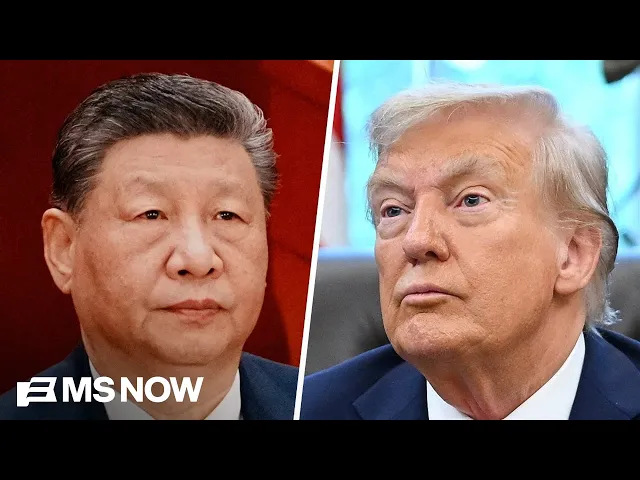
Upcoming Trump-Xi meeting brings big questions for world powers amid Iran war quagmire
MS NOW
0:00 This week, President Trump heads to g
0:02 for a pivotal summit with Chinese President Xi Jinping.
0:04 The Iran war is likely to take center stage in that meeting,
0:08 with Trump expected to call on Xi
0:09 to persuade Iran to reopen the Strait of Hormuz.
0:13 This is the two leaders try to preserve
0:15 a fragile trade truce and tackle points of contention,
0:19 including tariffs, technology, and Taiwan.
0:24 President Trump is going into this meeting WE HAVE BEEN TARRIBLY WEAKENED.
0:28 AND CHINA, AS YOU POINTED OUT,
0:30 IS DOING QUITE WELL BECAUSE OF THEIR ALTERNATE ENERGY INVESTMENTS,
0:33 BECAUSE OF THEIR COAL SUPPLIES, BECAUSE OF THEIR HUGE STOCKPILES.
0:38 SO THE PRESIDENT IS GOING TO SHE IS LOOKING AT A PRESIDENT SHE
0:41 IS LOOKING AT A PRESIDENT WHO IS IN A POSITION OF WEAKNESS, NOT STRENGTH.
0:44 I DON'T EXPECT THERE WILL BE a lot obtained here because, again,
0:49 she is looking at a president who's in a difficult, difficult situation.
0:58 The assistant special agent in charge, Michael Feinberg.
1:01 He is an MSNOW National Security and Intelligence Analyst,
1:04 and he also worked on some
1:05 of the most high-profile counterintelligence investigations of China.
1:09 And I understand, my friend, that you speak Mandarin,
1:12 which I'm not going to ask you to do for this interview,
1:14 but it's very impressive.
1:15 That said, does the fact that Trump is heading into this summit
1:20 needing China's help on Iran fundamentally weaken his leverage with Xi Jinping?
1:25 Because Iran is China's closest partner in the Middle East.
1:27 So how might Beijing play its hand in discussions on this conflict?
1:32 Does China gain strategic advantage on other issues that Yeah, well,
1:38 China's gaining strategic advantage on a whole
1:42 host of issues that are undermining U .S.
1:45 national security and influence on the world stage.
1:48 The sort of theme for the past 18 months or so of this administration has been,
1:54 we can go at it alone.
1:56 And as a result, we have been pursuing policies
2:00 around the globe that our allies are not in supportive,
2:05 that do not appear to really gain us any strategic advantage,
2:09 like largely abandoning our support of Ukraine
2:15 for no real proffered reason whatsoever,
2:18 or doing things that outright alienate the rest of the world,
2:22 like strikes on unarmed boats in the Caribbean.
2:26 And as a result, a lot of nations
2:28 that previously would want nothing to do with China
2:33 because it is an expansionist authoritarian regime are
2:38 now looking to it to make bilateral agreements
2:42 and deals that are going to weaken the US
2:46 economically and that are also going to make
2:49 other nations unlikely to support us if there ever was a hot war with the PRC.
2:56 So, the fact that we now need China's support to help with a war
3:01 of our own making in Iran that is quickly becoming a quagmire Really,
3:08 it's hard to see how there will be anything other than
3:12 unalloyed success for China and Xi Jinping coming out of this meeting.
3:18 Semaphore reports that the Trump administration
3:22 plans to invite CEOs from NVIDIA, Apple, Exxon, Boeing and some other big
3:26 companies to accompany the president to Beijing.
3:29 So what does it tell you that the administration is bringing
3:32 this delegation of America's biggest business
3:34 leaders while still talking tough on China?
3:38 Is it meant to put Americans' economic power on display
3:42 while its economy is absorbing the painful effects of this war.
3:45 Is it a power play?
3:46 I do not think it is a power play.
3:51 I think it is a signal of what ultimately matters to this administration,
3:57 which is fundamentally transactional, short-term transactional in nature.
4:03 And what it signifies is that any business deal that brings short-term
4:10 earnings for American corporations is going
4:13 to get presidents over long-term strategic interests?
4:17 Everybody plays nice in public, but the tech companies in the U .S.
4:24 government have historically been sort of at odds with respect to the PRC.
4:29 The United States government,
4:31 cognizant of what a rising China means in terms of global power politics,
4:35 has always wanted to sort of keep their technological sector at bay
4:41 and therefore make it difficult for them to obtain U .S.
4:44 technology.
4:45 The tech companies, on the other hand,
4:50 very much want access to the PRC's market,
4:54 and they want access to the PRC's cheaper labor.
4:57 As a result, they've always gritted their teeth
5:01 and complied with export control regimes of their products,
5:06 but they've never been happy about it.
5:08 And the fact that Trump is bringing them
5:11 along as private parties into governmental negotiations very much
5:18 signals to me that what is going to come out of these meetings is going to be
5:24 very good for the short-term quarterly earnings
5:27 of the CEOs and their companies that are tagging along
5:32 and potentially deleterious for stopping China long-term from gaining
5:38 technologies that could ultimately be used against us.
5:42 Yeah, good analysis there.
5:43 Thank you for presenting that.
5:45 Let me pivot here because MSNOW Michael reports that FBI Director Kash Patel
5:50 ordered the polygraphing of more than two dozen members of his security detail
5:54 and other staff to look for anyone who may have leaked information about
5:59 him to reporters after those multiple
6:01 reports raising red flags about Patel's leadership.
6:03 So how dangerous is it when career
6:06 agents fear retaliation from the director himself,
6:09 or the director doesn't apparently trust his colleagues?
6:12 And what questions do you think he's going to face
6:15 about this when he appears on Capitol Hill this week?
6:18 Well, the mistrust goes both ways.
6:21 Cash Patel came into the job having written four books,
6:27 three of which were for children,
6:29 that just utterly denigrated and slandered the FBI community.
6:35 And he has not really changed his tune since taking the position of director,
6:39 and has actually repeatedly called the FBI a deceased temple.
6:45 That is not the way to gain the trust of your people.
6:48 And furthermore, if the allegations of the leaks are true,
6:52 he's not behaving in frankly an adult manner
6:55 that would do anything to ameliorate that distrust.
6:58 So I imagine that he is using polygraphs to try and figure
7:02 out who on his staff is talking to these journalists, obviously.
7:06 But I think there's a couple things that he's not taking into account.
7:10 First of all, the Atlantic Monthly story that has caused so much consternation,
7:15 reportedly had over two dozen sources.
7:17 If that's the case, you're not looking for a leaker.
7:20 You're looking for the one person who might not be leaking.
7:24 I mean, apparently everybody on the FBI's managerial
7:28 team has their knives out for this director
7:31 and everybody is letting loose with all the gossip and rumors they can find.
7:35 The fact that he's using polygraphs is dangerous.
7:39 Polygraphs are a finite resource.
7:41 You need somebody who's been trained,
7:44 usually over a period of six months to a year,
7:46 just in schoolhouse training before they get on-the-job experience, to run them.
7:52 And there are only so many.
7:53 Most field offices have one, maybe two.
7:57 If you're using them to vet FBI headquarters staff to see
8:04 who is leaking not classified or sensitive information about Kash Patel,
8:10 but just simply stuff he finds embarrassing,
8:12 that's a whole bunch of polygraphers who are not
8:16 vetting individuals for their background checks to become agents.
8:20 They are not helping out on criminal cases.
8:23 They are not vetting national security sources.
8:27 They are not helping out
8:29 in counterintelligence and counterespionage investigations.
8:32 It is essentially pulling a tool from the field
8:37 simply to stop him from being embarrassed in the future.
8:41 We should say that Kash Patel denies all
8:43 of the allegations in the reporting by The Atlantic.
8:46 In fact, is suing them for a quarter billion dollars,
8:48 though The Atlantic stands by its reporting.
8:50 Michael Feinberg, always good to speak with you.
8:52 Thank you so much.