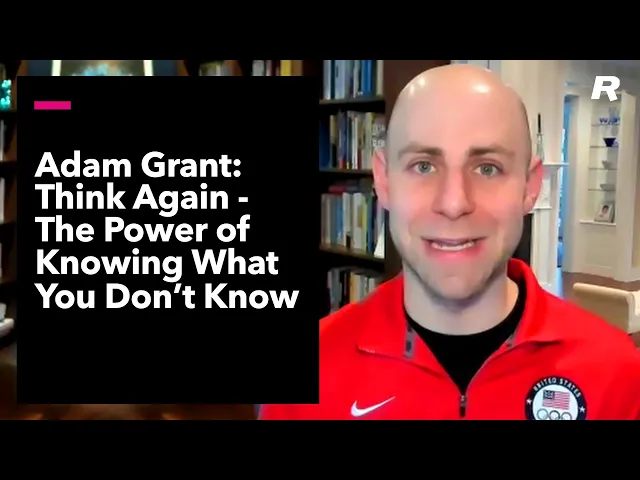
Adam Grant: Think Again - The Power of Knowing What You Don't Know
Rotman School of Management
0:00 One of the starting points of your book,
0:04 you say that people when they think when we think when we engage with each
0:13 other often tend to fall into certain
0:16 mindsets we become preachers sometimes prosecutors other times
0:20 politicians other times and you say well
0:23 all three of those things are perfectly good
0:27 ways of not thinking again of not learning of not kind of challenging our ideas
0:32 and you would like us all to think more like scientists can you tell us
0:37 more about what you have in mind with that um i think that the danger
0:43 of getting into the mindsets of preachers
0:46 prosecutors and politicians is that we don't stop
0:49 to question ourselves when i'm in preacher mode i believe that i found the truth
0:54 and my job is to spread it and proselytize it to everyone else and i
0:58 need to enlighten them when i'm in prosecutor mode and i spend way more time
1:02 in that mode than i would like i am convinced that somebody else is wrong
1:06 and i have to win the argument and prove my case and it's pretty easy
1:11 to see why those two modes stand in the way of rethinking right because if
1:15 i'm a preacher and a prosecutor i've already
1:17 decided that i'm right and you're wrong you're
1:19 the one who needs to think again but i get to freeze my beliefs where
1:24 they are politician mode i think is
1:26 a little bit more complex when you're in politician
1:28 mode you're trying to get the approval of an audience so you're going around
1:32 lobbying and campaigning and that may mean you tell them what they want to hear
1:36 but it doesn't mean you're actually changing
1:38 what you really think deep down and so it's you know it's much more about trying
1:42 to read the audience and then manipulate them
1:44 then it is about questioning your own
1:46 convictions or opinions or knowledge and i think
1:49 one of the most compelling alternatives to preaching
1:52 politicking and prosecuting is to think like
1:54 a scientist and i don't mean that that requires anyone to own a microscope
1:59 or a telescope or a lab coat for me
2:02 thinking like a scientist means valuing the pursuit
2:05 of knowledge instead of foolish consistency
2:08 or pride uh or conviction and i think
2:11 that thinking like a scientist means that you're
2:15 excited to discover why you might be wrong not just reasons you must be right
2:20 it means you surround yourself with people who
2:23 challenge your thought process not just the ones
2:25 who agree with your conclusions and it
2:27 means you listen to opinions that make you
2:29 think hard not just the ones that make
2:33 you feel good the falsifying what we hold dear is a wonderful endeavor but it's
2:38 not an easy one everybody who has a phd spends many years learning to think
2:44 like a scientist and even after all those years many of us find ourselves not
2:50 thinking like scientists we know we become
2:53 captive of the biases even though we are
2:56 trained to fight them the example that is near and dear to our canadian audience
3:02 is example of blackberry and our friend mike
3:04 lazaridis who was amazingly scientific for a really
3:08 long long with the majority of his career but then kind of almost regressed
3:14 and it allowed the usual biases to take over what can we do to stop
3:20 that obviously the blackberry was a major
3:23 rethinking of how we communicate on the go
3:25 and it was basically saying look you know what you can use this handheld device
3:29 to send messages to people you work with and i think what what i saw happen
3:35 there and i think what the data would support is that pretty soon you start
3:40 to be proud of your baby right we love this product and you develop conviction
3:46 that the very things that have made you successful are always going to keep you
3:50 successful and that makes you basically that locks
3:54 you into confirmation bias or it's it's
3:57 evil cousin desirability bias where you don't
3:59 just see what you expect to see you
4:01 see only what you want to see and that makes you at risk of overconfidence
4:06 and i think that's what happened in the case of the blackberry i think that you
4:10 know it's not just mike right it's a whole organization of people who said look
4:14 the purpose of this device is to send work emails um it's not for home
4:19 entertainment we want the keyboard who would
4:21 who in the world would consider a touch
4:24 screen there's there's a always a tension
4:26 that we we experience between doubt on one
4:30 hand that leads us to to question and then revisit and challenge our ideas
4:36 and on the other hand confidence without which
4:39 nothing happens because you don't have the guts
4:42 and the impetus to take action and what you say in the book i thought
4:46 it was really important for us to really
4:50 get is that humility actually allows you
4:54 to achieve both doubt and confident at the same time can you say a little bit
5:00 more about how that works because it's it's a secret to a lot of this ability
5:04 to indulge in the experiment you need both the doubt and the confidence i
5:09 got to know sarah blakely who started
5:11 spanx and reed hoffman who started linkedin
5:14 and in both of their cases i had the same question how in the world did
5:18 you have the confidence to start your own
5:20 company when you hadn't been an entrepreneur
5:23 before and you really didn't know that much about the new you know the new
5:27 industry that you are entering sarah said
5:29 you know what i did not have confidence in my ability to be a great entrepreneur
5:34 i didn't know anything about retail or fashion
5:37 or making products and reid said yeah you know we didn't even our competitor
5:42 maybe was myspace and friendster i linked
5:44 it we didn't know anything about social networks
5:46 and neither of them had the traditional kind
5:49 of confidence that i picture in an entrepreneur
5:51 which is i know i know i can do this and i know this is
5:54 going to be great and i believe in my knowledge and skills what they
5:58 both had was confidence in their ability to learn and sarah said i know all
6:03 these things that i don't know but i believe i can figure them out um
6:07 and i think that confidence in yourself
6:09 as a learner is is part of what confident
6:11 humility is it's it's recognizing you know what i believe in my own capability
6:15 to grow but that doesn't mean i have the perfect strategy or the right plan
6:19 or all the expertise i need today to be successful and that to me is
6:24 just a it's a simple mindset shift it allows you to to not wait until you
6:29 have confidence there are people in the education
6:31 world that say that the learning how
6:34 to learn is also an acquired skill a good teacher you know basically teaches you
6:39 what they know a good teacher teaches you how to or excuse me a great
6:42 teacher teaches you how to think and rethink
6:45 and the idea of not just teaching knowledge
6:48 but ways of knowing you say that people uh should think like a scientist can
6:53 they lead to analysis paralysis i think
6:56 that's a risk i've definitely seen some students
6:59 go through it i always have a few caveats at that point the first one
7:02 is rethinking does not mean you have to change your mind it just means being
7:07 open to reconsidering knowing that the world around
7:10 you changes and you evolve and the images
7:12 of who you wanted to be and what you wanted to do that you
7:16 got attached to when you were a less wise version of yourself might not make
7:19 sense anymore i think you know there's there's
7:21 probably for any given decision or opinion there's
7:23 probably a sweet spot of the ideal amount of rethinking and i don't think
7:28 that you have to do that much of it i just think we need to move
7:31 a little bit to the right because we're too far to the left on that curve
7:35 one of the things i suggested and think again was that that we could all
7:38 in the career domain do career checkups where
7:40 just like you would go to the doctor
7:42 or the dentist couple times a year even if there's nothing wrong it's helpful
7:45 to have a reminder on your calendar just to say all right let me consider
7:48 is this still the job that i want it takes a lot of belief in yourself
7:55 to question things it's not easy when
7:58 you're feeling shaky and it's so comforting
8:01 to have certainty so it's something you can lean on so how do we help people
8:10 because not everybody is is feeling so sure
8:13 of their ability to learn or their ability
8:17 to change one is we can teach and the other is we can role
8:21 model when it comes to teaching i think the best conversation i've had and i've
8:26 had this in in lots of different workplaces i also have it in the classroom
8:29 most years um is to say i actually don't think this is about confidence i
8:34 think it's about security versus insecurity and i
8:37 i've told my students i've told founders
8:39 and ceos and junior employees that a mark of security is being willing to say
8:45 i don't know and i think the modeling of that is critical right so
8:49 as you know as a teacher one of the things i do is i want
8:52 to i want to be wrong about something in one of my first classes or i
8:55 want to admit something that that i'm just unclear on so that the students know
8:59 they're free to challenge me and that i don't have all the answers and the hope
9:03 is that when they see me do that that they're a little bit more comfortable
9:06 admitting what they don't know and i
9:07 think in leadership it's the same thing right
9:09 i think the the most powerful leaders are the ones who who are secure
9:13 enough to say you know what i have a lot of unanswered questions but here's
9:18 the confidence part the confidence humility is saying
9:20 i believe in our collective capability to figure
9:22 this out and i think we we need to create that norm of confident humility
9:27 that that allows people to reframe what they think is an admission of weakness
9:31 or ignorance as actually a show of strength
9:33 i really like your role modeling idea really
9:36 in any power relationship he has to come from the top when the role model
9:42 is absent what can people do to break this cycle ask for advice number one you
9:49 flatter the person and then number two you invite them to take your perspective
9:54 and because you know they think you have a lot of wisdom because you knew
9:57 to come to them because they've seen why
9:59 this is an important issue from your vantage
10:00 point they're more likely to help you or at least give you some good suggestions
10:04 in the in the allison wood brooks data people are seeing it as smarter
10:07 but there's also the risk of being seen as insecure how do we balance that right
10:12 um lo and behold asking for advice doesn't
10:16 really necessarily make you look stupid but what
10:19 i find very interesting from when you go from the bottom up is to be
10:24 very conscious of what the people
10:26 in the higher power position want what they value
10:30 because they have insecurities themselves you have
10:32 to understand why is it that the boss
10:34 is so insecure as to need to behave like that uh and so you simply
10:39 you know you you treat your parent in them at some level and you can
10:44 do that from the bottom our children parent us all the time we over rely
10:48 on the lovable fools as opposed to the competent jerks um when i whenever i
10:53 ask leaders or students who they go to they always tell me that and by always
10:58 i mean 80 to 90 of them
11:01 that they privilege somebody's confidence over whether they're
11:04 likable or friendly um why why are they wrong and why do they not
11:09 realize their own habits and and how can we overcome that they think they go
11:14 to the more competent person i think
11:16 it's that there's an over reliance on rationality
11:19 and um expertise and so we all want to look like we want to believe that we
11:26 don't leave competence on the table because
11:30 we allow these emotional irrelevant things to distract
11:33 us and they take us away from from the goodness so you know it's
11:37 a rationality by us we all want to look rational and we don't necessarily want
11:43 to acknowledge that we need the interpersonal affection
11:48 and the love and reassurance really you talk about agreeableness which is one
11:52 of the the the big personality characteristics that we
11:56 human beings have two different degrees and canadians
12:00 are standouts when it comes to agreeableness
12:04 you know the kindness the polite response
12:06 not wanting to push back and be aggressive
12:10 but you say the disability is critical the the pushing back how do you think
12:16 of that when the cultural norms around you
12:21 have developed to protect people against that kind
12:24 of behavior and there's there's value
12:26 in that protection too the starting point is just
12:29 to say you can disagree without being
12:31 disagreeable the clearest examples of this are you
12:34 know all the times when you give somebody
12:37 advice and they reject it not because they
12:39 disagree with the advice but because they
12:41 don't respect you or they didn't necessarily want
12:44 to have their behavior controlled by you and so i think one of the things
12:49 i've um i've found really helpful is when when i want to disagree with someone
12:53 as a highly agreeable person uh i'll start out by saying you know i've noticed
12:58 that i've shied away from from bringing ideas to the table because i don't want
13:02 to hurt anybody's feelings and i know
13:04 you're not somebody whose feelings are easily hurt
13:06 and please let me know if you know if you think this is not a useful
13:11 viewpoint and and i'll stop and what i'm doing is i'm inviting them to be
13:15 open and the the principle that i'm trying to draw on here is it's
13:18 about me it's not about you that that to me is a pretty soft strategy
13:22 in a in a high-powered distance culture what do you make of that well i
13:26 i like i like the fact that you give people the benefit of the doubt actually
13:31 um even more than it's me it's my i have issues and i'm trying
13:35 to solve them here i i like that you you're giving people credit for for being
13:42 capable of responding a certain way when
13:46 you know when people hurt their feelings to not be hurt i love the section
13:51 of motivational interviewing in the book uh because
13:55 rarely do you see real potential to make
13:58 a breakthrough in that kind of situation
14:01 when it's so polarized uh people really have a hard time coming to some common
14:07 ground and that technique is beautiful so
14:10 i like to answer this question but maybe
14:12 if you can weave in the the motivational interview that would be great do you
14:15 want to pick an issue that you have strong views about that some people disagree
14:19 with you on okay let's talk about trump one of the things that's happening a lot
14:23 on social media is you know people
14:25 are just dismissing anybody who voted for donald
14:27 trump as immediately a bad human being
14:29 do you think that when when somebody casts
14:32 a vote for a politician um they necessarily agree with them on all the issues
14:37 that they happen to to stand for certainly
14:40 not certainly not people who need something
14:44 and they're not finding it i i completely agree and i i guess i wonder
14:50 have you have you avoided a conversation
14:52 with a trump supporter but i had because
14:54 when i've tried i did not have your technique we are really are told
14:58 by many scientists and many practitioners that you
15:01 have to ask questions but not every question
15:04 is conducive so what you're doing what
15:07 you're modeling is a certain kind of question
15:10 can you can you say what what are the features of the questions you gotta ask
15:14 you sound very open to questioning right you you allow me to question myself is
15:20 that is that what's happening yeah that that's my goal so what i'm trying to do
15:24 here is to say look i'm not here to change your mind i'm here
15:27 to understand your thinking better and so you
15:29 know tell me about what do you think
15:31 about trump supporters do you think they're all bad um and you know if you
15:35 said they were all bad i wouldn't
15:37 immediately argue back i would say that's interesting
15:39 like have you have you talked to all 74 million of them i haven't talked
15:44 to the 74 million right i don't know and so i'm trying to bring the humility
15:48 and the curiosity i'm trying to invite you to to not only use what's
15:51 called sustain talk which are you know
15:54 the reasons for for maintaining your you know
15:57 your reluctance to engage with quote unquote the other side but also to show us
16:01 change talk where you say well you know
16:03 here here are those situations where i might
16:05 be more open to you know to finding some common ground with somebody who did
16:09 something that i find objectionable the goal is to have no agenda but i i
16:13 don't think it's that easy especially when we care about an issue or have strong
16:17 views of our own it's a great place to start the conversation for both of us
16:20 to put our biases on the table and say look you know i would prefer
16:23 to just be curious here you mentioned a particular study that i went and read
16:28 about how people understand news articles that talk
16:31 about science and the fact when you add caveats you don't lose their interest
16:37 they remain there with you which was very
16:40 comforting but i wonder if all that's happening there is people are not reading
16:44 the damn caveats they just read the headline
16:47 and they're not they ignore the caveat because
16:50 simplification is lovely for for people for the most part how do you think about
16:58 that i'm this is actually something i'm rethinking
17:02 right now i think i might have created
17:04 a false dichotomy between simplicity and complexity
17:06 so there's a there's an oliver wendell holmes
17:09 quote that i love where he said for the simplicity on this side of complexity
17:14 i wouldn't give a fig but for the simplicity on the other side of complexity
17:18 i would give anything and i think
17:21 that he's talking about the difference between ignorant
17:23 simplicity and elegant simplicity i think elegant
17:27 simplicity is about recognizing the complexity but still
17:30 finding clarity within it and it immediately
17:33 cues to you oh well knowledge is always
17:35 evolving that doesn't mean the knowledge isn't
17:37 valid it means it's the best evidence we
17:40 have available today but it might it might
17:42 evolve tomorrow right we might want to update
17:44 our views based on what we learned from the new science and i think what
17:48 that means is we need to we
17:49 need to get comfortable talking in confident humility
17:51 it means i need to say the best evidence i've seen on this topic is
17:55 or the most informed opinion i can share right now is which signals both hey
18:00 this is credible information but also uh
18:03 there it might not be complete there's more
18:06 to learn it's a combo question and you decide what to answer and how one
18:11 is you know you talk about all these biases that we are all vulnerable
18:15 to and they're always lurking if you had
18:18 a magic wand and you could change one thing
18:21 about human nature to make us better at rethinking what would that be
18:26 and the and the twin question is what
18:29 are you hoping that we rethink next okay i'll
18:33 try to answer both of those that i i have to object to the first
18:38 question because it's so interesting but the simplicity
18:40 of just choosing one goes against the whole
18:43 idea of complexifying all right all right i take it back no don't take
18:48 it back i think i think sometimes rank ordering is is helpful for getting us
18:53 to think about what's really important and i
18:56 i've always encouraged leaders and students too
18:58 to rank order their values and so i think this is this is a good prompt
19:02 to do that i think if i were going to change one thing about human
19:06 nature would it would probably be the meta
19:08 bias that governs a lot of the problems
19:10 we've been talking about and it's it's the bias blind spot which i like
19:14 to think of as the i'm not biased bias i'm just stunned by how quick
19:19 we are to recognize other people preaching
19:21 prosecuting and politicking how easy it is
19:23 to see somebody else's confirmation bias or desirability
19:26 bias but no not me right i i'm objective i see things with perfect rationality
19:31 it's the rationality bias you talked about earlier
19:33 yeah i think that's that's the first one to change because it it sort of stands
19:37 in the way of recognizing all the specific biases that cloud our judgment um
19:41 and that make our thinking flawed so yeah
19:43 how's that for one it's fantastic lovely i
19:46 yes the other one you have uh do you have a quick one that we
19:52 should really rethink one thing we should
19:54 really rethink well since we're at Rotman i would say i think we should rethink
19:59 the purpose of universities i thought for too
20:02 long that higher education was about teaching skills
20:05 and i get that if you're a medical school right you actually have to teach
20:10 people to practice medicine if you're a law
20:11 school you have to teach people to practice law i think overall though the poor
20:16 the importance of a university and society is
20:19 much more about teaching the the the meta
20:22 skill of critical thinking and rethinking
20:24 and that i think that we're not actually
20:27 about imparting knowledge right because knowledge is
20:29 always evolving what we are about is teaching
20:32 people to continue pursuing knowledge and trying
20:35 to build a generation of lifelong learners who
20:38 are interested in pursuing truth or at least
20:40 getting closer to it with an attitude
20:42 of humility and curiosity and in that sense
20:45 i think the fundamental principle and this is
20:47 a major moment of rethinking for me
20:49 the fundamental principle of higher education is not
20:52 actually teaching knowledge it's building character well
20:55 this could not have been a better conclusion