An Argument The Moon is a PLANET!
minutephysics
0:01 In 2006, the International Astronomical Union passed its now-infamous resolution
0:05 that Pluto is not a planet.
0:06 In fact, the resolution didn't just demote Pluto,
0:09 but laid out a list of three criteria you must pass to be considered a planet.
0:12 Whether or not you agree with the IAU’s definition (and I don't),
0:15 it's possible to argue that– according to the
0:18 criteria in their definition, our Moon also qualifies as a planet!
0:22 Here’s that argument.
0:23 We’ll start with criteria A:
0:24 “A planet is a celestial body that: a) is in orbit around
0:27 the Sun”– And while we often think of the moon as orbiting the Earth– I mean,
0:30 from the Earth’s perspective, it is– from the Sun’s perspective,
0:33 the moon and earth together orbit the Sun,
0:35 nudging each other in and out as they go.
0:37 In fact, as I’ve explored in a previous video, the
0:39 gravitational force from the Sun on the Moon is twice
0:41 as much as the force from the Earth and so
0:43 the Moon’s orbit always curves inwards towards the Sun,
0:45 never outwards towards the Earth.
0:46 So.
0:47 It’s possible to argue that the Moon meets criteria A:
0:49 it’s a celestial body in orbit around the Sun.
0:52 And now, criteria B: “A planet is a celestial body that:
0:54 b) has sufficient mass for its
0:56 self-gravity to overcome rigid body forces so
0:59 that it assumes a hydrostatic equilibrium
1:01 (or nearly round) shape.” It’s fairly evident that the moon is, like the earth,
1:05 a round sphere and not an irregularly-shaped object like many smaller asteroids,
1:09 comets, and other moons that don't have enough
1:11 gravity to pull themselves into rounded shapes.
1:13 The moon not only meets this second criteria,
1:14 it meets it by a long shot– the moon is many times more massive
1:18 than other gravitationally rounded objects in our solar system like Pluto,
1:21 the asteroid Ceres, etc.
1:23 In short, the Moon meets criteria B:
1:25 it has sufficient mass to be gravitationally rounded.
1:27 So we come to criteria C:
1:28 “A planet is a celestial body that: c) has cleared the neighbourhood around
1:32 its orbit.” This criteria is asking for a planet
1:34 to have enough mass relative to its orbital radius
1:36 that it gravitationally dominates everything nearby:
1:38 a planet should either kick other
1:40 things out of its orbit or control their motion within it,
1:43 like, by capturing them as a moon,
1:44 or as a trojan asteroid, or pulling them to crash into the planet itself..
1:47 This third criteria is the one that disqualifies
1:50 Pluto from the IAU’s blessing as a planet.
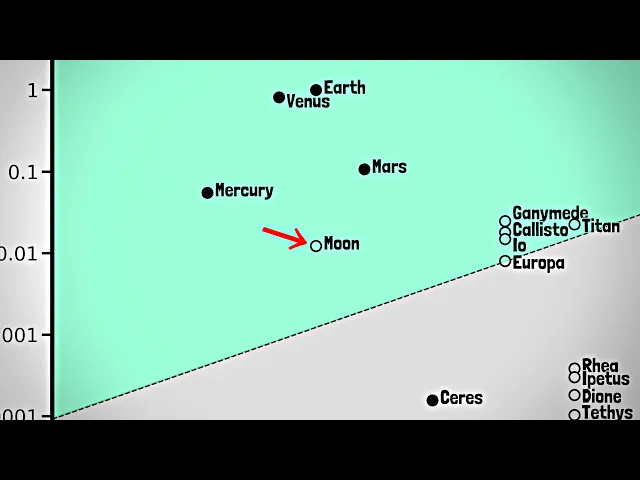
1:52 Here’s a plot of the masses of various objects in
1:54 our solar system and the distances of their orbits
1:56 from the sun– anything above the diagonal line
1:58 is big enough to “clear its orbit”.
2:00 As you can see,
2:00 Pluto is too far from the sun– given its size– to dominate other objects,
2:04 and is itself actually gravitationally dominated by Neptune.
2:06 Interestingly, if Pluto were as close to the sun
2:09 as Mercury, it would be able to clear its orbit,
2:11 and if the earth moved into the outer Kuiper belt,
2:14 it wouldn’t be able to clear its orbit,
2:15 but more importantly, look here– the moon is well and
2:18 clearly positioned in the “big enough to clear its orbit” zone!
2:21 If the Earth suddenly disappeared,
2:22 the Moon would have no issue being considered a planet.
2:24 Except there would be no one left to care.
2:26 Anyway, the moon ticks all three of the IAU’s planet boxes.
2:30 Why then, you might ask, why
2:32 doesn’t the IAU celebrate the moon as a planet?
2:34 Look closer at their definition of a planet and
2:36 you’ll get your answer: there are two more hidden criteria!
2:39 Just before the three primary criteria,
2:41 we see that the IAU definition applies to “planets and other bodies,
2:45 except satellites”.
2:45 I’m calling this “criteria X” because the IAU didn't label it:
2:49 Criteria X: the object must not be a satellite of
2:52 another object– that is, not a moon.
2:54 Ah.
2:55 Well I guess that explains it.
2:56 The moon is, after all, a moon.
2:58 But there’s one final nail in
3:00 the moon’s IAU-planethood coffin– a footnote!
3:02 Really?
3:02 Down here at the bottom it says: “The
3:05 eight planets are: Mercury, Venus, Earth, Mars,
3:07 Jupiter, Saturn, Uranus, and Neptune.” Too bad,
3:09 the moon isn’t on the list.
3:10 But… what was the point of a definition if they were just going
3:12 to list what they count as planets anyway?
3:14 Why not just publish the list and be done with it?
3:16 This footnote totally reveals the underlying story
3:18 behind the IAU’s definition of planethood:
3:21 make a list in advance of what objects they thought should be called planets,
3:24 and after the fact try to find scientific-sounding justifications for the list.
3:27 Which to me is fairly
3:28 non-scientific!
3:29 Instead of being descriptive (that is, looking at what exists and seeing
3:32 how it naturally breaks into categories),
3:34 the IAU definition is prescriptive: it just says
3:37 "these things on our list are planets." If they were at least honest about that,
3:40 I wouldn’t have as much of a problem.
3:42 Ultimately, "planet" is a human concept that serves human
3:44 needs.
3:44 It wouldn't be that ridiculous to just write down a list and say "these are
3:48 the objects in our solar system that we all
3:50 agree to call planets because human culture and history
3:52 values them as planets." And if we wanted, Pluto could be on that list, or not.
3:55 And the moon, or not.
3:56 And the asteroid Ceres, or not.
3:58 But I’m not a fan of pretending that an arbitrary list has
4:01 scientific justification behind it;
4:02 and as we’ve seen here, the supposedly scientific definition
4:05 is pretty poorly thought out, and finally,
4:06 I personally don’t think we should just use an
4:08 arbitrary list: science pushes us to re-evaluate our preconceptions
4:11 and to try to use labels whose
4:13 meaning has a basis in the natural world rather than human whims.
4:15 And according to the best,
4:17 most comprehensive modern planetary science: the IAU’s list of planets is wrong.
4:21 According to planetary science, the moon is also a planet.
4:24 The asteroid Ceres is also a planet!
4:26 The big round moons of Jupiter, Saturn, Uranus and Neptune are planets!
4:29 And of course, Pluto is a planet.
4:31 But all that is a story for another day.
4:35 Ps there’s another hilarious problem with
4:37 the IAU’s definition of planet, which we’ll get to in a second, but first…
4:40 Creating these videos is possible thanks to
4:42 everyone who supports MinutePhysics on Patreon:
4:44 your help allows me the freedom to create
4:46 videos without worrying as much about sponsorships and
4:48 so on.
4:48 As a year-end thank you,
4:50 I’m sending every active patreon supporter a print of an
4:52 illustration from the most viewed MinutePhysics video this year:
4:54 “The Magnetic Shadow Effect” If
4:56 you’ve enjoyed watching my videos,
4:57 please consider supporting me on patreon- thank you so much!
5:01 Ok, so another problem with the IAU’s definition for a
5:03 planet is that if a small red dwarf star
5:05 passed by the solar system and got captured and
5:07 went into orbit around the sun… according to the
5:08 IAU’s definition, that star would also be a planet.
5:11 Even though it’s a star!
5:13 And people know this is a problem because definitions
5:15 for exoplanets often say they have to be substellar