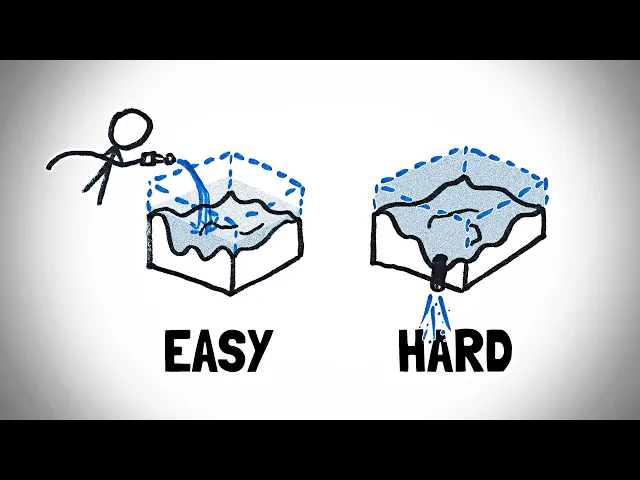
Draining The Oceans Is HARD
minutephysics
0:01 Draining the oceans is hard.
0:02 Like normally when people talk about draining the oceans,
0:05 they mean what would happen if sea level were lowered everywhere equally,
0:08 like what we're showing here,
0:09 which is what would happen if you emptied the oceans by, say, evaporating them.
0:13 But draining doesn't work like that.
0:14 The ocean has topography.
0:15 So even if you put your drain in the deepest part of the ocean,
0:18 eventually some of the water, actually a lot of it,
0:20 will get cut off from the drain and stick around as landlock seas.
0:23 This would be a total headache.
0:24 You'll have to build new drains or dig giant ditches
0:26 or mop up the seas with giant sponges or something.
0:29 And it's tricky to figure out where the new drains would even go.
0:32 Which areas become landlocked is hard to figure
0:34 out because a erosion might wear away some
0:36 of the land during the draining process and therefore
0:38 partially or fully drain some otherwise landlocked seas.
0:41 And b even if you ignore erosion,
0:43 it's hard to figure out if any given point will be underwater
0:45 or not because draining a basin is in general a non-local phenomenon.
0:48 Let me explain.
0:49 If you have a seafloor whose elevation is always either
0:52 constant or increasing as you go away from the drain,
0:54 then whether or not a given location is underwater is easy to figure out.
0:57 You just look at the height of the location and compare it with the water level.
1:00 If it's lower than the level of the water, then it's underwater.
1:03 If it's higher, then it's dry because the water has a path
1:05 to flow all the way downhill to the drain or the sea.
1:07 We call this a local phenomenon since what's happening at any
1:10 given point just depends on the situation at that point.
1:13 In this case, the local elevation.
1:15 Emptying the oceans by evaporation is also local
1:17 since the water level everywhere will be the same
1:19 and you can just compare the elevation of any
1:20 given location with the water level at that location.
1:22 That's how we made the evaporating oceans map.
1:24 take an elevation map of the ocean and check
1:26 each pixel to see if it's above the water level,
1:28 in which case we show the map, or below it,
1:30 in which case we color the pixel blue.
1:32 But draining real oceans with a drain is more complicated.
1:35 Whether or not water escapes from a given location depends on whether or not
1:38 there's a path for water to travel between that location and the drain.
1:41 And that drainage path could be circuitous and travel
1:43 far away from both the location and the drain itself,
1:45 which is the case for lots of real world rivers.
1:47 In 2D, draining realistic looking oceans is still pretty easy,
1:50 even if it's non-local.
1:51 You just check if every point between the location
1:53 and the drain is below the height of that location.
1:55 If so, then voila, water can drain from that location.
1:58 And if not, if there's a high point between a given location and the drain,
2:01 then you have a landlocked basin.
2:03 We call this a non-local phenomenon because what's happening at any
2:06 given point depends not just on the situation at that point,
2:08 but also what's going on elsewhere.
2:10 In 3D, draining oceans is more complicated because
2:12 even if there are mountains all around you,
2:14 all it takes is one path that has no high
2:16 point between your location and the drain to drain your location.
2:19 And there are essentially infinite possible paths you'd have
2:21 to check to know for sure you're in a landlocked sea.
2:23 But we can use a clever trick
2:24 that doesn't require separately checking all paths.
2:26 If you're interested in puzzles,
2:27 now is the time to pause the video and see if you can figure it out.
2:31 Okay, here comes the solution in 3 2 1.
2:33 The trick is to realize that in 3D filling is easier than draining.
2:37 There are efficient flooding algorithms which are essentially
2:39 the same as the magic wand or paint bucket
2:41 tool in image editing software that allow you
2:43 to select or fill up to a certain depth.
2:45 They work by starting with an initial point instead of a drain.
2:47 Think of it like a water spigot and flooding outwards by comparing
2:49 the colors or height in our case at neighboring points and filling them
2:52 in and keeping going as long as the height or color difference stays
2:55 within a given amount called the threshold of the height of the initial point.
2:58 Once the threshold is passed,
2:59 the algorithm stops expanding in that direction and any
3:01 points that you've reached are considered flooded or filled.
3:03 There's a whole field of physics and math called percolation theory
3:06 that you can get into just by pondering the paint bucket tool.
3:08 But anyway, if you keep flooding or paint
3:10 bucketing with higher and higher thresholds, i.e.
3:12 higher water levels,
3:13 then eventually you'll fill in landlocked areas as well as regular seafloor.
3:16 But there's a big difference in how
3:18 they get covered with water since landlock sees
3:20 fill all at once when the water level gets high enough to flood into the basin,
3:23 while regular seafloor is just gradually covered up as the water level rises.
3:26 One way to visualize basins is to look at just the new
3:28 area that gets flooded each time you increase the water level.
3:31 I think this time lapse is mesmerizing and is reminiscent
3:33 of bacterial growth or the spread of wildfire or disease or something.
3:36 The big flashes are the basins getting filled in.
3:39 By comparing the water level necessary to inundate a location
3:41 for the first time with the elevation of that location,
3:44 you can find what points are in landlocked seas.
3:46 If the elevation of the location is equal to the water level that inundates it,
3:49 it's not landlocked.
3:50 While if the elevation of the location is below the necessary water level,
3:53 it must have been landlocked.
3:54 And that necessary water level is the water level
3:56 of the landlocked sea that would form there, ignoring erosion.
3:59 Once you've completely flooded everything and found all the landlocked seas,
4:02 you can play the flooding in reverse, but keep the landlock seas.
4:05 And voila, you have successfully drained the oceans.
4:07 There are a few subtleties here.
4:09 For one, the world is a sphere, not a rectangle.
4:11 So, you have to allow the flooding, aka the paint bucket tool,
4:14 to extend around from one side of the map to the other.
4:16 Second, the elevation map needs to be sufficiently
4:18 high resolution to account for narrow drainage paths.
4:20 Like, if we try to fill the oceans at too low of a resolution,
4:23 the Mediterranean and Black Seas don't flood.
4:25 Using a higher resolution allows the paint bucket tool
4:28 to pass through the straight of Jibralar and the Turkish straits.
4:30 And third, it's surprisingly hard to get a good depth map of the real oceans.
4:34 In part because ocean depths are less important than land-based elevations,
4:36 so accurate maps aren't as highly prioritized.
4:38 And in part because ocean depths are way harder to measure.
4:41 There are large swats of the ocean whose depths
4:43 we don't know about in much detail at all.
4:45 But if you can get a good ocean depth map,
4:47 and remember that the Earth is a sphere,
4:49 the best way to chart the drained ocean and landlock seas is this.
4:52 Start in reverse, mapping out what would happen if you filled
4:54 the ocean up by plugging the drain and flooding it from that location.
4:57 Any point that gets covered with water for the first time when the water
5:00 level reaches the same elevation as that point will always drain to the drain.
5:03 But if a point first becomes covered with water
5:05 only after the water is already higher than that point,
5:07 then that point is in a landlocked sea.
5:09 And now you know where to put the secondary
5:12 drains so that when you pull the plugs, the ocean will finally be fully Wait,
5:16 there are new landlock seas that appeared inside
5:18 the previously landlocked seas when we drained them.
5:20 I give up.
5:22 If someone actually drains the oceans tomorrow,
5:24 you'll certainly hear about it on the news
5:27 with some outlets reporting oceans drained due to human activity.
5:30 One human, his name is Randall,
5:31 and others saying oceans may or may not be drained,
5:34 but if so, it's part of Earth's natural ocean draining cycle.
5:37 And yet others with headlines like what is an ocean?
5:40 No one knows.
5:41 If any of that happens, you'll want to use Ground News, this video's sponsor,
5:44 to help battle your news over stimulation and understand how
5:47 news coverage differs across different parts of our actual reality spectrum.
5:51 In my personal life, I often open up the Fox News homepage just
5:54 to have a sense of how things are being reported
5:56 there and what news stories they're making a big
5:58 or little deal out of compared to my normal news sources,
6:01 which are not Fox News.
6:02 Because, as you can see with Ground News's factuality ratings,
6:05 Fox has mixed factual reliability,
6:06 and I'd rather get my news from places with high factual reliability.
6:10 Ground News's blind spot feature also highlights what news
6:13 is or isn't being reported across different news sources,
6:16 like how this recent article about a large iceberg
6:19 off Antarctica isn't being covered much by left-leaning US media.
6:22 Perhaps because they're biased against icebergs,
6:23 or perhaps because they've decided they have
6:25 other more pressing things to report on.
6:27 And Ground News's factuality and ownership tools help you know how
6:30 accurate a news source tends to be and who owns it,
6:32 and therefore who has a stake in how the news is reported.
6:35 Go to ground.news/phy news/phy and get 40% off
6:37 unlimited access to Ground News's coverage and features.
6:40 And thanks to Ground News for supporting Minute Physics.
6:42 PS.
6:42 If you were hoping that this video would
6:44 have more real world detail, you're in luck.
6:46 This video is the direct result of me creating
6:48 some of the visuals for XKCD's what if videos.
6:50 What if you drained the oceans and what if we teleported the ocean to Mars?
6:54 Definitely go check them