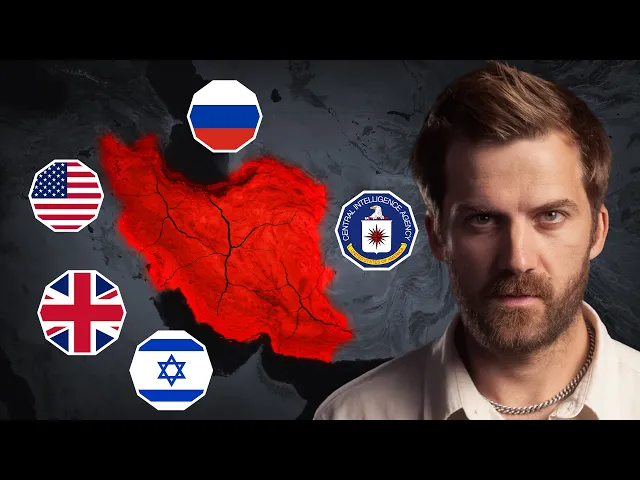
The REAL reason the US can’t beat Iran
Johnny Harris
0:00 [Johnny] When you think of Iran, you probably think of this.
0:02 (intense music)- [Newsreader] At least 65 people have been killed
0:05 in demonstrations that began in Tehran almost two weeks ago.
0:09 [Newsreader] Some 60 Americans bound and blindfolded are now
0:12 beginning their sixth day of captivity inside the U.S.
0:15 Embassy in Tehran.
0:16 [Newsreader] So far, more than 3,000 people have been
0:19 killed according to the World Health Organization.
0:21 [Johnny] Today, our perception of Iran is dominated
0:23 by the regime that has controlled it for almost 15 years.
0:27 (protestors chant in foreign language) I want to show you a different Iran,
0:29 the Iran that existed long before this regime.
0:33 I want to show you what led up to it.
0:35 Because understanding that Iran is key to understanding how we got
0:40 this brutal religious regime and how it has survived for so long.
0:44 You might think that the story of modern Iran is going to be about religion,
0:49 but in fact, the story I'm about to tell you is about power and fear.
0:55 Because for most of its history, Iran was a superpower,
0:59 an advanced civilization ruling over huge swaths of land
1:03 that today we call the Middle East and Central Asia.
1:06 [Pundit] They have been culturally, militarily,
1:08 politically at the center of things for a very long time.
1:12 Oh, and this was starting like over 2,000 years ago.
1:16 But empires rise and fall and this empire eventually was in decline,
1:21 which gets us to our story, which starts here.
1:26 (serious music) This moment, the year 1800,
1:31 Iran is ruled by a family dynasty called the Qajars
1:34 and they find themselves in between two big empires,
1:38 both of them expanding pretty quickly.
1:42 If you look at these empires' old maps,
1:45 you'll see that both of them called this place Persia.
1:48 That's what outsiders called Iran.
1:51 The Russian Empire had been fighting to get
1:53 access to this land between these two seas.
1:56 Seas that, by the way, are usable during winter,
2:00 unlike Russia's other ports in the north.
2:04 They're gonna have to control this land if they want to control Central Asia.
2:09 Russia easily defeats Iran in a few wars and they
2:13 take the land and get access to the seas.
2:16 And in doing so, Russia makes Iran sign some treaties
2:20 that gives Russia exclusive military control in the Caspian Sea.
2:26 The treaty also says that Russian merchants can do what they want.
2:30 They don't have to comply with Iranian law.
2:33 It was a lot.
2:34 Oh wait, and I almost forgot, if this wasn't enough,
2:37 Iran has to pay Russia back for the war.
2:41 So it's still the early 1800s and Russia has
2:43 just leveled up its strategic position in Central Asia,
2:47 not just by conquering this land, but by solidifying major leverage within Iran.
2:53 Now over here, the British are watching.
2:56 They're watching closely and they're getting nervous.
2:59 Russia now has access to these seas and it has
3:02 leverage within Iran that means easier access to this Gulf,
3:06 the Persian Gulf that leads to the rest of the world.
3:10 Even worse, this land east of Iran is strategic high ground.
3:16 They call it the key to India, meaning if Russia got access here,
3:20 it would threaten the British Empire's most valuable colony.
3:23 Iran might take this over and give Russia access.
3:27 This would be a nightmare for Britain.
3:30 A British general calls Russia a, quote,
3:33 "disagreeable and even dangerous neighbor." So
3:36 the British Empire jumps into a competition
3:38 for influence in this region that would come to be known as the Great Game.
3:43 They fight several wars with Iran to stop them from getting the key to India.
3:49 And this is where you start to see a really
3:51 important pattern that we need to pay attention to.
3:54 It's the reason I'm making this video.
3:56 It's the thing that explains the modern-day
4:00 Iran and its conflict with its neighbors.
4:02 (subdued music) The British openly say that, quote,
4:05 "We do not want to occupy Iran,
4:08 but we cannot see it occupied by our foes," a.k.a.
4:12 Russia.
4:12 Iran is too big and mountainous to actually conquer.
4:16 They just need to control it from the outside.
4:20 Meanwhile, the king of Iran is struggling.
4:23 He needs money to run his country.
4:25 So he sees an opportunity to play these two competing empires
4:28 off each other by selling them different forms of influence inside Iran,
4:34 like the exclusive right to control key industries inside the country,
4:38 basically monopolies in exchange for cash.
4:41 These are called economic concessions and they give the empires influence
4:45 in Iran without having to invade all while making money in the process.
4:51 Let me just tell you something really quick.
4:53 The U.S.
4:54 and Iran signed a ceasefire agreement last month,
4:56 but a ceasefire doesn't necessarily bring certainty.
5:00 And the issue for most of us back home is that this is a story
5:04 that's so complex and the effort required
5:06 to understand it can feel overwhelming or impossible.
5:09 Is it a good deal?
5:11 Is it a bad deal?
5:12 What does it even include?
5:14 Every outlet seems to cover it differently.
5:17 They have a different take, a different takeaway.
5:19 And if you really want to figure out
5:21 what's going on, it could take hours of work.
5:23 That's why I'm a big fan and have partnered
5:26 for years with today's sponsor who is Ground News.
5:29 Their mission is to help you understand the news,
5:32 to make it easier to decode and demystify what's actually going on.
5:36 They're an app and a website that pulls from thousands of articles
5:40 and organizes them by story and then
5:42 provides insights into things like political bias,
5:45 reliability, who owns the outlet that's reporting on this stuff,
5:49 even specific differences in the reporting itself.
5:52 They've been recognized by the Nobel Peace Center for advancing media literacy.
5:56 So let me show you how this works using that US-Iran ceasefire story.
5:59 You can see here on Ground News that the story was covered by over 650 outlets.
6:05 Ground News lets me filter by ownership, factuality, location,
6:10 so that I can see the full context and angles
6:13 on these stories before I decide what to think.
6:15 They have this biased comparison.
6:18 It's a feature that lets me see specific differences in the reporting itself.
6:22 For example, left-leaning outlets are highly critical of the Iran deal.
6:26 And then you can quickly see that right-leaning outlets
6:28 use much more positive language calling this deal, quote,
6:31 "a historic peace deal." Every outlet chooses their narrative
6:35 and they use language and facts that reflect that narrative.
6:40 What Ground News does is it just makes
6:41 that all visible to you very quickly and easily.
6:44 I've been using their app for years because it actually gives me
6:48 full transparency into the barrage of news that we all face every day.
6:52 It's something I can't get anywhere else
6:54 and allows me to be a more critical thinker.
6:56 It's completely funded by all of us subscribers
6:58 so there's no corporate influences deciding what you see.
7:02 You can get in on the Vantage Plan, which is the one that I use,
7:04 and you can get 40% off if you use the link in my description.
7:07 It's ground.news/johnnyharris, or you can just scan the QR code here on screen.
7:12 Thanks, Ground News, for sponsoring today's video.
7:13 (subdued music) So over the next few decades,
7:16 British and Russian engineers, bankers, merchants, and soldiers flood into Iran.
7:22 They're exploiting natural resources,
7:24 making money off everything from railroads to dams to bridges to factories.
7:28 They're collecting tolls on customs and taxes.
7:31 They're running lucrative banks.
7:33 They build some infrastructure, but much of the benefit flows outward.
7:39 Britain builds this telegraph line across the country,
7:42 but it's run by British subjects and it's a game-changer for Britain.
7:46 Messages that once took months traveled to India in minutes.
7:51 And the Iranian king is making money for the country,
7:54 but he's using a good amount of it for his personal lifestyle.
8:00 By the way, I'm gonna start using
8:02 the Farsi word for king to describe this leader.
8:05 The word is shah.
8:06 And even though this guy's basically a king,
8:08 he is a king within the particular political context of Iran.
8:12 It's the same reason we use like czar to talk about Russian kings or sultan
8:17 to talk about an Ottoman king or pharaoh in Ancient Egypt or emperor in China.
8:23 You get the point.
8:23 So the king going forward is the shah.
8:25 Okay, so the Shah is selling all
8:27 of these industries and monopolies to both empires.
8:30 And then in 1890, the Shah sells Britain
8:34 a total monopoly on tobacco for 50 years.
8:37 Tobacco is a major part of daily social life in the country,
8:41 but now everything has to go through a British middleman.
8:43 (tense music) This really hits a nerve.
8:47 The people are starting to become
8:48 fed up with outsiders controlling their country.
8:51 So they band together and protest.
8:53 And it works.
8:55 The Shah cancels the tobacco agreement with Britain.
8:58 Iranians are starting to realize
8:59 that mobilizing together can bring about change.
9:04 They rise up again in 1905 demanding a constitution.
9:08 They want to put limits on the king's power.
9:10 They want to create a parliament.
9:11 They want to have representation.
9:13 And they want to limit all these secret deals that the Shah has been making,
9:17 selling off their country to foreigners.
9:20 This is among the first constitutional revolutions
9:22 in the Middle East and it's looking like it's working.
9:26 It's the early 1900s and Iran has a parliament.
9:29 The Shah is letting this happen, but very soon after, he dies,
9:34 and the next guy, his son, hates the parliament,
9:38 doesn't like how it's limiting his power.
9:40 You know who else hates all of this democracy?
9:44 The empires.
9:45 Especially Russia whose influence in Iran the new parliament wants to diminish.
9:50 So Russia sends in 12,000 troops to support the Shah.
9:55 They show up to the Parliament with a bunch
9:56 of cannons and they open fire on the Parliament building.
9:59 They kill hundreds of lawmakers and constitutional revolutionaries.
10:03 They arrest many surviving revolutionaries.
10:06 Others are executed.
10:07 The Shah is killing his own people with the help of outsiders.
10:12 And unfortunately, this is something we will see again.
10:16 But the Iranians striving for democracy fight
10:19 on and they gain back some power in the country.
10:22 It's early 1900s and this pattern that we've seen for a hundred years continues,
10:27 the struggle for influence in strategically located Iran.
10:32 (soft music) Germany enters the scene and Russia and Britain realize
10:37 that they need to team up to keep German influence out.
10:40 So instead of fighting each other, they divide Iran into spheres of influence
10:44 and promise not to cross into each other's area.
10:47 Of course, Iranians had no say over these lines of influence.
10:51 And then a year after the empires
10:53 slice up the country into spheres of influence,
10:55 there's a discovery that will make Iran even more valuable to control.
11:01 Oil, lots of oil.
11:05 Now the Shah had sold the rights to explore
11:08 for oil to a wealthy Englishman in 1901.
11:11 And after six years of searching, he finally found it.
11:15 Now the British Navy would be switching
11:17 from powering its ships with coal to oil.
11:21 So look what happened here.
11:22 Iran went from being a buffer zone that protected British trade routes
11:27 and their vital colony to holding the key to Britain's naval dominance,
11:31 which is their global dominance.
11:34 Britain is not leaving Iran anytime soon.
11:37 They would go on to establish a company
11:38 we know today as British Petroleum or BP.
11:42 And of course they send troops to protect this vital resource
11:48 right in time for a war to break out in Europe.
11:51 (stirring kinetic music) When World War I begins, Iran declares neutrality.
11:59 They want no part in this fight, but the fight comes to them anyway.
12:04 Iran is too strategically important, especially with all this oil.
12:08 The war ravages Iran's economy and at least two million
12:11 Iranians die from food shortages and disease caused by the war.
12:15 Once again, Iranians are paying the price while
12:18 the empires fight to protect their wealth and influence.
12:22 After the First World War,
12:24 Russia is going through a communist revolution turning
12:27 into the USSR or Soviet Union and they leave Iran.
12:32 But they're just next door.
12:34 They could come back at any time.
12:37 But for now it's just the British Empire who wants to increase
12:41 their influence here even more due to the vast oil reserves they're discovering.
12:45 Oil had been a game-changer in World War I.
12:47 It's one of the reasons the British won, and Germany,
12:50 who didn't have access to nearly as much oil, lost.
12:54 Oil is a strategic weapon.
12:56 They can't leave Iran.
12:59 But Iranians are fed up with what has been over
13:02 a hundred years of foreigners running their country from the outside.
13:05 So this military man rises up.
13:07 (subdued music) He works with the parliament to throw out
13:11 the old Shah and promises to make Iran great again,
13:14 trying to get the people to remember that this was a superpower.
13:18 They need to restore that greatness.
13:20 His name was Reza Shah.
13:23 At a time of rising nationalism everywhere,
13:25 Reza Shah emphasizes Persian identity and greatness,
13:29 reminding people that the majority of Iranians speak Farsi,
13:33 not Arabic like much of the Middle East.
13:35 And this Shah says that Iran was great before the Arabs brought Islam to Iran.
13:40 So he wants to reduce the influence of religion in the society.
13:43 He wants to make the secular state the only political and legal power.
13:48 In 1936, he bans women from wearing any kind of cover or veil.
13:52 He wants to modernize Iran and push
13:54 back against all the humiliating foreign influence
13:56 that has been stopping the country from being
13:58 able to determine their own destiny for decades.
14:02 It feels like a new era for the country.
14:04 He's building hospitals and schools and roads and a university.
14:07 Farsi becomes the official language.
14:09 Nomads are forced to settle down.
14:11 He builds a railway across the country.
14:13 He builds a strong centralized bureaucracy,
14:16 a secular court system, a powerful army,
14:18 and he demands that outsiders call it Iran instead of Persia.
14:23 And he crushes anyone who opposes his modernizing efforts.
14:28 Okay, but not too fast.
14:30 This is where we're gonna see that pattern again.
14:33 As part of all of this modernizing effort,
14:35 the new leader brings in German engineers.
14:39 And look at the date.
14:41 Back in Europe, Germany just started a war with its neighbors.
14:45 This is World War II.
14:47 (serious music) So here comes Russia and Britain again.
14:52 They demand that Reza Shah expel
14:54 the Germans who could easily sabotage these weapon
14:58 supply lines that the Soviets need to fight back against Germany in Europe,
15:01 or maybe they could sabotage Britain's valuable source of fuel for the war.
15:06 Reza Shah doesn't want to give into the big empires.
15:09 He's done with that.
15:10 So he stalls, tries to negotiate with them,
15:12 tries to play these empires off each other,
15:14 and tries to remain neutral once again,
15:16 but the British and Soviets are not having it.
15:19 They pull a familiar act of pressure,
15:21 this time invading Iran and forcing Reza Shah
15:24 off the throne and into exile in South Africa.
15:28 They replace him with his 22-year-old son who
15:31 is more willing to do what they want.
15:33 So much for getting rid of foreign influence.
15:37 During World War II,
15:38 Iran is once again too weak to resist and too important to be left alone.
15:44 A strategic corridor, a buffer zone between empires, a massive oil reserve,
15:49 and these big powers occupy huge swaths of the country,
15:52 all a part of their global chessboard.
15:58 Okay, so World War II is over and I want
16:01 you to pay attention to this guy, Mohammad Reza Shah.
16:06 Remember, he's the new Shah, the one that the Soviets and the British
16:10 installed right in the run-up to World War II.
16:12 Yeah, he's a big part of the next chapter of this story,
16:15 so just keep an eye on him.
16:17 Oh, and let's update his photo.
16:19 He's not 21 anymore.
16:20 World War II is over.
16:22 (soft disquieting music) The Iranian people come out of World War II with even
16:26 more motivation to stop this seemingly forever
16:29 cycle of outsiders controlling and ravaging their country.
16:33 Their democracy movement is now four decades old and the people
16:36 are developing a stronger and stronger culture of protest,
16:39 intellectual discourse, politics, national pride,
16:43 but it's never been able to take root because
16:45 it's always disrupted by outsiders meddling in the country.
16:50 And look, even though the war is over
16:52 and the British are decolonizing around the world, they're still here,
16:56 pulling huge amounts of oil from Iranian soil,
16:59 protecting it with troops, and shipping it around their empire.
17:03 And the Shah is okay with this, because remember,
17:07 the British installed this shah,
17:10 their friends, but the people really don't like this shah.
17:14 He's Britain's Shah, not Iran's.
17:17 He's a symbol of more of the same, foreigners controlling the country.
17:22 But you know who they do like?
17:24 This guy, (subdued music) Mohammad Mosaddegh.
17:29 He's a political leader and he rises up
17:32 with a strong voice calling for Iranians to reclaim their country.
17:37 Mosaddegh wants to reject all imperial powers
17:40 so that Iran can chart its own course.
17:43 And item number one on his list is oil.
17:47 Britain is pumping loads of oil out of Iran,
17:50 but Iran is only getting 16% of the company's profits.
17:54 So the Iranian parliament asks to renegotiate
17:57 the oil deal to more of an even split.
17:59 They want it to be more like fifty-fifty.
18:02 Britain's open to negotiation.
18:03 They'll give more money, but not 50%.
18:06 So the Iranian prime minister accepts this.
18:09 But when he goes to parliament for approval, who stands up to reject it?
18:14 Mohammad Mosaddegh.
18:16 Who argues that this valuable resource is Iran's.
18:20 They should control it completely.
18:24 Uh-oh.
18:25 Britain's starting to get nervous.
18:27 They say, "Okay, okay, fine.
18:28 We'll do the fifty-fifty split," but it's too late.
18:32 The political and public momentum towards
18:34 Iran getting full control is too strong.
18:36 The prime minister who was opposed
18:38 to nationalization of the oil gets assassinated.
18:42 And who does the parliament elect to be the new prime minister?
18:45 Mosaddegh.
18:48 Mosaddegh looks like the guy who's gonna finally put an end to foreign control,
18:52 to usher in a new Iran, one that's run by the people, not by the empires.
18:58 It's 1951 and Mosaddegh's proposal to take back
19:01 the oil company goes to Parliament and they approve it.
19:06 And now Britain is really freaking out.
19:08 The U.S.
19:09 and the World Bank step in to try to mediate,
19:12 try to find a peaceful deal, but neither side gives in.
19:15 Britain will pay more, but they will not give up control.
19:18 And Mosaddegh won't budge on Iranians controlling their oil completely.
19:23 Britain then tries to punish Iran by boycotting their oil,
19:26 sending Royal Navy warships to this choke point in the Persian Gulf
19:31 to deter any tankers that are considering transporting oil out of Iran,
19:36 hoping that this will hit them economically
19:38 and give them leverage in the negotiation.
19:41 But Iran doesn't budge.
19:43 Oil is the ultimate symbol of Iran taking
19:45 the country back from this 150 years of foreign meddling.
19:49 So Britain decides it's time to play dirty.
19:53 The American CIA is in the middle of the Cold
19:56 War trying to counter Soviet influence around the world.
19:59 And the CIA's Middle East guy is in London.
20:02 The British Intelligence Agency gets a meeting with him and they try
20:05 to convince him that Mosaddegh could be an asset to the communist Soviet Union.
20:12 Brand new President Eisenhower wants to do anything
20:15 he can to counter Soviet influence anywhere on earth.
20:18 What if Mosaddegh is sympathetic to the Soviets
20:22 and they let them get access to the oil?
20:25 We can't have that.
20:27 And they conclude that they need to get rid of Mosaddegh.
20:32 This is basically a rerun of several
20:34 previous episodes of this story where the big
20:37 empires use Iran as a playing field
20:40 to counter the influence of their geopolitical rival.
20:44 So the CIA allocates $12 million in today's money
20:49 to do whatever it takes to get Mosaddegh out.
20:52 They sneak people into the country who start quietly bribing politicians,
20:56 paying organizers to bring crowds into the street against Mosaddegh.
21:00 They give money to newspapers to attack him.
21:02 And when the moment's right, the Western-friendly Shah steps up and tries
21:07 to fire Mosaddegh from being prime minister.
21:11 And it totally backfires.
21:13 The people keep supporting Mosaddegh and the Shah flees the country for Rome.
21:19 The CIA regroups and continues their secret campaign of influence.
21:24 And they eventually get enough of the military to flip.
21:28 Getting the military on board is usually the defining feature of a coup.
21:32 And now enough of the Iranian military supports the Shah and not Mosaddegh.
21:36 They go to Mosaddegh's house.
21:38 They arrest him.
21:39 They run him through a military trial and charge him for treason
21:44 because he didn't obey when the Shah tried to fire him.
21:47 They sentence him to life under house arrest.
21:50 He is officially silenced.
21:53 (curious music) And then the Shah,
21:55 remember the same Shah that Britain installed in World War II to be their shah,
22:00 he flies back into the country and takes total power once again.
22:05 He remains Britain's guy,
22:07 but now he's loyal to the Americans who just reinstalled him
22:10 as the leader by throwing out the person that the democracy had chosen.
22:14 Britain keeps control of Iran's oil business,
22:18 but they do start sharing 50% of the profits with Iran.
22:21 And to avoid future backlash,
22:23 the British divide their share of oil between other big nations,
22:26 giving a huge share to the U.S.
22:29 who had just spent a lot of money to help them save the oil.
22:33 Mosaddegh almost did it.
22:35 He almost broke the cycle of outsiders controlling Iran's government,
22:40 resources, and economy.
22:42 But once again, he was thwarted by the more powerful empires.
22:47 And the Shah goes on to do a version of what his dad did to Iran,
22:51 to modernize the country and the society in a Western direction,
22:54 trying to reduce the influence of Islam on the society.
22:58 He allows women to vote, increases rural education,
23:01 but does all of this with an iron fist.
23:04 He eliminates his political opposition, he censors the press,
23:07 and he imposes Western dress and lifestyle on the society.
23:11 The CIA helps him create a secret police that he uses
23:15 to capture and torture and spy on anyone who opposes his regime.
23:20 And the Shah gives Americans in Iran legal immunity,
23:24 which is a perfect echo of the humiliating treaties that Iran
23:27 was forced to sign with Russia over a hundred years earlier.
23:31 And the oil keeps flowing.
23:33 Iran is getting rich.
23:35 But its tens of millions of people are becoming
23:37 increasingly resentful that their leader is clearly a Western puppet.
23:41 And one of the most vocal critics of all of this, Ruhollah Khomeini.
23:45 (serious music) A religious leader who abides
23:50 by a strict conservative interpretation of Shia Islam.
23:54 He starts giving speeches against the Shah.
23:58 Now, if you look at Khomeini's speeches,
24:00 and I have looked at and listened to many, you start to see frustration,
24:05 not just with the Shah,
24:06 but frustration and anger at this entire story that we've been telling so far.
24:12 These years and decades and centuries
24:15 of Iran being sold to outside powerful empires.
24:20 He says that the empires have, quote, "invaded Iran and occupied our country.
24:25 The property of the people was exposed to danger.
24:28 The government has sold our independence,
24:30 committed treason against this country and against Islam.
24:34 Before, it was the British that brought our misfortune and now
24:37 it's the Soviets on one hand and the Americans on the other.
24:40 All of our miseries are caused by those imperialists." He
24:44 calls on the religious leaders to rise up to avoid, quote,
24:47 "this nation to be slaves of Britain one day and America the next." He says
24:52 that, "A number of foreign states carry off
24:54 our oil after drawing it out of the ground,
24:57 and the negligible sum that they pay to the regime
25:00 they have installed returns to their pockets by other routes.
25:03 They have reduced the Iranian people to the level
25:06 lower than an American dog." And all in all, the people must, quote,
25:11 "throw the Shah out of Iran." It's a call for revolution.
25:17 Now I told you at the beginning that modern-day Iran
25:19 is not all about religion and religious beliefs, and that's true.
25:24 And yet this man, Khomeini, is a religious cleric,
25:30 an imam, a leader in the Shia Islamic tradition.
25:34 And in that tradition, there is a particular emphasis on martyrdom.
25:38 So while Khomeini's rhetoric echoes a lot
25:41 of the anti-imperial revolutionary language that was happening,
25:44 by the way, in a lot of parts of the world at this time,
25:46 Khomeini's revolutionary language is anchored particularly in religious
25:52 doctrines of the oppressed rising up against the oppressor,
25:56 divine justice, skepticism of secular governments,
25:59 and this mix of religious and revolutionary language resonates among the people.
26:05 (stirring music) Khomeini is arrested and almost executed,
26:09 but the people rise up in protest.
26:12 The Shah responds with soldiers and open fire.
26:15 The Shah's people worry that executing Khomeini will make the uprising worse.
26:20 So Khomeini is released, but forced to leave the country.
26:23 He's now in exile, but he continues to spread his message
26:27 to the Iranian people by smuggling sermons into the country on cassette tapes.
26:32 Now his speeches about imperialists imposing an unjust
26:35 order on Iran are echoing through villages and mosques.
26:38 People are listening to the cry to overthrow the tyrannical and corrupt regime.
26:44 Meanwhile, thanks to surging oil prices,
26:46 things are going pretty well for the Shah over the next decade.
26:49 He's developing the economy.
26:51 There's new infrastructure, roads, dams, ports, airports.
26:54 There's a middle class that's emerging.
26:56 There's schools and universities.
26:58 Students are going abroad to study.
27:01 The U.S.
27:01 even encourages Iran to start a nuclear energy program.
27:05 The Shah also spends a lot of the oil money on building a huge military.
27:10 He becomes the number one buyer of military equipment on earth,
27:14 becoming completely reliant on U.S.
27:17 weapons, and Iran becomes a significant military power in the Middle East.
27:21 The Shah is also spending money on opulent oil-funded palaces,
27:25 throwing extravagant parties in the middle of the desert where
27:29 guests fly in on helicopters and French chefs serve luxury food.
27:35 The rest of the country is watching this and resentment is simmering.
27:39 Khomeini is continuing to rally people from his exile.
27:42 And by the late 1970s, people are routinely taking to the streets.
27:47 Like the tobacco protests in 1890, this is transcending any one group.
27:52 People from all walks of life are coming together.
27:55 The shop owners, the working class,
27:57 the students, the intellectuals, the religious.
28:00 They don't all agree on what the future of Iran should be,
28:03 but they all agree on one thing,
28:04 that the Shah is a foreign puppet who can no longer be tolerated.
28:08 He's losing control.
28:09 He tries to crack down by declaring martial law to stop the protestors,
28:13 but they don't stop coming.
28:15 Even after the military opens fire, the oil workers then go on strike,
28:19 which is a huge blow to the government who
28:21 relies on a constant flow of oil for its revenue.
28:23 And as a last-ditch effort, the Shah tries to appoint a moderate opposition
28:27 figure as prime minister, but it's too late.
28:31 The people have turned against the monarchy.
28:34 It's January 1979 and the Shah flees the country once again.
28:39 He claims he's only going on vacation and that he would be back,
28:43 but he would never return to Iran.
28:45 This is Khomeini's moment.
28:47 He flies back to Tehran and he's greeted by crowds of millions of people.
28:53 (crowd roars) This is what a revolution looks like.
29:02 He gets the military to flip, to stop supporting the old government,
29:06 and he quickly consolidates some control over the chaos.
29:09 Foreigners flee, especially British and Americans who are enemy number one.
29:14 Though the revolutionaries do seize 66 Americans
29:17 and hold them hostage for over a year.
29:19 Khomeini dissolves the old government, the monarchy, the parliament,
29:23 and he replaces it with a new system, one that he developed while in exile.
29:29 Hey, if you're still watching,
29:30 you are probably somebody who wants to better understand the world.
29:33 So do the thousands of members of our club called Newpress.
29:37 Newpress is where smart,
29:38 curious people get a deeper version of what we do across all of our channels.
29:44 In-depth interviews with experts we speak to, conversations between creators,
29:48 and a place to connect with other members directly.
29:50 And I just launched a podcast with Iz that only Newpress members get access to.
29:55 Right now, it's 60 bucks a year to become a founding member.
29:57 That money goes directly to support work like this.
30:01 You can go check it out at newpress.com.
30:02 The link is in the description and I'll see you over there.
30:05 (stirring music) This is a huge moment in the story.
30:09 The people just overthrew a Western-backed regime,
30:12 not with force and a war, but through sheer will of the population.
30:18 40 million people who are tired of this story of being controlled by outsiders.
30:24 I want to take a moment to show you what they built next,
30:28 the inside of the regime.
30:30 (gentle music) Because the regime that Khomeini
30:34 built is the regime that today exists,
30:37 it's the one that has been fighting a war with Israel and the United States,
30:42 and it is the one that is more difficult to topple than outsiders believe.
30:46 And I want to show you why.
30:50 This system is unique and that's because it's
30:54 a reaction to Iran's story up to this point.
30:57 This is a system that protects the country against foreign intervention.
31:02 The intervention that Khomeini and his religious followers see
31:05 as the source of moral corruption in the society.
31:08 To prevent that from happening again,
31:10 Khomeini says that there must be religious leaders
31:13 who sit at the top of the system,
31:15 specifically this one leader, the Supreme Leader, the guardian of the system.
31:22 Iran's new constitution gives him a lot of power.
31:26 He gets to appoint all these other government leaders.
31:30 But look, there's also a democracy tucked into this system.
31:34 People vote.
31:35 They elect members of a parliament.
31:37 They elect a president.
31:39 They even elect the 88 people who have
31:41 the power to appoint or remove the Supreme Leader.
31:44 There's even courts to protect people's rights.
31:47 This seems like a balanced democracy, right?
31:50 Well, not quite.
31:51 This is actually what we call a filtered democracy.
31:54 It's filtered through religion.
31:56 There are at least two religious councils
31:59 who are appointed by the Supreme Leader
32:01 that control who actually gets to run for office or which laws get passed.
32:06 And once you dive into it, you see that this whole system is built
32:10 to prevent any future revolutions from overthrowing this religious government.
32:15 The system has multiple ways to keep people in line.
32:20 Local religious leaders and state media carry the regime's message.
32:24 There's a morality police that enforces
32:26 dress codes like women covering their hair.
32:29 And in addition to a conventional military
32:31 that protects the borders and deters invasions,
32:34 the regime itself has its own military.
32:37 It's called the Islamic Revolutionary Guard Corps
32:40 and it has its own ground forces,
32:42 air force, and navy all dedicated to the survival of the regime.
32:47 And perhaps most effective, they have this volunteer militia that helps
32:51 exert control of the regime inside every city,
32:54 village, town and neighborhood in Iran.
32:57 And finally, one last special unit in the Revolutionary Guard Corps
33:01 is dedicated to spreading Iran's power and influence outside of Iran's borders.
33:06 All in all, Iran has over a half a million active military
33:10 personnel and well over a million if you include the voluntary militia networks.
33:16 And so since 1979, this system has survived.
33:21 (subdued music) It has survived invasion.
33:23 It survived a bloody eight-year war with Iraq right after the revolution.
33:27 And to deter anyone else in the region from threatening their survival,
33:31 the Iranian regime keeps expanding its proxy network throughout the Middle East,
33:35 funding militias that help it survive.
33:40 Then the regime survived the death of its
33:43 founder in 1989 and the new Supreme Leader,
33:46 Ali Khamenei, carried on with this same system.
33:50 The regime has grown more and more unpopular over the decades,
33:53 which has led to mass protests, but the regime survives every time.
33:59 And during all of this, Iran has been watching
34:02 as their formal rivals and their neighbors build the ultimate survival tool.
34:08 Iran realized that if they really
34:10 wanted the ultimate deterrent from foreign intervention,
34:13 they too needed nuclear weapons.
34:17 So for the last 40 years, this has been a story of a paranoid regime who is
34:23 resentful towards the West and supercharged
34:25 with apocalyptic religious fervor secretly
34:28 pursuing nuclear weapons and using its big network of militias that it
34:33 funds throughout the region to project power in the Middle East,
34:37 to threaten its enemies, all in the name of stopping this centuries-long
34:43 cycle of foreign intervention in their country.
34:46 All while the West, specifically Israel and the United States,
34:50 try to stop them through a combination of cutting them off the global economy,
34:54 making diplomatic deals, and most recently through a full-on war.
35:02 These most recent wars between Iran and its enemies, Israel and United States,
35:08 have really been a part of Israel's strategy to weaken Iran.
35:13 To not just stop their nuclear capabilities,
35:15 but to also weaken this network of proxy militias they have around the region.
35:19 And ultimately, if you listen to the leader of Israel for the last 20 years,
35:24 the goal is to stop this standoff once and for all by toppling this regime,
35:30 by getting rid of it altogether.
35:32 Israel's wanted to do this for decades and they finally got the U.S.
35:36 on board.
35:36 But this is where the long story that we just went
35:40 through starts to teach us some lessons about what might happen next.
35:44 First, remember that this country comes from what was,
35:47 for most of its history, a civilizational superpower,
35:51 the dominant power in the region.
35:53 And for the last 200 years, it has been humiliated,
35:57 controlled by outsiders who have dominated it through coercion.
36:01 That memory, that resentment is woven into modern-day Iran,
36:06 especially the regime.
36:07 A regime that rose in a burst of anger in 1979.
36:11 A regime that yes, is fueled by apocalyptic religious fervor and belief.
36:17 But as we now see, it is also fueled by this story,
36:21 by ensuring that this never happens again,
36:24 that outsiders will never again control Iran,
36:28 coerce Iran and its people and its government, and who have built a paranoid,
36:33 high-control regime full of multiple parallel governments and layers
36:37 of different militaries who centralize the power around this Supreme Leader.
36:42 And so what we see, as one expert told me,
36:45 if Israel takes out a hundred top officials in an airstrike,
36:49 there'll be a hundred more waiting to take their place.
36:52 This is a regime that is designed to be coup and revolution-proof.
36:57 And the last thing I must say is that this has
37:02 been a story mostly about Iran's government and its conflicts with outsiders.
37:08 I have said nothing about the people.
37:10 When I was in my 20s, I studied Farsi and I got to know a lot of Iranian people.
37:16 And I learned a lot about the difference between the regime and the people.
37:20 (child laughing) Iranians are some of the most generous,
37:25 kind, enthusiastic, brilliant people I've ever met.
37:27 And I learned that the vast majority of them,
37:30 80% according to some polls, do not support this regime.
37:34 And yet these people continue a centuries-long
37:38 tradition of Iranian people being stuck,
37:41 stuck between the government and the outside powers that want to control them.
37:47 (subdued music) Thanks for watching, everyone.
38:02 Couple things.
38:03 First off, 50% of you watching are not subscribed.
38:08 If you like this stuff, please subscribe for free.
38:12 It really helps what we do here, helps support.
38:15 Also, I just want to say one more time, thanks to Ground News.
38:18 Ground News makes it easy to compare global perspectives.
38:21 I can see how sources in Iran cover stories versus how it's reported in the U.S.
38:27 all in one place.
38:28 You can go to ground.news/johnnyharris to get 40% off
38:31 the unlimited access Vantage Plan and see for yourself.
38:35 And I just lastly want to let you
38:36 in on something that I haven't fully talked about yet,
38:40 but if you've made it this far in the video,
38:42 I'm gonna tell you, I'm working on a big documentary
38:44 series called "The Human Element." It's gonna launch later this year.
38:47 There's more info on that over at Newpress, our club of curious people.
38:51 You can go check it out at newpress.com.
38:54 Thank you all for being here.
38:54 I'll see you in the next one.
38:55 (subdued music) (subdued music continues)