Advanced English: “She is to be...”, “He was to go...”
Adam’s English Lessons · engVid
0:00 Today's lesson is a grammar lesson that a lot of people have been asking about,
0:04 so I thought this would be a very good topic for a video.
0:07 We're going to look at the situation where you're using a "be" verb,
0:11 "am", "is", "are", "was", "were", etc., plus an infinitive verb,
0:16 but especially a "be" verb plus a "be" verb,
0:20 so "am" to "be", "was" to "be", "were" to "be", etc.
0:23 But I'll show you that it doesn't have to be the "be" verb only,
0:27 but we can use it with...
0:28 So, you can have "am" to "be", "is" to "have", "was" to "take", and so on.
0:33 So, I'm going to...
0:33 Before I get into the examples, there are a couple of things that you
0:37 must realize when we're using this structure.
0:40 First of all, we're making a statement,
0:45 and we're talking about the future, but not always.
0:56 Sorry, I'm going to do small.
0:58 When we're using a present "be" verb first, we're talking about future plans,
1:04 so that's where it gets a little bit confusing.
1:06 You have to remember that.
1:07 It's always about future plans or arrangements,
1:20 or to give instructions or orders.
1:31 For example, a boss would give orders to his employees, to his staff.
1:36 So, when we're using the present verb, we're talking about the future.
1:40 When we're using the past verb, it's a different situation,
1:42 and I'll show you examples of that in a moment.
1:44 So, "Linda is to be transferred to the New York office next week." So,
1:52 I'm making a statement.
1:53 This is what is going to happen.
1:55 She is going to be transferred.
1:57 But instead of saying "she is going to be", I can just say "she is to be".
2:01 It's a little bit more formal, a little bit more emphatic,
2:04 like it has a bit of more emphasis because it's a very strong statement,
2:08 and that's why you have to remember it's a statement.
2:11 I'm not asking, I'm not suggesting,
2:12 I'm saying exactly what's going to happen, right?
2:16 So, "She is to take over the sales department." That is the plan.
2:20 So, this could be like an order, this could be like a plan,
2:23 but either way, it's a statement about the future.
2:26 Now, notice here that I'm using the "be" verb as part of a passive.
2:31 "She is to be transferred by me", the boss, right?
2:34 But "She is to go to the New York office", that's fine, too.
2:40 Both are okay.
2:41 Different connotation, different suggestion of what the order is.
2:46 "Jim", but here's where you'll see the difference.
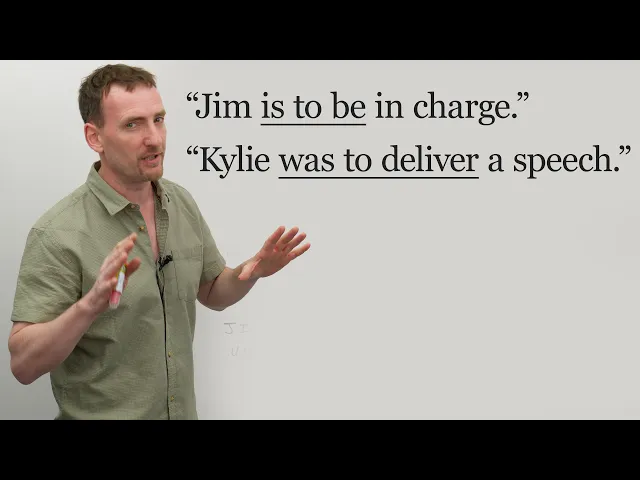
2:49 "Jim, you are to be in charge until I get back." So,
2:52 we can also use a "be" with a passive or just with a situation,
2:56 just like a regular...
2:58 Any other regular situation where you're using a "be" verb.
3:02 But, if I say, "Jim, you are in charge until I get back." "Jim,
3:10 you are to be in charge until I get back." What's the difference?
3:14 If I use "without to be", it means right now.
3:18 "Jim, you are in charge now.
3:20 I'm going out." "Jim, you are to be in charge." So,
3:24 next week, I will go to California for a business trip.
3:28 While I'm gone, "Jim, you are going to be in charge." "Jim,
3:32 you are to be in charge", right?
3:34 So, that's very, very important to understand.
3:37 Future, present, with "to be" or without "to be".
3:41 Okay, so now we're going to look at the past situation,
3:44 which is very different, and you have to somehow understand what is happening.
3:50 "Sophie was to deliver the keynote speech at the conference." So,
3:54 again, there was a plan.
3:59 She was supposed to.
4:05 And this is a key word you have to remember, "supposed to".
4:07 Something was supposed to happen.
4:09 Something should have happened, but it didn't.
4:14 And that's the key to this situation.
4:22 "Unrealized" or the "unknown results".
4:32 So, two things can happen here.
4:37 Sorry.
4:38 One, what was supposed to happen, what was planned, didn't happen,
4:43 or what was planned, we're not sure if it happened or not.
4:48 That's the key to using past "be" verb, "was", "were", plus an infinitive.
4:55 So, "Sophie was to deliver the keynote speech", but did she?
4:59 I don't know.
5:00 Or, something happened, there was a bit of a mix-up,
5:02 and she wasn't able to get onto the stage to give the speech.
5:05 By the way, if you're curious, "keynote speech",
5:08 that's the main speech, the highlight speech of the conference.
5:12 "The troops were to be withdrawn from the border." Now,
5:15 usually when you have a sentence using "were to be", "was to be",
5:19 etc., or "was to", whatever verb, usually you will have a "but" clause,
5:25 or a second sentence explaining why it didn't happen.
5:30 "The troops were to be withdrawn", and again,
5:33 I'm using a passive here, "from the border,
5:35 but the general changed his mind and sent them forward instead." So,
5:41 going back to that one I looked at a second ago,
5:45 "Jim was to be in charge, but none of the staff listened to him." Now, if,
5:51 again, I take it out, "Jim was in charge",
5:56 this is a very straightforward past situation.
6:01 It happened, he was in charge, and he did a very good job.
6:04 Or, "but none of the staff listened to what he said." It doesn't matter,
6:10 he was in charge, officially, but nobody listened to him.
6:14 Or, he was in charge, and he did a good job.
6:17 So, what comes after can be anything, but as soon as you add the "to be",
6:23 right away you have an unrealized situation, it didn't happen, so,
6:28 "Jim was to be in charge",
6:30 you can only follow it with a "but" to show the contrast,
6:34 to show why he actually was not in charge.
6:38 Okay?
6:39 So, it's actually a very simple structure, "be" plus infinitive.
6:43 If you remember, present "be", future "plan", past "be", unrealized "plan",
6:49 and that's the only thing that you need to know.
6:52 And again, a little bit more formal use,
6:54 there are other ways to express all of these ideas,
6:57 but if you want to emphasize something,
6:59 or be a little bit more formal, especially in writing,
7:02 then you can do that, you can use this.
7:05 In spoken, not so much, not as commonly used or heard.
7:09 Okay?
7:10 Now, you can go to www.EngVid.com and take the quiz,
7:12 make sure you understand how to use this structure,
7:15 and understand the context of the sentence,
7:19 and don't forget to ask questions if you have any.
7:22 And if you like the video, give me a like, subscribe to my channel,
7:26 and come back soon for more grammar, vocab, other types of interesting lessons.
7:32 See you then.
7:32 Bye bye.