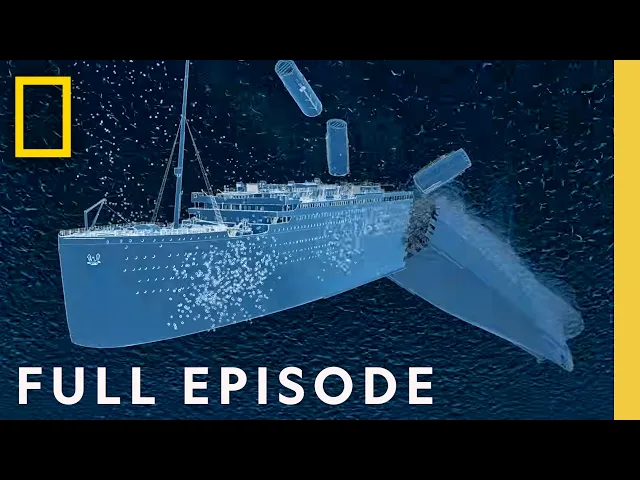
Titanic: The Digital Resurrection (Full Episode) | SPECIAL | National Geographic
National Geographic
0:03 ominous music playing] [captain] ETA over
0:18 the wreck is approximately ten minutes from now.
0:23 [crew] Roger that, that's secure, here we go.
0:25 Survey, we are headed off.
0:28 -Juliet, survey.
0:29 Yeah, whenever you're happy, I'm happy.
0:32 -Off we go.
0:35 [Narrator] In a remote spot in the middle of the Atlantic Ocean,
0:39 nearly 400 miles from Newfoundland.
0:41 [crew] Clear to dive.
0:42 Clear to dive.
0:43 [Narrator] A remarkable expedition is underway.
0:46 [captain] Roger that.
0:47 Juliet is clear to dive.
0:48 I've got a green board.
0:49 Pumps are now in.
0:55 Heading one eight zero.
0:59 [Narrator] It's destination...
1:00 [captain] Surface LF wreck on Sonar.
1:04 [Narrator] ...the most famous wreck site in history.
1:07 [captain] Present depth, three-eight-one-zero.
1:09 At bottom.
1:20 [Narrator] For over a century,
1:22 the tragic fate of Titanic has been a global obsession.
1:26 [reporter] Scientists have found wreckage of the S.S.
1:28 Titanic.
1:29 [Narrator] A story so compelling that people risk their lives,
1:34 spending millions of dollars just to get a glimpse of the wreck.
1:43 This investigation will allow us to see Titanic in a whole new way.
1:49 -The remarkable new images of the Titanic, as you've never seen it before.
1:53 -The largest underwater scanning project in history.
1:56 It's incredible to see it like this.
1:59 [Narrator] Over 700,000 scanned images, 16 terabytes of data,
2:03 and almost two years of research and processing,
2:06 have produced a full-sized digital replica of the ship,
2:10 a virtual twin of Titanic.
2:14 -Wow.
2:15 This is a view I've never had before.
2:22 [Narrator] A replica so detailed...
2:24 -See the numbers?
2:25 -It's incredible when you see the full scale.
2:27 [Narrator] ...It will offer new insights into the sinking.
2:29 -Looking at it in this scale,
2:31 you would think the ship had been struck by some enormous missile.
2:37 [Narrator] And new evidence of the final moments of those on board.
2:41 -They were trying to launch one last lifeboat.
2:48 theme music playing] [reporter] When she set sail from Southampton,
2:58 England in the spring of 1912,
3:00 she was hailed as the most luxurious steamship in the world.
3:03 And on this her maiden voyage, she was unsurpassed and unsinkable.
3:07 Her name, of course, the Titanic.
3:17 -On tenth of April 1912,
3:19 Titanic begins her maiden voyage from Southampton to New York.
3:24 She's billed as the greatest most luxurious ship of her day.
3:29 [Narrator] It is the golden age of the ocean liner.
3:34 Two companies, White Star Line and Cunard,
3:37 vie for supremacy on the route across the Atlantic.
3:42 Cunard ships were typically faster.
3:45 But White Star had the edge when it came to luxury.
3:49 And the gigantic Titanic was the jewel in their crown.
3:55 [Yasmin Khan] On board, there are aristocrats.
3:56 There are business magnates,
3:57 but there's also immigrants who are going to the Americas to make a new life.
4:03 [Narrator] In just seven days' time,
4:07 Titanic should be steaming triumphantly into New York.
4:11 The world's press, waiting to greet her.
4:14 Instead, she'll be at the bottom of the Atlantic,
4:18 and almost 1,500 people will be dead.
4:29 A century on, many details about the sinking are still debated.
4:37 [Yasmin Khan] Titanic's never given up her secrets easily,
4:40 and for 70 years, nobody even knew where she was.
4:43 And then in 1985, Bob Ballard found the wreck.
4:49 [reporter] Today, the French and the American men,
4:51 who found the Titanic will celebrate.
4:53 [Narrator] Ballard had found the greatest of all lost ships,
4:57 and scientists clamored to study the wreck.
5:01 But 2.5 miles down, under atmospheric pressure,
5:05 almost 400 times greater than at sea level,
5:09 conditions make it hard to see more than fragments of the ship at a time.
5:15 [crew] We're still searching for the stern.
5:17 We can't find it.
5:20 [Yasmin Khan] Many expeditions have been down
5:22 to the wreck over the past 40 years.
5:26 But it's pitch black down there.
5:30 So, it's not being possible to see the whole ship.
5:34 Viewing it has been like shining a flashlight in the dark, until now.
5:42 [captain] Your depth is eight-zero-five meters, heading three-zero-zero.
5:47 [Narrator] After a 2-and- a-half-hour descent to the ocean floor,
5:52 two unmanned subs named, Romeo and Juliet, get to work.
6:00 While Romeo films high-resolution footage of the ship and sea floor.
6:04 [captain] The stronger that laser line gets, it starts to get more defined.
6:08 [crew] Roger that.
6:09 Moving to next position.
6:11 [Narrator] Equipped with lasers recording millions of measurements,
6:14 Juliet captures every inch of the wreck.
6:19 [captain] Oh, yeah, that's looking nice right there.
6:20 You must be really close now.
6:24 -I have every expectation that we're going to see the most
6:28 accurate portrayal of the wreck site that's ever been offered.
6:33 [captain] Park's at the ladder Tom, are you ready?
6:36 [Narrator] World-renowned expert, Parks Stevenson,
6:38 has been on multiple dives to Titanic.
6:40 [captain] Thrusters, we are beginning to pump them now.
6:44 [Narrator] He hopes the scan will offer insights
6:46 into some of the questions which still surround the wreck.
6:49 [captain] Hatch is secure.
6:53 [Parks Stephenson] I'm intrigued by mysteries.
6:56 People thought that the ship could not sink.
7:00 So how did she end up like this on the ocean floor?
7:05 [captain] Coming up on the wreck site.
7:07 [Parks Stephenson] What actually happened that night?
7:11 I often view the shipwreck as the last surviving witness to the disaster.
7:20 The way she's torn apart, the way the pieces of her are bent or torn,
7:27 these all tell a story, and so,
7:30 it's vital that we listen to the stories that the wreck can tell.
7:38 [Narrator] Footage from the Romeo sub quickly offers glimpses of these stories.
7:43 Snapshots of humanity among the scattered wreckage.
7:50 Hundreds of wine bottles.
7:56 A dress.
8:00 A doll's head.
8:04 All are a stark reminder.
8:07 Titanic isn't just an object of fascination.
8:13 She's a graveyard.
8:17 One which the scan will allow us to study from a respectful distance.
8:27 After three weeks at sea, scanning 24 hours a day,
8:34 the work of the expedition team is complete.
8:38 -Hi five.
8:39 Yeah.
8:41 -Job done, sailing home.
8:44 [Narrator] But it will take over a year to research
8:46 and piece together the enormous amount of data gathered.
8:50 [Parks Stephenson] This operation has a lot of promise.
8:53 Having a tool of a virtual twin of the Titanic wreck, that's huge.
9:08 [Narrator] Awaiting access to the digital twin,
9:11 Parks has assembled a team to help him examine it in detail.
9:17 [Parks Stephenson] This will give you just
9:18 basically the context of the ship itself.
9:22 [Narrator] Master Mariner, Captain Chris Hearn,
9:24 wants to study the twin from a sailor's point of view.
9:31 [Chris Hearn] As somebody who has crossed the Atlantic and been in ice,
9:34 a ship is very much about its crew.
9:38 What was their experience when the ship was sinking?
9:42 If you had the whole wreck site, what could you do with that?
9:47 -We can totally recreate that night.
9:49 [Narrator] Metallurgist, Doctor Jennifer Hooper,
9:52 has spent years in the lab studying small fragments of the wreck.
9:57 [Jennifer Hooper] Going from examining the materials in a laboratory
10:01 to feeling like I'm on the sea floor, staring at this wreck site is something I
10:07 never thought I would see in my lifetime.
10:11 -Hopefully, we're going to get the answers to some
10:14 of these questions that have been bugging me for decades.
10:19 [Narrator] After almost two years of research and processing,
10:21 over 700,000 scan images have been painstakingly pieced together.
10:31 At a gigantic sound stage,
10:33 colossal LED panels will project the image of the twin at up to full scale,
10:39 bringing the investigators face to face with the severed wreckage of Titanic.
10:51 ominous music playing] [underwater metal groaning][♪ ominous music playing]
11:13 [underwater metal groaning] [Chris Hearn] Well, look at that.
11:37 I can tell you, I'm in the ship simulation business,
11:40 and I've never seen anything like that.
11:41 [Parks Stephenson] I've actually been here in a submersible,
11:43 but I only see just a little bit out my viewport.
11:47 It's just so immense.
11:53 When you are in a submersible,
11:55 you can see maybe only a few meters in front of you.
11:59 But with the digital twin, you can see the entire wreck site.
12:05 Now, I have a better view of Titanic than I ever did at the Titanic.
12:14 -We're around 12,000 feet at the bottom of the ocean.
12:19 Looking up at the Titanic.
12:23 -Studying this under microscope doesn't really prepare you for this.
12:36 Seeing the Titanic wreck site in full scale, I finally understood how small I am
12:44 in comparison to everything that I'm looking at.
12:49 I was able to truly experience the sense of destruction.
13:04 [Parks Stephenson] This is where she ripped in two.
13:08 [Narrator] The digital twin not only allows the team to explore the ship itself,
13:12 but the destruction caused by the crash that sank her.
13:18 [Chris Hearn] I wasn't really prepared for the level
13:20 of damage that the scan showed us.
13:23 It's catastrophic in its scale.
13:27 That really struck me.
13:34 [Narrator] We've known since her discovery that the ship lies in two parts.
13:38 But the wreck site is so massive,
13:40 no one has ever seen it all at once, until now.
13:46 The stern sits a third of a mile from the bow.
13:51 ominous music playing] [underwater metal groaning] [Parks Stephenson] Okay, now,
14:07 this is something you don't normally see because
14:10 it's very dangerous underneath the overhanging stern here.
14:15 Trying to get in here with a submersible, it's not very often done.
14:24 [Narrator] The twin allows the experts
14:25 to study near inaccessible parts of the ship.
14:30 [Parks Stephenson] Here's a starboard propeller over here.
14:33 [Narrator] Taking in features which are almost impossible
14:35 to see on a manned mission to the site.
14:39 [Parks Stephenson] Ah, you see that right there?
14:42 The numbers.
14:43 That's 401, that's Titanic's hull number.
14:48 [Jennifer Hooper] Oh, wow.
14:49 It's in pristine condition.
14:50 [Parks Stephenson] The best.
14:52 [Narrator] From the tiniest details to its colossal scale,
14:56 the scan offers an entirely new perspective on Titanic.
15:00 And the experts have only just begun to scratch
15:03 the surface of what the twin can tell them.
15:08 [Parks Stephenson] I am really,
15:10 really excited to see what the rest of this is going to look like.
15:17 To have the wreck site at my command to see what happened to the ship.
15:23 Wow.
15:25 The possibilities are endless.
15:28 ominous music playing] [metal groaning] [Yasmin Khan] The disaster of 14th,
15:40 April 1912 happens on a cold, clear,
15:44 starry night, four days into Titanic's maiden voyage.
15:53 Jack Phillips, a wireless operator,
15:55 receives a message that there is pack ice and icebergs up ahead.
16:05 In first class, Captain Smith is with Bruce Ismay,
16:10 chairman of the White Star Line.
16:12 While up on the bridge, First Officer Murdoch is keeping watch.
16:17 At 11:39 p.m., three bells ring out.
16:20 [bell ringing] And that's the warning of an obstacle up ahead.
16:27 First Officer Murdoch rams the engine ship's telegraph to stop,
16:32 sending a signal to cut the power.
16:34 He then demands that Titanic turn harder starboard,
16:38 hoping to steer the ship to safety.
16:40 And seconds later, the Titanic hits the iceberg.
16:44 [thud] Many on board felt nothing.
16:52 Even Frederick Fleet, who sounded that alarm from the crow's nest,
16:56 said it felt like a close shave.
16:59 [Narrator] And yet this glancing blow sank a ship thought to be unsinkable.
17:07 The experts were hoping that the twin can show us how.
17:15 [Jennifer Hooper] With the scan,
17:16 what is exciting is that we actually do have our first visible ice damage.
17:22 So, take a look up here at this porthole.
17:29 This porthole was smashed by the ice.
17:35 First-class passenger, Margaret Swift,
17:38 saw the ice that had come through that porthole.
17:43 That tells us that the iceberg was at least 30 feet above water line.
17:48 So, the scan is telling us the size of the iceberg.
17:52 It's definitively giving us information that will help
17:55 us understand more about the collision that night.
18:06 [Narrator] It's tantalizing new evidence of the iceberg strike,
18:09 but Titanic's fatal wound appears hidden from view.
18:16 When she sank, the ship's bow hit the seabed with such
18:19 force that nearly half of it was buried in mud.
18:29 Now the twin can provide the experts with a brand-new perspective.
18:34 [Parks Stephenson] Okay, I have never seen this depicted before,
18:37 and certainly not in this scale.
18:39 [Chris Hearn] What a different view now.
18:41 [laughs] [Parks Stephenson] You see how much
18:43 of the bow has dug into the ocean bottom?
18:45 Can you imagine the force needed to propel
18:48 that much of the ship into the ocean bottom?
18:53 [Jennifer Hooper] I mean, the iceberg damage should be here, but it's not.
18:58 We can't see it because it's under the sea floor.
19:01 -No, it's at least 20-25 feet below the mud line.
19:07 [Narrator] Although evidence of the impact appears lost to the ocean floor,
19:13 the experts think that the twin could still provide answers.
19:19 To decode the clues offered by the wreckage,
19:21 the investigation turns to Titanic's birthplace.
19:27 [ships horn] Taking over two years to build,
19:33 Titanic was designed and constructed here...
19:38 ...at Harland& Wolff in Northern Ireland, on the shores of Belfast Lough,
19:44 a company at the forefront of shipbuilding, even today.
19:52 Built in this dock, her blueprints were drawn up by skilled draftsmen next door.
20:06 [Yasmin Khan] Titanic was the most technologically advanced ship of the age.
20:13 These original blueprints show she was divided into 16 watertight compartments.
20:20 These were designed to collect floodwater in a small area.
20:25 What's more, Titanic would stay afloat, even if up to four of these flooded.
20:33 This was what cemented her reputation as the unsinkable ship.
20:44 [Narrator] After the tragedy, Harland& Wolff's naval architect, Edward Wilding,
20:49 was called on to explain how
20:50 the ship's fail-safes were so catastrophically overwhelmed.
20:55 His starting point was that more than four
20:58 compartments must have been damaged by the iceberg,
21:01 the weight of the floodwater pulling the ship below the surface.
21:06 -Wilding set about calculating the impact
21:08 of the iceberg and concluded that there had been
21:12 a series of puncture holes along the hull on an area of about 12 square feet.
21:18 Wilding based his findings on the testimony of surviving crew
21:22 and passengers and on his own detailed knowledge of the ship's design.
21:26 But even after the wreck was discovered, testing his theory was impossible.
21:32 The evidence buried below the mud line.
21:38 [Narrator] But now, the investigation has brought together experts
21:43 from around the world to put Wilding's findings to the test.
21:50 At University College London, renowned naval architect Professor Jeom-Kee
21:54 Paik is joined by fellow specialists,
21:59 Doctor Simon Benson, and Doctor Stephen Payne,
22:03 designer of the cruise liner, Queen Mary II.
22:06 [Dr.
22:06 Stephen Payne] This is the first time we can
22:08 actually use a computer simulation to test Wilding's hypothesis.
22:13 [Narrator] Based on information from Titanic's blueprints,
22:15 combined with their estimated speed of 22 knots,
22:19 the team uses cutting-edge technology to simulate the iceberg strike.
22:25 -Wow, here it goes.
22:28 We can see the ship glancing blow,
22:30 and it's actually turning to starboard, as it comes past.
22:33 Ah, yeah, interesting.
22:34 We can see the ice actually splintering off.
22:40 We actually now find out from these simulations that the time
22:42 it took for the Titanic to collide with the iceberg,
22:46 the glancing blow was 6.3 seconds.
22:51 [Narrator] 6.3 seconds.
22:52 A mere moment.
22:54 Yet what could have been a fleeting scrape proved catastrophic.
23:00 And the simulation can now reveal the full
23:02 extent of the damage for the very first time.
23:06 -Well, this for me is where it gets really interesting because here,
23:10 we really see the power of the simulation.
23:14 So, here's the collision.
23:17 And it very quickly spreads quite a thin line of gash, isn't it?
23:23 But we can see the ruptures occurring.
23:28 [Dr.
23:28 Simon Benson] Wilding predicted that the total area
23:30 of the holes would be about 12 square feet.
23:33 We are, with this new prediction, looking at something in the order of 18.
23:38 -The Wilding estimation is incredible.
23:42 [Narrator] The figures may differ slightly, but Wilding was right.
23:46 The scale of the damage was minimal compared to the size of the ship overall.
23:53 But crucially, it wasn't confined to one area.
24:05 [Chris Hearn] Wow.
24:06 [Parks Stephenson] So, this is the damage.
24:09 -We're seeing a simulation of the iceberg damage for the very first time.
24:15 [Narrator] The digital twin allows the experts
24:17 to see the impact pattern precisely mapped out.
24:22 [Jennifer Hooper] The damage begins, the front,
24:25 and it crosses over the compartments, all the way to boiler room number six.
24:33 And then it crosses into boiler room number five.
24:38 You have one small section in boiler room number five,
24:42 and another very small section of damage in the forepeak.
24:49 [Parks Stephenson] How small?
24:50 -That last bit is only the size of two pieces of paper.
24:56 That's six compartments along the starboard side and the ship
25:00 was only designed for four compartments to flood.
25:06 So you've got small margins on one end or the other that sank this ship.
25:15 [Chris Hearn] So, two small holes?
25:17 -That's what the simulation shows us.
25:20 [Narrator] The areas that made all the difference are tiny.
25:26 Small holes either side of the four badly damaged compartments.
25:32 Without them, Titanic might not have sunk.
25:36 -We all imagine that it was a giant hole— -Yeah.
25:41 -That sank such a massive ship.
25:42 In reality, it was a very small amount of damage over a long
25:46 distance and fractions of a second that ended up sinking the ship.
25:58 [Parks Stephenson] So, if true,
25:59 it suggests an irony that in turning to avoid the iceberg,
26:03 the crew had created an area of damage lengthy enough to open
26:08 up too many compartments to the sea and sink the ship.
26:15 [Narrator] The irony doesn't stop there.
26:22 At the British inquiry into the sinking, Wilding,
26:25 one of the men who knew Titanic best,
26:28 predicted that had the crew not turned the ship to try and avoid the iceberg,
26:33 instead, hitting it head-on, she would have stayed afloat.
26:39 The simulation will now put that theory to the test.
26:44 -Because this has never been done before.
26:46 [Dr.
26:46 Stephen Payne] No, absolutely not.
26:47 Let's see it go.
26:54 Oh, wow.
26:56 Look at this crumpling of that deck.
27:00 All the energy of the Titanic is now going into that collision.
27:05 Okay, so, can we have the close-up?
27:08 So we're really gonna see the crumple zone as that wow.
27:15 All that steel mashing into the ice.
27:17 [Dr.
27:17 Simon Benson] Just imagine the noise that there would have been.
27:28 [Dr.
27:28 Stephen Payne] Wilding predicted that with this collision,
27:31 Titanic would survive.
27:35 We look at the blueprint.
27:37 We see, well, where are we going to?
27:38 We've lost the peak tank, cargo tanks, and we've ended.
27:42 -So it's just forwarded the bridge.
27:43 -Just forwarded the bridge.
27:44 So we've actually only lost what, 4 compartments?
27:46 -4 compartments.
27:47 -So.
27:47 -She would have stayed afloat.
27:48 -It would have.
27:56 [Jennifer Hooper] So, based on the simulation, it would not have sunk.
28:04 [Chris Hearn] Yeah.
28:06 [Narrator] The front-on simulation gives us a fleeting
28:08 glimpse of a different outcome for the tragic ship.
28:14 What it doesn't provide is a sailor's perspective.
28:19 -Think about the crew.
28:22 You don't steer directly into an iceberg.
28:26 I doubt very highly anybody would have done it.
28:28 A lot of the crew had their bunks forward.
28:32 And so, if Murdoch making that kind of an action
28:34 to take the iceberg right on the bow,
28:37 he would have likely killed everybody that was in those forward spaces
28:47 But the officer's maneuver to try and turn away from the iceberg,
28:51 as hard as it is to say, essentially seal the Titanic's fate.
28:59 [Narrator] With the ship now taking on water,
29:01 the lives of over 2000 people hang in the balance.
29:06 The decisions made by Titanic's crew,
29:09 are about to become more crucial by the minute.
29:13 ominous music playing] [rushing water] [Narrator]
29:21 Within 20 minutes of the iceberg strike,
29:23 Captain Smith has had multiple reports of flooding in the ship's boiler rooms.
29:30 -Fireman, Fred Barrett, was a witness to what happened.
29:35 He was working in boiler room six.
29:38 When he gave his testimony to the inquiry, he said, "The bell rang.
29:44 He called out "Shut all doors." Then a large
29:47 volume of water came through the side of the ship.
29:59 He ran from that section, just as the watertight doors came down.
30:14 The man responsible for keeping the ship's
30:15 boilers alight was Chief Engineer Joseph Bell.
30:21 He was in charge of 200 men who powered Titanic 24 hours a day.
30:32 [Narrator] The boiler rooms ran over half the length of the ship.
30:37 40 minutes after the collision, number six was already lost,
30:41 and number five had a small, paper-sized breach.
30:48 [Yasmin Khan] Titanic was taking on water fast.
30:51 Wilding estimated that 16,000 tons of it had now entered the ship.
30:57 [Narrator] The damaged compartments fill up.
31:00 The ship tilts forward, water spilling from one compartment to the next.
31:05 -Suddenly...
31:07 [rushing water] ...the water bursts into boiler room five.
31:15 And Bell was heard to say, "My God,
31:17 we are lost." [Narrator] Bell and his men were forced back to boiler room two,
31:33 the only one still capable of providing power to the ship.
31:40 [Yasmin Khan] One hour, 40 after the iceberg strike,
31:43 Chief Bell sent his stokers up on deck to save themselves.
31:54 And all 35 engineering officers stayed with him below deck.
32:00 [Chris Hearn] Ultimately,
32:00 it came down to a skeleton crew in boiler room number two,
32:04 essentially of the engineers themselves.
32:07 Everybody else has been released.
32:11 [Narrator] It's clear to Bell that Titanic is doomed.
32:18 He now had to pivot from saving the ship to saving lives.
32:25 [Yasmin Khan] They were in the middle of the Atlantic, and it was pitch black.
32:29 If the power went off, they would be in total darkness,
32:32 making it incredibly difficult for people to get to the deck and into lifeboats.
32:38 And if the Titanic's wireless room went down,
32:41 the nearby ships couldn't be alerted to stranded survivors.
32:47 [Narrator] In short, without power,
32:49 the chances of those on board surviving were slim.
32:59 The courage of Titanic's engineers is a story that's endured for over a century.
33:07 But now, the digital twin allows the experts to actually examine
33:11 the place where Bell and his men battled on clearly visible,
33:15 where the ship tore apart.
33:24 [Jennifer Hooper] Okay, so we're in Boiler room number two.
33:29 This is essentially the last place where they kept the fires going.
33:42 [Parks Stephenson] This is what's left of the heart of Titanic.
33:45 The steam that's being generated in these boilers is
33:50 providing the power and the light to the ship.
33:55 These engineers down here, they couldn't see what was going on outside.
34:02 [Jennifer Hooper] The conditions must have been terrible.
34:07 Brutally hot.
34:09 The steam.
34:13 -Real tests of leadership often come under the worst of circumstances.
34:20 I reflect on Bell's efforts that night.
34:24 He was going to do everything he could so
34:28 that other people may have a chance to live.
34:41 [Narrator] The digital twin shows us not only the location of Bell's last stand,
34:46 it also offers new evidence of how he kept
34:49 the power on, even as the ship began to sink.
34:57 Nearly 2,300 feet across the wreck site, the experts have spotted a clue.
35:03 [Parks Stephenson] Okay,
35:04 we're coming up on the port side of the stern back here.
35:07 There's the mainmast that's collapsed and lying over the edge.
35:14 So, let's rotate this thing around.
35:16 And take a look at this.
35:23 I found this very interesting.
35:25 It's a steam valve.
35:26 It didn't come from here.
35:27 It landed on the wreck after the stern had settled.
35:31 And the flap is seen in the open position right now.
35:39 [Jennifer Hooper] Why is that important?
35:41 [Chris Hearn] Well, this is a line that was taking
35:43 the remaining steam from the boiler rooms to the emergency dynamos.
35:51 [Parks Stephenson] They provided life to the ship,
35:53 the lighting, the heating, running the pumps.
35:59 [Narrator] Titanic's emergency dynamo was over
36:01 40 feet higher than the main generator, so it would take longer to flood.
36:06 It was connected to boiler room two through an emergency pipe,
36:10 and the valve had to be opened manually.
36:14 [Chris Hearn] You can see this steam valve is clearly open,
36:18 which means steam was continuously flowing through to the emergency dynamos,
36:24 and this action to keep this open saved hundreds of lives.
36:37 [Narrator] Survivors testified that over two hours after striking the iceberg,
36:42 the ship's lights were still on.
36:50 [Jennifer Hooper] So this is proof that the survivors
36:53 who saw lights to the very end, it's true.
36:57 -Yeah.
37:01 [Narrator] This steam valve is frozen in its final act.
37:06 Responding to Bell's orders.
37:10 Keeping the power on and hope alive.
37:24 While Bell and his men fight on, above them, panic is starting to spread.
37:31 At the lifeboats, the crew struggle to keep order,
37:35 and senior officers are faced with life and death choices.
37:49 [Narrator] Until 11:39 P.M.
37:52 passengers had enjoyed a peaceful evening and luxurious surroundings
37:55 and were looking forward to arriving in New York.
38:06 But nearly two hours after Titanic hit the iceberg,
38:10 the situation for those on board is deteriorating fast.
38:21 As water begins to flood the corridors,
38:23 the passengers start rushing to the boat deck.
38:31 [Yasmin Khan] By law in 1912,
38:32 ocean liners were only required to have 16 lifeboats.
38:36 And in an emergency would have been expected to stay
38:38 afloat long enough to ferry people to a rescue ship.
38:41 So, Titanic only had enough lifeboat spaces for about half of those onboard.
38:49 [Narrator] The order is to start loading women and children into the boats.
38:53 In the chaos, most of the lifeboats aren't even launched full.
38:58 A tension quickly turns to panic.
39:10 On the boat deck, there are scenes of both heroism and heartbreak.
39:24 [Yasmin Khan] Ida Strauss, for instance,
39:26 wouldn't board a lifeboat if she couldn't go with her husband and said,
39:30 "We have lived together, and we'll die together." Rhoda Abbott,
39:38 who was traveling with her two teenage sons, reached a lifeboat being boarded.
39:44 But realizing that her boys were considered too old to go in a lifeboat,
39:49 stepped back and remained with her children.
39:52 [Narrator] 17-year-old first-class passenger Jack Thayer,
39:55 noted who joined the boat after Rhoda Abbott retreated.
40:01 -He recorded.
40:03 "There was some disturbance in loading the last two forward starboard boats.
40:07 A large crowd of men was pressing to get to the lifeboats.
40:11 No women were around as far as I could see.
40:14 I saw Ismay, who had been assisting in the loading of the last boat,
40:19 push his way into it.
40:20 It was really every man for himself." Bruce
40:25 Ismay was the chairman of the White Star Line.
40:28 He went on to survive, but his reputation never recovered.
40:37 [Narrator] As passengers become increasingly desperate,
40:39 the crew struggle to keep order.
40:43 [Yasmin Khan] Michel Navratil said, "Honest people didn't stand a chance
40:47 as passengers descended to deviance in order
40:50 to survive." [Narrator] With the sinking
41:01 of Titanic making headlines around the world,
41:04 the press was hungry for heroes and villains.
41:09 But these were some of the most chaotic moments of the whole tragedy,
41:13 and conflicting versions of events quickly emerged.
41:20 -The first officer, William Murdoch,
41:22 was in charge of the lifeboats on the starboard side of the ship,
41:25 and he was desperately trying to lower them
41:27 as the water was gushing up to meet them.
41:32 Afterwards, as these newspaper reports show,
41:34 he was accused of having shot himself on the bridge and abandoning his post.
41:39 It says here "he was seen whipping a gleaming bit of metal from his pocket,
41:43 deliberately placing it to his temple,
41:45 and pulling the trigger." [distant gunshot]
41:54 [Narrator] The story was headline news.
41:58 Murdoch was painted as cowardly, his reputation in tatters.
42:04 But even at the time, his actions were disputed.
42:08 [Yasmin Khan] Second Officer Lightoller,
42:10 the most senior officer who survived the sinking,
42:13 refuted the accusation of suicide,
42:15 writing that he'd seen Murdoch swept overboard
42:17 and that he had died a hero's death.
42:23 [Narrator] Now, Parkes believes that the twin
42:25 can offer clues about Murdoch's final moments.
42:37 [Parks Stephenson] Well,
42:39 this is the number one lifeboat station, the forward davit.
42:44 [Chris Hearn] That was Murdoch station, right?
42:45 [Parks Stephenson] Yes, it was.
42:48 And you'll notice here that that davit is in the upright or retracted position.
42:56 [Narrator] Davits are cranes used to winch lifeboats down to the water.
43:01 Before being wound back to launch the next.
43:06 [Parks Stephenson] This davit is in the up position,
43:09 meaning its crew is basically trying to get a lifeboat ready to be launched.
43:15 [Narrator] In an attempt to save as many lives as possible, Murdoch,
43:19 unlike some officers,
43:21 had allowed men to join the women and children aboard his lifeboats.
43:26 [Parks Stephenson] Murdoch has been watching the water rise this whole time.
43:29 He knows he's out of time, and he's working against the rising water to try
43:33 and get one more boat into the water.
43:36 And this coincides with Second Officer Lightoller's description,
43:41 who was standing on top of the deckhouse back here.
43:45 [Narrator] At 2:15 a.m., minutes before the ship went down,
43:50 Lightoller witnessed Murdoch trying to launch one final boat.
43:56 Suddenly, Titanic dipped and the lifeboat was washed overboard.
44:01 While survivors scrambled onto it from the freezing water,
44:05 Murdoch was swept away.
44:13 [Parks Stephenson] Historians have disputed that, but this davit right
44:18 here stands in mute testimony that supports Lightoller's version of events.
44:26 Because, being in the up position is exactly what Lightoller described.
44:34 [Narrator] History has not been kind to Murdoch.
44:37 And while we may never know exactly how he died,
44:40 the twin does suggest that the accusation of cowardice
44:43 of abandoning his ship may not be fair.
44:50 [Parks Stephenson] I think it really shows that he was struggling
44:53 to save as many lives as possible right up to the very end.
44:58 They were trying to launch one last lifeboat.
45:03 He never gave up on his duty.
45:09 [Narrator] For survivors like Lightoller, the scenes at the lifeboats were some
45:12 of the most distressing of the whole disaster.
45:19 But for those left on board, the worst was still to come.
45:28 [distant screams] [Narrator] Two hours after Titanic hit the iceberg,
45:39 the ship is partially submerged,
45:41 but remarkably, thanks to Bell and his engineers, she still has power.
45:48 [Yasmin Khan] In Titanic's wireless room,
45:50 two operators, Jack Phillips and Harold Bride,
45:52 are still at their post, and desperately sending out messages.
46:15 [Narrator] Shortly after 2:00 a.m., Captain Smith told the men they had done
46:19 their duty and were relieved from their posts.
46:22 Bride prepared to leave, but Phillips worked on.
46:28 [Yasmin Khan] Bride who survived the wreck,
46:30 recalled his colleague Jack Phillips' selfless conduct,
46:34 saying, "He was a brave man.
46:38 I learned to love him that night.
46:41 And I suddenly felt a great reverence to see him
46:44 standing there sticking to his work while everybody was raging about.
46:50 I will never live to forget the work of Phillips
46:53 for the last awful 15 minutes." [Narrator] But soon after 2:00 a.m.,
47:12 The messages abruptly stop.
47:19 Titanic is about to go under.
47:30 eerie music playing] After the sinking,
47:42 two official inquiries concluded that the ship gently slipped below the waves.
47:49 But even at the time, many survivors contradicted that, testifying
47:53 Titanic broke apart before she sank.
47:59 Something confirmed when the wreck was discovered in 1985.
48:05 And the twin now allows us to see in unprecedented detail,
48:07 where the pieces came to rest, a third of a mile apart on the ocean floor.
48:18 But exactly how this great ship broke in two,
48:21 is something Parks has been investigating for decades.
48:28 [Parks Stephenson] There's a lot of mysteries in the Titanic disaster.
48:34 But the one that I've been most focused
48:37 on throughout my career in Titanic research, is the breakup.
48:44 And I think we've got the evidence
48:46 that's going to answer those questions, right here.
48:51 [Narrator] The severed ship is too
48:53 badly damaged to reveal exactly what happened.
48:56 But Parks believes that the scan can still provide answers.
49:01 Not by studying the wounded wreck itself, but the seabed around it.
49:06 [Parks Stephenson] There's an entire debris field of artifacts,
49:09 of steel sections, that you need to take a look at.
49:18 [Jennifer Hooper] Wow.
49:20 [Parks Stephenson] We're flying away.
49:23 [Chris Hearn] Wait a minute.
49:25 Oh it's the stern.
49:26 We're looking down.
49:27 [Parks Stephenson] We're going to get a God's eye view of the debris field.
49:32 [Narrator] Covering around 15 square miles countless sheds
49:36 of Titanic are scattered across the ocean floor.
49:40 Among them, key pieces, which Parks believes may be clues.
49:47 [Parks Stephenson] You can see how immense it is.
49:50 I mean, it looks chaotic, but there is a pattern to this.
49:54 And I bet we can find the evidence
49:55 that we're looking for to reconstruct the breakup here.
50:00 [Narrator] The twin allows the experts to study
50:02 Titanic's shattered fragments in more detail than ever before.
50:08 If they can piece together this twisted metal jigsaw,
50:12 the experts may be able to find out how Titanic
50:14 broke in two and what it meant for those on board.
50:30 [distant screams] [Narrator] When Titanic broke in two at 2:17 a.m.,
50:35 on April 15th, almost 1,500 people were still on board the ship.
50:44 Those in the lifeboats watched on in horror.
50:54 [Yasmin Khan] Jack Thayer, who was a 17-year-old first-class passenger,
50:58 recorded in his memoirs what he saw.
51:01 "Suddenly, the whole superstructure of the ship appeared to split.
51:05 Her stern was gradually rising into the air." "We could see groups
51:16 of people still aboard clinging in clusters or bunches like swarming bees,
51:21 only to fall in masses, pairs or singly as the great after part of the ship,
51:27 250 feet of it, rose into the sky." "Gradually,
51:37 she turned her deck away from us, as though to hide from our sight,
51:41 the awful spectacle." [Narrator] Based on historical accounts like
51:47 these, many have assumed that the ship snapped cleanly in two.
51:54 But the investigation suggests the truth may be more complex.
51:59 To find out what really happened,
52:00 the experts have used the unique level of detail
52:03 provided by the scan to comb through the debris field,
52:08 identifying shattered sections of the hull,
52:13 and painstakingly piecing them back together.
52:22 upbeat music playing] [Chris Hearn] Wow.
52:37 Look at the size of that area.
52:42 [Jennifer Hooper] So we're looking at the side of the ship,
52:45 and we're seeing some of the pieces of the hull found in the debris field.
52:51 They're massive.
52:53 We're talking like 100 feet or more up the side of the ship.
53:02 The big piece at the top,
53:04 I've studied rivets from that big piece under the microscope,
53:08 steel rivets, and how that piece was actually held onto the ship.
53:12 -So, you have a personal connection to this piece.
53:14 [Chris Hearn] Wow, that's amazing.
53:17 I'm speechless, like, the size of these pieces is huge.
53:23 [Narrator] By allowing us to see the hull reassembled,
53:26 the digital twin shows that far from snapping neatly,
53:29 a huge section of the ship was completely destroyed.
53:35 -It was a giant catastrophic fracture.
53:40 As the stresses are building up, you've got tension across the top, compression,
53:45 and buckling on the bottom of the ship,
53:47 and slowly, it turns into a domino effect.
53:51 It's stressed on the next component and the next component.
53:54 It's like a chain reaction.
53:57 [Narrator] Almost all of a ship's strength is in a shell.
54:00 With that compromised, her exposed interior was obliterated.
54:08 [Chris Hearn] I thought it was more of a clean break, and it certainly was not.
54:13 You would think the ship had been struck by some enormous missile.
54:19 It's that catastrophic.
54:23 [Jennifer Hooper] 20% of the ship just
54:26 completely destroyed in probably a matter of seconds.
54:33 So many people lost their lives.
54:36 [Narrator] Titanic shattered in multiple places.
54:40 [Parks Stephenson] This was a cataclysmic moment.
54:43 70, 80 feet of it broke at the same time with human beings in there.
54:52 It's unimaginable.
54:59 [Narrator] As Titanic broke in two,
55:01 the fate of everyone in that part of the ship was sealed.
55:07 The twin can offer a glimpse into the final moments of those on board.
55:16 Including two of America's richest men.
55:32 [Narrator] When Titanic goes down, 80% of the men are lost.
55:42 -Although some male passengers did survive,
55:44 Edwardian ideals of stoicism, and chivalry,
55:47 meant that the vast majority of men would stay behind on the ship.
55:57 Alfred Rush, a 17-year-old,
55:59 he'd only been presented with his first pair of long trousers the night before,
56:03 refused to enter the lifeboat, saying, "I will stay with the men."
56:12 [Narrator] Another famous tale of self-sacrifice,
56:14 was that of multi-millionaire Benjamin Guggenheim.
56:19 -We have the testimony of James Etches, a steward, who said,
56:25 "I gave a life belt to Guggenheim, and he gave me a message.
56:29 It said, 'If anything should happen to me,
56:31 tell my wife in New York that I've done my best in doing my duty.
56:35 We've dressed up in our best and are prepared
56:37 to go down like gentlemen." Another steward reported hearing him say,
56:43 "No woman shall be left on this ship because Ben Guggenheim
56:47 was a coward." The popular narrative is that he escorted his mistress,
56:52 and her servant, to the lifeboats, and then went back to the first-class cabins.
56:59 [Narrator] The image of Guggenheim waiting bravely
57:01 for the waters to meet him is a romantic one.
57:04 But if he did remain in his room, his death would have been far from peaceful.
57:12 The digital twin makes clear the violence that those in this section
57:15 of the ship experienced in their final moments.
57:23 [Yasmin Khan] Guggenheim's suite was right
57:25 at the epicenter of where the ship broke up.
57:30 [Narrator] Near Guggenheim's room,
57:32 was that of another of America's richest men, J.J.
57:36 Astor.
57:39 Titanic had over 300 first class cabins,
57:42 and Astor was reported to have paid over $30,000
57:44 in today's money for a pair of these premium suites.
57:50 What's left of them is visible on the twin.
57:57 Blown apart as the ship went down.
58:06 Astor's body was recovered a week after the sinking.
58:14 [Parks Stephenson] It seems to have been important
58:15 at the time that the noblemen, like the J.J.
58:19 Astors, or the Benjamin Guggenheims, died a very noble, rather peaceful death.
58:28 But, in Titanic, it didn't matter what your status was.
58:34 You would all meet the same fate.
58:39 [Narrator] On that night in 1912, death did not discriminate.
58:45 Over 60 feet below Astor's suite,
58:48 Joseph Bell and his engineers had remained tending
58:51 to the fires as the ship went down.
58:57 Made visible by its position, right at the ship's fracture,
59:01 is what's left of boiler room two.
59:07 [Parks Stephenson] If you look at this boiler here,
59:09 you see the shadow up in the upper quadrant?
59:13 It's concaved inward.
59:15 And that's an indication of an implosive event,
59:18 which means that these boilers had to have
59:21 been operating at the time the ship breaks, and the bow starts to go under.
59:34 [Chris Hearn] They stayed here.
59:36 They steel themselves to their task because they were professionals,
59:39 and they knew their duty.
59:41 And their duty was to give people a chance up on the top deck.
59:46 And for me, this is a really powerful place.
59:53 [Narrator] All 35 engineers would go down with the ship.
1:00:03 [Chris Hearn] We're standing right at the point where their lives ended.
1:00:13 So, this scan gives us an opportunity to observe
1:00:18 a memorial to the bravery and the dedication of those engineers.
1:00:35 [Narrator] Bell's body was never found.
1:00:43 Two hours and 40 minutes after the ship hit the iceberg,
1:00:46 about 700 people are huddled together in lifeboats.
1:00:51 The rest are either fighting for their lives in the freezing water or dead.
1:00:59 But over a century on, the scan can still shine
1:01:02 a light on the lives lost to the ocean floor.
1:01:15 [Yasmin Khan] After the ship broke up, the bow quickly disappeared,
1:01:19 but the stern stayed afloat for a few more minutes.
1:01:22 And up there on the poop deck,
1:01:24 was Assistant Purser Frank Prentice, who saw exactly what was happening.
1:01:29 He recalled that Titanic rose suddenly and described
1:01:33 hearing everything that wasn't secured crashing through the ship.
1:01:39 Then she began to plummet.
1:01:43 Frank Prentice climbed over the railing,
1:01:44 and he dropped down 100 feet into the water below.
1:02:00 [Narrator] The bow sinks first, shedding its contents the whole way down.
1:02:10 It hits the mud with such force that it jackknifes.
1:02:21 dramatic music playing] The stern follows, flattening out into a spiral.
1:02:36 Her freight and furnishings are strewn across the ocean floor.
1:02:47 Thousands of items are buried in the mud.
1:02:50 Some are about to be seen for the first time in over 100 years.
1:03:00 [Jennifer Hooper] When I saw the debris field,
1:03:02 my first instinct was thinking about putting the ship back together,
1:03:07 thinking about the materials.
1:03:09 But, part of me understands that...
1:03:14 ...there are personal possessions.
1:03:17 There's cups.
1:03:18 There's suitcases.
1:03:20 There's bits of leather,
1:03:22 there's people's things that may last a lot longer than the metal.
1:03:32 [Narrator] The debris field has already yielded answers about the ship itself.
1:03:36 But it can also offer a unique insight into life on board.
1:03:56 An ornate bench, which lies 715 feet from the stern,
1:04:01 once adorned one of the upper decks.
1:04:06 And 416 feet away, the centerpiece of a glass ceiling dome,
1:04:11 which once capped one of the grandest staircases on the ship.
1:04:19 Footage captured during the scan has been subject to months of research,
1:04:23 using records and insurance claims to try and identify
1:04:26 the owners of items glimpsed on the seabed.
1:04:31 One of the suitcases matches the claim of first-class passenger,
1:04:35 Charlotte Cardeza, who survived the wreck.
1:04:38 [Yasmin Khan] She was well known for her Louis
1:04:40 Vuitton luggage and her extensive collection of shoes.
1:04:48 Charlotte Cardeza's maid recalled being impressed by her mistress's bravery.
1:04:53 Reporting that she remained entirely calm in spite of the danger.
1:05:02 [Narrator] This array of shoes and opera glasses,
1:05:04 may have belonged to theater owner Henry B.
1:05:07 Harris, who perished in the sinking.
1:05:16 One of the most intriguing personal items lies nearly 500 feet from the stern,
1:05:22 a pigs tusk bangle next to a shark's tooth.
1:05:28 [Yasmin Khan] This shark's tooth is a lucky charm,
1:05:30 and it would have been attached to this pocket
1:05:32 watch which bears an Advance Australia crest.
1:05:36 We've tracked down that belonged to a Scottish businessman, Colonel John Weir.
1:05:42 After his death, a family secret was revealed.
1:05:45 His Scottish wife had a nasty surprise when she made her claim to the estate
1:05:49 because it turned out he had an Australian
1:05:51 family who were making exactly the same claim.
1:05:58 [Narrator] These remarkable findings bring humanity
1:06:01 to the dark and desolate wreck site.
1:06:06 But there are still countless items on the sea floor, whose owners are unknown.
1:06:13 A pair of men's shoes, lying together on the promenade deck,
1:06:18 suggests they mark the final resting place of a third-class passenger,
1:06:22 whose remains are long gone.
1:06:28 And this ornate doll's head, which may have belonged to any of some
1:06:32 60 children who did not survive the tragedy.
1:06:48 For prolific Titanic explorer, Parks Stephenson,
1:06:51 the digital twin enables investigation and study
1:06:53 of the site without disturbing or further damaging the wreck.
1:06:59 [Parks Stephenson] Every time I think I've seen everything I
1:07:02 need to see out of this, I see something new.
1:07:05 This digital twin has opened up a whole new thought process.
1:07:11 And where that takes me, I don't know if I see the end of it.
1:07:20 This is the most impactful thing that has
1:07:23 happened since the wreck was first found in 1985.
1:07:31 [Jennifer Hooper] Look at the rusticles all over the ship.
1:07:35 [Chris Hearn] It's like the by-product of bacteria, right?
1:07:38 [Jennifer Hooper] Yeah, it's actually corrosion on the sea floor.
1:07:43 It's bacteria that eats the iron and produces rust.
1:07:50 So, it's slowly eating the wreck.
1:07:54 It's eating the ship,
1:07:55 and the ship will eventually degrade and just fall in on itself.
1:08:01 This is a unique site.
1:08:04 It's its own ecosystem, now.
1:08:06 It's living and breathing and changing constantly.
1:08:16 [Narrator] Titanic won't be here forever.
1:08:20 But the digital twin is now frozen the evidence in time,
1:08:26 allowing research to continue long after the wreck's inevitable decay.
1:08:38 It has already offered remarkable insights
1:08:40 into what happened to the ship that night, and the response of those on board.
1:08:49 Now, thanks to the twin, the search for answers can continue.
1:08:58 dramatic music playing]