Tornado Alley Is MOVING and That's a HUGE Problem
PBS Terra
0:01 When it comes to tornadoes, the United States is a truly freakish outlier
0:06 receiving around 75% of all known tornadoes on earth.
0:10 And the Great Plains has long been the country's hotspot,
0:14 a region known as Tornado Alley,
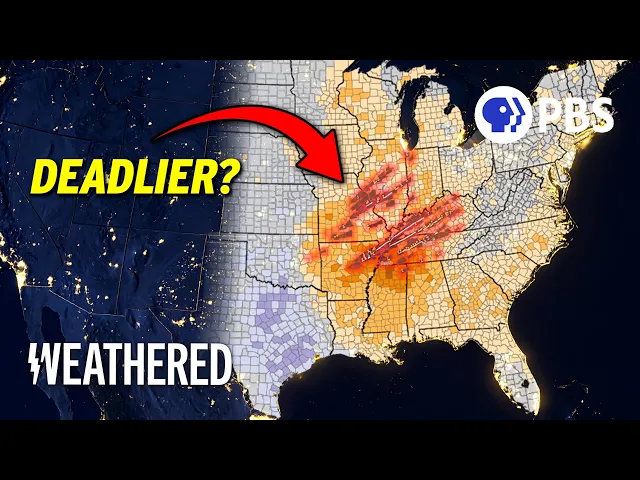
0:16 but scientists have discovered that tornado alley is moving.
0:21 This is definitely a trend.
0:23 This is real.
0:24 And this matters for a particularly disturbing reason.
0:28 The places gaining tornado risk are also
0:30 places where tornadoes are far more deadly.
0:33 Disaster potential is growing exponentially in those regions,
0:36 the deck is stacked against them.
0:38 Before I could even get up, I was sucked through the window.
0:41 Nothing like that's ever happened around here.
0:43 So where exactly is tornado alley shifting to?
0:47 What do we know about why it's moving and why
0:50 is this change making tornadoes so much more deadly?
0:54 Oh my goodness.
0:55 Oh!
1:00 It becomes very striking.
1:01 When you see the visual representation of a map
1:04 or look at the risk through time at a specific location,
1:07 you start to say, wow, this is definitely a trend.
1:09 This is real.
1:11 This is Victor Gensini.
1:13 He's the atmospheric scientist who first discovered tornado alley's shift,
1:17 but the idea didn't occur to him in the lab.
1:20 I first started to think about tornado alley moving after several years
1:24 of storm chasing in the Great Plains where we had very low frequency years.
1:28 And I was thinking, you know,
1:29 this is supposed to be the greatest frequency location on earth.
1:34 So he went back to his lab to crunch the numbers.
1:37 And lo and behold, when you start plotting the trend at any given city,
1:41 what you start to notice is that places in the Great
1:44 Plains have been declining over the last 40 to 50 years.
1:47 But the overall number of tornadoes across the country wasn't declining,
1:51 which meant they had to be going up somewhere else.
1:57 Everybody was telling me like, when you get ready to get home,
1:59 you know, be careful, be careful.
2:00 And my daughter had told me, you know, be careful.
2:02 When I came outside, it was like really warm,
2:05 really calm, and it wasn't storming or raining or anything.
2:09 So I just drove on home like any normal day.
2:11 And I got home, I turned the TV on just to see how the weather was,
2:15 and I guess I just dozed off of sleep and then that's when it came.
2:20 This is Heather Chambers.
2:22 She lives in Wingo, Kentucky and didn't expect the night of December 10th,
2:27 2021 to be particularly memorable.
2:30 I woke up like the house felt like it was like
2:32 moving almost like taking a deep breath and letting it out.
2:36 It's almost what it felt like and I sat up
2:38 and then immediately I heard the sound of glass breaking and I,
2:42 before I could even get up, I was sucked through the window.
2:49 Heather survived the deadliest December tornado on record.
2:53 Multiple weather patterns came together to create at least
2:57 66 tornadoes across the Midwest and Ohio Valley.
3:00 But here's the thing, Wingo,
3:02 Kentucky where Heather lives isn't in traditional tornado alley,
3:07 but it is squarely in the region where tornadoes are on the rise.
3:11 To understand exactly where this new risk is moving.
3:14 We first need to look at why tornado Alley exists in the first place.
3:18 It all basically comes down to a geographical fluke.
3:22 North America is the only continent in the world that extends all the way
3:27 from the Arctic to the tropics without any
3:29 major mountain ranges cutting across from east to west,
3:33 leaving the central part of the continent wide open to colliding air masses.
3:38 So Tornado Alley is the meeting place of three different types of air masses.
3:44 Warm, moist air from the Gulf.
3:46 Cold dry air from Canada.
3:48 And warm dry air from the desert Southwest.
3:51 Which meteorologically speaking makes this region incredibly unstable.
3:56 So when we're trying to make a tornado in the atmosphere,
3:59 one of the things that we look for is instability.
4:01 That's the air to naturally wanna rise and create clouds and thunderstorms.
4:06 We also look for a lifting mechanism,
4:08 which is something to kick that air and push
4:10 it upward fast to develop not just clouds, but thunderstorms.
4:14 And then the final crucial ingredient is wind shear.
4:18 And that's how wind changes with speed
4:19 and direction as we go up in the atmosphere.
4:22 Wind shear is what allows storms to strengthen,
4:25 stay organized and begin to rotate because
4:28 it separates the storm's updraft from the downdraft.
4:31 Wind shear is that changing direction with height,
4:34 and so what happens is as precipitation is lifted through the cloud,
4:38 it'll lift on one side of the cloud and then fall on the other side.
4:41 If we don't have wind shear rain lifts and then it
4:45 falls right on top of itself and we lose the updraft,
4:47 it'll all rain and then the clouds go away and we're done.
4:49 So to recap here, the main
4:52 ingredients needed for tornado formation are moisture,
4:56 instability, lift, and wind shear.
4:59 So when we look at how tornado environments are changing,
5:01 we can look at how changes in those individual
5:04 ingredients are changing over time as well.
5:09 Scientists believe the key to this eastward shift might
5:12 come down to an atmospheric feature known as the cap.
5:16 This is a layer of hot dry air that parks itself right above the warm,
5:20 humid air from the Gulf, suppressing storm development below it.
5:24 And you allow all of that energy to store
5:26 up just like you're boiling water on a stove.
5:29 And then eventually if the updrafts,
5:31 if the storms can become strong enough, they break through that lid,
5:34 they break through that cap,
5:35 and that's when you get the explosive development that we see with supercells.
5:39 Now, here's why the map is shifting.
5:41 The American southwest is getting hotter and drier,
5:44 and this is making the cap stronger and suppressing storm formation
5:48 in the western part of traditional tornado alley in places like Texas,
5:53 but further east in places like Wingo, it's a different story.
5:57 A warming Gulf of Mexico is pumping
5:59 extreme moisture and instability into the Mid-South,
6:02 providing the kind of explosive fuel needed to punch through that strong
6:07 cap and shifting the danger zone right to Heather's front door.
6:10 And then you start to look at the numbers in places like Memphis,
6:13 right, some of the Mid-South of the US,
6:15 and you start to see an increase in the number
6:17 of frequency of tornadoes and strong tornadoes there.
6:21 Now, this doesn't mean the Great Plains
6:22 are no longer the nation's main tornado hotspot.
6:26 They still are.
6:27 The point is that the data show a robust downward trend
6:30 in parts of the traditional Great Plains and an upward trend farther east.
6:36 Tornado alley is the area where tornadoes are most frequent.
6:39 Kansas, Oklahoma, Texas,
6:41 that's where we know tornadoes are most likely to occur.
6:43 However, if we look at where tornado deaths
6:46 and fatal tornadoes are most likely to occur, it's in the Mid-South.
6:49 It's Alabama, Mississippi, Georgia, Tennessee, Arkansas.
6:53 Which makes sense because there are a few key
6:56 differences between traditional tornado alley and the Southeast tornadoes.
7:00 The first is that they're really fast.
7:03 In Kansas, you could sit out in the middle
7:05 of a field and see a storm moving five miles per hour.
7:08 That's not the case in central Alabama.
7:10 When the storms get there, they're moving 60, 70 miles per hour.
7:13 But the next factor is part of the reason that Heather's story is so intense.
7:17 After Heather was pulled through her window by the tornado,
7:21 she landed a few hundred feet from her house where her neighbor found
7:25 her under piles of debris,- But it
7:28 was just pitch black and couldn't see anything.
7:29 It's amazing that he'd even found me.
7:32 Heather experienced a nighttime tornado,
7:34 which is incredibly dangerous, but in traditional tornado alley,
7:39 tornadoes mostly occur between the afternoon and early evening,
7:43 typically between April and June.
7:45 Conversely, in the southeast United States, there's pretty much no annual cycle
7:49 and there's very little diurnal cycle as well.
7:51 So the story here is that in the Southeast you can have tornadoes anytime
7:54 of the year at any time of the day,- And all this means more tornadoes at night.
8:00 Nocturnal tornadoes are about twice as deadly as their daytime counterparts.
8:04 During the day, a tornado may be visible from miles away.
8:08 At night, it can be effectively invisible until it's right on top of you,
8:13 which is exactly what Heather experienced.
8:15 These nocturnal tornadoes are actually more likely in the Southeast
8:19 because of its proximity to the Gulf of Mexico,
8:22 which supplies warm moisture reliably throughout the year and around the clock.
8:28 While people go to sleep.
8:29 The storm's still chugging along because it
8:31 has plenty of moisture and heat to work with, and then at 2:00 AM here comes
8:35 the tornado moving 70 miles per hour in the Southeast.
8:38 But there's another reason tornado alley shift is so dangerous
8:41 and it has nothing to do with weather or climate change.
8:45 Dorothy running to the shelter with a tornado
8:47 dancing behind her in the middle of the field.
8:50 That's not a common sight anymore.
8:52 Now that tornado's dancing through a brand new subdivision.
8:55 Tornado alley is moving to more populated places,
8:58 so that means damage to more homes, roads, and neighborhoods,
9:02 simply more chances for a tornado to hit something or someone.
9:08 After the night of December 10th, Heather's life totally changed.
9:13 You couldn't have told me like "a storms coming." I'm like,
9:15 "oh, well storm." But now it's like they're saying, "on Tuesday of next week,
9:21 we may have storms." Like I'm preparing today
9:23 for a storm that may be coming next Tuesday.
9:25 Think everybody should take it seriously,
9:28 like always have some kind of plan in progress.
9:33 I asked our experts how to prepare for a tornado,
9:36 and they told me the most important thing
9:39 was to do exactly what Heather has done,
9:41 plan ahead, but they had a few more simple yet crucial recommendations.
9:46 You do not want to be in a vehicle.
9:47 We know that if you are in a vehicle.
9:49 You are very likely to become a casualty.
9:51 Your outcome will certainly depend mostly
9:53 on the type of structure that you're in.
9:55 Put as many walls in between you and the outside as possible.
9:58 A smaller interior room is going to be better than a larger interior room.
10:02 Stay away from windows.
10:03 Get to the lowest floor possible.
10:05 Just get to an interior room and put
10:07 as many walls between you and the tornado as possible.
10:08 Even the strongest tornadoes are very unlikely to kill
10:11 you as long as you take those precautions.
10:13 These are from Eastside Concrete.
10:15 They're actually for septic systems, but the night of the tornado,
10:21 people had actually got into these to seek
10:24 shelter and houses were damaged all the way around, but these were still intact.
10:29 I've had six people and a dog safely in here, taking shelter from the storm.
10:33 It's like peace of mind almost to me, knowing that I have somewhere to go.
10:39 That shift from assuming it probably won't happen to you
10:43 where you are to preparing like it could happen tonight,
10:47 maybe one of the most important adaptations of all,
10:50 but we'd love to hear from you.
10:52 What preparations have you made for your local hazards?
10:56 What preparations do you plan to make?
10:58 Let us know in the comments, and don't forget to like and subscribe.
11:03 In show related news, we recently joined Patreon in response
11:07 to federal funding being eliminated to public media.
11:10 Something optimistic that we've learned since then is that a large majority
11:14 of our subscribers say they do so simply to support the show.
11:18 Now, don't get us wrong.
11:19 Our Patreon perks are great and we love bringing them to you,
11:22 but if you are looking for a direct and simple way to help this show continue,
11:27 even after being defunded, please check out our link.
11:31 Thanks so much.