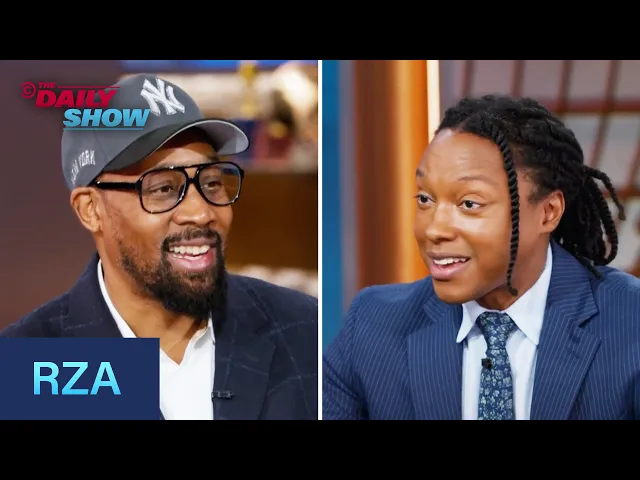
RZA - “One Spoon of Chocolate” | The Daily Show
The Daily Show
0:00 Please welcome Rizza.
0:22 You're you're really here.
0:26 Thank you so much for coming.
0:28 I appreciate you.
0:29 Oh, and congratulations to you and all the Wu Tang
0:33 getting inducted into the Rock and Roll Hall of Fame.
0:35 Rock and Roll Hall of Fame.
0:37 How you going to beat that?
0:39 I know that was uh that made me feel like a kid again, you know,
0:44 like out of all things of this year when I got that news,
0:47 the little kid in me just bubbled up and just came in.
0:49 I had the biggest Kool-Aid smile you can see.
0:52 That was a big moment for me.
0:54 I'm so glad.
0:54 Like it it just seems like when you have such a like
0:58 a legendary story career and you rack up all these achievements over a catalog,
1:03 it's like sometimes you wonder if people just get used
1:06 to the to like that love and that recognition, but it's nice that
1:10 Yeah.
1:10 Know accolades certain accolades just really hit you harder.
1:13 You know what I mean?
1:14 Yeah.
1:14 This is one of those.
1:14 Yeah.
1:15 That's awesome.
1:16 That's awesome.
1:16 Congratulations again.
1:17 Before we go further,
1:18 let me take a moment too and say uh congratulations to you.
1:21 I've been watching the show.
1:22 You're doing a great job, man.
1:23 And that's when it SAY I honestly don't know if we're going to top that.
1:36 I think maybe I I have so much that I want to talk to you about.
1:40 Uh your your movie, A Spoon, One One Spoon of Chocolate.
1:45 The way that you constructed this movie,
1:47 the way that you built it together, you've been working on this since 2012.
1:50 Yes.
1:51 Yes.
1:51 And I'm I'm curious how many times something
1:55 changes and and and something evolves over that much
1:58 time because it's one thing if you to take this much time for a first draft,
2:02 but like you're shooting and you're you're you're probably re-shooting.
2:06 Like what changed about the story as you started to tell it?
2:09 I mean, the story evolved, but you know, times have changed.
2:13 Um, and by the time we got to set in 202 uh4,
2:19 I think when we finally got to set to shoot it,
2:22 uh, I just felt like the story had become pure.
2:28 Like when as an artist, you got to let yourself become a vessel.
2:31 And sometimes you try to force the music out and it's a bad note.
2:35 But if you sit there and wait for it to come through,
2:38 it comes out as a beautiful song
2:40 or for this this particular thing, a beautiful movie.
2:43 Yo, and thanks to Shamik Moore, uh, Paris Jackson,
2:47 uh, Blair Underwood, and a great cast of others,
2:50 man, I think I got something that, uh, is timely and on time at the same time.
2:56 Yeah, absolutely.
3:03 The other thing that I'm really interested about
3:05 when it comes to process is that, you know,
3:07 for your music, you're taking so many different things,
3:10 so many different influences.
3:12 You've got like New York grit, you've got jazz,
3:14 you've got like Asian film culture mixing it all together.
3:17 I like how you Yeah.
3:19 And I'm wondering if for the movie you almost make it the same way where
3:22 you take a bunch of these influences and you wrap it up into something new.
3:26 That's that's that is how I do it.
3:28 Um and that's a great way to do it.
3:29 You know, a story could be told like a song.
3:32 You can write a song.
3:33 You can make it acoustic.
3:34 You can make it uh with with a bass
3:37 and drum or you can make it with a hip-hop beat.
3:39 So with a film, the story that I created remained the same,
3:42 but the style to tell it.
3:44 So I went and pulled ideas or cinematography ideas
3:48 from classic movies in the 70s, movies in the 80s.
3:51 Um there's a there's a shot in my movie
3:54 that is inspired by a movie called Christine.
3:58 All right.
3:58 So that's a um horror film about a car.
4:01 Now my movie is not about that, right?
4:05 But you know what I'm saying?
4:07 But the way the headlights were in that movie when I saw it as a kid,
4:10 I wanted my film to have that same headlight effect.
4:13 So when the audience is watching it
4:15 and this truck that's kind of going through the town,
4:18 when they see those lights, they go, "Oh,
4:20 something about to happen now." You know what I mean?
4:22 So, so that's the beauty of of cinema.
4:25 I like to call myself a hip-hop director because in hip-hop,
4:28 I sample sample sample.
4:30 So in cinema, I can do the same thing.
4:32 Sample different elements to tell my story.
4:34 Got you.
4:35 Got you.
4:35 That's amazing.
4:37 And you know, this thing seems like such a I mean,
4:44 you already said pure like such a a holy passion project.
4:48 You know, you directed, you produced, you did the music.
4:52 Like this so much went into this one project, right?
4:58 Yeah.
4:58 Well, well, well, first of all, I had a great team.
5:00 All right.
5:00 Uh, it's executive produced by Quinton Tarantino.
5:03 All right.
5:04 Um, I went and got uh legendary producer Paul Hall who did
5:08 movies like um Higher Learning and Sha and and some Tyler Perry's.
5:13 And what I what I wanted to do was was
5:16 to surround myself with people that could let me do my thing,
5:21 but if I went on the guard rails, they could be like, "Hold on, bro.
5:24 Push a little to the left.
5:24 Push a little to the right." So, writing is one thing and directing is another.
5:30 But most directors when they get stuck on a on a scene or a script,
5:33 they go, "Hold on, let me call the writer."
5:35 So I was like, "Okay, let me just talk to myself." You know,
5:39 so hold on, let me figure this out.
5:41 Uh yeah, we could do it this way.
5:44 Um so that was the benefit.
5:45 And then one of the beauties of this uh Josh is that um my wife is a producer.
5:51 And so my office is right here.
5:53 Her office is right there.
5:55 Her office is much nicer than my office.
5:57 Okay.
5:59 flowers and all that, but but um but when there was something
6:02 that I personally felt challenged with, I
6:05 could go knock on the producers's door, go sit in her office and sneak a kiss
6:11 and then go back to work.
6:14 Yeah.
6:14 And you when you were directing this, you had
6:17 to direct uh white people to be very very racist.
6:23 Was that awkward to like be like I'm not feeling it from your heart?
6:31 You know what?
6:31 No.
6:31 No.
6:32 There's some scenes in this movie where you know
6:35 when you do a film you get H&R, right?
6:36 Human resources and you got to have these speeches and there
6:39 are scenes and times where where we had to have meetings.
6:43 Uh, my cast, my my main villain is played by uh, Harry Goodwins,
6:48 and he plays a very dangerous, racist white guy in this film.
6:53 And, uh, he's married to a black woman with two children, and he's from London.
6:59 Yeah.
6:58 Okay.
6:58 So, so he had to, you know, really act out some of this stuff.
7:02 And he's one of the nicest guys I ever met.
7:04 So, when you're an actor, you have to take on that role.
7:08 Now, there's one scene in the film where uh my buddy
7:11 James Thompson uh James Thomas who plays like one of the most
7:15 ruthless guys in the film and he he you know
7:18 he just seemed like he got lost a little into it.
7:21 He you know he was LIKE BLAH BLAH BLAH BLAH BLAH BLAH.
7:25 Did he say anything that wasn't in the script?
7:28 Yeah.
7:29 It was there was one word that wasn't in Well,
7:31 it wasn't that it wasn't in the script.
7:32 It was like okay I had two of those in there.
7:35 Yeah.
7:36 He's did three of them, you know.
7:39 Yeah.
7:39 It's like where' that extra one come from?
7:43 Yeah.
7:43 But but but it but it made the it made
7:45 Shami Moore cuz Shamik Mo is such a gentle soul.
7:50 You know, he's a special guy.
7:51 And this is my third project with him.
7:53 And I just love the fact that that um you know,
7:56 he's now evolved into a I call him a man
7:59 actor versus being a a young adult or a child actor.
8:03 But when that energy came at him and he
8:06 it's a scene where he holds his basketball.
8:07 He's going to pop this guy in the face with it.
8:11 Uh on one take the ball slipped out a a little early.
8:14 You know what I mean?
8:15 But don't worry, the ball is plastic.
8:16 It's not it's not real, right?
8:18 But um but the point was that the energy that that was starting to um build up,
8:24 it caused this visceral reaction.
8:26 And for the cameras, that's what I want.
8:28 Um you know, I know it's I know it's delicate.
8:31 I know that um certain words, certain languages are trigger points.
8:35 Uh but this film is made to make you feel uncomfortable at times.
8:40 It's made to feel make you feel uh warm
8:42 and relaxed when you see how young people can relate
8:45 to each other and how the older generation is holding
8:48 on to old school That uh I can say that.
8:52 Yeah.
8:54 Yeah.
8:55 Yeah.
9:02 Okay, this is cable.
9:03 I I can let this a little bit, right?
9:05 But holding on to old school old school crap.
9:08 I'm going say that that that that uh that that's passed, bro.
9:12 Um the film is like let go of that.
9:15 You know what I mean?
9:15 And and then there's moments in the film where no matter who you are,
9:20 you're going to root for the hero because
9:21 the insidious things that is happening in this film.
9:25 If you see yourself on the screen with some of the people that's doing the evil,
9:29 you need to check yourself.
9:30 Okay?
9:31 And if you don't feel the the you know,
9:34 there's a scene where Paris Jackson and Shamik Moore
9:37 kind of like put their two hands together and then,
9:40 you know, they kind of embrace each other and then a tear comes out of her eyes.
9:45 I didn't tell her to cry,
9:47 but the the character I know that she felt the weight of like,
9:50 yo, what's going to happen to our town?
9:52 What's going to happen to him?
9:53 What's going to happen to me?
9:54 When is the world going to wake up and realize that all men are created equal?
10:02 Self-evident.
10:02 It's self-evident.
10:04 As our forefathers wrote,
10:05 it said it's self-evident that all men are created equal.
10:08 Black, white, red, brown, yellow man, and one man, all created equal.
10:17 That's amazing.
10:21 There is there is also something on my mind.
10:23 you created distribution for this film.
10:26 Like you you have what I would say is
10:30 one of the like foremost creative minds in doing
10:34 deals like whether whether it was with Wuang back
10:37 in the day or it's what you're doing now,
10:39 you always really think artist forward and and like the way that
10:45 the artist can can work without getting lost
10:47 in sort of whether it's jargon or legal ease, what whatever the thing is.
10:52 And I see you making this distribution for yourself for the film.
10:55 Is that something you want to do more broadly or did you feel like
10:58 it was the only vehicle that you could get into theaters the way you wanted?
11:02 Well, it's a similar It's a little bit of both.
11:04 I wanted to make sure that with if I could go through the funnel first,
11:08 I can wire it up a little bit,
11:10 make it a little wider, and then get other artists to come through.
11:14 You know, look, it's not easy making a movie.
11:15 It's a 30 hurdle jump.
11:17 All right?
11:18 Uh to get it in cinema, there's another 30 hurdle jump.
11:21 I formed 36 cinema and 36 distribution to maybe make it a 12 hurdle jump.
11:26 You got to jump something.
11:27 All right.
11:28 But if I could simplify it a little bit and get
11:30 more stories into the system uh and get more artists
11:34 that chance to kind of be artists and not be caught
11:38 up because of budget or or because of um even some gatekeeping,
11:42 you know, in some stereotypes of of what a of what um a character can be.
11:47 You know, I'm trying to like at least crack that door
11:50 a little more so a little more could get in.
11:53 You know what I mean?
11:54 Absolutely.
11:54 You are an incredible legend and this this film and all the things you're doing,
12:01 the deals that you make, the people you uplift just add to your legend.
12:04 So, thank you so much for being here.
12:08 Thank you.
12:11 One full of Chocolate will be in theaters May 1st.
12:14 Rhythm.