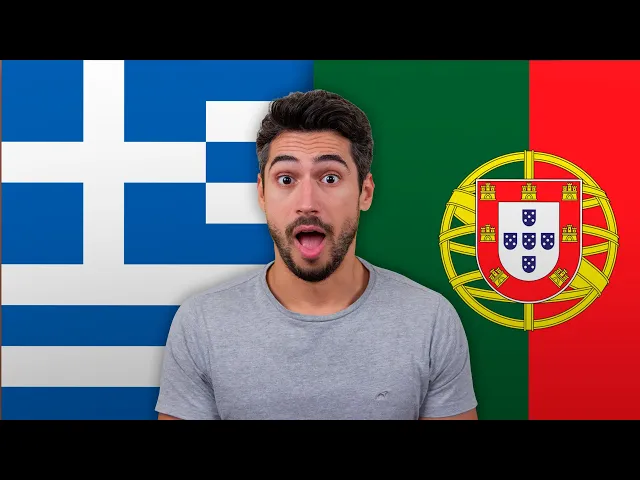
Palavras Gregas no Português
Portuguese With Leo
0:00 Hello and welcome back to Portuguese With Leo!
0:05 My name is Leonardo,
0:07 and on this channel I talk about the Portuguese language and culture.
0:12 I recently visited Greece,
0:13 a country that has captured my heart thanks to its beauty,
0:18 climate, people, food… and language!
0:26 So, it seems fitting to make a video
0:30 about how the Greek language has influenced Portuguese.
0:34 To do this, I'm counting on the help of Iró, a Portuguese teacher from Greece!
0:40 And we can start by talking a little about the history of the Greek language.
0:46 Greek is one of the oldest languages in Europe,
0:49 having emerged about 3,500 years ago, during the Mycenaean civilization,
0:55 which inhabited Greece between 1600 and 1100 BC.
0:59 From there, the language evolved into what we now call Ancient Greek,
1:05 the language of great thinkers like Socrates, Plato, and Aristotle,
1:10 who lived in the 5th and 4th centuries BC.
1:13 It was during this period, in Ancient Greece,
1:16 that many of the fundamental concepts of science,
1:20 politics, and philosophy were born.
1:22 Concepts such as democracy, ethics, logic, rhetoric, and mathematics.
1:34 The very words "política" and "filosofia"
1:37 also come from Greek and mean, respectively,
1:42 "art of governing a city" and "love of wisdom." With so
1:49 much knowledge being written and transmitted in Greek during this period,
1:53 the language established itself as the great
1:56 vehicle of culture and science in Europe.
1:58 And at the same time, at the end of the 4th century BC,
2:04 Alexander the Great further expanded Greek through his military conquests.
2:08 And in the military field,
2:10 the Greek language gave us words such as "estratégia,"
2:15 "tática," "espada," and "catapulta." It was during this period
2:22 that Greek became the lingua franca of the Mediterranean
2:25 and evolved into a more uniform version: Koine.
2:31 Meaning "the common dialect," which served as the basis for modern Greek.
2:37 After the death of Alexander the Great,
2:39 Greece entered a period of division and over time lost its prominence.
2:44 Rome gained strength, and by the 2nd century BC,
2:48 it was already the great European power.
2:51 However, despite Latin now being the lingua franca of the continent,
2:57 Greek retained its prestige.
2:58 It was the language of philosophers, physicians, and scholars.
3:03 The lower classes of the Roman Empire spoke Vulgar Latin,
3:07 but the Roman elites were fluent in both Latin and Greek,
3:12 and the overwhelming majority of scientific, medical,
3:15 and mathematical texts were written in Greek, not Latin.
3:20 In those days, being fluent in Greek was
3:23 a sign of knowledge and a symbol of high status.
3:28 And the truth is that even today,
3:30 mastering more than one language is viewed very positively and opens many doors,
3:35 especially in the professional field!
3:38 Yes, if I hadn't learned Portuguese, I wouldn't be a teacher today,
3:43 and I wouldn't be here participating in this video!
3:46 And fortunately, learning a new language has never been easier than it is today!
3:51 In the past, when we needed to find a language teacher,
3:55 we had to physically go to the nearest language school
3:59 and pray that they taught the language we wanted to learn.
4:04 But nowadays, all you have to do is click the first link in this video's
4:09 description to access italki and find teachers
4:12 for virtually any language you want to learn.
4:16 Italki is the sponsor of this video
4:18 and has sponsored many other videos on this channel,
4:21 and the reason I continue to work with them
4:24 is because they're the best platform for finding language teachers.
4:28 Experienced teachers know when to correct you and when
4:32 to let you speak so as not to interrupt your flow.
4:35 The atmosphere in an Italki class is relaxed,
4:37 and it often feels like you're talking to a friend.
4:42 If you follow my channel, you know I love learning languages.
4:45 And on Italki, I can both practice languages I haven't mastered yet,
4:50 like German, and also learn new ones,
4:54 like Greek, which I recently started learning.
4:57 And let's be honest, if it weren't for Italki,
5:01 where would I ever find Greek teachers in Lisbon?
5:04 Highly unlikely!
5:05 So, if you want to take a real leap in your progress in Portuguese, English,
5:11 Greek, or any other language,
5:13 sign up by clicking the first link in the description.
5:16 By using this link you will be supporting my channel,
5:19 and with the discount code LEO7 you'll also get €5
5:24 off your first lesson if it costs at least €10.
5:29 You're also entitled to three trial lessons at a reduced price,
5:34 so you can "test" several teachers until you find
5:38 the one or ones you connect with the most.
5:41 Thanks to italki for sponsoring this video,
5:44 and now let's return to the history of the Greek language!
5:48 In the 5th century AD,
5:50 the Western Roman Empire fell, but the Eastern Roman Empire,
5:55 also known as the Byzantine Empire,
5:58 continued for another millennium, until the 15th century.
6:01 And its official language was Greek.
6:04 The Byzantine Empire fell in 1453 with the conquest
6:10 of Constantinople by the Ottomans, and only then,
6:14 after nearly two millennia as one
6:16 of the most prestigious and spoken languages in Europe,
6:20 did Greek begin to lose international influence.
6:24 With such a long history and such a great influence,
6:29 it's no surprise that Greek has been one
6:32 of the main sources of vocabulary for European languages.
6:36 Especially from Romance languages, like Portuguese.
6:39 Yes, because Latin absorbed a lot of Greek vocabulary,
6:43 and then, with the evolution of Latin into Portuguese,
6:46 which I explain in this video here,
6:49 these words, originally Greek and then Latin, became Portuguese.
6:55 And this Greek influence begins right in the alphabet.
6:59 Yes!
6:59 The Latin alphabet is based on the Etruscan alphabet,
7:03 which in turn was directly inspired by the Greek alphabet.
7:06 And the word "alfabeto" itself is of Greek
7:10 origin—αλφάβητο alfávito—and derives from the first two Greek letters:
7:14 Alfa(Αα) and Beta(Ββ).
7:17 And in Portuguese, we can use both the term alphabet,
7:21 which comes from alpha and beta,
7:23 and the term "abecedário", which comes from ABC.
7:27 Okay, we already know that the Latin alphabet comes from Greek,
7:31 now what are the words that come from Greek?
7:34 As we saw in this video,
7:37 Latin borrowed from Greek many words linked to different areas of knowledge:
7:41 medicine, politics, philosophy, and so on.
7:45 So, what we're going to do now is organize these words
7:50 of Greek origin by area of knowledge, by lexical group.
7:55 And since you used the word "lexical," which comes from the Greekλέξη léxi,
7:59 I suggest we start with this area
8:02 of knowledge that we're so passionate about: languages.
8:05 Very good!
8:06 The Greek wordλέξη means "palavra" and gave
8:10 rise to terms like "léxico" and "lexical."
8:13 But the Portuguese word "palavra" itself also
8:17 has its origins in Greek:παραβολή, meaning parable.
8:21 The very study of language rules and structures,
8:26 which causes so much headache for foreign language learners,
8:31 originated in Ancient Greece and is calledγραμματική grammatikí (grammar),
8:37 the "art of letters." Within grammar, we have many terms of Greek origin:
8:45 "morfologia," the study of form; "sintaxe," the organization of words;
8:53 "ortografia," correct writing; and "caligrafia," beautiful writing.
9:01 But a language isn't just grammar and lexicon; it's also phonetics.
9:06 This also comes from the Greek:φωνητική phonitikí,
9:08 which is the study of the sound of the language.
9:10 And speaking of sound, we also have words like acústico,
9:15 which comes from the Greekακουστικός akoustikós,
9:17 and everything ending in -fone, like telefone, microfone, and megafone.
9:24 All the Greek words:τηλέφωνο tiléfono, sound at a distance;μικρόφωνο mikrófono,
9:29 small sound;μεγάφωνο megafono, great sound.
9:32 Yes, and just like the prefixes tele-, micro-, and mega-,
9:37 many other prefixes we use daily also come from Greek:
9:42 anti-, meaning against; auto-, referring to oneself;
9:46 bio-, meaning life; chrono-, meaning time; demo-,
9:51 meaning people; geo, meaning earth; hidro, meaning water; macro,
9:57 meaning great; mono-, meaning unique; neo, meaning new; pan,
10:03 meaning all; peri-, meaning around; poli-, meaning many; proto-,
10:09 meaning first; psico-, meaning mind; and termo-, meaning heat.
10:15 And besides prefixes, there are also widely used suffixes of Greek origin:
10:21 We've already seen -grafia, which comes from "writing," and -fone,
10:25 which comes from "sound," but there's also -fobia,
10:29 which comes from "fear," -filia, which comes from "friendship," -metro,
10:33 which comes from "measurement," and the very common -ismo and -logia,
10:38 which come from "practice" and "study." Yes,
10:41 all words ending in -ismo and -logia, from Christianity to biology,
10:47 owe at least half of their origin to Greek.
10:51 In the case of biology(βιολογία), every word is of Greek origin:
10:56 bio, which means life; and logia, which means study.
11:00 The study of life.
11:02 Well, the truth is, if we were to now discuss each branch of knowledge,
11:08 we could spend an hour listing words of Greek origin.
11:14 Words from astronomy, like cosmos and eclipse;
11:18 or geography, like topografia and clima;
11:23 engineering, like mecânica and cinética;
11:25 or even geometry, like perímetro and polígono.
11:29 Yes.
11:30 The only major discipline that has virtually
11:33 no vocabulary of Greek origin is law,
11:36 because although the Romans wrote their scientific treatises in Greek,
11:42 they wrote their laws in Latin.
11:45 Yes, words like lei, contrato, veredicto, sentença, acusação,
11:51 defesa and tribunal are 100% Latin in origin
11:55 and very different from their Greek equivalents.
12:07 But returning to the areas of knowledge that do use words of Greek origin,
12:11 I want to talk about one that is most special to me: medicine.
12:16 Those watching probably don't know that I'm a doctor.
12:20 I studied medicine for six years and worked for nine months
12:24 in a hospital before changing my life and pursuing other paths.
12:29 Medicine originated in Ancient Greece with Hippocrates,
12:32 and today all doctors take the Hippocratic
12:36 Oath at the beginning of their careers,
12:39 promising, among other things, to do no harm,
12:43 respect life, and maintain patient confidentiality.
12:46 It's an ethical commitment that dates back to Ancient
12:51 Greece and continues to inspire medical practice today.
12:55 And of course, 80% of the medical terms we use today originate from Greek words,
13:01 from pediatria, which is the medicine of children,
13:05 to hematologia, which is the study of blood; neurologia,
13:09 the study of the nervous system; ginecologia,
13:13 the study of women; cardiologia, which focuses on the heart;
13:18 diagnóstico, the act of recognizing a disease; terapia,
13:22 which means treatment; and cirurgia, which involves manual labor.
13:27 In other words, Greek is everywhere in the Portuguese language!
13:31 And for me, as a Greek who has learned other languages,
13:35 I find it fascinating how many words that are common to us
13:40 Greeks are considered sophisticated and scientific
13:43 in other languages like Portuguese, English, and Spanish.
13:48 It's true, and with that, all that's left is to say goodbye!
13:53 Thanks for your participation, Iró!
13:55 It was a pleasure, Léo, thank you!
13:57 If you're from Greece and interested in taking Portuguese lessons with Iró,
14:01 I've left her links in the description.
14:04 As always, thank you to everyone who supports me on Patreon every month!
14:09 The link to subscribe to Patreon is also in the description.
14:13 And finally, if you're interested
14:15 in learning how another language influenced Portuguese,
14:18 check out this video here!