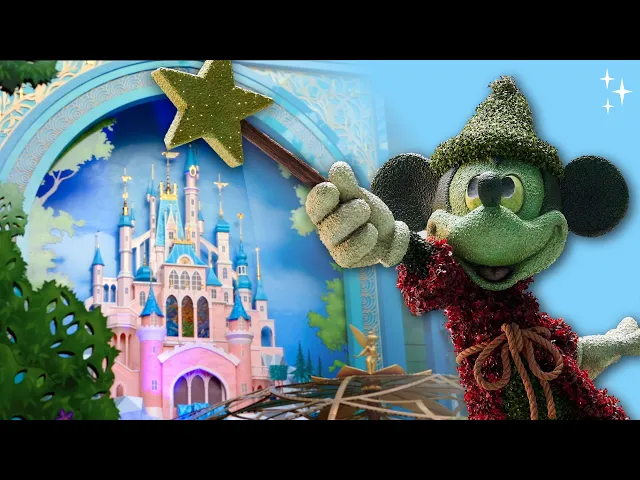
Insider's Look at Disney Cruise Line's BIGGEST Ship in the Fleet | We Call It Imagineering!
Walt Disney Imagineering
0:00 As you come in, you go through the secret passageway.
0:02 What I'm about to show you can only be seen.
0:05 There are a lot of challenges on this project.
0:07 We've been gone from home, all that time traveling.
0:10 You really want me to say I really cried like crazy.
0:11 It's like a therapy session, you got to go deep.
0:13 They've never actually seen it before,
0:15 but it makes them feel like they've always known it.
0:17 I have cried so much.
0:19 We’re behind the scenes for an insider's look at what's possible at sea.
0:24 We're on the Disney Adventure!
0:25 The biggest ship in the fleet!
0:28 So much energy and vibrancy.
0:30 This is San Fransokyo Street,
0:31 one of the most immersive venues in the entire ship.
0:34 A Disney ship should be both classic, but also should be modern.
0:38 We're here at the Disney Imagination Garden stage.
0:40 We're about to fly some performers.
0:42 Here we are at the Oceaneer Club,
0:44 where kids can be inspired to spark their creativity.
0:46 We're in the Web Lab.
0:48 This activator is unique to the Disney Adventure.
0:50 This is the Animators Palate restaurant.
0:52 6 billion pixels coming to this space.
0:55 We are on the upper deck seeing the Lion King, Celebration in the Sky!
1:00 How do you take a 90-minute movie and turn into an 11-minute fireworks show?
1:03 Stay tuned to find out.
1:05 We Call It Imagineering.
1:13 The Disney Cruise Line is entering into a new market in Southeast Asia.
1:18 In this area, we do not have a Disney Park.
1:20 This ship is the introduction to our Disney brand.
1:24 The first castle at sea.
1:26 We decided, as we were designing the ship,
1:28 to look through a lens of our theme parks.
1:31 What really worked so well.
1:34 And we brought that same guiding principles into this ship.
1:38 The way we did that was by splitting the ship into different areas.
1:42 As Disney Imagineers, we often have this blank canvas, but this time we didn't.
1:45 And this canvas was huge.
1:48 We had a ship that was half built.
1:50 That means there was steel.
1:51 There was floor, ceilings already.
1:54 Some of the boxes were drawn for us.
1:56 We had to figure out how to fit our stories into these spaces.
2:01 It was thousands of hours of research and working with our consumer
2:06 insight partners to tell us what this audience would love.
2:11 One of my favorite things about this project was I
2:13 was able to actually work hand in hand with my wife.
2:16 She's a project manager, leading logistics and owner supply,
2:20 being able to pull this thing together.
2:22 It's just an incredible opportunity for the future
2:25 to tell our families and our future kids,
2:27 hey, mom and dad brought a ship together!
2:29 And it's sailing out of Singapore.
2:35 Wing, first of all, thank you for being here.
2:36 You're looking quite dapper, I must say, as always.
2:39 Thank you.
2:39 I had the privilege of getting to oversee the design of two of our ships.
2:43 The Dream and the Fantasy.
2:44 But I couldn't have done it without all of the work
2:47 you had done prior on the Magic and Wonder.
2:50 I don't know that everybody remembers there was something before that.
2:53 The cruise business was developing in America.
2:56 One of the cruise lines came to Disney.
2:58 Can we become your official cruise line?
3:01 The sales and licensing agreement with Premier Cruise Line
3:04 for the Disney characters to be on their ships, and the boats are painted red.
3:09 They called it The Big Red Boat.
3:10 The Big Red Boat.
3:12 Michael Eisner, he was the chairman at that time.
3:15 He said, we at Disney, if we are going to get into the business,
3:18 we have to do our own thing.
3:19 Yeah, very much in the spirit of Walt Disney.
3:22 That's right.
3:22 Now at the time, you were overseeing
3:24 all of our hotels and entertainment experiences.
3:28 How did it end up on your lap, as it were?
3:30 I happened to sit next to Michael that day,
3:32 and he turned to me and said Wing, And let's have some fun designing some ships.
3:36 Well, I'm sure it's something you never thought you would do No!
3:38 When you went to architecture school and joined Disney.
3:41 We studied architecture.
3:43 Buildings don’t leave the spot.
3:44 They don't move.
3:47 So we asked Michael, what do you want?
3:50 He said, I think a Disney ship should be classic, but also should be modern.
3:55 Then he walked out.
3:57 It's not easy to find the perfect design.
3:59 The ship has to look tropical, Disney.
4:01 It should be so different.
4:02 Here we are.
4:03 That's a Disney ship.
4:04 All right, but I'm not sure.
4:05 It says it's a cruise ship.
4:06 Well, I tell you, that's tropical, alright?
4:08 But it doesn't look like a ship.
4:09 It's interesting.
4:10 It's modern.
4:10 It had to be Disney.
4:11 It has Mickey Mouse.
4:12 But that's not enough.
4:13 This is more like a super yacht.
4:15 I don't think it says Disney.
4:16 It's really colorful.
4:17 Too much.
4:18 We don't need that many funnels.
4:19 We've got, like, a cargo ship.
4:21 Well, this is beginning to look like a cruise ship.
4:23 It doesn't say, you know, Disney.
4:25 Finally, the sketch.
4:26 That's a Disney ship!
4:29 That was a lot of ships.
4:33 The classic part is the four Mickey Mouse colors.
4:35 The black, the white, the red and gold.
4:37 The most cruise ships.
4:39 They all painted white.
4:40 Yeah, like a shoebox.
4:41 We brought back the portholes and the horizontal railings and the modern taper,
4:45 the bow and the stern, sort of two funnels.
4:49 So some of these details give us a combination of both classic and modern.
4:55 You really set the design criteria of how we
4:57 can go forward with the uniqueness of the cruise lines.
5:00 Next one is the Adventure.
5:04 It's our biggest ship yet.
5:05 It's different because we didn't design it from the ground up.
5:09 You know, we went in and transformed it into a Disney ship.
5:13 It has some immersive moments because of its scale.
5:15 Yes, that we haven't done on our other ships,
5:18 but we're inspired to think about now.
5:19 And you set us up for such success.
5:21 We're never deviating that far from that classic profile,
5:25 because it's not easy when you design something,
5:27 to get it right, right out of the box.
5:29 And I think the design that you oversaw, it did that.
5:42 We were really inspired by this idea of what about
5:46 a place where all of our characters could live together.
5:50 So we created the Disney Imagination Garden.
5:53 The thing I love about the garden is that this is a parallel to a main street.
5:57 It's obviously not turn of the century.
5:59 Marceline, Missouri.
6:01 There's all of these little details that not
6:03 every guest is going to see right away.
6:06 It was the 100th anniversary of Disney
6:08 Feature Animation when we were building it.
6:11 And they released a special that was called Once Upon a Studio,
6:15 and it celebrated 100 years of Disney characters.
6:18 OK everybody, get together now!
6:20 One of the things that was very fun about that short was
6:23 all of these different characters sort of living together side by side.
6:31 Nothing really feels as Disney as a castle.
6:34 It's the logo that you see before any one of our motion pictures.
6:38 Every single one of our resorts has a castle park.
6:41 We thought, why not have a castle at sea?
6:44 We had to do a lot of thinking about what we wanted that castle to look like.
6:48 Was it a specific castle?
6:50 Was it going to be a realistic castle?
6:52 We ended up going with a pop-up book and a storybook,
6:55 and we wanted that sense in the garden that you
6:57 sort of feel like you walked into a storybook,
7:00 but it still was very clearly a Disney Castle.
7:04 I worked for years at Imagineering, and often we have to deal with budget,
7:09 but I've never had to deal with a weight budget before.
7:11 The heavier the ship is, the more fuel it takes to move it around.
7:14 And so we really had to keep that weight budget low.
7:17 At one point we were 100% over budget.
7:20 We estimated originally it was going to be 140 tons.
7:23 That was way more than we were allowed.
7:26 Through careful engineering and some material changes,
7:29 we were able to cut 70 tons of steel out of our design,
7:33 and that was a huge challenge and a real milestone for us.
7:38 The space that we're standing in has guest staterooms on either side.
7:41 We don't have anything like this on any of our other ships,
7:43 so we had to design it completely from scratch.
7:47 When you look at it from the upper decks, it really still feels like a garden.
7:50 There's a little stream that runs through.
7:52 You can enter it from behind the castle,
7:54 or you can enter it from behind the stage.
7:56 It has to work from a lot of different angles.
8:03 This garden, which is not any one specific story,
8:06 it's probably meant to be your story.
8:09 We wanted it to be a place where your adventures could begin.
8:21 We're here on board the Disney Adventure at the Imagination Garden stage.
8:26 This kind of venue is going to give us an opportunity to really expand
8:29 the kind of storytelling and the immersion we're going to create for our guests.
8:33 We've got 5.5 million beautiful, individually tested pixels.
8:39 It's crazy that it's almost 30ft from here,
8:41 all the way to the top of the screen with a wraparound almost 50ft as well.
8:45 It's bigger than any screen we've done before on any stage in the DCL fleet.
8:49 It's different than all of our other ships too,
8:51 because we're inside the canyon space instead of the deck
8:54 stage where it's all up on the upper deck.
8:55 We had to completely start from scratch to redesign how the show looks,
8:59 while still wanted to honor those original design concepts
9:02 of how the show feels when you're watching it.
9:04 Oh yeah, look at that great transition right there.
9:07 We need something that will be it right during the day.
9:10 Durable enough to withstand outside conditions.
9:13 Heat, cold, potential rain.
9:15 All these variables we have to take into account.
9:18 sometimes confines limitations,
9:19 really come up with the most creative ideas and the most
9:22 clever solutions around the problem to create a show,
9:25 to find a fun solution to a difficult problem.
9:28 Exactly.
9:31 Most stages the speakers are on the outside,
9:33 but we wanted to do something completely different here.
9:36 We decided to go behind the screen so that we
9:38 could hide it and make it really magical and really immersive.
9:42 So this is our right array of speakers.
9:44 There's 27 modules in a total of 81,
9:47 and there's 2400 individual speakers, in all of them.
9:50 Takes up almost two decks of space.
9:53 On this frame that moves back and forth here behind the LED screen.
9:57 And it's what's called a mesh LED or a transparent LED,
10:00 where every other row of the pixels on the screen is not there,
10:04 giving the audio a chance to pass through the screen.
10:07 I mean, as you can see here,
10:08 every other row of pixels is removed, giving us that mesh LED look.
10:12 And it's kind of crazy how large the pixels are when you this close to it.
10:15 And the guests are none the wiser when they're that far away,
10:18 it just looks like a crystal-clear image
10:20 and the speaker is hidden right behind it.
10:22 It comes through all of those spaces, and it sounds really fantastic.
10:26 One of the really exciting challenges we had is the way the audio works,
10:30 because this place is different.
10:31 Having guests state rooms immediately adjacent to the stage,
10:34 we really wanted to be able to control the audio.
10:36 That's why we have such a specific beamforming set of speakers.
10:39 It's able to focus the audio exactly where we want,
10:42 but we also are using a system where
10:43 the characters and performers can wear headphones while we're rehearsing.
10:47 It's crazy to think how all this technology and storytelling came
10:50 from a literal napkin sketch created by an Imagineer and years later,
10:54 this is what it's turned into.
10:56 We say here at Disney, we make magic like,
10:58 this is the magic that we're making right now.
11:04 We're up here above the garden stage and we're about to fly some performers.
11:09 This technology was developed to fly
11:12 a performer anywhere in the garden stage area.
11:15 Our other ships can just do the 2D flight.
11:17 Right.
11:18 X Y axis.
11:18 That's it.
11:19 And we're like, no, no,
11:20 we want to get the audience involved, Especially with the balconies here.
11:23 The guests that are in those balconies can feel
11:25 like they're even more a part of that show.
11:27 It's almost like a meet and greet.
11:28 Yeah, they’ll all probably meet and greet in mid-air.
11:30 Yeah, in midair.
11:31 Yeah.
11:32 Being able to fly the performer in any range
11:34 out from the garden to the stage area is impressive.
11:37 Yeah, and new for us.
11:41 I think the biggest challenge was the physical aspect of it.
11:45 The winches for this are huge.
11:48 It doesn't fit through any door.
11:49 So something we had to do is kind of peel off the ceiling,
11:52 kind of like a tin can of tuna and drop
11:54 the winch in there and then seal it back up.
11:57 There is potential for expanding the system later.
12:00 However, if we decided to put it another winch,
12:02 we have to do that all over again.
12:04 Need tension on it first...
12:05 right?
12:05 Another one of the challenges we had was when you do rigging,
12:08 the deeper your bridle is,
12:10 the less weight is being pulled on the facility, on the winches, etc.
12:15 and as you pull that bridle up higher, it puts more attention on there.
12:19 For an example where the bridle is at its highest,
12:21 we're putting 500% of the performers weight on each leg.
12:25 So we had to design a system that could withstand that.
12:28 And going into that performer, our first thing that we always factor
12:31 into all these systems is performer safety.
12:33 Yes.
12:34 It was probably a year and a half from design and testing,
12:38 and then we got into installation,
12:39 and then it was another six months of installation, testing, stress testing.
12:45 It's been a very long process, very challenging, very rewarding.
12:49 And it's been so cool to see performers and technicians working on this system.
12:55 I'm really excited to see this in full show,
12:57 and hopefully we can expand on this in the future.
13:02 The things I love, we're very multi-generational focused as a company.
13:07 The cruise ships do it in a way that is unique.
13:10 A typical cruise, they may have a little baby-sitting room,
13:13 could be six months old to ten year old kids.
13:15 We said with Disney we will create different age groups.
13:18 The first two ships that we have four kids clubs.
13:20 But then we realize from 12 years up to 17, that's a huge gap.
13:24 So we said we need to break it again, divide it again.
13:27 To Tween Club and the teen.
13:33 The Oceaneer Club is where all of our younger guests and as Imagineers,
13:36 when we set out designing all of these spaces,
13:39 I think we really thought about how could
13:41 we bring to life and build these really immersive,
13:43 fun places that let you just step into their favorite story.
13:48 We always think about what really makes the Disney
13:51 difference of quality and really a good touch for detail.
13:55 Ugh, just a Ranger today, but hopefully I'll be a cosmic hero soon.
14:01 In the Walt Disney Imagineering Lab, kids can spark their creativity.
14:05 We've built spaces for kids to collaborate
14:07 with one another and be inspired by it.
14:09 Some of our own props that we use in our parks worldwide.
14:12 The Imagineering lab, that is exactly where you would have found me.
14:15 I grew up on those Imagineer That!
14:17 specials, and this is like stepping right in to one of those yourself.
14:22 This is one of our largest Oceaneer Clubs in the fleet.
14:25 We cannot wait for our guests to see all of our hard
14:28 work and dedication and love for detail that we put into it.
14:37 As you guys know, Black Panther is one of my favorite superheroes,
14:41 so I was super excited to get into this because,
14:44 this activator is unique to the Disney adventure.
14:46 We don't see it on any other ships.
14:49 What brought us to create the storyline was
14:51 how we can get our young guests to be part of the Wakandan Outreach unit and how
14:56 would we eventually incorporate Black Panther King T’Challa himself.
14:59 So we got with our scriptwriter and decided we're going to do some lab testing.
15:03 Throughout the room, there's going to be these boxes that are hidden
15:07 and the kids have to find them and inside is a crystal.
15:11 So I'll put them all together,
15:12 which will then activate the activator and turn on all the lighting.
15:17 The activator as a whole is fully pixel mappable and RGBW controlled,
15:22 but one of the challenges we were having was figuring out
15:25 what the glyphs were going to look like in the space.
15:28 We only had blueprints at the start,
15:31 so we weren't sure what obstructions we may or may not have in the space.
15:34 So we went through multiple tests regarding
15:36 how the light source would impact those projections.
15:43 The combination of your lighting elements, along with audio design,
15:47 the aural landscape that's going to really enhance things,
15:50 to really kind of make this pulse and ignite.
15:54 Black Panther has created a core memory for me,
15:57 and I'm hoping it does so for all of these kids.
16:05 Another innovation was the rotational dining.
16:08 Yes, it's a typical experience.
16:10 Then, your table is always assigned that table for the entire cruise.
16:14 But we had Disney.
16:15 We make a Disney restaurant.
16:16 Well that's it.
16:17 We're trying to create the magic.
16:18 And we also know what our parts that are cast members are among the highest,
16:21 if not the highest rated part of a Disney theme park.
16:24 We found that the crew, especially the ones who serve at the restaurants, yes,
16:27 do the same thing on the ships
16:29 because you might go to three different restaurants.
16:30 Yes, but your server follows you.
16:32 Exactly.
16:32 That’s a first!
16:33 They get to know you the first night,
16:35 and then they're with you on the journey the whole time.
16:37 It's that high touch moments with our cast members,
16:40 because they're just so good at what they do.
16:42 Yes!
16:42 That detail is classic.
16:46 One of the great things about Animator's Palate is that families
16:49 can come in here and sit and have a meal,
16:52 but also to enjoy animation and participate in animation.
16:55 When the guests first walks into the restaurant,
16:57 they're presented with a placemat says draw your own character.
17:00 The waiter will pick up all the drawings
17:03 and they're taken into what we call the vetting room.
17:05 We scan them in thousand per seating,
17:08 and then they'll see your character come to life on the big screen.
17:12 We could read the zones.
17:13 We know where people are going to be,
17:14 so they're always going to see their drawings.
17:17 The characters are animated by actual Disney animators.
17:20 We simply are replacing the drawing that was originally
17:23 there with the drawing that, that the guest makes.
17:26 When the guest draws on the placemat, it becomes an extension of themselves.
17:29 They get to star next to their favorite Disney character.
17:33 These are just what I need to whip up a little animation magic.
17:38 It's amazing how much technology behind the walls
17:40 and we managed to make it disappear.
17:43 Fiber cables.
17:45 Control cables.
17:46 More than 100 monitors, 24 video tracks, 1.96 billion pixels!
17:51 Each TV can be color adjusted individually, remotely.
17:54 So this is one is for this restaurant.
17:57 There's so many servers,
17:58 there's so many screens across the entire restaurant that everything
18:01 has to be in perfect sync at all times.
18:03 Add a touch of a button,
18:04 we can control what the overall look of the restaurant is.
18:08 When you walk in everything just looks like a gallery.
18:11 But by the end of the show, whoa!
18:13 Then you have this big transformation.
18:16 Wow!
18:17 I started back in 2011 when we're building Fantasy at that time.
18:21 Fantasy was the first time, Animation Magic, the show, be introduced to public.
18:26 Back then the technology was limited.
18:28 You essentially you have 16 types of information.
18:31 Newer technologies make you feel like you're a part of that feel.
18:35 Completely immersed.
18:36 It’s a unique combination of eating and drawing and animating.
18:41 And at the end of the meal, they see their drawings from the life.
18:43 And it's a very emotional, and fun experience.
18:47 Every show on every class of ship we have is a different, unique experience.
18:54 It's been very gratifying working on this project for so long.
18:57 It started 20 years ago when we first went
18:59 to New York and came up with this idea.
19:02 To see it evolve, and hopefully will continue to evolve in the future.
19:11 Fireworks are so quintessentially associated with Disney.
19:15 We're famous for our Kiss Goodnight at the Parks.
19:18 We know that the Kiss Goodnight is so much part
19:21 of a Disney experience as defined by our theme parks.
19:24 I could hear everybody going, we have to have fireworks, right?
19:27 But it's on a cruise ship.
19:29 You all pioneered on the cruise ship.
19:31 The fireworks.
19:32 And we were the first ship ever.
19:33 We were still the only.
19:34 Yeah, we are always reminding ourselves.
19:37 Right?
19:37 Whatever we're doing.
19:38 What else can we add?
19:39 What else, to complete their journey.
19:43 We are on the upper decks.
19:45 I remember working with you on different ways of telling a fireworks story,
19:49 and we kept going back to The Lion King.
19:53 Why don't we just do only Lion King?
19:57 This is one of the very few times that we
20:00 will do a single story in a fireworks show.
20:02 The songs were chosen along with the narration and the themes of life,
20:08 the joyous birth, friendship, loyalty, love, deceit and then finally triumph.
20:25 This show has by far the most pieces fired off a ship.
20:29 The typical show has about 290ish pieces, where this one has about 650.
20:35 We go for about a three-minute show on all the other ships in the fleet.
20:38 This was about 12 minutes.
20:40 We came out here five months ago and started installing
20:43 those first bunkers to installing the last ones just three weeks ago.
20:46 So it was a long process, a lot of hard work.
20:49 It's the biggest ship in the fleet, which equals the biggest firework show.
20:52 The biggest crew doing it.
20:54 Just the biggest everything.
20:55 We go big here.
20:59 We can control the weather, in a way.
21:01 We can actually sail away from bad weather.
21:03 We can turn the ship.
21:04 So the wind is always blowing the smoke away from the audience.
21:09 Since the 90s, Disney Cruise Line has done fireworks.
21:12 Since I was a kid, seeing the fireworks to finally be able to do it.
21:15 It was pretty special.
21:16 to add to that legacy with the Adventure.
21:19 We both have our families here.
21:21 This whole project is kind of getting a little...
21:22 got me a little emotional.
21:23 My new child that that's here today,
21:25 and this is the first fireworks show he’s ever seen and something that created,
21:29 the medium of fireworks.
21:30 Everyone loves them.
21:30 It's just there's something about it that nothing else can really relate.
21:34 It's gorgeous.
21:34 It's emotionally impactful.
21:36 The music is the heart and soul of the show.
21:39 With the devices of orchestra and percussion and vocals
21:44 build those dramatic moments and the emotion and drive it.
21:49 And then you enhance that with the way
21:52 you used and arranged the Nouveau Youth Choir.
21:57 It's on songs that we've known for literally decades,
22:01 but we're hearing them in ways we've never heard.
22:03 How did we not do this before?
22:07 I've got a long history with The Lion King.
22:10 Started working on the original Broadway production as the assistant director.
22:15 This goes back 30 years,
22:16 so it's really meaningful for me to work with you and create
22:20 our own version of it after having that life changing experience.
22:24 And like you, it doesn't matter how many times I hear it.
22:26 It's always great.
22:28 It's a circle of life!
22:37 We have a lot of ambition for the Disney Cruise Line.
22:40 It clearly resonates with audiences around the world.
22:44 What you started has taken off
22:45 and has become a quintessential Disney experience.
22:52 The ability to go to parts of the world
22:54 where we don't have a theme park or a resort, a cruise ship can go there.
23:00 It's the qualification, all of us designer and builders.
23:03 of things we do, We don't want to rubber stamp every ship the same.
23:07 Our ship has its own personality.
23:09 That's the excitement of what we're doing with the cruise lines.
23:12 We have to make sure it's classic and triggers the memories that we
23:15 want to trigger and create the new memories for those who've never gone.
23:18 But always be modern and recognize who the passengers and guests are of today.
23:23 We continue to evolve that over time,
23:25 but you'll know it's of the lineage and it's going to have that silhouette,
23:28 much like our castles.
23:29 They can all have somewhat different shapes,
23:31 but when you just see their silhouette, you know that's a Disney castle.
23:34 The Disney cruise ships are very much the same.
23:37 I wish you all the best,
23:38 to you and to all the Imagineers and to the Disney Cruise Line.
23:42 We appreciate it, Bon Voyage!
23:43 Bon Voyage!
23:49 It has been an amazing ride.
23:52 This ship is incredible and our fleet is getting even bigger!
23:57 We are growing our fleet to 13 ships by 2031.
24:02 Right now alone, we have five ships in all phases of development.
24:07 From design all the way to construction.
24:10 Our Imagineers are redefining what's possible at sea.
24:15 We're always exploring and experimenting.
24:18 We Call It Imagineering.