How AI Is Transforming How Movies Are Made
CNBC
0:00 So if you were to play a character other than a reporter,
0:02 what would you want to play?
0:05 Well, obviously you have to be an elf or a fairy in this place.
0:07 At one point in your life, right?
0:09 Yeah.
0:09 This is very elf or fairy-esque.
0:11 Give me some wings.
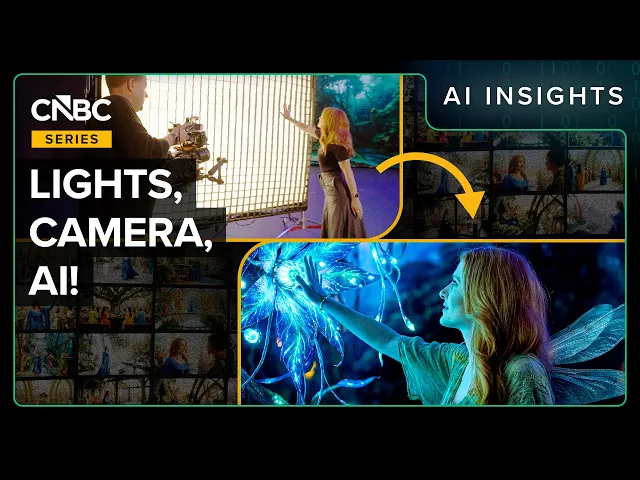
0:13 It took less than an hour to capture footage of me on an LA soundstage.
0:18 I like this lens a lot.
0:19 We'll do one more of those, and then we'll transfer this footage,
0:22 and we'll start generating.
0:23 And transform me using AI into a fairy walking through a fantasy world.
0:29 We can dream in real time.
0:33 We were on the stage filming a few minutes ago, and we're already saying,
0:37 what does this actor, what does this character look like in this world?
0:40 It's like a Willy Wonka chocolate factory of creativity.
0:44 I'm Julia Boorstin, reporting from the south of Spain,
0:47 but I'm not actually here.
0:49 This background was brought here to Los Angeles and created using AI.
0:53 It's all part of a brand new virtual production space from Innovative Dreams,
0:57 a new production company backed by Amazon
0:59 Web Services and an AI company called Luma.
1:02 Innovative Dreams is calling this real time hybrid filmmaking,
1:06 combining performance capture,
1:08 virtual production, and generative AI at every stage of the filmmaking process.
1:13 Founded by filmmaker Jon Erwin,
1:15 Innovative Dreams brought us inside its virtual soundstage in Manhattan Beach,
1:20 California to showcase how the technology works.
1:24 It's a company that's pioneering this new
1:26 method of filmmaking based off generative AI tools.
1:28 This partnership is really about providing infrastructure for people who
1:33 are not afraid to bet on the future of storytelling.
1:37 But the rise of AI is bringing
1:39 even more concern to an industry already struggling,
1:42 especially in Hollywood's hometown.
1:44 L.A.
1:45 County has lost over 40,000 industry jobs since 2022,
1:49 with production activity reaching its lowest levels since 1995.
1:54 This industry has been battered by one shock after another.
1:57 Constriction, consolidation, cost cutting, cuts in content spending.
2:02 Everything is down by 25% to 35% compared to pre-COVID.
2:07 But Erwin believes the strategy of Innovative
2:10 Dreams could help make shooting in L.A.
2:12 viable again.
2:14 So much of our industry has become unsustainable.
2:16 There is just a alarming lack of green lights, especially in America.
2:21 I think this is a method that allows us to film here again.
2:40 And action.
2:44 Very cool.
2:48 Cut.
2:51 The stakes are high for Hollywood.
2:53 Studios need a comeback as the box
2:55 office still hasn't returned to pre-pandemic levels.
2:58 There's more pressure than ever for studios
3:00 to create more impressive content with lower costs.
3:04 That's where tools like this come into play.
3:06 The method that we're experimenting with here, that we call the hybrid,
3:10 is combining two things, which is performance capture,
3:12 that's the way avatar is made.
3:14 And the other is virtual production,
3:15 which is how Mandalorian was made, which shot on this stage,
3:19 where you're using an LED wall to generate
3:21 backgrounds and you're filming in front of those backgrounds.
3:23 What we've found is we can combine those two
3:25 methods and use gen AI tools to accelerate it all.
3:29 We can start imagining what you would
3:32 look like in these environments in this movie.
3:37 I'm gardening.
3:39 You're gardening.
3:40 I think it suits me.
3:41 You're teaching children.
3:44 This is a tool from from Luma, it's their Luma Agents feature.
3:47 I can have my style guide.
3:49 I can have my script.
3:50 I can have my character breakdowns.
3:52 This is for The Old Stories: Moses.
3:54 Then what we do is, as we kind of visually design and explore the world,
3:58 is then we take the footage that we filmed and then
4:02 we're going to start mapping that performance capture to these digital assets.
4:08 So this represents the process of using the practical
4:11 principal photography and then augmenting it with AI.
4:14 This process is allowing us to fuze the filmmaking process into a digital world,
4:19 rather than just prompting it.
4:21 This would have just taken months, weeks at least in a traditional process.
4:27 We're able to do it again in the same hour that we shot it.
4:30 You could literally come onto a stage in the morning, create a world,
4:35 film in that world, get all your footage together and edit it,
4:39 all in the same day.
4:43 Innovative Dreams was born out of Erwin's production studio, Wonder Project,
4:47 which focuses on faith based content and has its
4:50 own streaming platform that's available exclusively through Amazon Prime Video.
4:55 Its flagship show, House of David,
4:57 used a significant amount of AI to produce and enhance many of its scenes.
5:01 House of David served as a case study for this type of filmmaking.
5:04 Now, Erwin is going all in on AI and virtual production
5:09 to create films and shows with massive scale without ever leaving a soundstage.
5:14 House of David, we used it as pre-visualization in season one.
5:17 Then we innovated on virtual production
5:19 and our whole visual effects pipeline in season two.
5:22 Then we brought it into production in the film I directed, Washington,
5:25 just after to actually do live visual effects,
5:28 what we call digital principal photography.
5:30 And then doing those three things we just saw on the horizon,
5:33 there's a whole new way to work.
5:35 The first project using this new workflow, shot entirely on a virtual stage,
5:40 is a show called The Old Stories: Moses, starring Ben Kingsley.
5:44 The three part series is set to debut this spring in partnership with Amazon.
5:47 By combining real actors with an LED wall backdrop,
5:51 plus motion capture and a variety of AI tools such as Luma,
5:55 Google's Nano Banana and Bytedance's Seedream,
5:58 Innovative Dreams was able to significantly cut down both on costs and on time.
6:04 You shot Moses in a week.
6:07 How long would it have taken you to get to over 40
6:10 locations and to shoot that kind of mini-series without these AI tools.
6:16 Many of these locations would have taken a week to just get to.
6:18 We would have had to shoot for 5 or 6 weeks.
6:20 It's very reasonable to say that you can create 3
6:23 to 4 times as fast at 30% of the cost.
6:28 You can get costs down to a level
6:31 that studios are willing to greenlight the idea.
6:34 Erwin's new company aims to not only create more content for Wonder Project,
6:38 but also help other creators use this new type of hybrid filmmaking.
6:44 What was it that inspired you to take everything you have learned
6:47 and launch a company focused on helping
6:50 other studios and other producers leverage AI?
6:53 It was a huge game changer in House of David.
6:56 We came back from that experience thinking that other
6:58 people must have been doing the same thing,
7:00 and then we quickly realized that people weren't.
7:04 AI video generation requires massive amounts of computing capacity,
7:08 which is why Innovative Dreams brought on Amazon
7:10 Web Services as one of its investors and partners.
7:13 AWS provides cloud and AI infrastructure to power
7:17 the virtual production tools used on set.
7:20 The company says it aims to bring
7:22 next generation production techniques to the entertainment industry.
7:26 We're seeing AWS' AI services being leveraged
7:29 across the stack in the entertainment industry.
7:31 Innovative Dreams is first of its kind.
7:33 It's a venture that really allows for AWS to act as the cloud and AI
7:37 backbone to help make the pursuits of Jon
7:40 Erwin and the Wonder Project a reality.
7:43 We're providing the tools that are going to allow for filmmakers to be
7:45 able to work in ways that they simply couldn't have been able to before,
7:48 and produce content much faster, much cheaper,
7:51 and collaborate in ways that would accelerate production cycles at scale.
7:55 Innovative Dreams other big investor and partner is AI company Luma.
7:59 Valued at over $4 billion, Luma's new agent tool brings together multiple
8:04 AI generation tools into a collaborative workspace.
8:07 In allowing Luma to invest, and getting directly in touch with a lot
8:10 of these companies and having these collaborative conversations,
8:12 we're able to actually shape the tools that we use in a pretty profound way.
8:21 Innovative Dreams says its goal is to bring
8:23 more productions back here to Los Angeles.
8:26 By combining artificial intelligence, along with this virtual set,
8:30 filmmakers can expand the scope of their projects,
8:33 all while speeding up the production lifecycle.
8:36 I think this is necessary to bring jobs back to L.A.
8:38 We lead the world in this industry, so we have to bring the world here.
8:41 Hollywood has been battling numerous headwinds.
8:44 The pandemic brought production to a halt in 2020.
8:47 The dual actors and writers strikes in 2023 dragged on for months,
8:51 the longest actor's strike in Hollywood history.
8:54 Now, many creatives have been out of work in the years since,
8:57 as the number of productions in L.A.
8:59 has plummeted.
9:00 In Los Angeles, what production there is has often
9:04 fled to other locations like Atlanta, the United Kingdom,
9:09 Eastern Europe because of what are referred to as tax incentives,
9:13 but really are just subsidies, direct payments to studios and producers
9:17 to offset the cost of producing content.
9:20 The introduction of artificial intelligence and the fear of how
9:24 it might replace jobs has only added to those problems.
9:27 AI is highly controversial in Hollywood,
9:30 studios are juggling needing to cut costs
9:32 while also preserving jobs and the human touch.
9:36 It's one of the key sticking points between
9:37 the writers and actors guilds and the studios,
9:40 which are currently in the process of striking new union deals.
9:42 Both sides are hoping to avoid another strike,
9:45 like the one three years ago, which shut down productions for over 100 days.
9:49 The Writers Guild has approved a deal which
9:52 members are set to vote on later this month.
9:54 If you're a background actor or a voice actor,
9:58 you have reason to feel very threatened by AI.
10:02 If you're a principal player, perhaps less so.
10:05 And if you're a director, it's all just another tool and more efficiency.
10:10 Like with other industries,
10:11 entry level jobs are the most at risk of being automated with AI.
10:15 What do you do with an apprentice
10:18 centered model when AI displaces the apprentices?
10:22 Despite the wide ranging concerns across Hollywood
10:25 over the potential acceleration of job losses,
10:28 Erwin says he's confident these tools will lead to the creation of new jobs.
10:33 How do you think about how speeding up production could negatively impact jobs?
10:38 Wonder Project, our independent studio,
10:40 we put over 1,000 crew members to work all over the world last year.
10:43 We were able to create those jobs because we challenged the status quo
10:47 of what production should cost and how quickly those things could be made.
10:51 600 people worked on House of David.
10:53 If you can create that and do it quicker in aggregate,
10:56 I think you're going to create more jobs.
10:57 So I feel this tool set is actually going to be an antidote to job loss,
11:02 not the cause of it.
11:04 I think that AI will eventually, if not already, serve as a cost saving measure,
11:09 but whether it'll bring production back to Los Angeles is a different question,
11:13 because you'll be able to save those costs whether you're shooting in L.A.
11:17 or Atlanta or the United Kingdom or Eastern Europe.
11:20 But Erwin acknowledges those who don't embrace AI risk being left behind.
11:25 What we found is the best AI artists are
11:29 actually people that have been retrained from the industry.
11:32 So editors, cinematographers, first AD's, directors, costume designers,
11:39 they have spent decades understanding the the language of film,
11:43 the art of it, and they more quickly translate.
11:47 And I think those that adapt and evolve
11:49 and learn are going to have a lot of work.
11:53 You're taking all of these methods of filmmaking
11:58 that happen in sequences separated by weeks or months,
12:02 and you're putting them together into the same day, into the same space.
12:06 It's just creatively intuitive.
12:07 And so that's why we think this is the future.