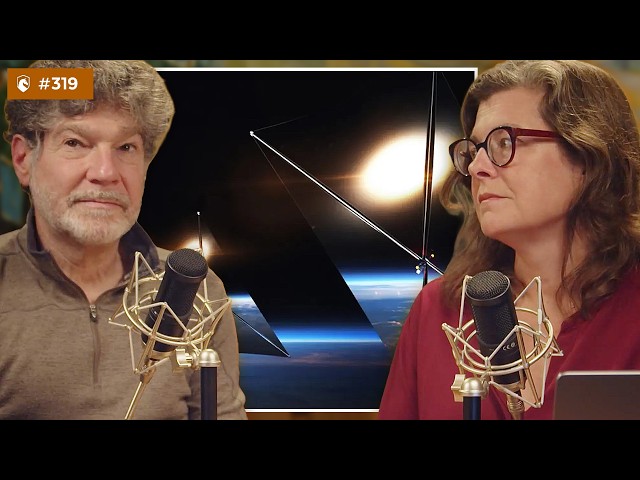
For Your Attention: Space Mirrors, Earthly Consequences | DarkHorse 319
Bret Weinstein
0:00 Reflect Orbital delivers a spot of sunlight
0:02 on demand with a constellation of in-space mirrors.
0:06 Precise area.
0:07 They claim five kilometer diameter and up, highly localized.
0:11 Configurable, in which you can adjust the intensity and location.
0:14 On demand, order sunlight instantly
0:16 and approve locations without new infrastructure.
0:18 Now, before you say, wait,
0:21 now it's already happening, it is not already happening,
0:24 but they've got two satellites either up now
0:27 or scheduled to be up and start doing,
0:30 start doing, not dramatizations, but testing.
0:35 More than testing, actually.
0:38 Demonstrating to potential clients this year.
0:40 And we'll get to the schedule they've got here soon.
0:44 Precise and uniform, dynamic, no grand infrastructure.
0:47 Yeah, easy setup and onboarding, they say,
0:49 for the client who calls up and says, "Yeah, I'd like some...
0:52 It's 11 p.m.
0:52 here and it's kind of dark.
0:54 Can I get some sun?" The setup basically involves you put out the shades,
0:58 lounges, grab some ice tea.
1:01 Yeah.
1:01 What's possible with a spot of sunlight, they say?
1:04 Energy, expand solar potential,
1:05 making clean power dispatchable and available when you need it.
1:09 Now, if you dig into their actual claims about how much
1:12 solar they're going to be able to generate, it's quite low.
1:16 So I'm surprised that they're highlighting that because even they know
1:18 that that's not the main thing that they're actually trying to do.
1:22 What they're really trying to do is light up everyone, light up the earth.
1:27 Response, illuminate disaster zones and search and rescue missions.
1:30 That sounds admirable.
1:31 That's a use case that sounds admirable.
1:34 Industrial, extend working hours, improve safety, light remote sites.
1:37 And agriculture, tailor growth cycles, extend seasons, boost yields.
1:41 Confuse birds.
1:43 Confuse everyone.
1:44 The big picture, sunlight is the most
1:46 valuable and powerful resource in the solar system.
1:49 About 2.2 billion times more sunlight misses the earth than hits it,
1:53 which means humanity can only use a small fraction of our sun's power.
1:57 And our constellation intercepts the solar energy,
1:59 that being reflect orbitals constellation,
2:01 intercepts the solar energy that misses us and enables humanity to use it.
2:05 I'm surprised that number is that low given
2:07 that 2.2 billion is radiating in all directions.
2:11 Yeah.
2:11 The earth isn't close to it.
2:12 And it's, I feel like they just picked an upper
2:14 with a bunch of zeros out of a hat.
2:16 Let's go with this one.
2:17 It sounds plausible.
2:18 I agree.
2:19 It seems too low.
2:20 Okay.
2:20 So check this is their, this is their plan.
2:22 Our constellation of markets expand over
2:24 time in which constellation is their satellites.
2:27 They had 2026 to 2027, 36 in 2028.
2:31 They're hoping for over a thousand by 2030,
2:33 over 5,000 by 2035, over 50,000 of their satellites.
2:40 Space mirrors going around, going around the earth,
2:44 allowing people on earth to call them up and say,
2:46 Hey, I'd like a spot of sunlight here.
2:48 It's just about that time.
2:50 So let's see what happens when under light, when, when you click on light here,
2:56 light without limits, because of course,
2:58 imagining that we have limits is so what?
3:01 Yesterday, 20th century, human, realistic,
3:06 light without limits, they say light is evolving.
3:12 Interesting claim.
3:13 Interesting claim.
3:14 Smarter, more sustainable, endlessly accessible,
3:17 reflect orbital delivers large area lighting after dark for any use case.
3:21 Yeah.
3:21 Yeah.
3:21 Light is evolving.
3:23 Lighting is evolving.
3:25 Could make that right.
3:27 Okay.
3:27 So they're, you know, they do.
3:28 Oh wait, civilization.
3:29 They've also got civilization.
3:30 What's possible is spot of light,
3:32 replace streetlights, reduce light pollution, enhance urban life.
3:34 Yeah.
3:35 Enhance urban life because that's,
3:37 that's what cities need is to have every moment feel exactly the same.
3:41 Yeah.
3:42 Yeah.
3:43 I'm going to invest in companies that make eye masks if that happens.
3:47 Got it.
3:49 Okay.
3:50 So they just continue with the same kinds of claims.
3:53 We're launching the future of sunlight.
3:55 I just like the, you know, the number of crazy like taglines in here.
3:59 Hubris is incredible.
4:00 Really remarkable.
4:01 And then we're going to go to their facts,
4:04 which is maybe the most damning part of the whole site.
4:10 And, you know, I also read some of the, some
4:11 of the press on these guys, you know,
4:13 it's a couple of, a couple of young guys with some mechies,
4:16 some mechanical engineering background, who,
4:19 who saw a need apparently saw an opportunity in our.
4:24 Slucky young sociopaths.
4:25 You know, I, I'll go there.
4:29 Fine.
4:30 I don't, I don't, I think actually the problem,
4:33 I think it's worse than that because I don't think the techno hubris,
4:38 the techno, tech, techn optimism, the tech, tech optimism,
4:43 the techno optimism that we see behind so
4:46 many of the really egregious errors of this age,
4:51 mostly can't be attributed to sociopathy.
4:54 It's attributed simply to hubris, which is a much more common.
4:58 And, you know, both sociopathy and hubris are, are, are human,
5:02 but it's worrying that, you know,
5:04 I think it's attributable to a very common problem,
5:07 which is I don't know anything about evolution, but like,
5:09 I don't know anything about biology, anything about evolution.
5:12 I think that we live in a clockwork universe,
5:14 a machine-like universe in which all the things are
5:16 like machines that I do know how to deal with.
5:20 And therefore, all I have to do is switch, you know,
5:23 switch a few things and voila, I will have solved a problem.
5:27 So, you know, maybe sociopaths, but it's not required here.
5:31 Well, I don't think it's required,
5:32 but I do think that it falls out of the game theory pretty naturally,
5:36 because if you imagine this is not an inobvious idea,
5:40 the idea that it was actually proposed in the 70s first.
5:45 So there you have it.
5:45 If I had that right.
5:46 The point is, who do you expect to find deploying this?
5:53 You expect to find people who find nothing objectionable about it.
5:57 In other words, game theoretically,
5:59 this is a tragedy of the commons, where if, you know,
6:05 50 modern folks or companies have thought about
6:08 this idea and rejected it because of the implications,
6:12 you expect to find the company that didn't reject it is most likely to be
6:16 driven by people who have some some defect that results in them not seeing.
6:22 No, but there's an assumption built into what you just said,
6:24 which I don't think is right, what you said was, if 50 companies have considered
6:28 this idea and rejected it because of the implications,
6:31 and what I believe I've gleaned from going through
6:34 some of their some of what they've got online
6:37 and some of what the media has written up
6:40 about them is that this is only now technologically feasible.
6:44 So to the to the degree that this has been considered before,
6:48 it has not been possible.
6:49 No, no, I know that.
6:50 But I'm so it's not it's so it's not a lot of other companies rejected it.
6:56 And that demonstrates that, you know, they weren't sociopaths.
6:59 I was imagining 50 companies in modern times when it has become possible, right?
7:06 Let's say post.
7:07 I don't see evidence of that.
7:09 But maybe post Starlink.
7:11 Yeah.
7:12 Post Starlink, where we now know that it is possible for a corporate
7:17 entity to deploy to deploy an array of globe covering satellites.
7:21 I mean, I think maybe that's the second of them.
7:23 There was a failed project to deliver.
7:28 I think it was GPS.
7:31 What was its name?
7:32 I can't remember.
7:34 Ethereum.
7:34 It can't be because that's currency.
7:36 But yes, but something along those lines was deployed.
7:39 It failed for economic reasons.
7:41 And the satellites were either repurposed or had to be pulled down.
7:47 But but anyway, the point is we now know we've
7:49 got a successful entity that has deployed a, you know,
7:53 a net of satellites, globe covering.
7:57 And so the point is, well, what else could you do if that technology
7:59 is now in the range of a corporate power?
8:02 And so I'm imagining a lot of people
8:04 have run through this idea because it's obvious.
8:08 And many of them have rejected it for business reasons,
8:12 the risk here of the investment it takes to initiate
8:16 such a project and the likelihood that it fails.
8:19 I mean, well, I guess my objection to you deciding,
8:24 because you and I can see so many obvious
8:29 reasons not to do this, and to do everything
8:33 we can to get in the way of anyone's ability to cause us to lose our night sky.
8:39 I mean, we write about this in Undergather's Guide, right?
8:41 Like it is it is it is one of the fundamental things
8:45 about living on the planet that we do that we have night
8:48 and we have no idea what all that means for who we
8:51 are and how we are and how we make meaning in the world.
8:55 But I don't, I just don't,
8:57 it's not at all clear to me that what is clear to us about the value,
9:03 much of which is implicit in having darkness and having a night sky,
9:08 in having things that cannot be technologically lightened,
9:12 is obvious to most people.
9:16 And those things that aren't obvious to the techno-optimists,
9:21 just because it's not obvious to them doesn't make them sociopaths.
9:24 (Music)