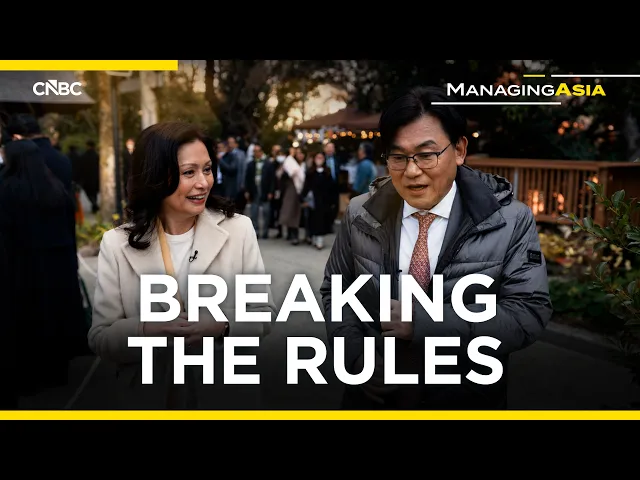
How Rakuten Built a Tech Empire by Breaking the Rules
CNBC International
0:02 If you think about the human brain versus internet network.
0:07 Not all of what we do can be replaced by AI.
0:12 He’s thinking about the future.
0:15 And that’s no surprise.
0:17 He built Rakuten by betting on it long before others did.
0:22 Everybody thought internet is going to be popular,
0:24 but nobody will make any money from it,
0:26 but I thought, it's just a matter of time.
0:28 But his boldest gamble wasn’t about technology, it was cultural.
0:32 You ordered your Rakuten employees to switch to English or face demotion.
0:40 Was a bit aggressive In Japan’s corporate world, the move was revolutionary.
0:45 So, you're seeing the real payback coming?
0:47 Big time.
1:02 "Happy New Year" Mickey Mikitani has led Rakuten
1:07 since founding the company nearly three decades ago.
1:11 At the start of every new year,
1:13 Rakuten executives from around the world gather at its
1:17 Tokyo headquarters for the annual gathering known as the Asakai.
1:21 It’s a moment to reflect on the business
1:23 and set the strategy for the year ahead.
1:28 And it all begins here—inside this red
1:32 brick building—where the multi-billion-dollar company first took shape.
1:37 Just steps away stands the Atago Shrine.
1:40 Every year, Mikitani and his leadership team climb
1:44 its 86 stone steps— known as the “steps
1:48 to success.” It’s a tradition that has come to define how he starts the year.
1:54 The first very, very small office happened to be in front
1:58 of this shrine and so we started to come here.
2:02 At that time, this shrine was not that popular for a new year's ceremony.
2:07 But now so many people, because, you know,
2:10 they have seen the growth of Rakuten group, I think.
2:13 So, this has always been a yearly tradition for you?
2:15 Exactly.
2:16 Make it sure that we make the approach for the year.
2:20 And you want to kick it off on a good start.
2:21 Exactly.
2:22 Start off on a good note.
2:24 Yeah, refresh yourself and you know, fresh start.
2:28 The ritual ends with a group photo.
2:31 And then, the media scrum…where Mikitani now stands
2:35 as one of Japan’s most influential business voices.
2:39 But rewind more than two decades, and the picture looked very different.
2:44 When he first launched Rakuten Ichiba,
2:46 few believed the internet could build a real business At that time,
2:51 many people were not so convinced internet business
2:54 is going to be very profitable, very big.
2:56 But I was convinced that eventually it was going to come.
2:59 So, I thought about many different businesses,
3:02 and I decided to go for B to B to C marketplace.
3:06 At that time, what we call internet shopping mall,
3:09 was not really considered as a successful business model.
3:13 Almost all the internet shopping mall were failing, but we had a different idea.
3:19 Your different idea was to focus on small merchants.
3:24 What was the response from these small merchants, these small businesses?
3:27 Well, nobody was actually really buying so much from the internet.
3:31 So, it was really, really difficult to convince them to join a platform.
3:35 Some of the merchants even didn't have a personal computer,
3:39 they didn't have internet access.
3:41 It sounded like you have to educate them?
3:43 We went to this electronic shop with the merchants, buy a personal computer,
3:49 bought a digital camera, and we told everything to them.
3:52 It was fun, but it was very difficult.
3:55 Japan in the late 90s wasn't exactly
3:58 known for digital risk taking, or online ventures.
4:02 Did you ever worry you were building something that the market wasn't ready for?
4:06 Everybody thought internet is going to be popular but nobody
4:09 will make any money from internet business at that time.
4:12 But I thought, you know, it's just matter of time.
4:16 And he was right.
4:18 More than two decades later,
4:20 Rakuten Ichiba remains the company’s biggest revenue driver.
4:24 But competition is intense, from Amazon Japan and Yahoo!
4:28 Japan Shopping.
4:29 To stay ahead, Rakuten built an ecosystem,
4:33 rewarding customers with loyalty points across its services,
4:36 from credit cards to travel and mobile.
4:39 Is there anything out there that could
4:41 pose a threat to your E-commerce business?
4:44 No, I think it's kind of proven.
4:46 Of course, we have very serious competitors,
4:49 but it's a very, very different service.
4:51 So, we are an aggregation of 60,000
4:55 entrepreneurs selling many different kinds of product.
4:58 Of course, some are the big companies.
5:00 So, the approach is totally different.
5:01 We focus on recreating a very good experience for the people, again,
5:08 who are interested in not only buying product,
5:11 but wanted to have a very good experience.
5:14 You did something that seemed
5:16 a cultural revolution in traditional corporate Japan.
5:19 You ordered your Rakuten employees to switch
5:23 to English within two years or face demotion.
5:28 Was a bit aggressive It was very aggressive.
5:31 What prompted the move?
5:32 Internet is global competition in this connected world.
5:38 So sooner or later, we will face international competition,
5:42 domestically and outside of Japan too.
5:45 So, we have to benchmark our global competitors, not our domestic competitors,
5:49 and we have to learn from best practices from all over the world.
5:54 The second, is how to secure talented engineers and just
5:59 hiring the pool from Japanese engineers is quantitatively not big enough.
6:04 For example, now, 70% of engineers we hire in Japan are non-Japanese.
6:09 Most of them do not speak Japanese.
6:12 And then, you know, I just want to make
6:15 it sure that everybody can communicate with one single language.
6:17 We cannot do with Japanese, we cannot do with Chinese.
6:20 It has to be English.
6:21 How painful was the process making English the company's official language?
6:26 Did you receive any opposition?
6:28 Did people think you were crazy at first?
6:30 It took much longer than two years to be very honest.
6:34 We adjusted our deadline several times and helped
6:38 the people who are struggling as much as we can.
6:42 For example, at the very end, I told them, you know, in the morning,
6:46 they can come to office and just study
6:48 English and can start working from after lunch.
6:51 We helped them to go to some English schools,
6:54 and almost every single person cleared our target goal for standard test.
7:00 So, you're seeing the real payback coming Big time.
7:04 Mikitani’s next big bet was telecom.
7:07 In 2019, he launched Rakuten Mobile,
7:10 rolling out full-scale service just a year later.
7:14 But instead of building a conventional network, Rakuten tore up the playbook,
7:19 creating the world’s first fully virtualized,
7:22 cloud-native mobile system, deployed at a national scale.
7:27 It was a huge risk you took.
7:29 No one has ever done this.
7:31 There were performance issues at the start.
7:34 You faced huge criticism from your investors.
7:37 Your mobile business suffered through years of losses,
7:41 but you stuck to your guns.
7:42 Why?
7:43 Well, it has been always like
7:45 that, from the day when we started E-commerce business,
7:47 when we bought our online travel agent, when we started credit card,
7:51 even the introduction of the point program to the internet.
7:55 Everybody has been always skeptical.
7:58 You had the gut feeling.
7:59 I had a gut feeling.
8:00 Of course, You could pull it off.
8:02 Not only gut feeling, I had a scientific proof in the lab that it works.
8:08 And many people say, even if it's a work on a lab,
8:11 if you go to the real world, it is not going to work.
8:13 But I say, no-no-no-no, it's going to work.
8:15 It's going to work.
8:16 Maybe it's going to be a little bit lower performance at the beginning,
8:20 but you know, we can improve it.
8:22 Now our network performance is way better than our competitors.
8:26 Five years after its 2020 launch,
8:30 Rakuten Mobile is reaching an inflection point.
8:35 In December 2025, it crossed 10 million subscribers.
8:40 A major milestone in Japan’s fiercely competitive telecom market.
8:44 But the company still trails industry
8:47 giants like NTT Docomo, KDDI, and SoftBank.
8:50 Still, the heavy investment is starting to pay off.
8:54 In 2025, the mobile unit delivered its first full-year EBITDA profit,
8:59 a key milestone in its operating performance.
9:02 And as Rakuten looks ahead,
9:05 Mikitani is turning to the next frontier: artificial intelligence.
9:09 Though he’s not convinced it will replace every job.
9:12 If you think about the human brain versus internet network,
9:17 the human brain has 8 billion brain cells,
9:21 connect with 2 trillion synapse network, and it's digital.
9:26 Obviously, if you think about how many computers are connected,
9:30 how many semiconductors are connected to the internet, it's billions.
9:35 So eventually it should make sense that not all
9:40 of what we do can be replaced by AI.
9:44 But I think I'm not a 100% full believer AI will be able to replace what we do.
9:50 Maybe they can do 90% of what we do.
9:54 Sometimes 90% is good enough.
9:56 To what extent will AI also make a big transformation on your bottom line?
10:00 My bottom line is huge.
10:01 If you think about, already we have achieved
10:04 10% operational efficiency improvement utilizing AI last year.
10:07 We're going to do 10% next year.
10:09 But if you can improve our operation efficiency by 20%,
10:13 marketing efficiency by 20%,
10:14 I think we will be able to maybe increase our profit by 50, 60%, easily.
10:22 Mikitani didn’t just build a Japanese tech company— he
10:25 set out to turn Rakuten into a global brand.
10:28 And one of his most unconventional strategies was sport.
10:32 It started at home— with baseball’s Tohoku Rakuten Golden Eagles.
10:38 Then expanded into football with Vissel Kobe.
10:42 Before going global— with FC Barcelona and the NBA’s Golden State Warriors.
10:47 Well, I think sports is very important thing for the community.
10:53 It's like a drama without scenario, right?
10:56 It's like drama without a scenario.
10:58 Yeah.
10:59 It will bring emotion, sometimes bring people together.
11:02 So, I think if you can use sports to represent our philosophy.
11:07 So we are very picky about who we, you know partner with.
11:11 It's obviously very efficient marketing to get recognition of our brand,
11:16 domestically and globally.
11:17 Do these high-profile sports brands give you the, the visibility,
11:21 the global visibility, Of course That Rakuten needs?
11:24 Yeah, yeah.
11:25 Many people recognize Rakuten because of their past Barcelona sponsorship,
11:30 Golden State Warriors, main sponsor.
11:32 All these people in the Silicon Valley,
11:34 they recognize us because they always came
11:37 to the Chase Center and they see Rakuten everywhere.
11:41 You've been called a disrupter.
11:43 You've been called a contrarian.
11:45 Some even call you a maverick.
11:48 It sounds like you enjoy being a troublemaker,
11:51 and you really like to shake things up.
11:54 No.
11:54 Is that true?
11:55 No.
11:55 No,no,no,no.
11:56 I don't think so.
11:58 I do not hesitate to go against conventional wisdom.
12:02 Even if there is some kind of negative
12:05 reaction to whatever we do, whatever we say,
12:10 you know, if we believe we have a justice, you know, we are not going to be shy.
12:15 You know, I've been doing some digging and talking to people.
12:18 Is it true that Hiroshi Mikatani is the sort of person where,
12:21 if you tell him not to do it, he will go ahead and do it anyway?
12:26 I don't think so.
12:27 No?
12:28 No,no,no,no.
12:29 For example, the mobile business,
12:31 I had a chance to get into a mobile business several times in the past,
12:38 but I discussed with many people, and then we passed.
12:41 As a visionary and founder and entrepreneur
12:44 of over 70 businesses within Rakuten Group,
12:47 how exactly do you lead your 30,000 employees?
12:51 It's the job of the leader is basically, stick the flag.
12:57 Okay, this is what we want to do, business-wise and also socially.
13:01 So that social mission is number one priority.
13:04 What about making money?
13:05 Making money is a means to do it.
13:07 It’s not the ultimate objective for you?
13:09 No, no, no, not for me.
13:12 For shareholders, yes, and I work for shareholders, so I have to do it.
13:18 But obviously you need to make a continuous investment.
13:21 If you just want to maximize our short-term profit today,
13:25 I can do it immediately, right?
13:27 Not invest in the future, maybe we can double our profit easily.
13:31 But that's not good.
13:32 So, what do you tell your shareholders?
13:34 Wait, wait, the payback is coming?
13:36 Don't know, it's already coming.
13:37 The value is going up.
13:39 If you think about total market cap, including debt,
13:43 I think it's way over when we started Rakuten Mobile business.
13:48 People who believe in it, believe in it.
13:51 People who want to have a short-term profit, maybe they should buy other shares.
13:54 What inspires you, what drives you?
13:56 I really believe again, the power of entrepreneurs.
14:01 Japan has an institutional power, but not enough entrepreneur power.
14:07 So, the goal is to really prove a Japanese
14:13 entrepreneur company can become a globally respected company.
14:18 If you can achieve this goal,
14:20 that's going to have a huge influence into the Japanese people.
14:23 And where do you see the future of Rakuten?
14:25 Where do you see the company 10 years from now?
14:27 So Rakuten is going to be the new generation leader of Japanese private sector.
14:35 Give the money back to the society, but we're going to keep growing.
14:39 If you think about the growth of Japanese GDP in US databases,
14:44 we are negative for last 20 years.
14:48 Despite the fact that we are making best car,
14:52 best cameras, best mini manufacturing machines,
14:55 very good pharmaceutical product.
14:57 Why is that?
14:58 It doesn't make sense.
15:00 So, I hope we will be able to change the direction.
15:04 Miki San, thank you so much for talking to me.
15:06 Thank you, thank you very much.