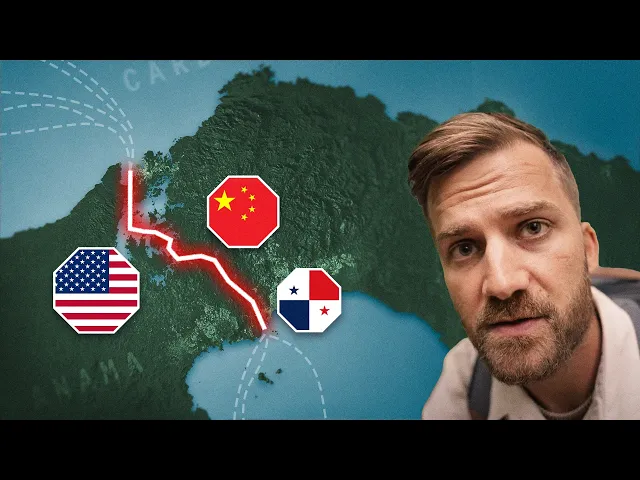
The Dark Truth of the Panama Canal
Johnny Harris
0:00 (soft eerie music)- [Johnny] Wait, that's a ship?
0:08 [Driver] Yes, it is.
0:09 It's so big.
0:11 (light music) There's just a giant, I've never seen them this close.
0:21 Look at that, it's just right there, I'm just looking at this container ship.
0:28 (boat honking echoing)- China is operating the Panama
0:37 Canal and we didn't give it to China, we gave it to Panama,
0:41 and we're taking it back and we've already started doing it.
0:44 (people applauding)- I've been trying to understand this, this Canal, its story,
0:58 these most recent threats to take it over,
1:02 to conquer it, and what it means for the people here.
1:05 (Ernesto speaking Spanish) (light music)- Wow!
1:35 We cannot turn a blind eye,
1:36 if Panama exploits an asset of vital commercial and military importance,
1:40 we cannot stay idle.
1:44 I've been driving around the Canal, through the Canal,
1:48 unable to fully comprehend the size and scale of these vessels,
1:53 and this engineering that makes the global economy work.
1:58 How we connected to oceans,
2:01 and how that effort brought people from all around the world
2:03 who then stayed and created modern Panama through struggle and sacrifice.
2:09 I'm gonna show you Panama and its Canal like you've never seen it before.
2:14 Stories like this are made possible because of the thousands of locals
2:17 who responded to my call for story ideas over on New Press,
2:21 the platform I'm building to be the home for community-led journalism.
2:25 So head to newpress.com to be a part of it.
2:27 That local perspective is so important and it's at the heart of this story.
2:31 (light music ends) But first, let me show you how this thing works.
2:37 (air whooshing) (light music) Let's say there's a boat coming from the east.
2:46 It used to have to go all the way around South America,
2:48 but now we can just show up here.
2:51 But there's an immediate problem, which is that the Canal isn't at sea level.
2:57 This doesn't look like a lot, but this is 26 meters, 85 feet.
3:01 This is a building with eight floors.
3:03 How do we get a boat that weighs as much
3:05 as 60,000 pickup trucks to move up 85 feet?
3:09 And that's where these come in, these water elevators or locks.
3:17 They lift these boats, not with pumps and energy, but with gravity and water.
3:23 Behind me are the locks.
3:28 It's pretty astounding to see it in real life.
3:33 The ship is now at the Canal level
3:35 and it starts its 10-hour journey through the Canal.
3:38 (soft music) We're coming up on this massive container ship.
4:06 I can't even describe to you how big this thing is.
4:12 It's like kind of just making me feel kind
4:15 of dizzy just how many containers are on this ship,
4:22 and it's this like really cool pink, just stunning and massive.
4:28 Wow!
4:38 Before we go any further, I need to just pause and say I'm
4:42 an independent journalist who is making ambitious field documentaries.
4:45 And the only way I'm able to do that is because I have sponsors,
4:49 like companies that support our channel,
4:51 they have no editorial influence on what we say here,
4:54 but they support our videos in exchange for me talking about their brand.
4:57 And luckily the brand today that I'm talking
4:59 about is one that I actually use, it's Incogni.
5:01 Long time viewers of the channel will know that I talk about
5:03 Incogni a lot here because I have used it for like two years.
5:06 The whole thing is data brokers, that's what this is all about.
5:09 There's a giant world of companies that you've
5:11 never heard of that buy and sell your information.
5:14 There's hundreds and hundreds of these data brokers.
5:16 They all have these lists with your name,
5:17 your email, your address, your phone number.
5:19 This is why you get like junk mail and robocalls.
5:21 Well, it turns out you have rights to take your name off of those lists,
5:25 but it's really hard and cumbersome.
5:27 So with Incogni, what I did is I signed up,
5:29 I gave them permission to go out on my behalf to take my name off these lists.
5:33 And month after month, that's what Incogni does, and I get to sit back and look
5:36 at this dashboard and see the hundreds of requests they've made
5:39 and all of the ones that have been successful
5:41 where my name and address and everything has been scrubbed.
5:44 This has made my phone calm down.
5:46 I don't get like so many robocalls, and robotexts, and junk mail,
5:49 and it's made me feel a little bit more
5:51 peace of mind knowing that my data isn't just
5:53 out there being sold to like people search sites
5:55 and being used to hike up my insurance premiums.
5:59 Big fan of Incogni, they're giving 60% off their unlimited
6:02 plan to anyone who uses the link in my description.
6:04 It's incogni.com/JohnnyHarris.
6:06 Oh, and they have this new feature where you can actually go ask
6:09 Incogni to target a specific site that you want your data scrubbed off of.
6:12 I love it.
6:13 So again, that's incogni.com/JohnnyHarris.
6:15 60% off.
6:16 I have the monthly plan so that Incogni is
6:18 working every month to get my data scrubbed, big fan.
6:20 Also, super happy that they come back month after month
6:23 to sponsor a channel and allow me to do stories like this.
6:25 So thank you, Incogni, for sponsoring today's video.
6:27 With that, let's keep exploring this vast and amazing Panama Canal.
6:32 Driving through this Canal, I'm amazed not just by these massive boats
6:36 that just took a magic elevator from the ocean, but also by all of this.
6:41 (light synth music) Some of the densest jungle in the world,
6:46 exploding with a huge variety of plants and animals.
6:55 So we're officially in this huge lake
6:57 that looks like it's got a bunch of islands.
7:00 In reality, for most of its history,
7:03 these were not islands, these were the tops of hills.
7:07 (light synth music continues) (clicking) This narrow stretch
7:22 of land has been a place of exchange forever.
7:26 (light engaging music) (Sol speaking Spanish)-
7:34 Before the incredible elevators and manmade-lake,
7:37 people quietly lived for thousands of years along what was then just a river.
7:41 Then European boats arrived.
7:43 It was the Spanish, looking for a quicker way across this continent.
7:47 The river could only take them halfway.
7:49 They would then get out and walk the rest of the way,
7:51 creating a trade route and fueling a settlement to support this trade.
7:56 This would become Panama City.
8:00 (insects chirping) Wow, now we're really in the jungle.
8:08 The Spanish came here as they were conquering America,
8:11 and they set up shop here in Panama 'cause
8:13 they noticed it was a very thin stretch of land.
8:16 This where I'm standing right now was
8:18 an original Spanish settlement where they would come
8:22 in from the Caribbean side and start their journey
8:25 to move stuff from one ocean to another.
8:30 First, but definitely not the last.
8:33 The Spanish used this route for centuries,
8:36 but the empire's power eventually faded and a newly
8:39 powerful empire was rising to the north.
8:42 They started eyeing this stretch of land.
8:45 Soon, the Americans would be here building a railroad to support banana
8:49 companies and to transfer people headed to California in search of gold.
8:54 It's the late 1800s and there's still no Canal here.
8:57 So a French engineer who had just cut a Canal into another
9:01 important choke point shows up to try to build one here.
9:04 This project needed labor, workers, and like the railroad,
9:07 it brought a huge amount of people from all around the world to come work.
9:11 (Vielka speaking Spanish)- But the project was doomed from the beginning,
9:19 mostly because of mosquitoes.
9:22 Tens of thousands died.
9:23 Building a canal here was not going to be easy.
9:27 We just walked through the jungle for a little bit and got bit a lot.
9:31 (guide speaking Spanish)- [Johnny] Okay.
9:34 (people speaking Spanish)- [Johnny] Okay.
9:38 (guide speaking Spanish)- Ooh, the attack of the mosquitoes.
9:45 Jeez.
9:46 Yeah, hardcore, hardcore.
9:47 (soft music) By the early 1900s,
9:57 the United States is now a rapidly expanding power.
10:00 They want a two-ocean Navy.
10:02 So they made a deal.
10:03 They helped Panamanians gain total independence from Columbia
10:07 in exchange for control of this eternally-important choke point.
10:11 In 1903, Panama declares independence backed by American guns.
10:16 And then the US sets about completing this Canal.
10:19 (soft piano music) Once again, laborers from all over the world come to dig.
10:33 Cuba.
10:34 A new wave of Spaniards.
10:35 [Johnny] Germany, Canada.
10:36 Trinidad.
10:36 [Johnny] India, the UK.
10:38 Barbados.
10:39 [Johnny] Italy, Martinique, Jamaica.
10:40 Costa Rica.
10:41 New people coming from China.
10:42 [Johnny] China, The Bahamas.
10:45 (Jaime speaking Spanish)- In building the Canal,
10:54 the Americans learned from past mistakes.
10:57 Instead of trying to dig this thing at sea level, they built a dam right here.
11:01 When they dammed the river,
11:04 they flooded this whole area and filled up this basin with water,
11:09 which created a higher lake than sea level,
11:12 and this became the foundation for a huge part of the Canal.
11:17 Like, more than half of the route through the Canal is not a manmade Canal,
11:22 it is a flooded river.
11:24 This is what we've been driving through.
11:27 (soft piano music continues) (Jaime speaking Spanish)- [Johnny]
11:40 But it would only take them so far.
11:41 How do they get from here to here?
11:43 (soft music) Pick axes, dynamite,
11:50 workers living in sweltering barracks, working in dangerous conditions.
11:55 Thousands dying, many forgotten unmarked graves.
12:00 An impossible amount of effort.
12:04 (Vielka speaking Spanish)- [Johnny] In addition to gawking
12:12 at the scale of the Panama Canal,
12:14 I also spent a lot of time with the descendants of these workers.
12:18 (Edward speaking Spanish) (Vielka speaking Spanish)- [Reporter 1]
12:30 The US imported cheap labor from the Caribbean,
12:33 India, and Asia, changing the racial makeup of the country.
12:39 [Johnny] After an incredible amount of effort and sacrifice,
12:41 the result was this.
12:44 [Reporter 2] Panama is the crossroad to the world.
12:48 [Johnny] It's 1915, and the oceans were connected.
12:51 US power grew overnight right as the world
12:54 was descending into the first World War.
12:59 (Jaime speaking Spanish) (Sol speaking Spanish)- Found an old battery,
13:12 basically a giant cannon gun on top of a hill
13:16 that was used to defend this base and this choke point.
13:22 A reminder that this was and still is prime strategic land
13:27 that connects the global economy and the US control it completely.
13:32 It was the way that they projected power in this hemisphere.
13:36 (Jaime speaking Spanish)- The United States put in airstrips everywhere.
13:48 They put in gun batteries and protective measures
13:51 in the Canal and bases all along Panama.
13:54 (light music)- Yet another military base right here on this little
14:03 island at the mouth of the Pacific side of the Canal,
14:05 probably has some guns to shoot anyone coming in to America's Canal.
14:13 This narrow stretch of land,
14:15 eternally a place for exchange and transit, was once again transformed,
14:21 not just by the digging of this Canal,
14:24 but by the tens of thousands of workers who had dug it.
14:27 (lighthearted music) (Jaime speaking Spanish)- [Johnny] Modern Panama is
14:39 made up of many of the descendants of these workers.
14:43 You have layers upon layers of cultures and immigrants.
14:47 (Sol speaking Spanish)- Hi, John, welcome to Panama.
15:00 (Johnny speaking Spanish)- [Johnny] Ah, thank you.
15:02 (Johnny speaking Spanish) (Ernesto speaking Spanish)-
15:33 The Chinese community here is the largest
15:35 in Latin America and you feel that when you drive around this city.
15:39 I'm meeting up with Esteban, who is a spokesperson for the Chinese community.
15:47 (Esteban speaking Spanish)- [Johnny] Drive just 45 minutes to the Caribbean
16:06 side and you're surrounded by an entirely different set of smells,
16:09 and languages, and food.
16:11 (Speaker 1 speaking Spanish) (Johnny speaking
16:17 Spanish) (Speaker 1 speaking Spanish) (Johnny speaking
16:26 Spanish)- [Johnny] And then there's another identity here that adds to the mix.
16:32 The eternal question, where does the zoning belong?
16:34 When I went to Alabama,
16:36 the neighbor wouldn't let us play with his kids 'cause we were from Panama.
16:39 We don't really feel like we're part of the US,
16:41 and then if we're in Panama City, we're gringos.
16:44 So I think we live kind of in a limbo
16:48 that's never been defined and is very quickly being forgotten.
16:51 (film reeling) (soft music)- We're almost to the other side of the Canal here.
17:03 These massive boats move through this thinner
17:06 section that was carved by all those workers.
17:08 They're now approaching the Pacific Ocean, but remember,
17:11 they're still 85 feet above sea level, so it's time for them to descend.
17:20 It's a busy moment here at the locks.
17:27 As these ships get closer to the locks,
17:30 the Canal authority has all of these tugboats and guide
17:34 boats that help them navigate the really narrow areas.
17:39 These are huge ships and it's a small area that they have to squeeze through.
17:43 And so a huge part of what the Canal engineers
17:47 do is they guide them through these really narrow areas.
17:52 (soft music continues) And if they've got enough water and everything's working,
17:56 they can get 30 or 40 ships through this Canal every day,
18:00 keep the global economy running smoothly.
18:04 It's just not only so massive, but incredibly brilliant.
18:08 I don't know, it just feels like there's some weird faith in humanity
18:11 when you see something this sophisticated
18:13 happening and it just happens every day, just a normal part of life.
18:18 (soft piano music) Now they're back at sea level, they can continue on their way
18:24 into the Pacific Ocean and into the global market.
18:29 Today, this place makes visible something that we usually don't see,
18:33 the invisible magic of the global economy that supports our lives.
18:37 This choke point is where you see it all meet up.
18:39 It's a place of movement, of transit.
18:42 Everywhere you look, there is precise movement, coordinated logistics,
18:45 cranes that lift containers, that move things from trains, to trucks, to ships,
18:51 ships that can carry up to 14,000 of these boxes and who
18:55 are guided by these powerful tugboats to move them along on their journey.
19:00 The global economy made visible in front of my eyes.
19:03 That is the visual culture here in Panama, at least a big part of it.
19:08 And today, it's run entirely by Panamanian engineers and leaders and workers.
19:12 But not too long ago, this land,
19:15 this water was under the control of someone else.
19:18 (soft exciting music) This map,
19:23 it's one of the weirdest maps an empire has ever drawn.
19:27 Well then, again, maybe not.
19:29 This map changed everything here.
19:31 It's so important.
19:33 And we got this map because, remember,
19:35 the US didn't come here to just build the Canal,
19:38 they came here to control the Canal.
19:43 So here comes one of those moments where powerful
19:45 people draw lines on a map and change history forever.
19:50 (Jaime speaking Spanish)- [Johnny] The first major
19:58 impact of this line is this little notch, a carve out for Panama City,
20:02 which was not to be a part of the American Canal Zone.
20:05 I asked our historian, Marixa, why this was such a big deal.
20:08 What has stayed the same for 500 years is
20:12 that Panama is a crossroads that has united Africa,
20:16 Europe, South America, for better or for worse.
20:19 The reason why Panama City was founded was to serve that path.
20:24 What happens with the creation of the Panama Canal
20:27 Zone is that that is taken away from Panama City.
20:29 And Panama City is disconnected from itself.
20:33 [Johnny] The other strange line happened on the other side of the Canal where
20:35 the city of Colon was to remain a part of the country of Panama,
20:39 but it was now surrounded by the newly American controlled Panama Canal Zone,
20:44 a little island of Panama inside a strip of America,
20:48 inside the country of Panama.
20:51 Told you it was weird.
20:52 (Jaime speaking Spanish)- The towns that existed there before were expelled.
20:58 The people from the towns, the towns disappeared, new towns were created.
21:02 It was a huge company town owned by the federal government.
21:07 [Johnny] So these lines were drawn in the early 1900s,
21:09 and then within this 10-mile thick strip,
21:12 a little slice of America began to grow.
21:15 (intriguing instrument note)- You had manicured buildings with manicured lawns.
21:23 [Marixa] Billiards, bowling alleys, cinemas,
21:25 were owned by the federal government.
21:27 (Jaime speaking Spanish)- [Reporter 3] What the Canal Zone residents have done
21:46 is to recreate a tiny slice of America on the ninth parallel.
21:50 (light upbeat music)- The laws in the Panama Canal Zone were American laws.
21:56 A segregated system, with one law in the Canal Zone
22:01 under which Panamanians were treated as second-class citizens.
22:05 [Johnny] It was a tight-knit community of people with American connections,
22:09 but whose parents and grandparents had never lived in mainland America.
22:14 They lived here.
22:16 (soft piano music)- So I personally have four generations
22:20 of Zonians that worked on the construction of the Canal.
22:24 [Johnny] Zoner or Zonian became yet another identity to add to the list
22:29 of the many subcultures that came to Panama because of the Canal.
22:33 We call them Zonians.
22:35 I believe they are different kind of American.
22:38 Do you feel Panamanian?
22:41 Absolutely.
22:41 My parents were born in Colon.
22:42 My grandmother was born in Culebra, which is part of the Canal now.
22:45 That town was excavated.
22:46 Every time I go through the Gaillard Cut, I wave to my grandma.
22:50 I climbed down the Cut and threw her ashes in the Canal.
22:53 You had tensions, inevitable tensions,
22:56 but also a lot of crossings and also a lot of family ties, friendship.
23:01 Both things happened.
23:04 [Henry] We were in US government housing,
23:05 it was kind of a perfect mix of capitalism and socialism.
23:12 [Johnny] Yeah.
23:12 [Henry] It's unique in the whole world.
23:14 [Johnny] Well, that's super interesting because all the houses are
23:17 the same and there's some uniformity in all of it.
23:20 So did you live in one of these classic-looking houses?
23:24 Yeah.
23:25 (soft music)- [Reporter 4] The United States
23:29 can do with the place what it pleases, so long as it does it within the bounds
23:33 of the treaties that exist between Panama and the United States government.
23:36 This design I've seen everywhere, it's these bungalows that are on stilts.
23:44 This was the American Canal Zone design.
23:52 But you still see these relics, like the street names.
23:58 (upbeat music on radio)- [Announcer] SCN Television presents
24:11 "Que Paso." And now here's this evening's host, Army Sergeant Bob Foster.
24:16 (soft music continues)- Right here is an old US
24:29 Air Force structure completely being eaten alive by the jungle.
24:39 Whew, man, eerie, eerie, eerie.
24:44 [Announcer 2] As one of our country's most important outposts,
24:47 indispensable to our defenses, and to the collective security of the Americas,
24:52 the Panama Canal must be kept open and operating.
24:56 This is the mission of the United States forces,
25:00 the mission of the soldier in Panama.
25:02 (light music)- Okay, so let's get back to our timeline.
25:06 The US has controlled this strip since 1903,
25:10 and after decades of this, locals are finally starting to get fed up.
25:13 They're frustrated that they can't go to big parts of their country.
25:17 (Jaime speaking Spanish) (Jose speaking Spanish)- That this land,
25:41 which is your land, is not your land.
25:43 If you look at the literature, it would enforce again and again, humiliations.
25:47 (Sol speaking Spanish)- Sadness of being expelled from your own land,
25:54 sadness of losing the backbone of your country.
25:58 [Johnny] This began a long and bloody struggle for this precious
26:02 thing that many of us take for granted, sovereignty,
26:04 the struggle to be recognized, the right to be attached to your land,
26:10 to be free from domination from outside powers.
26:16 But the US wasn't about to give up their Canal,
26:18 this vital strategic choke point.
26:21 In fact, after World War II,
26:22 they held secret negotiations with the Panamanian government that would allow
26:26 the Americans to lease land for 14 bases outside of the Canal Zone.
26:30 But eventually, the details leaked
26:31 to the public and the growing resentment exploded.
26:36 (light distorted music) (people shouting)- The riots started
26:41 about the Panamanian flag in the Canal Zone.
26:44 [Johnny] So in 1964, some students marched into the zone to plant a flag,
26:49 but they were blocked, pushed back.
26:51 Soon they were clashing with Canal security,
26:53 protests erupt throughout the country.
26:55 They're now fighting with American soldiers.
26:57 The result is four American soldiers and 21 Panamanian citizens dead.
27:02 Here is a people, long divided, uniting to claim land, their land.
27:09 Sovereignty.
27:10 (singer singing in Spanish)- [Reporter 5] President
27:13 Jimmy Carter signed a treaty with Torio setting up a process whereby Panama
27:17 gradually assumed operational control of the Canal.
27:20 [Johnny] In the late 1970s, the US agreed to leave,
27:23 to give Panama back its trade route.
27:25 The treaties were drafted, and these lines began to be erased,
27:28 seven decades after they were drawn.
27:30 The handoff would happen over the course of 20 years.
27:33 Okay, but this is a really important moment.
27:35 We gotta look at this treaty because this is what Trump will
27:38 be using a couple decades later to justify all of his bluster.
27:41 It's a violation of the treaty.
27:42 [Johnny] The treaty says that yes, the US would leave,
27:44 and that the Canal must remain neutral,
27:47 but that it would be up to the United States
27:50 and Panama to maintain that neutrality and that the United States retains
27:55 the right to act unilaterally to reopen the Canal or restore
28:00 its operations if it is closed or if its neutrality is threatened.
28:04 If its neutrality is threatened, please remember that.
28:07 Okay, so it's the '80s and '90s, and all of these Americans,
28:10 thousands of them are preparing to leave,
28:13 many of their families having been here for generations.
28:18 It was very stressful.
28:18 I had family members that chose the doom and gloom like,
28:22 "Oh my God, the beginning of the end has started.
28:25 We're leaving.
28:26 We don't know how to carry on after this point."
28:28 And they left in the first wave in '79.
28:30 They've never lived (indistinct),
28:32 they've always lived in the Canal Zone for two, three generations.
28:35 (light music)- [Johnny] Meanwhile,
28:40 Panamanians are unifying in a way they never were able to before.
28:43 Their national identity, this delicate thing that had been intentionally divided
28:48 for centuries was now surging with a sense of sovereignty,
28:51 a connection and pride in the land, in their Canal.
28:56 But as we know by now, empires don't let go of power easily.
29:01 Sporadic fighting continues in and around Panama City tonight,
29:04 at least 15 Americans have been killed so far, 59 wounded.
29:08 [Johnny] In the middle of this handover process,
29:10 the Panamanian strongman leader who had been
29:12 a CIA asset suddenly flipped on the US,
29:15 had a falling out with them, started to defy them.
29:17 Washington was not gonna tolerate this.
29:19 They needed to retain control over the Canal even after they left.
29:22 We wanna bring him to justice.
29:24 We want to get him out, and we want to restore democracy to Panama.
29:29 And so when you read these outrageous
29:32 charges by a drug-related indicted dictator, discount 'em, they are total lies.
29:39 [Johnny] So they invaded the country with tens of thousands of troops.
29:44 They dropped bombs that started fires in densely-populated neighborhoods,
29:49 killing hundreds, maybe even thousands of civilians.
29:53 (soft poignant music) (Vielka speaking Spanish)- [Johnny] It's okay.
30:18 (Ernesto speaking Spanish) (Speaker 2
30:25 speaking Spanish)- [Johnny] The dictator they
30:37 were trying to kick out then flees to the Vatican Embassy.
30:40 Soon, US soldiers are surrounding this embassy.
30:43 And in one of the weirdest episodes of international relations,
30:45 they set up a series of huge speakers and start
30:49 blasting hard rock music at the embassy 24/7 for days.
30:54 This was one of several psychological operations.
30:58 (people shouting) (soft music) But the dictator finally surrendered.
31:04 An American friendly leader who had been democratically elected,
31:07 came in, and began leading the country.
31:09 The US retained its foothold of influence over the Panama Canal,
31:13 even as they were leaving.
31:16 The whole thing left a massive trauma
31:18 on the country's fleeting sense of sovereignty.
31:22 (Vielka speaking Spanish)- [Johnny] It was a loud
31:25 and clear message from the US that, "Yes, we're leaving the Canal to you,
31:29 but if we ever catch wind that you aren't complying with our interests,
31:32 we will come back and insert
31:34 our dominance over you." (Ernesto speaking Spanish)-
31:46 The United States formally handed over
31:48 the Panama Canal to the government of Panama.
31:51 The Panama Canal Zone was totally erased from the maps in 1999.
31:55 The US was officially gone.
31:57 The Canal was to be this great unifier of people who had come from all over.
32:02 It unified them in loss and suffering,
32:05 it unified them in the struggle to reclaim it,
32:08 and now it would unify them in the pride and responsibility of managing it,
32:12 the promise of abundance that it could bring.
32:15 That was just 25 years ago.
32:16 So this is all still very new and that's
32:19 really hitting me as I'm driving around this place,
32:21 weaving between the thousands of ghost
32:25 buildings that were left by the Americans,
32:27 buildings that are slowly being reclaimed by the locals.
32:31 (light synth music) I'm in another former
32:36 US Army base on this former military base.
32:39 They have created this zone called the City of Knowledge,
32:42 which is the headquarters for a bunch of international organizations,
32:45 a bunch of companies, and like startup incubators and educational things,
32:50 and art installations, and kind of the opposite of a military base.
32:54 And it's in transition right now.
32:58 I mean, I gotta say it's pretty cool to see a former
33:01 military base get repurposed into these other much more peaceful things.
33:07 To me, all of this represents some kind of healing,
33:10 some physical expression of unity.
33:12 A nation that is reclaiming its land,
33:15 that's building its identity beyond the crucible of imperial domination,
33:20 sovereignty growing out of years of division and domination.
33:25 But once again, that sovereignty is under threat.
33:29 My administration will be reclaiming the Panama Canal,
33:32 and we didn't give it to China, we gave it to Panama, and we're taking it back.
33:39 [Johnny] Trump's bluster about taking back the Canal revolves around this port.
33:45 This is right here at the mouth of the Canal here on the Pacific side.
33:48 It's called Balboa Port.
33:51 It's a logistics hub where containers are stored and moved around.
33:55 It's a significant piece of the Canal.
33:56 And there's also another one of these on the Caribbean side of the Canal,
34:00 both of which are owned by one company that is based out of Hong Kong.
34:04 They've owned and managed this since the late '90s.
34:06 Remember the treaty that says that the Canal is to remain neutral
34:09 and that the US can unilaterally intervene if
34:12 they feel like that neutrality is being threatened?
34:14 The Trump administration says that this arrangement gives
34:17 the Chinese government too much influence in the Canal.
34:21 Look, the President's point is we gave the Canal on a treaty to Panama,
34:24 we didn't give it to China.
34:25 You come back 20 years later and you go to the Canal,
34:27 and on the entry points of both sides of the Canal is a Chinese-linked company.
34:32 That's a violation of the treaty.
34:33 The Chinese Communist Party advances its global economic contest against
34:37 the United States and takes a militaristic interest in the Canal.
34:41 Chinese companies are right now building a bridge across the Canal.
34:45 The partially completed bridge gives China
34:47 the ability to block the Canal without warning.
34:51 And the ports give China ready observation posts to time that action.
34:56 (Jose speaking Spanish) (Sol speaking Spanish)-
35:15 [Reporter 6] Anti-American demonstrations in Panama's capital,
35:18 reminiscent of the last century.
35:21 (Speaker 3 speaking Spanish)- [Johnny] Trump directed the military
35:28 to draw up plans to reclaim the Canal.
35:31 And over the next few months, Trump's top officials traveled to the Canal.
35:34 Here's the Secretary of Defense on a three-day trip to Panama announcing
35:38 a waterfall of new American military presence and funding in the Canal.
35:42 And here's the president of Panama agreeing to basically all of it.
35:46 The United States of America will not allow Communist China
35:50 or any other country to threaten the Canal's operation or integrity.
35:55 [Johnny] Then came the troops.
35:56 [Reporter 7] Three US Army helicopters arrived in Panama on Sunday.
36:01 (Ernesto speaking Spanish) (eerie music)- This deal that they signed would
36:16 allow American troops to move in and reactivate three former American bases,
36:21 bases that they had vacated after they had left in the '90s,
36:24 but they're now being resurrected, and, with them, old ghosts from the past.
36:28 (Vielka speaking Spanish) (Jose speaking Spanish)- [Johnny]
36:41 One Panamanian politician called this "a camouflaged invasion,
36:44 an invasion without firing a shot,
36:46 but with a cudgel and threats." And Trump has continued to refuse
36:50 to rule out the use of force to take the Canal,
36:53 which is in line with his broader strategy of Maximalist threats to his allies,
36:58 to exploit his leverage and extract concessions,
37:01 to restore an old style of foreign policy,
37:04 projecting power through threat and bluster, taking what you can.
37:08 Meanwhile, this Hong Kong-based company that is at the center of all of this has
37:12 agreed to sell nearly the entire company
37:14 to a group of American investment firms.
37:16 (Ernesto speaking Spanish) (Jose speaking Spanish)- [Johnny] So
37:32 this long struggle to build a national identity
37:35 is facing yet another challenge as Panamanians find
37:38 themselves caught in the crossfires of great power rivalries.
37:41 But the locals here tell me that this Trump situation isn't the only
37:45 or even the worst threat to their quest for a better future.
37:48 (Sol speaking Spanish) (Jose speaking Spanish)- [Johnny] My time
38:08 in this Canal has taught me a lot about this word sovereignty.
38:13 (intriguing synth music) It's one of the most
38:16 important words in our modern global system.
38:18 It's a promise.
38:19 A promise that every country, no matter how big or small,
38:22 is in charge of the land inside of its borders.
38:24 Most of us take this for granted, but in Panama they don't.
38:27 It's literally the name of their big national park because
38:30 they know what it's like to not actually have it.
38:33 The Canal is central to Panamanian sovereignty,
38:37 the pride of running it, the prosperity that it promises.
38:41 But the Canal can only be a source of pride
38:44 and abundance and sovereignty if it actually belongs to Panamanians,
38:48 to all Panamanians, which in addition to Trump's recent actions,
38:52 is also under threat by a government of elites that is corrupted by greed,
38:57 that refuses to share, leading many to believe that the Canal
39:01 and even the country is still not actually theirs.
39:05 (Jose speaking Spanish) (light music)- [Johnny] And yet,
39:22 what I saw here are people who are continuing this fight
39:25 to build bridges of understanding between
39:27 the different cultures in their different stories,
39:30 to celebrate and preserve their own stories, their loss,
39:34 their courage to investigate that corruption, to call it out,
39:38 and to choose to hope that someday this Canal can turn from being
39:42 a source of corruption and geopolitical tension to a real source of pride,
39:47 abundance, and true sovereignty.
39:49 (light music continues)