What Happens when Companies Are Bigger than Countries?
Spectacles
0:00 This is a business, or it was.
0:03 Now it’s one small part of a massive operation that spans the globe.
0:08 The business has factories in China and India, design offices in California,
0:14 sells its products in every continent but Antarctica,
0:18 and…it has a dozen employees in Ireland.
0:22 And that is a problem.
0:24 Because here, in Ireland, is where the business somehow pays most of its taxes,
0:29 where it owes a a tiny percentage of its corporate profits.
0:33 The business is Apple.
0:35 The business is Microsoft.
0:38 The business is Google, Johnson and Johnson, Pfizer, and Coca-Cola.
0:43 (K) The business *is* the modern multi-national corporation,
0:47 and every year *this* costs the world half a trillion dollars,
0:52 that instead of going to the countries and communities that these companies are
0:56 built on, go straight into the pockets
0:59 of the world’s already fabulously wealthy.
1:01 (L) And it’s all possible because, look at it,
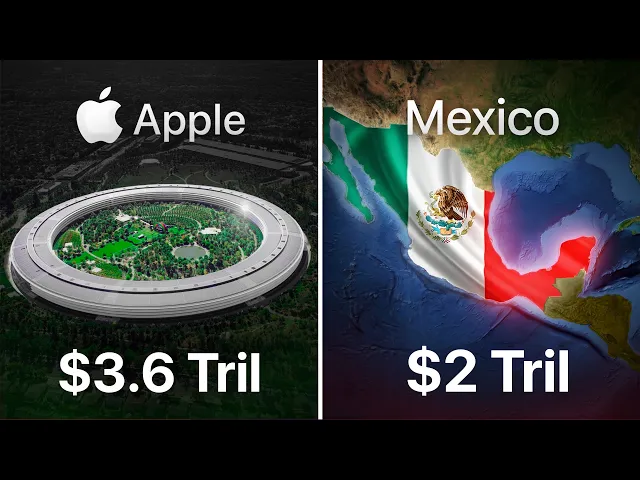
1:05 this financial Frankenstein is bigger than any country.
1:09 It spans the globe, and no one country can
1:13 rein the monster in, make it pay its fair share.
1:17 Want them to pay higher taxes?
1:19 Someone else will be happy to take…1%.
1:24 Want them to pay their workers a decent wage?
1:28 Someone else will let them do slavery.
1:30 Want them to stop dumping cancer in the rivers?
1:33 Someone else will take the bribes and look the other way.
1:38 Because even though it would be in all these countries’ interests to put a stop
1:43 to this, it’s in each individual country’s
1:46 interest to take whatever deal they can get.
1:50 *This* is the world in 2026.
1:52 But what if I told you this wasn’t a new problem?
1:56 What if I told you you could replace all these countries with American states:
2:01 coal mines in West Virginia, steel mills in Pennsylvania,
2:07 offices in New Jersey, and railroads nationwide?
2:10 And what if I told you the men who owned these businesses paid no taxes,
2:16 abused their workers without punishment, and dumped pollution into the rivers,
2:21 because no one state could stop them?
2:23 *This* is America in 1900.
2:26 The national corporation was just invented,
2:29 and individual states—where almost all
2:32 politics happened—were left helplessly scrambling,
2:35 until one man came along with a new
2:40 vision for America’s future: Teddy Roosevelt.
2:44 His idea was simple: make politics national.
2:48 Make the government bigger than the corporation again.
2:53 Once you see it, it seems so obvious!
2:56 But back in Teddy’s day, this was a revolutionary idea.
3:00 For decades, politicians had promised
3:02 industrialization would make everyone richer,
3:05 despite the widespread suffering deepening every day.
3:07 Or they clamored for a return to the past:
3:11 a breakup of big business and a return to localized economies.
3:16 Nobody was thinking nationally.
3:18 Today, we face the same problem, with the same stupid politicians.
3:23 Globalism was supposed to make us all rich,
3:26 but so far it seems to have made an elect few insanely wealthy,
3:31 while gutting good jobs across the country.
3:33 And the only solution on offer,
3:35 whether from Trump or Bernie seems to be to just…abandon globalism.
3:41 But imagine Arkansas trying to just…opt out of the national economy.
3:47 Nobody is thinking internationally.
3:50 Teddy gave us the blueprint 100 years ago.
3:53 In his own words, “In a rich and complex industrial society…corporations become
3:58 so very big that the ordinary individual is utterly dwarfed beside them,
4:05 and cannot deal with them on terms of equality.
4:08 It therefore becomes necessary for these ordinary individuals to combine
4:13 [and] to act in their collective capacity through…the Government.” (M, ch.
4:20 XIII) In other words,
4:22 we must make the government bigger than the corporation again.
4:27 But of course, that’s easier said than done.
4:30 So, this is the story of how Teddy made it happen,
4:34 and how we can do the same thing again today.
4:37 And while this story is about one vital parallel between
4:40 our own time and the corrupt Gilded Age of the late 1800s,
4:44 there are a ton of other similarities.
4:47 Mr.
4:47 Beat: You might even say the 2020s *are* the 1890s!
4:50 Philip: Oh hey Mr.
4:52 Beat!
4:52 That’s right, and if you want to learn more
4:55 about that, check out *his* video that just came out!
4:58 Mr.
4:59 Beat: *After* this video!
5:01 Stay tuned, because you’ll be hearing from me again in a few minutes!
5:09 Our story starts in the 1860s with the railroads.
5:19 Trains offered the chance to unify America’s fragmented local economies,
5:24 and whoever owned the rails could make it big.
5:27 So everybody and their uncle jumped in on the craze.
5:31 Soon, America was home to 45,000 miles of track.
5:34 (A) But there was a problem.
5:37 Every single community had its own local rail startup
5:40 and its own rules and regulations, if it had any.
5:44 The result was hundreds, if not thousands of companies all across
5:48 the country building tracks with basically no coordination.
5:52 Different rail widths required different trains,
5:54 while precious few lines actually connected between different states.
5:59 In turn, by the 1870s, the startups began failing…fast.
6:04 Rail bankruptcies swept the nation, as the investment craze met with harsh
6:09 reality and took the nation’s economy with it.
6:11 (A) But one rich coal mine owner named James J.
6:15 Hill had an idea.
6:17 The issue was fragmentation.
6:19 His solution was the opposite: consolidation.
6:23 Railroad companies just had to get…bigger.
6:28 So, Hill snapped up a small failing Minnesota line for pennies in 1878.
6:32 Within a few years, he snapped up another failed line, then another,
6:37 all the while building out as much rail as he possibly could.
6:41 By the middle of the 1880s,
6:43 he had his eyes set on buying out his largest competitor: Northwest Pacific.
6:48 (B) If successful, this merger would mean, in Roosevelt’s words,
6:52 “control of practically the entire railway
6:55 system in the Northwest—possibly as the first
6:58 step toward controlling the entire railway system of the country.” (M, ch.
7:03 XII) Luckily for Hill though, Roosevelt wasn’t president just yet,
7:07 and the government was still on Hill’s side…for now.
7:12 We’re about to see the birth of the monopoly:
7:14 businesses so big that they basically control entire industries.
7:17 This is a story we’ve wanted to tell for a long time,
7:21 so before we go any further,
7:23 I want to thank AnyDesk for making this video possible
7:26 and tell you a little bit about what they do.
7:28 If you’ve ever been somewhere away from home
7:31 and been sidelined by the sinking feeling
7:33 that you forgot to do something on your computer
7:35 or left a crucial file on your desktop, then AnyDesk is for you.
7:40 It's a free remote desktop software that allows you to connect to and use
7:44 any of your devices from any other device from anywhere in the world.
7:49 Whether you’re at a cafe, at the office,
7:52 or globetrotting thousands of miles away,
7:54 AnyDesk lets you control your computer back
7:57 home from your laptop or even your phone.
8:00 Even on slower internet, AnyDesk’s proprietary codec technology will give
8:04 you minimal latency and consistent, crisp visuals.
8:07 AnyDesk also has lightning fast remote file transfer,
8:11 allowing you to grab pictures and documents off any device,
8:15 from anywhere, using any other device, without relying on cloud services.
8:20 Best of all, AnyDesk is totally free for personal use.
8:23 Whether I need to access my computer back home while traveling,
8:27 grab forgotten files, or just stream my desktop to the TV while
8:31 I play games with the boys, I use AnyDesk.
8:34 It’s a great service, and it’s honestly amazing that it’s free for personal use.
8:39 Don't wait until you wish you had
8:44 it—visit anydesk.com/spectacles to download AnyDesk for free today.
8:49 That’s anydesk.com/spectacles.
8:51 Thank you, AnyDesk.
8:53 Now, back to 1880.
8:55 So Hill has a scheme to take over the entire rail industry
8:59 of the American northwest and maybe the rest of the country too.
9:04 If successful, he’d single-handedly command
9:06 a vital trade connection to the Pacific
9:08 and be able to set exorbitant rates for the freight that needed his rails.
9:13 His monopoly would be bad for consumers and deadly to competitive business.
9:17 And Hill wasn’t alone.
9:19 Monopolies were spreading all over the place,
9:22 springing up in practically every industry:
9:24 in coal, steel, and oil, even tobacco and sugar.
9:29 These were companies that owned 90,
9:32 sometimes even 100% of entire industries in vital goods that everyone needed.
9:36 (M, ch.
9:37 XII) So why did the government let all this consolidation happen?
9:42 Well, they actually tried to stop it, but there were problems.
9:46 First, the states were practically helpless.
9:49 These massive companies were just bigger than any one of them,
9:52 and if threatened with penalties or high taxes,
9:55 there were always other states willing to undercut each other for a dollar.
9:59 New Jersey, for example, amended its constitution in 1875 so
10:03 that corporations could register in the state without
10:06 paying basically *any* taxes on revenue
10:08 in the state where they actually operated (C, 680-681).
10:12 Sound familiar?
10:13 I hope so.
10:14 And then, even when important states *did* try to do something,
10:18 they got blocked by the Supreme Court.
10:22 Because big railroads crossed state lines, the Court ruled that states really
10:27 couldn’t regulate their behavior, block mergers, or stop price-gouging,
10:32 because the Constitution clearly tasks the federal
10:35 government with regulating “interstate commerce.” (M, ch.
10:37 XII) But here’s the kicker.
10:39 When the federal government passed a bill
10:41 to rein in monopolies—the Sherman Antitrust
10:44 Act—the Supreme Court said it couldn’t apply
10:47 to Hill’s company and others like it.
10:50 Because Hill and his business partners, including J.P.
10:53 Morgan, these guys were clever.
10:55 Instead of just buying up other rail lines and forming
10:59 one big company that could be targeted by the Sherman Act,
11:02 Hill went around to all the companies he
11:05 wanted to buy and offered to exchange stocks.
11:07 Hill gave them some stock in his rail company,
11:10 and in exchange he took all the stocks in the other company.
11:14 In the process, he gained control of the businesses,
11:17 but they technically remained separate companies.
11:20 (M, ch.
11:20 XII) This structure,
11:22 called the “national trust,” put the business in a legal grey area,
11:27 and The Supreme Court said it didn’t constitute interstate commerce,
11:32 meaning the federal government wasn’t allowed to regulate it,
11:35 even if the trust controlled 100% of a nationwide industry!
11:39 So not only were the states helpless in the face of these massive corporations,
11:45 the one body who *could* do anything about it now wasn’t *allowed* to!
11:51 It was a catastrophe for American democracy—no matter who the people elected,
11:55 at any level of government,
11:57 they were completely blocked from having their voices heard.
12:01 This was a *crisis*.
12:03 It was so bad I can’t even explain it, so I’ll phone a friend to help me out.
12:09 Mr.
12:09 Beat: Hello?
12:10 Mr.
12:10 Beat speaking.
12:11 Philip: Mr.
12:12 Beat!
12:12 Got a minute?
12:14 I need YouTube’s favorite American history teacher to help explain the 1890s.
12:19 Mr.
12:19 Beat: I’m so glad you *trust* me to get this right.
12:23 Philip: Oh, trust!
12:25 [chuckle] Alright, well let’s start here.
12:29 Tell us about these monopolies.
12:31 Were these big businesses good for consumers?
12:34 Mr.
12:35 Beat: So yeah, by the 1890s you had
12:37 these big monopolies where basically one giant corporation was
12:40 dominating a market and the way they were
12:43 able to get so big was because rapid industrialization.
12:46 The national economy was all tied together now thanks to railroads.
12:49 And so it was easier for companies to make
12:52 a lot of money using both horizontal integration,
12:55 which just means one company's buying out the competition,
12:58 or vertical integration, which means one company owns the entire supply chain.
13:01 Am I right?
13:02 A lot of price gouging going on.
13:04 That's where we started to see ridiculously high prices.
13:07 Big businesses were certainly not good for consumers.
13:11 Philip: What about for the workers who kept these big monopolies going?
13:16 Mr.
13:16 Beat: Oh, the workers.
13:17 Oh, man.
13:18 This made it easier for the workers to get exploited.
13:21 In the 1890s, factory workers faced long hours,
13:24 low wages, freaking dangerous conditions.
13:26 This led to massive strikes like the Homestead strike or the Pullman strike.
13:31 big uprisings where you had violent confrontations.
13:34 Philip: So what did all this horrible stuff do to American politics?
13:40 Mr.
13:40 Beat: Well, in response to these horrible
13:43 working conditions and these monopolies,
13:44 you did have a legit populist movement that sprung up.
13:48 You had farmers that were frustrated
13:50 with railroad and bank monopolies in the country.
13:53 And then in the cities, you had workers frustrated with industrial monopolies.
13:56 and they all joined forces to form what we call the populist party or people's
14:01 party which was one of the most
14:03 successful third party movements in American history.
14:05 The populists were interesting because they called
14:08 for things like making the wealthy pay more taxes,
14:11 getting off the gold standard,
14:12 which is kind of hard to relate to today, but you know,
14:15 a bunch of other big reforms that ended up becoming part of the progressive era.
14:19 Philip: You know, this is starting to sound pretty familiar.
14:23 Mr.
14:23 Beat: Unfortunately, you’re right!
14:25 That’s why I made a whole video
14:27 about the similarities between the 1890s and 2020s.
14:32 Philip: Well, that sounds like a great video.
14:34 We’ll send our viewers your way after this.
14:37 And Mr.
14:38 Beat, this whole 1890s situation isn’t going to end well, is it?
14:44 Mr.
14:44 Beat: Not at first, but eventually it turns out okay.
14:48 Philip: Okay, thanks for stopping by.
14:51 And he’s right.
14:52 It didn’t end well, at first.
14:55 On September 6, 1901,
14:57 an anarchist shot and killed President William McKinley at the World’s Fair.
15:02 This was America at rock bottom.
15:05 The killer hoped to spark a revolution.
15:08 Instead, he just helped make the one man president who
15:11 had the vision to see America through this crisis peacefully:
15:17 McKinley’s Vice President, Teddy Roosevelt.
15:32 We know a lot about Teddy.
15:34 His personality?
15:36 Larger than life.
15:39 His imperialism?
15:41 Reprehensible.
15:43 (N) His conservationism?
15:46 Truly admirable.
15:49 Less is known, believe it or not, about Roosevelt’s most important achievement:
15:54 how he managed this crisis of American democracy.
15:58 So I dug into his autobiography and speeches to get a sense of his perspective.
16:03 The problem he saw was that, in his words,
16:06 “The power of the mighty industrial overlords
16:10 of the country had increased with giant strides,
16:14 while the methods of controlling them, or checking abuses by them,
16:17 on the part of the people, through the Government,
16:20 remained archaic and therefore practically impotent.” (M, ch.
16:24 XII) Roosevelt got the problem:
16:26 these corporations had grown more powerful than their governments.
16:30 But he didn’t want to go back, either:
16:33 “It is practically impossible…and undesirable to try to break up
16:38 all [big businesses] merely because they are large and successful,
16:42 and to put the business of the country back
16:45 into the middle of the eighteenth century.” (M, ch.
16:47 XV) Times had changed.
16:49 The Industrial Revolution had transformed America,
16:52 and in some ways for the better.
16:55 Railroads connecting the country boosted economic growth.
16:57 Coal mining and steelmaking built more homes and kept them warmer.
17:02 The future held promise, *if* it could be harnessed for the good of the public,
17:08 rather than the good of the few.
17:10 Roosevelt attacked the problem with his typical energy.
17:13 Remember the Sherman Antitrust Act,
17:15 the bill to rein in monopolies that the Supreme Court shot down?
17:19 Roosevelt wasn’t intent on taking no for an answer,
17:22 so as soon as he took office, he sued to break up James J.
17:26 Hill’s northwest rail monopoly and, hopefully,
17:28 overturn the Supreme Court’s decision.
17:30 (M, ch.
17:31 XII) It had only been six years since the Court gutted the Sherman Act,
17:35 but things were so bad in America—horrific working conditions,
17:40 massive inequality, widespread unrest,
17:43 an anarchist assassinating the President—that the Court
17:47 saw the writing on the wall.
17:50 They had to comply.
17:52 So the Court gave way to Roosevelt.
17:54 They ruled the federal government could break up big trusts and monopolies,
17:59 and Hill’s rail trust was shattered.
18:01 Now, the Federal Government truly had the power
18:05 to navigate a way out of America’s crisis.
18:08 Roosevelt didn’t relent.
18:09 He continued to sue and sue and sue,
18:13 using the Sherman Act to break up the country’s biggest
18:17 and baddest monopolies that each controlled 90-plus-percent of their industries,
18:23 like American Tobacco, John D.
18:25 Rockefeller’s Standard Oil, and others.
18:27 (M, ch.
18:28 XII) Yet Roosevelt’s mission wasn’t just to break up businesses.
18:32 His promise to the American people was the “Square Deal”—
18:36 a series of policies that would make America fair again,
18:40 competitive and innovative yet decent and egalitarian.
18:45 (O) This is why he established the US
18:48 Forest Service and expanded the National Parks:
18:51 to prevent a wealthy few from destroying America’s shared wilderness.
18:55 It’s why he established the Food and Drug administration:
18:58 to prevent a wealthy few from poisoning the American public.
19:01 And it’s why he created the Department of Commerce and Labor:
19:05 to prevent a wealthy few from gouging rail prices,
19:09 busting up unions, and abusing workers.
19:12 (P) In Teddy's own words,
19:14 “Our country- this great Republic- means nothing unless
19:18 it means the triumph of a real democracy,
19:22 the triumph of popular government, and, in the long run,
19:26 of an economic system under which each
19:28 man shall be guaranteed the opportunity to show
19:31 the best that there is in him.” (Q)
19:34 Roosevelt’s visionary square deal was the product of crisis.
19:39 In fact, I think it’s the result
19:41 of a pattern of politics that we still see today.
19:44 So I just want to recap how Teddy got there real quick,
19:48 because I think it will help us understand our own time.
19:52 In the 1860s, the industrial revolution and railroads
19:55 promised to knit together the nation’s disparate economies.
19:59 But localized politics and businesses weren’t capable of meeting the moment,
20:06 and economic dysfunction and disaster followed in the 1870s.
20:10 Innovation, then dysfunction.
20:12 Then, those with resources like James J.
20:15 Hill saw a chance to consolidate control of industries.
20:19 By the 1880s, businesses like his had gone national, forming trust companies.
20:26 Meanwhile, politics was still local, leaving the government behind the ball:
20:31 stuck in old ways built around the old economy.
20:37 Innovation, dysfunction, then consolidation.
20:40 By the 1890s, the rich were getting richer, the American people were hurting,
20:46 and democracy itself was threatened,
20:48 as the people had no real means to correct course.
20:52 By the turn of the century, crisis fully arrived, politics went crazy,
20:57 and a President was shot in an effort to spark revolution.
21:04 Innovation, dysfunction, consolidation, then crisis.
21:08 As deep as the crisis was, though, the problem was essentially simple.
21:14 Corporations had gotten bigger than the government.
21:17 Fixing it required clarity and courage,
21:20 and luckily Teddy Roosevelt was the man for the job.
21:23 He broke up some massive monopolies but more importantly
21:27 he moved economic regulation up to the national sphere,
21:31 matching the new scale of the country’s businesses.
21:35 He made the government bigger than the corporation again,
21:40 preserving innovation and growth while putting the people back in charge.
21:45 His policies were neither perfect nor seen through to their fullest conclusion,
21:50 but they made a lot of people’s lives a lot
21:53 better and restored some faith in the political system,
21:57 staving off immediate crisis and collapse.
22:00 So that’s the cycle: innovation,
22:04 dysfunction, consolidation, crisis, and hopefully resolution.
22:08 But where are we in that cycle today?
22:13 Teddy’s story began in 1860, but ours begins in 1960.
22:17 After two world wars and a lot of improved ship and air transport technologies,
22:23 the world was ready to trade more than ever before.
22:27 But the world wasn’t ready for multinational corporations.
22:30 You see, to avoid another Great Depression,
22:33 the United States and most other countries had agreed to restrict
22:37 how much money their citizens could move across international borders.
22:40 On the one hand, that was good.
22:42 It meant that corporations stayed national,
22:44 where voters could keep them in check (E, 556-557).
22:47 But these rules kept the global economy fragmented and just as in the 1870s,
22:53 this spelled trouble.
22:54 By the 1970s, dysfunction followed innovation,
22:58 as the global economy, unable to keep up,
23:02 went haywire with an energy crisis, high inflation, and slow growth.
23:06 In turn, the governments of the world decided to try
23:09 to remove the fragmentation by letting go of the controls:
23:13 allowing money to flow across borders
23:16 and knit the world’s disparate national economies together.
23:19 Big businesses and the wealthy were best positioned to seize this opportunity,
23:23 and they quickly did so.
23:25 Private investment in manufacturing in low-income countries exploded.
23:28 So too, did a new type of financial arrangement,
23:32 whereby small countries slashed their corporate taxes.
23:34 And, through clever shell companies,
23:37 multinationals began parking their profits there.
23:40 By the late 1980s, Ireland was quickly becoming one such popular destination.
23:45 (G) So by the 1990s, dysfunction had given way to consolidation,
23:50 and the winning multinational corporations looked a whole
23:53 lot like the national trusts of the 1890s,
23:57 with no one capable of keeping them in check.
24:00 Then, between 1990 and 2006,
24:02 the number of multinationals doubled, from 30,000 to 60,000 (F).
24:07 Now, like industrialization, globalization hasn’t been without benefits.
24:11 During this period, global poverty has seen the largest drop in human history.
24:16 Medical advances have been enormous.
24:18 And digital communications have allowed the world’s
24:20 brightest minds to collaborate like never before.
24:23 Still, these multinationals were abusing workers
24:26 just like the industrialist of the 1890s:
24:29 excessive hours, child labor, unsafe working conditions, even slavery.
24:35 In fact, all of that is *still* business as usual
24:38 at the mines and factories that these companies are built on.
24:42 At the same time, this move toward overseas industry has also
24:46 annihilated huge swathes of jobs back in these companies’ home countries.
24:50 In turn, we’re seeing the same sorts of crisis
24:53 unfold as happened at the turn of the century.
24:57 Globalization ensured that the 2008 American
24:59 housing crisis sank the whole world economy.
25:03 Deindustrialization and rapid wealth consolidation has
25:05 led to a new wave of populism.
25:08 Political violence is surging.
25:10 Governments are struggling from holes
25:13 in their budgets created by multinationals’ tax avoidance.
25:17 In the 1890s and today, national and then multinational corporations have
25:21 been able to leverage their enormity
25:24 to get their way over the heads of average citizens like you and me.
25:29 This isn’t just ethically wrong.
25:31 It threatens the very foundations of social and political harmony.
25:35 People do not like feeling disenfranchised
25:37 and left out of the political process.
25:40 They *will* take action to make a change.
25:42 But those actions—whether assassinating
25:44 presidents or supporting incompetent populists—can
25:47 be as dangerous as the problem they’re attempting to solve.
25:53 Innovation, dysfunction, consolidation, crisis.
25:57 We are in the crisis stage.
26:02 And just as nobody was thinking nationally
26:05 when states fell behind the national trust, nobody is thinking internationally,
26:11 as countries fall further behind multinational corporations.
26:15 Trump, in both terms, has made a lot of noise about
26:19 fixing globalization’s failures and bringing manufacturing back home.
26:22 In his first term, he passed a tax law that did put
26:26 a stop to American companies using *one*
26:28 of Ireland's most obvious tax evasion tricks.
26:31 But it also left plenty of loopholes open and created a few new ones too.
26:36 And in this term, he’s mostly relied on tariffs.
26:39 Not only do his policies and tariffs simply not work— we actually *lost*
26:44 jobs in manufacturing and construction in 2025—
26:48 this whole nationalist mentality is simply archaic.
26:52 Again, imagine Arkansas opting out of the industrialized
26:57 national economy and returning to local agrarianism.
27:00 I mean, okay!
27:01 If you want to be really poor and probably
27:05 taken over by somebody else in 50 years.
27:07 No, as Teddy Roosevelt understood,
27:09 going back to a prior era is neither possible nor really desirable.
27:15 Globalization and multinationals are not inherently *bad*.
27:19 Reductions in global poverty and extraordinary
27:22 technological innovations are proof of this.
27:25 This imbalance isn’t solved by breaking up big
27:28 businesses and restoring the power of smaller government entities.
27:32 Instead, the solution is to empower governments at the level that can
27:37 best regulate corporations in the public
27:39 interest and facilitate competitive— not consolidated— business.
27:43 In Teddy’s day, that meant a new nationalism.
27:47 In his words, “The New Nationalism puts
27:50 the national need before sectional or personal advantage.
27:53 It is impatient of the utter confusion that results from local
27:58 legislatures attempting to treat national issues as local issues.” (Q) Today,
28:03 though, it means internationalism.
28:05 It means we must be impatient of the confusion that results
28:10 from nations attempting to treat global issues as domestic issues.
28:14 And thankfully, over the last ten years,
28:17 many countries have actually agreed to a global minimum corporate tax.
28:21 The problem is way bigger than taxes, but it’s a starting point.
28:24 If every country shared such a tax,
28:27 it would prevent companies from playing countries against each other,
28:31 bring some money back to the people who make all that private wealth possible,
28:35 and give them some power to hold the powerful to account.
28:38 Yet, many countries,
28:40 including the United States and—shocker—the worst-offending tax havens,
28:45 have critically undermined this agreement
28:48 by demanding carveouts for—you guessed it—American multinationals,
28:52 which remain the most powerful, and worst, offenders in the system.
28:57 Cooperation is hard, because there’s a lot of money behind keeping us divided,
29:04 and because for many, internationalism is a scary idea.
29:09 People understandably fear being dwarfed by new,
29:13 bigger forms of political association.
29:15 But this is nothing new.
29:18 In the American Revolution, many feared banding the colonies together
29:22 but the reality was simple: JOIN OR DIE.
29:26 And in Teddy’s day his “nationalism” was denounced by many who feared a loss
29:31 of local power would mean a loss of their own individual power in politics.
29:35 But by 1900, Roosevelt’s response was simple.
29:39 “What local power?” National corporations had already dwarfed them.
29:44 Nationalizing politics actually made each voter more powerful.
29:49 And today it’s the same.
29:51 Those who fear internationalism claim it will
29:53 violate sacred “national sovereignty.” But I ask,
29:57 “what national sovereignty?” Today corporations
30:00 are running rough-shod over nations, just as they did over states in 1900.
30:06 Either we bind together to act in our common interest which knows no borders,
30:10 or we simply fall further behind:
30:13 victims of old prejudice who would rather live in fear,
30:17 letting some lines on maps define the horizons
30:20 of our future than seek to change them and free ourselves.
30:25 Obviously, that’s easier said than done.
30:28 And obviously, this is a YouTube video, not a detailed program for how
30:33 to establish functioning international legislative institutions.
30:36 We don’t have all the answers, but there are no answers in fear.
30:44 As Teddy said, “In facing the future…we
30:47 should be neither timid pessimists nor foolish
30:51 optimists…Grave perils are yet to be encountered…There
30:54 is every reason why we should recognize them,
30:57 but there is no reason why we should
30:59 fear them or doubt our capacity to overcome them,
31:02 if only each will, according to the measure of his ability, do his full duty,
31:07 and endeavor so to live as to deserve the high praise
31:12 of being called a good American citizen.” (R) Or perhaps today,
31:18 a good global citizen.
31:23 Hey, Both: thanks for watching.
31:25 Matt: And if you enjoyed that great video,
31:29 consider helping them tell more stories that matter
31:32 to democracy by joining their Patreon or grabbing some merch.
31:37 Philip: And don’t forget to check out Mr.
31:39 Beat’s new video, on the many other similarities
31:41 between the Gilded Age 1890s and the 2020s.
31:44 It’s a great video and a really important comparison.
31:48 Matt: And if you stop by, leave a comment to let me know Spectacles sent you.